
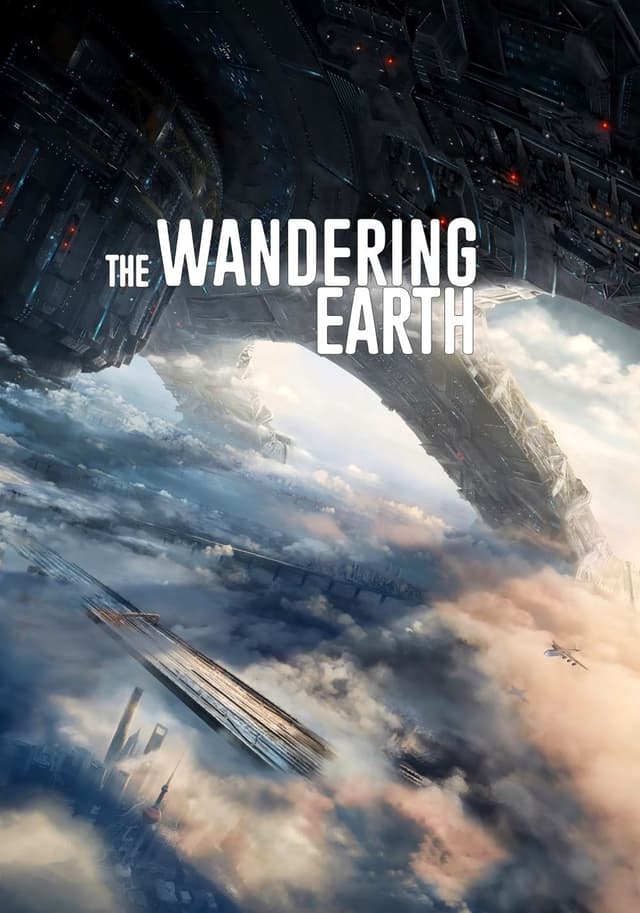
The Wandering Earth Budget
 Science FictionActionDrama2h 6m
Updated
Synopsis
When the Sun begins to expand in such a way that it will inevitably engulf and destroy the Earth in a hundred years, united mankind finds a way to avoid extinction by propelling the planet out of the Solar System using gigantic engines, moving it to a new home located four light years away, an epic journey that will last thousands of years.
What Is the Budget of The Wandering Earth?
The Wandering Earth (2019) was produced on a budget of approximately $50 million (roughly 330 million yuan), a figure that was enormous by Chinese film industry standards at the time but modest compared to the $150 million to $200 million budgets typical of Hollywood science fiction tentpoles. The production was led by China Film Group Corporation, with actor Wu Jing contributing a significant personal investment after several original financial backers withdrew from the project during pre-production.
Director Frant Gwo spent years developing the film, and the final budget reflected the team's determination to achieve blockbuster-grade visual effects without the infrastructure or experience base that Western studios had built over decades. Every yuan was stretched across over 7,000 VFX shots, massive practical set construction, and a cast of relative newcomers paired with Wu Jing's star power. The result was a landmark production that proved Chinese studios could deliver spectacle at scale.
Key Budget Allocation Categories
- Visual Effects and CGI accounted for the largest portion of the budget, covering more than 7,000 VFX shots that depicted the Earth being propelled through space by thousands of fusion-powered engines, frozen cityscapes, and the catastrophic gravitational capture by Jupiter. Multiple Chinese VFX houses collaborated to deliver the work, with some shots requiring months of iteration.
- Practical Sets and Production Design consumed a major share, as the team built full-scale underground city sets, transport vehicle interiors, and the surface environment of a frozen Shanghai. Frant Gwo prioritized physical environments wherever possible to give actors tangible surroundings, supplementing with digital extensions rather than relying on greenscreen alone.
- Cast and Performance costs remained relatively lean. Wu Jing, the film's biggest name, was also an investor in the production rather than commanding a top-dollar salary. Lead actors Qu Chuxiao, Li Guangjie, and Zhao Jinmai were early-career performers whose combined fees were a fraction of what Hollywood A-listers would command for comparable roles.
- Location and Staging expenses covered shooting at multiple Chinese studio facilities as well as outdoor locations used to simulate the frozen Earth surface. The logistics of coordinating practical environments with VFX plates required careful scheduling to keep costs in check.
- Post-Production and Sound Design included extensive color grading, compositing, and an original score, plus the creation of a Mandarin-language sound mix designed for IMAX and premium large-format screens across China.
- Marketing and Distribution were handled primarily by China Film Group, which leveraged the Chinese New Year release window to maximize visibility. Prints and advertising costs within China were substantial, though exact figures were folded into the distributor's overall campaign spend rather than the production budget.
How Does The Wandering Earth's Budget Compare to Similar Films?
At $50 million, The Wandering Earth operated at a fraction of the cost of the Hollywood blockbusters it was inevitably compared to, yet it competed with them at the box office within China and across Asian markets.
- Gravity (2013) had a budget of $100 million and earned $723 million worldwide. Alfonso Cuaron's film required pioneering virtual cinematography, but its scope was limited to two actors in Earth orbit, making The Wandering Earth's planetary-scale VFX ambition at half the budget even more striking.
- Interstellar (2014) cost $165 million and grossed $773 million globally. Christopher Nolan blended practical IMAX photography with targeted VFX for wormhole and black hole sequences. The Wandering Earth attempted comparable scale on less than a third of that budget.
- The Martian (2015) was produced for $108 million and earned $630 million worldwide. Ridley Scott's survival drama relied on a single planet's surface environment and practical Mars sets, a narrower VFX footprint than The Wandering Earth's frozen-Earth-plus-Jupiter catastrophe.
- Arrival (2016) cost $47 million and grossed $203 million globally. Denis Villeneuve kept VFX demands modest with a contained alien encounter story. At a comparable budget, The Wandering Earth delivered far more VFX-heavy spectacle, reflecting different audience expectations between art-house sci-fi and blockbuster spectacle.
- Moonfall (2022) carried a $140 million budget but earned just $67 million worldwide. Roland Emmerich's Earth-in-peril disaster film demonstrated that a high budget alone does not guarantee quality or returns, highlighting how efficiently The Wandering Earth converted its $50 million into a $700 million global phenomenon.
The Wandering Earth Box Office Performance
The Wandering Earth opened during the 2019 Chinese New Year holiday, the most lucrative theatrical window in the Chinese market. It earned approximately $691 million domestically in China, making it the third-highest-grossing film in Chinese box office history at the time. International receipts brought the worldwide total to approximately $700 million, with a modest $6 million from limited U.S. theatrical distribution.
Against a $50 million production budget, the standard break-even threshold (roughly 2x the budget to account for marketing and distribution costs) would have been around $100 million. The Wandering Earth obliterated that figure, generating an estimated ROI of approximately 1,300% using the formula (Worldwide Gross minus Budget) divided by Budget times 100. Even accounting for China's theatrical revenue split, where studios typically retain 35% to 40% of gross, the film was extraordinarily profitable.
The film's domestic dominance was the story. It outperformed every Hollywood release in China during its run, including Alita: Battle Angel and Captain Marvel, and proved that Chinese audiences would turn out in massive numbers for homegrown science fiction. Netflix acquired international streaming rights, expanding the film's reach beyond theatrical markets, though the U.S. theatrical run was limited to a handful of screens.
The Wandering Earth Production History
The Wandering Earth began as an adaptation of Liu Cixin's 2000 novella of the same name, part of the body of work that would later make Liu internationally famous through The Three-Body Problem. Director Frant Gwo had been developing a science fiction project for years and secured the rights to Liu's story, which imagines humanity building thousands of planet-scale engines to physically move Earth out of the solar system before the Sun expands into a red giant.
Pre-production was turbulent. Several financial backers pulled out of the project, skeptical that a Chinese production could deliver convincing science fiction at blockbuster scale. The Chinese film industry had no track record in the genre at this budget level. Wu Jing, fresh off the enormous success of Wolf Warrior 2 (2017), stepped in as both a lead actor and a personal investor, providing critical funding and lending his box office credibility to the project.
Principal photography took place across multiple Chinese studio facilities, with the production team building elaborate practical sets for the underground cities and surface environments. Frant Gwo insisted on physical sets wherever possible, believing that actors needed tangible environments to deliver convincing performances in a genre unfamiliar to Chinese cinema. The frozen Shanghai sequences combined location work with extensive digital augmentation.
The VFX pipeline involved more than 7,000 shots spread across multiple Chinese visual effects studios, a scale of domestic VFX work unprecedented in the country's film industry. The collaborative effort required constant coordination between practical photography and digital teams, and the compressed post-production schedule pushed the team to deliver right up to the Chinese New Year release date. The film was completed in time for the February 2019 holiday window, which proved to be the ideal launchpad for what became a cultural phenomenon.
Awards and Recognition
The Wandering Earth received significant recognition within the Chinese film industry and gained attention internationally as a milestone in Asian science fiction cinema. At the 32nd China Golden Rooster Awards, the film won Best Feature Film and Best Director for Frant Gwo, cementing its status as a landmark production. It also earned nominations at the Hundred Flowers Awards, China's audience-voted film honors.
The film was selected as China's submission for the Best International Feature Film category at the 92nd Academy Awards, though it did not advance to the shortlist. International genre festivals and industry bodies took note of the film's technical achievements, and it was widely cited in trade publications as the production that opened the door for Chinese science fiction as a viable blockbuster genre.
Beyond formal awards, The Wandering Earth's cultural impact may be its most significant legacy. Chinese state media and film industry commentators described it as the birth of "Chinese sci-fi blockbuster cinema," and its commercial success directly enabled the greenlit production of The Wandering Earth II (2023), which carried a larger budget and went on to earn over $600 million. The franchise established a template for large-scale Chinese genre filmmaking.
Critical Reception
The Wandering Earth holds a 76% approval rating on Rotten Tomatoes, reflecting a split between Western critics who found the narrative familiar and Chinese audiences who embraced it as a defining cultural moment. On Douban, China's most influential film review platform, the film earned a 7.9 out of 10 from millions of user ratings, a strong score for a mainstream blockbuster.
Western critics generally praised the film's visual ambition and scale while noting that its character development and dialogue followed conventions more typical of Hollywood disaster films than the contemplative science fiction of its source material. The consensus acknowledged that the spectacle was genuinely impressive, particularly given the budget, but that the emotional beats relied on familiar tropes: the estranged father-son relationship, the sacrifice play, the last-minute save.
Within China, the reception was overwhelmingly enthusiastic. Audiences responded to the film not just as entertainment but as proof that Chinese cinema could compete with Hollywood on technical and narrative scale. The collectivist survival premise, in which humanity works together rather than relying on a single American hero, resonated deeply with Chinese audiences and was frequently cited as a refreshing departure from Western science fiction storytelling conventions.
The film's success fundamentally altered the landscape for Chinese genre cinema. Producers who had previously dismissed science fiction as too risky for the Chinese market reversed course, and multiple large-scale sci-fi projects entered development in the years following The Wandering Earth's release. The sequel, The Wandering Earth II, validated that the first film was not a one-off phenomenon but the beginning of a sustainable franchise.
Frequently Asked Questions
How much did it cost to make The Wandering Earth (2019)?
The production budget was $48,000,000, covering principal photography, visual effects, cast and crew salaries, locations, sets, post-production, and music. Marketing and distribution (P&A) costs are estimated at an additional $24,000,000 - $38,400,000, bringing the total studio investment to approximately $72,000,000 - $86,400,000.
How much did The Wandering Earth (2019) earn at the box office?
Box office figures are not publicly available.
Was The Wandering Earth (2019) profitable?
Insufficient data for a profitability assessment.
What were the biggest costs in producing The Wandering Earth?
The primary cost drivers were above-the-line talent (Wu Jing, Qu Chuxiao, Li Guangjie); visual effects pipelines, virtual production technology, and speculative world-building.
How does The Wandering Earth's budget compare to similar science fiction films?
At $48,000,000, The Wandering Earth is classified as a mid-budget production. The median budget for wide-release science fiction films in the 2010s ranges from $30 - 80M for mid-budget to $150M+ for tentpoles. Comparable budgets: Indiana Jones and the Last Crusade (1989, $48,000,000); Robin Hood: Prince of Thieves (1991, $48,000,000); Instant Family (2018, $48,000,000).
Did The Wandering Earth (2019) go over budget?
There are no widely reported accounts of significant budget overruns for this production. However, studios rarely disclose precise budget overrun figures publicly. The reported production budget reflects the final estimated cost.
What awards did The Wandering Earth (2019) win?
39 wins & 40 nominations total.
Who directed The Wandering Earth and who were the key crew members?
Directed by Frant Gwo, written by Gong Geer, Yan Dongxu, Frant Gwo, Junce Ye, shot by Liu Yin, with music by Roc Chen, edited by Cheung Ka-Fai, Ye Ruchang.
Where was The Wandering Earth filmed?
The Wandering Earth was filmed in China.
Filmmakers
The Wandering Earth

Official Trailer
Build budgets like this one in Saturation
Start from an industry-standard feature film template, import the schedule and rates you already have, and let the cost report keep itself current as you spend. Real-time collaboration, no spreadsheets.