The Terminator Budget
 ActionThrillerScience Fiction1h 48m
Updated
Synopsis
In 1984 Los Angeles, a cyborg assassin called the Terminator arrives from 2029 with orders to kill Sarah Connor, a young waitress whose unborn son, John, will lead humanity's resistance against the machine network Skynet. Kyle Reese, a soldier from that resistance, follows it back in time to protect her, and the two go on the run as the Terminator hunts them across the city.
What Is the Budget of The Terminator?
The Terminator (1984), directed by James Cameron, produced by Gale Anne Hurd and distributed by Orion Pictures, had a production budget of $6,400,000, the figure listed by both Box Office Mojo and The Numbers. Production records put it slightly higher: the film was originally budgeted at $4,000,000, the budget was raised to $6,500,000 before shooting, and the AFI Catalog records that filming began on a $6,500,000 budget with a non-union crew. Saturation uses $6,400,000, and treats $6,400,000 to $6,500,000 as the reported range.
The film was financed independently. Orion agreed to distribute the film only if Cameron could find financing elsewhere, and in late 1982 John Daly, chairman of Hemdale Film Corporation, agreed to back it with help from HBO and Orion. Daly and Hemdale's head of production, Derek Gibson, became executive producers. Cameron, whose only feature directing credit was Piranha II: The Spawning (1982), had already sold the rights to his script to Hurd for $1, on the condition that she would produce it only with him as director. That deal kept him in the director's chair, and Cameron has since said he regretted giving the rights away.
Key Budget Allocation Categories
No line-item budget for The Terminator has been published, but the production record shows where a $6,400,000 film put its money and where it saved it.
- Night Shooting on Location: Toronto was chosen first, but it was dropped as too costly and the film was shot on the streets of Los Angeles, California, instead. According to the AFI Catalog, principal photography lasted ten weeks, eight of them at night, with fifteen days of second-unit filming. Cinematographer Adam Greenberg favored handheld cameras over Steadicam, saying several of the night scenes would not otherwise have been possible.
- Non-Union Crew: The film was made with a non-union crew. A visit to the set by a union business manager led to a dispute that the National Labor Relations Board settled in the production company's favor.
- The Terminator Puppet and Make-Up: Stan Winston, recommended by make-up artist Dick Smith after Smith turned the job down, had a team of seven artists work for six months on the Terminator puppet. It was sculpted in clay, cast in plaster reinforced with steel ribbing, then sanded, painted and chrome-plated, and Winston sculpted copies of Schwarzenegger's face in several poses in silicone, clay and plaster. The work won the Saturn Award for Best Make-up.
- Miniatures and Stop-Motion: Fantasy II, the effects company run by Gene Warren Jr., built the 2029 battle scenes and animated the stop-motion endoskeleton. To make the model believable, Cameron filmed Schwarzenegger injured and limping, a movement the puppet could copy. The AFI Catalog lists three further weeks of process and effects photography.
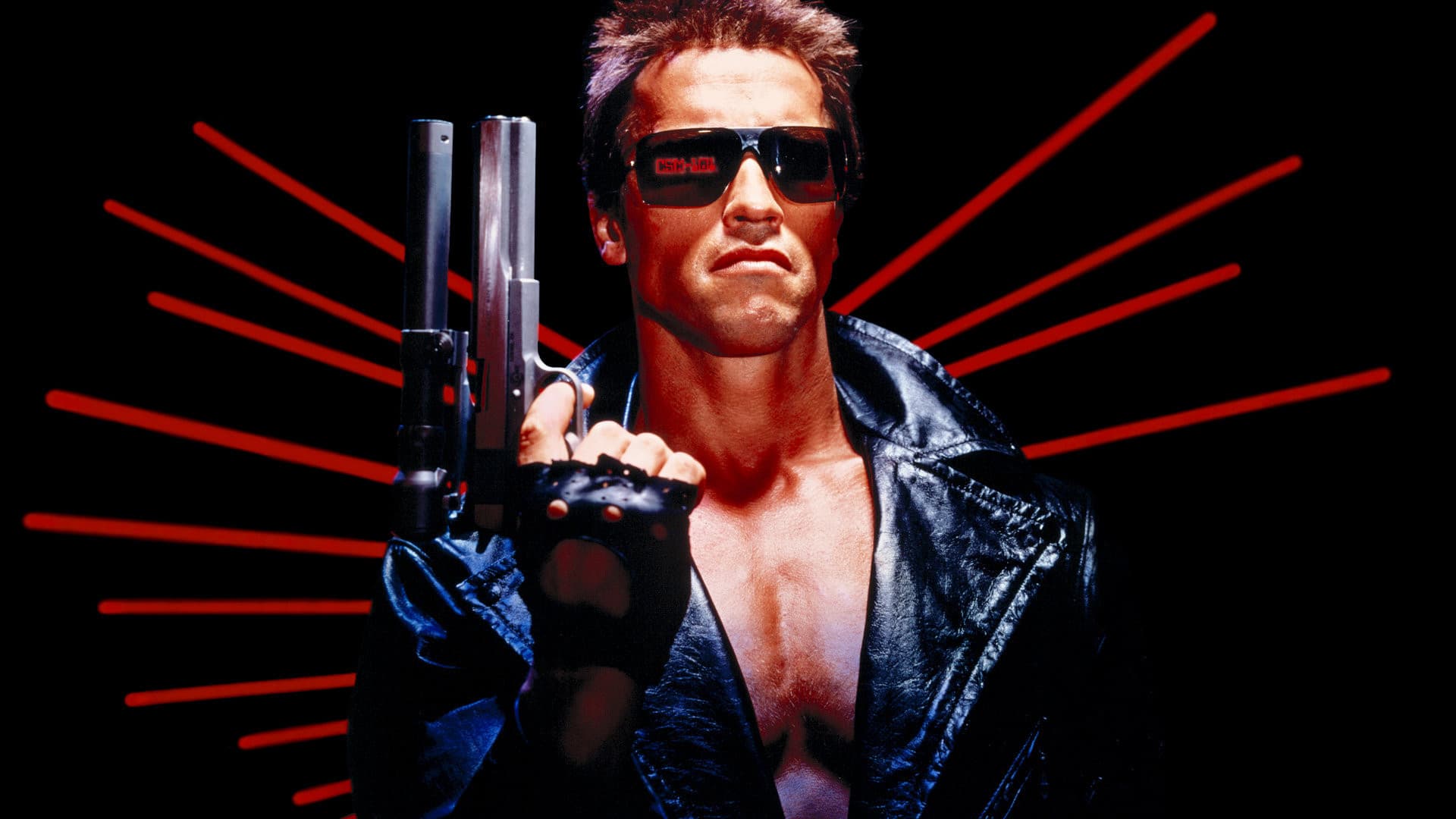
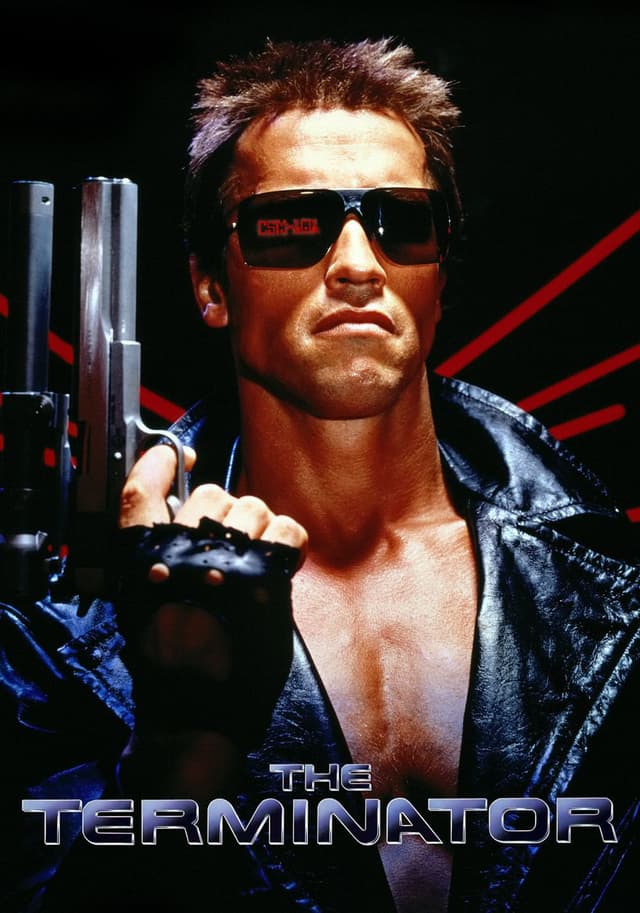
- Props and Weapons: Schwarzenegger trained with weapons for three months. The laser-sighted AMT Longslide pistol on the poster was modified by Ed Reynolds of SureFire, whose laser needed an external power supply that Schwarzenegger switched on by hand; Reynolds has said his only payment was promotional material.
- Synthesizer Score: Brad Fiedel, who had only worked in television, composed and performed the score on synthesizer rather than with an orchestra, recording almost all of it live. The main theme, built on a Prophet-10, runs in an unusual 13/16 time signature that came from an accidental loop on his sequencer.
How Does The Terminator's Budget Compare to Similar Films?
The films below shaped The Terminator or followed from it. Worldwide figures are Box Office Mojo's, across all releases.
- Halloween (1978): Budget $325,000 | Worldwide $47,175,973. John Carpenter's film was Cameron's model for a slasher made on a small budget. It cost a twentieth as much as The Terminator and grossed about 145 times its budget on Box Office Mojo's figures, against The Terminator's 12.
- Conan the Destroyer (1984): Budget $18,000,000 | Worldwide $31,042,035 (domestic only). Schwarzenegger's other 1984 release, whose shoot held up The Terminator, cost almost three times as much and grossed $7,329,165 less in the United States and Canada; Box Office Mojo records only its domestic gross.
- Aliens (1986): Budget $18,500,000 | Worldwide $131,060,248. Cameron began work on his next film while waiting for Schwarzenegger to finish Conan. It had almost three times The Terminator's budget and grossed about 67% more worldwide.
- Predator (1987): Budget $15,000,000 | Worldwide $98,268,458. Schwarzenegger's next science fiction action film cost more than twice as much and grossed about 25% more, a smaller return on its budget.
- Terminator 2: Judgment Day (1991): Budget $102,000,000 | Worldwide $518,868,620. The sequel cost almost 16 times as much as the original and grossed about 6.6 times as much, a measure of how far the first film's success moved Cameron and Schwarzenegger up the budget scale.
The Terminator Box Office Performance
Orion had little faith in The Terminator and held only one press screening. The film opened in the United States and Canada on October 26, 1984, and took $4,020,663 from 1,005 theaters to finish first for the weekend. Its second weekend rose 4.9% to $4,219,463 in 1,112 theaters, and it stayed at number one before Oh, God! You Devil displaced it in its third week. It had grossed $34,004,606 by the end of 1984, enough for 21st place on Box Office Mojo's chart for the year, and finished with $38,371,200 domestically. Cameron called it a hit "relative to its market, which is between the summer and the Christmas blockbusters."
Box Office Mojo's worldwide total of $78,371,200 is that complete domestic gross plus a flat $40,000,000 for international markets, which is a rounded estimate rather than a country-by-country total. Overseas, the film opened in Australia on December 20, 1984, in the United Kingdom on January 11, 1985 and in West Germany on March 15, 1985, but Box Office Mojo's market-by-market data covers only $411 from the original run plus recent re-releases, led by $434,411 across three releases in the United Kingdom. The Numbers carries the same $40,000,000 overseas figure with a slightly lower domestic total of $38,019,031.
Box Office Breakdown
The Terminator

The worldwide gross is about 12.2 times the production budget, and the domestic gross alone is about 6 times it, though those are statements about the negative cost, not about profit. Video added to the return: Thorn EMI released the film on cassette on April 10, 1985, with an initial order of 155,000 units according to the AFI Catalog, and it reached number four on Billboard's video rental chart in its second week. The Numbers estimates later Blu-ray sales at $10,909,275. No sequel has come close to the original's return on its budget: the five that followed cost between $102,000,000 and $200,000,000, including Terminator 3: Rise of the Machines (2003), Terminator Salvation (2009) and Terminator: Genisys (2015), and the most recent, Terminator: Dark Fate (2019), grossed $261,119,292 worldwide on a $185,000,000 budget.
No figure for what Orion spent on prints and advertising in 1984 has been reported, so the total investment, and with it a return per dollar for The Terminator, cannot be calculated.
The Terminator Production History
Cameron conceived The Terminator in Rome, where he fell ill during the release of Piranha II: The Spawning and dreamed of a metallic torso dragging itself out of an explosion with kitchen knives. Taking John Carpenter's low-budget Halloween as his model, he used the image as a launching pad for a slasher film, dismissed an agent who disliked the idea, and wrote the draft at the Pomona home of science fiction writer Randall Frakes. His friend Bill Wisher wrote the scenes involving Sarah Connor and the police, the two reading new pages to each other over recorded phone calls. An early outline sent two Terminators back, the second made of liquid metal; Cameron shelved it as beyond the effects of the time, and it returned as the T-1000 in Terminator 2.
Hurd, who had worked as Roger Corman's assistant at New World Pictures, bought the rights for $1 and took a co-writing credit for her edits to the script, though Cameron said she did no "actual writing." To close the financing, Cameron sent his friend Lance Henriksen into Daly's office ahead of the pitch dressed as the Terminator, with fake cuts on his face and gold foil on his teeth. Henriksen was later cast as Detective Vukovich because he had been essential to finding the money.
Casting began with Orion, which wanted a rising star with foreign appeal as Kyle Reese. Orion co-founder Mike Medavoy sent the script to Arnold Schwarzenegger's agent and suggested O. J. Simpson for the Terminator, which Cameron rejected because he did not think Simpson would be believable as a killer. Cameron went into his meeting with Schwarzenegger planning to pick a fight and rule him out, but spent it sketching his face while Schwarzenegger described how the villain should be played, and came back saying he would make "a hell of a Terminator." Schwarzenegger saw the low-profile film as a change of pace from Conan the Barbarian (1982) and speaks only 17 lines, fewer than 100 words. Sting turned down Reese, which went to Michael Biehn, and Linda Hamilton was cast as Sarah Connor after finishing Children of the Corn (1984).
Shooting was due to start in Toronto in early 1983, but Dino De Laurentiis exercised an option on Schwarzenegger's contract that kept him on Conan the Destroyer for nine months. Cameron used the delay to write a script for Rambo: First Blood Part II and to meet producers David Giler and Walter Hill about a sequel to Alien (1979), which became Aliens. Orion interfered little; of its two recorded suggestions, Cameron refused a canine android for Reese and accepted a stronger love story. Filming began in Los Angeles in early 1984, mostly at night against tight schedules before sunrise, and Hamilton spent most of it in pain after spraining her ankle a week before cameras rolled. Schwarzenegger asked to change "I'll be back" because he struggled with "I'll", and Cameron refused. Pick-up shots followed, and the closing scene of Sarah driving into the storm was filmed without a permit; Cameron and Hurd told a police officer it was a UCLA student film.
After release, Harlan Ellison claimed the film was taken from his Outer Limits episode "Soldier" and threatened to sue. Orion settled in 1986, paying him an amount that was never made public and adding an acknowledgment to later prints, over Cameron's objection. A sequel was announced in January 1985, but Terminator 2: Judgment Day did not arrive until 1991, by which time Cameron had made Aliens and The Abyss; he went on to Titanic (1997) and Avatar (2009).
Awards and Recognition
The Terminator received no Academy Award nominations. Its awards came from the genre and, later, from preservation and critics' lists.
- Saturn Awards: Won Best Science Fiction Film, Best Writing for James Cameron and Gale Anne Hurd, and Best Make-up for Stan Winston at the 12th Saturn Awards in June 1985, from seven nominations. The others were Best Actor for Schwarzenegger, Best Actress for Linda Hamilton, Best Director for Cameron and Best Music for Brad Fiedel.
- Time Magazine: Named one of the ten best films of 1984.
- National Film Registry: Selected by the Library of Congress in 2008 as culturally, historically or aesthetically significant.
- American Film Institute: Ranked 42nd on 100 Years, 100 Thrills; the Terminator was named the 22nd greatest screen villain, and "I'll be back" was voted the 37th greatest movie quote.
- Critics' and Industry Lists: Total Film ranked it the 72nd best film ever made in 2005, Empire included it in The 500 Greatest Movies of All Time in 2008, and in 2010 the Independent Film & Television Alliance named it one of the 30 most significant independent films of the previous 30 years.
Critical Reception
The Terminator holds 90% on Rotten Tomatoes from 134 critics, with an average rating of 8.0/10, and a Metacritic score of 84 out of 100 from 21 critics, indicating universal acclaim. Audiences polled by CinemaScore gave it a B+. The Rotten Tomatoes consensus reads: "With its impressive action sequences, taut economic direction, and relentlessly fast pace, it's clear why The Terminator continues to be an influence on sci-fi and action flicks."
Reviews in 1984 were mixed. Variety called it a "blazing, cinematic comic book, full of virtuoso moviemaking, terrific momentum, solid performances and a compelling story," and Richard Corliss of Time said it had "plenty of tech-noir savvy to keep infidels and action fans satisfied." The Los Angeles Times called it "a crackling thriller full of all sorts of gory treats." Janet Maslin of The New York Times was cooler: she called it a "B-movie with flair" but found "far too much" of the obligatory mayhem, "in the form of car chases, messy shootouts and Mr. Schwarzenegger's slamming brutally into anything that gets in his way."
Its standing rose afterwards. In 1991 Richard Schickel of Entertainment Weekly gave it an A and called it "one of the most original movies of the 1980s," and in 2015 Peter Bradshaw of The Guardian gave it five stars, writing that it "stands up tremendously well with outrageous verve and blistering excitement."
Frequently Asked Questions
How much did it cost to make The Terminator (1984)?
The Terminator had a production budget of $6,400,000, the figure listed by Box Office Mojo and The Numbers. It was originally budgeted at $4,000,000 and raised to $6,500,000 before filming, the figure the AFI Catalog gives for the start of production.
How much did The Terminator (1984) make at the box office?
The Terminator grossed $78,371,200 worldwide, according to Box Office Mojo: $38,371,200 in the United States and Canada and a rounded $40,000,000 internationally. It opened to $4,020,663 from 1,005 theaters and was number one for its first two weekends.
Was The Terminator (1984) profitable?
The figures point to a large profit, but no accounting has been published. Its $78,371,200 worldwide gross is about 12.2 times its $6,400,000 budget, and the domestic gross alone is about 6 times it. Orion's prints and advertising spend was never reported, so a net return and ROI cannot be calculated.
Why do sources give different budgets for The Terminator?
Box Office Mojo and The Numbers list $6,400,000. Production histories say the film was first budgeted at $4,000,000 and raised to $6,500,000, and the AFI Catalog says filming began on a $6,500,000 budget. Saturation uses $6,400,000.
How much did James Cameron sell The Terminator script for?
James Cameron sold the rights to The Terminator to producer Gale Anne Hurd for $1, on the condition that she would produce it only if he directed. The deal kept him in the director's chair, and Cameron later said he regretted selling the rights.
Who paid for The Terminator (1984)?
John Daly of Hemdale Film Corporation agreed in late 1982 to finance the film with help from HBO and Orion Pictures, which distributed it. Daly and Hemdale's Derek Gibson were executive producers, and Gale Anne Hurd produced through Pacific Western Productions.
Where was The Terminator (1984) filmed?
The Terminator was filmed in Los Angeles in early 1984, mostly at night, over ten weeks of principal photography. Toronto had been chosen first but was dropped as too costly, and the final highway scene was shot without a permit.
Why was The Terminator delayed?
Filming was due to start in early 1983, but Dino De Laurentiis exercised an option on Arnold Schwarzenegger's contract that kept him on Conan the Destroyer for nine months. James Cameron used the time to write a Rambo: First Blood Part II script and develop Aliens.
What awards did The Terminator (1984) win?
The Terminator won three Saturn Awards from seven nominations: Best Science Fiction Film, Best Writing for James Cameron and Gale Anne Hurd, and Best Make-up for Stan Winston. In 2008 it was selected for the National Film Registry.
How does The Terminator's budget compare to Terminator 2?
Terminator 2: Judgment Day (1991) cost $102,000,000, almost 16 times the original's $6,400,000, and grossed $518,868,620 worldwide, about 6.6 times the original's $78,371,200, according to Box Office Mojo.
Filmmakers
The Terminator

Official Trailer
Build budgets like this one in Saturation
Start from an industry-standard feature film template, import the schedule and rates you already have, and let the cost report keep itself current as you spend. Real-time collaboration, no spreadsheets.