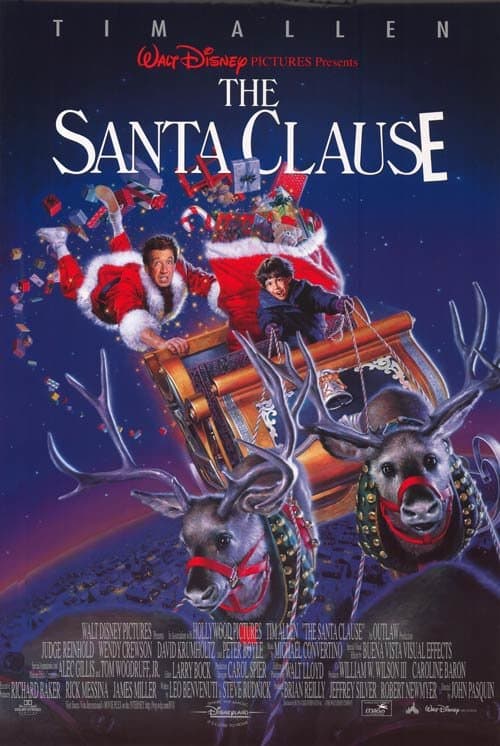
The Santa Clause Budget
 Adventure
Updated
Synopsis
Divorced dad Scott has custody of his son on Christmas Eve. After he accidentally kills a man in a Santa suit, they are magically transported to the North Pole, where an elf explains that Scott must take Santa’s place before the next Christmas arrives. Scott thinks he’s dreaming, but over the next several months he gains weight and grows an inexplicably white beard. Maybe that night at the North Pole wasn't a dream after all — and maybe Scott has a lot of work to do.
What Is the Budget of The Santa Clause?
The Santa Clause (1994) was produced on a budget of $22 million, a sensible investment for a mid-tier family comedy from Walt Disney Pictures during an era when the studio was enjoying a creative and commercial renaissance. Director John Pasquin, fresh from years collaborating with Tim Allen on Home Improvement, brought the project in on budget with a story that required practical North Pole sets, a handful of visual effects sequences, and a star at the very peak of his television fame making his theatrical leading-man debut.
The $22 million figure was modest relative to Disney's prestige animated releases of the same period, but entirely appropriate for a live-action holiday comedy with a contained story set across a few key locations: a suburban Chicago neighborhood (shot in Toronto), a department store rooftop, and the North Pole workshop. The production did not require globe-trotting location work or marquee ensemble salaries beyond Allen's own above-the-line deal.
Key Budget Allocation Categories
- Above-the-Line Talent: Tim Allen, already commanding $1 million-plus per Home Improvement episode by this stage of his career, was the film's central commercial asset. His deal, along with those of Judge Reinhold, Wendy Crewson, Eric Lloyd, David Krumholtz, and Peter Boyle, likely consumed $8 to $10 million of the total budget. The film's marketability rested almost entirely on Allen's transition from television to theatrical star.
- Production Design and Sets: The North Pole workshop, elves' village, and sleigh sequences were constructed at Toronto-area facilities rather than a Hollywood soundstage, taking advantage of lower Canadian labor and facility costs. The suburban Chicago neighborhood exterior scenes were shot on real Toronto residential streets doubled for Illinois. Practical set builds for the workshop interior and Scott Calvin's home anchored the film's visual identity.
- Visual Effects: The Santa Clause relied primarily on practical prosthetics and makeup to show Scott Calvin's gradual physical transformation, including weight gain suits and a progressively whitening beard. CGI was used sparingly for sleigh-flight sequences and rooftop moments. This effects strategy kept costs manageable while remaining convincing by 1994 standards.
- Music and ScoreComposer Michael Convertino provided an orchestral holiday score that anchored the film's warm, comedic tone without competing with licensed holiday standards. The score was a modest line item compared to the above-the-line talent costs, but its contributions to repeat holiday viewership have proven durable over three decades.
- Cinematography and Technical CrewCinematographer Walt Lloyd, who brought experience from prestige television and independent film, shot the film with a warm, bright palette that emphasized the fantasy elements without relying on expensive filtration or complex camera rigs. The Toronto shoot benefited from an experienced Canadian crew, helping the production stay on schedule.
How Does The Santa Clause's Budget Compare to Similar Films?
The Santa Clause occupied a sweet spot in the mid-1990s family comedy market: a $22 million production budget that was high enough to support recognizable talent and polished production design, but lean enough that the film could break even at a fraction of its eventual worldwide gross. The comparisons below reveal how efficiently the production was structured relative to its contemporaries.
- Home Alone (1990): Budget $18M | Worldwide $476.7M. The John Hughes-produced Christmas comedy set the template for the high-concept family holiday film at a similar budget level. The Santa Clause matched its budget tier while aiming for a gentler tone, and while it did not approach Home Alone's record-setting gross, it performed at a level that validated Disney's strategy.
- The Flintstones (1994): Budget $46M | Worldwide $341.6M. Released the same year by Universal, this TV-to-film adaptation spent more than double on a bigger ensemble and elaborate period production design. The Santa Clause's half-the-cost, half-the-return profile made it the more profitable relative to investment.
- Miracle on 34th Street (1994): Budget $26M | Worldwide $73.3M. 20th Century Fox's remake of the 1947 classic arrived in the same 1994 holiday season with a slightly higher budget and substantially lower returns, demonstrating that premise and casting mattered far more than production spend in the holiday family comedy category.
- The Santa Clause 2 (2002): Budget $55M | Worldwide $172.8M. The direct sequel nearly tripled the original's budget to support expanded North Pole world-building and a new ensemble, yet earned less worldwide and generated a far lower ROI. This comparison underscores how efficiently the original was produced.
The Santa Clause Box Office Performance
The Santa Clause opened on November 11, 1994, distributed by Buena Vista Pictures (Walt Disney's theatrical arm), and earned $18.9 million in its opening weekend from 1,969 theaters. The film held exceptionally well through Thanksgiving and into December, benefiting from the holiday-appropriate subject matter that kept audiences returning through Christmas. It finished with $144.8 million domestically and $189.8 million worldwide, making it one of the highest-grossing films of 1994 in North America.
Against an estimated total investment of $37 million (production budget plus an estimated $15 million in prints-and-advertising), the film's worldwide gross generated a studio theatrical share of approximately $94.9 million, assuming the standard 50% theater retention rate. That left Disney well clear of break-even on the theatrical run alone, before home video, television licensing, and merchandise revenue is counted. The ROI on production budget alone is approximately 763%.
Box Office Breakdown
The Santa Clause (1994)

Stated simply: The Santa Clause earned roughly $8.63 for every $1 invested in production. Even accounting for the P&A spend that theater splits only partially offset, the film generated exceptional returns and immediately validated Disney's bet on Tim Allen as a theatrical leading man.
The Santa Clause Production History
The Santa Clause originated with a spec screenplay by first-time writers Leo Benvenuti and Steve Rudnick, who conceived the central premise: a divorced father accidentally knocks Santa Claus off his roof, discovers a card in Santa's coat reading "If something should happen to me, put on my suit," and finds himself magically compelled to complete the Christmas Eve deliveries and ultimately take over the role permanently. The script was acquired by Hollywood Pictures, a Walt Disney subsidiary established to produce PG-13 and adult-oriented content, though the finished film was ultimately released under the more family-appropriate Walt Disney Pictures banner.
Producers Robert Newmyer, Brian Reilly, and Jeffrey Silver brought the project to Tim Allen, who was at the apex of his Home Improvement fame and actively seeking a vehicle that could translate his television persona to the big screen. Allen's casting was the film's defining creative decision: his exasperated everyman quality, established across years of the ABC sitcom, was precisely calibrated for Scott Calvin's arc from skeptical divorced dad to reluctant Santa. Director John Pasquin, who had directed multiple Home Improvement episodes and understood Allen's comedic rhythms intimately, was the natural choice to helm the production.
Principal photography took place in and around Toronto, Ontario, Canada in early 1994. The city's residential streets stood in for the suburban Chicago neighborhood where Scott Calvin and his son Charlie live, while Toronto-area production facilities housed the elaborate North Pole sets including Santa's workshop, the elves' living quarters, and the exterior sleigh launch pad. Filming in Toronto allowed the production to access Canadian tax incentives and lower crew costs while keeping the schedule manageable within the $22 million budget.
Post-production focused heavily on the physical transformation sequences. Tim Allen wore progressive weight-gain suits and underwent escalating makeup and prosthetics sessions to chart Scott Calvin's involuntary transformation into Santa Claus across the film's timeline. The film opened November 11, 1994, positioning it perfectly to benefit from the full Thanksgiving and Christmas moviegoing period. Its theatrical run extended into January 1995, with sustained holiday-season audience interest that padded the total domestic gross well beyond typical opening-weekend projections.
Awards and Recognition
The Santa Clause did not receive major film awards nominations from the Academy Awards, Golden Globes, or BAFTA. Family comedies of its type rarely competed in those circuits in the mid-1990s, and the film's critical reception, while generally positive, was not positioned as awards contention. Tim Allen was recognized at the MTV Movie Awards and various audience-choice ceremonies, reflecting the film's popularity with its core demographic.
The film's most significant recognition came through its cultural legacy and franchise longevity. Its commercial success prompted Disney to greenlight The Santa Clause 2 (2002) and The Santa Clause 3: The Escape Clause (2006), both with Tim Allen reprising the role. Three decades after the original's release, Disney+ produced a limited series continuation, The Santa Clauses (2022), again starring Allen, marking one of the longer-lived live-action franchise relationships in the studio's history. The original film is now a perennial fixture on holiday programming schedules and consistently appears on lists of the most beloved Christmas films of the 1990s.
Critical Reception
The Santa Clause holds a 70% approval rating on Rotten Tomatoes, reflecting a critical consensus that the film is a likable, well-cast holiday entertainment rather than a genre landmark. Critics in 1994 praised Tim Allen's performance and his easy chemistry with young Eric Lloyd, who plays his son Charlie. The fish-out-of-water premise, in which Scott Calvin's corporate instincts collide with the magical obligations of being Santa, was noted as an effective comedic engine that kept the film moving through its 97-minute runtime.
Some critics noted that the film's pacing occasionally slackened in its middle section as Scott comes to terms with his transformation, and the divorce subplot involving Judge Reinhold's character was cited as standard-issue family-comedy material. However, audiences proved far more generous than critics: the film's CinemaScore rating and word-of-mouth among families with children drove exceptional holds week-over-week through the holiday season. Roger Ebert noted Allen's effectiveness at calibrating warmth beneath his usual sarcastic persona, calling it a stronger-than-expected vehicle for his theatrical debut.
In retrospect, The Santa Clause is credited with helping establish the modern template for the studio holiday comedy: a high-concept, family-friendly premise built around a single recognizable television or comedy star, shot on a controlled budget, and released in the pre-Thanksgiving window to maximize the holiday theatrical window. That formula has been replicated repeatedly in the three decades since, confirming the original film's place as a quiet structural influence on the genre.
Frequently Asked Questions
How much did The Santa Clause cost to make?
The production budget was $22,000,000. Walt Disney Pictures and Hollywood Pictures produced the film, with Outlaw Productions co-producing the Tim Allen vehicle.
How much did The Santa Clause earn at the box office?
The film grossed $144,833,357 domestically and $45,500,000 internationally, for a worldwide total of approximately $190,300,000. It opened to $19,324,000 on November 11, 1994, becoming one of the highest-grossing live-action Christmas films of the 1990s.
Who stars in The Santa Clause?
Tim Allen stars as divorced toy executive Scott Calvin, who accidentally causes the death of Santa Claus and is contractually bound to take his place. Eric Lloyd plays his son Charlie, with Wendy Crewson as ex-wife Laura and Judge Reinhold as her new husband Neal.
Who directed The Santa Clause?
John Pasquin directed the film, his feature directorial debut. Pasquin had previously directed multiple episodes of Tim Allen's sitcom Home Improvement and collaborated with Allen again on Jungle 2 Jungle (1997) and Joe Somebody (2001).
What is the "Santa Clause" the title refers to?
The Santa Clause is a clause in the contract that Scott Calvin unwittingly agrees to when he puts on the dead Santa's suit, binding him to become the next Santa Claus permanently. The wordplay on "Clause" versus "Claus" drives much of the film's premise and humor.
Where was The Santa Clause filmed?
Principal photography took place in Toronto and the surrounding Ontario region, with North Pole interiors shot on soundstages at Pinewood Toronto. The Canadian location offered significant cost advantages over comparable U.S. production hubs.
What did critics think of The Santa Clause?
Reviews were positive, with a 73% approval rating on Rotten Tomatoes and a 57 out of 100 score on Metacritic. Critics praised Tim Allen's physical comedy and the film's genuine emotional core, with several reviewers comparing it favorably to Miracle on 34th Street.
Did The Santa Clause spawn sequels?
Yes. The Santa Clause 2 (2002) grossed $172,800,000 worldwide on a $65,000,000 budget. The Santa Clause 3: The Escape Clause (2006) grossed $110,800,000 worldwide on an $80,000,000 budget. A Disney+ continuation series The Santa Clauses launched in 2022 with Tim Allen reprising the role.
Was The Santa Clause profitable?
Yes. Against the $22,000,000 production budget and an estimated $20,000,000 to $25,000,000 in marketing spend, the worldwide gross of $190,300,000 produced an exceptional theatrical profit. Annual holiday television and streaming rotation has extended the franchise's commercial life for three decades.
How does The Santa Clause compare to other 1990s Christmas films?
The Santa Clause outgrossed Miracle on 34th Street (1994 remake, $46,300,000 worldwide on a $25,000,000 budget) and Jingle All the Way (1996, $129,800,000 worldwide on a $60,000,000 budget). It remains second only to Home Alone (1990) among the decade's Christmas family hits in terms of worldwide gross.
Filmmakers
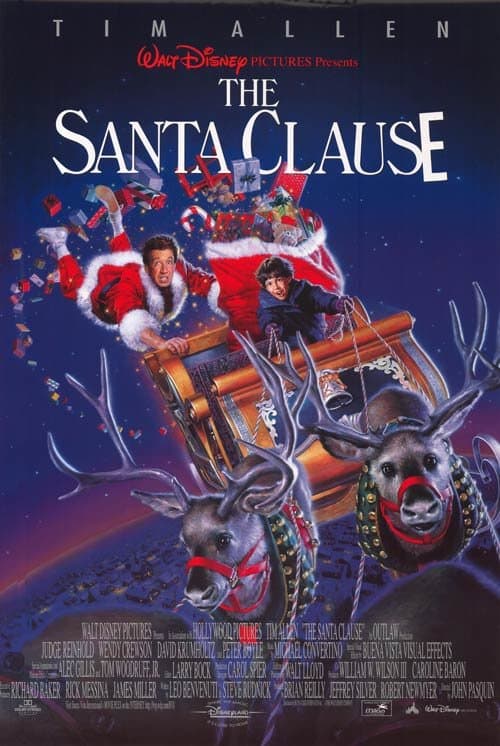
The Santa Clause (1994)

Build budgets like this one in Saturation
Start from an industry-standard feature film template, import the schedule and rates you already have, and let the cost report keep itself current as you spend. Real-time collaboration, no spreadsheets.