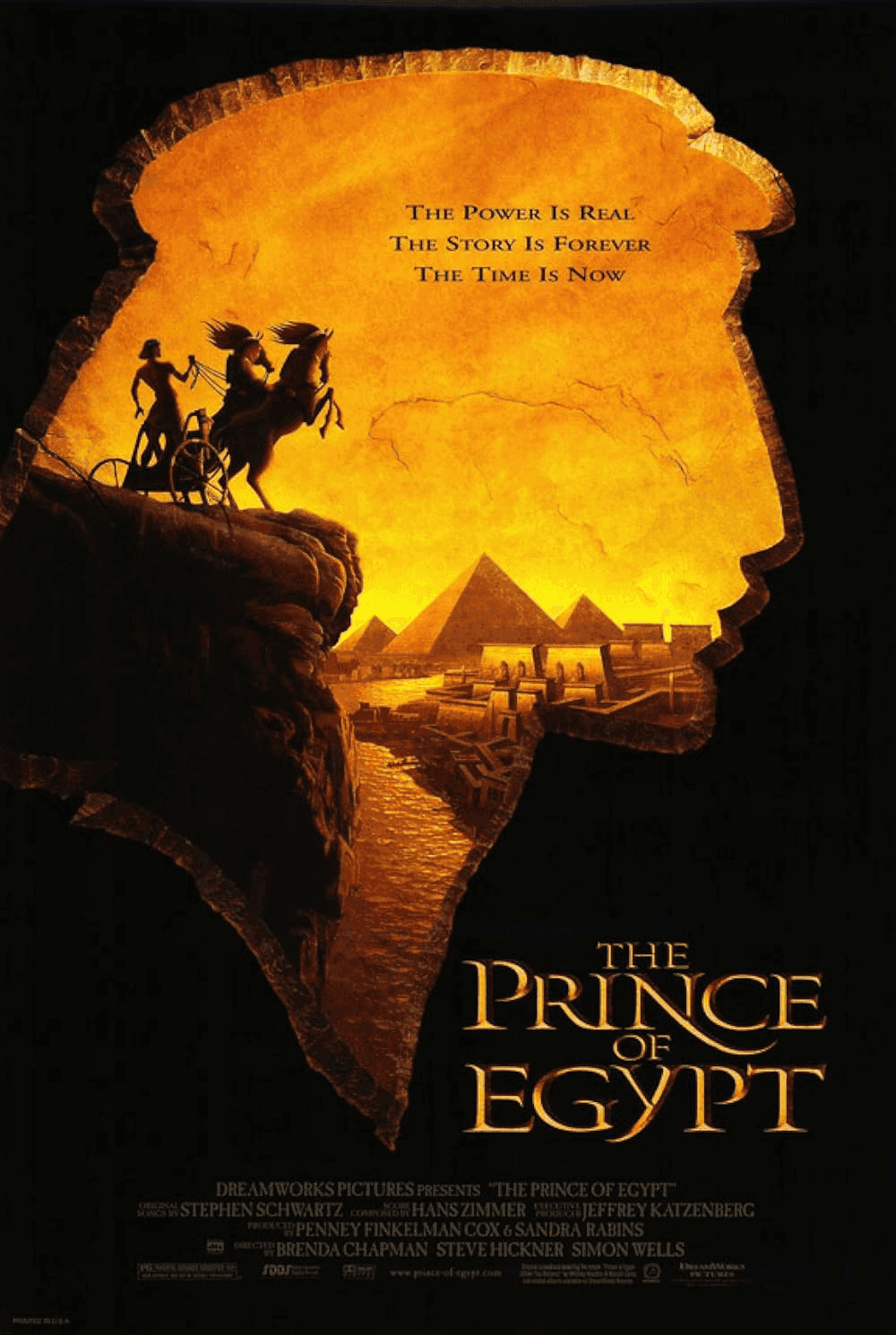
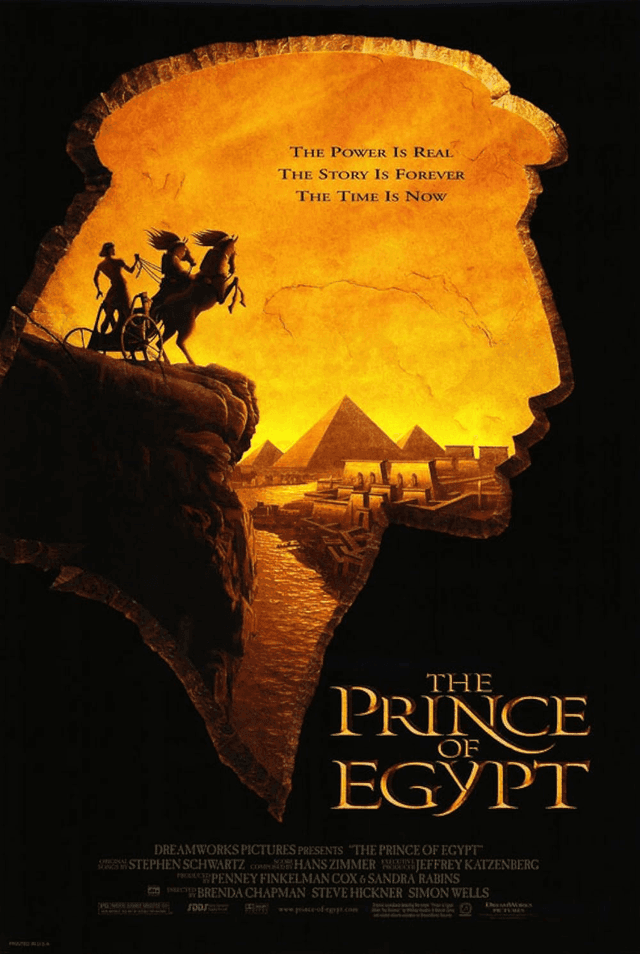
The Prince of Egypt Budget
 Adventure
Updated
Synopsis
Raised as a prince of Egypt alongside his adopted brother Rameses, Moses discovers his true identity as a Hebrew slave and is called by God to confront the new Pharaoh and lead his people out of bondage. The film retells the Book of Exodus with sweeping operatic musical numbers and traditional 2D character animation integrated with extensive CGI environmental work.
What Is the Budget of The Prince of Egypt (1998)?
The Prince of Egypt (1998), directed by Brenda Chapman, Steve Hickner, and Simon Wells, was produced on a reported budget of $70,000,000. The film served as DreamWorks Animation's debut traditional 2D animated feature, conceived by studio co-founder Jeffrey Katzenberg as a direct challenge to Disney's market dominance in family animation and as a statement project demonstrating that the new studio could match Disney's craft and emotional scale.
Producers Penney Finkelman Cox and Sandra Rabins, working under Katzenberg's executive supervision, structured the budget around an ambitious four-year production timeline, an A-list voice cast led by Val Kilmer, Ralph Fiennes, Michelle Pfeiffer, Sandra Bullock, Jeff Goldblum, Danny Glover, Patrick Stewart, Helen Mirren, Steve Martin, and Martin Short, original songs by Stephen Schwartz, and extensive CGI integration with traditional 2D character animation. The $70,000,000 figure was modest by Disney's standards, with Mulan (1998) reportedly costing $90,000,000 and A Bug's Life reportedly costing $120,000,000, but reflected DreamWorks' lean operating model and Katzenberg's hard-line cost discipline.
Key Budget Allocation Categories
The Prince of Egypt's $70,000,000 budget broke down across these major production areas:
- Four-Year Production Timeline: Active production began in 1994 and ran through late 1998, with story development, voice recording, character animation, and CGI integration all running in parallel for extended periods. DreamWorks Animation's Glendale facility ramped from a small team to more than 400 artists at peak production.
- Voice Cast: Val Kilmer (Moses and God), Ralph Fiennes (Rameses), Michelle Pfeiffer (Tzipporah), Sandra Bullock (Miriam), Jeff Goldblum (Aaron), Danny Glover (Jethro), Patrick Stewart (Pharaoh Seti I), Helen Mirren (Queen Tuya), Steve Martin and Martin Short (Hotep and Huy), with Brian Stokes Mitchell, Sally Dworsky, Linda Dee Shayne, and Amick Byram providing singing voices for select characters. The A-list cast required substantial above-the-line investment.
- Stephen Schwartz Songs: Composer and lyricist Stephen Schwartz (Pippin, Godspell, Wicked) wrote the original songs including "Deliver Us," "All I Ever Wanted," "Through Heaven's Eyes," "Playing with the Big Boys," and the Oscar-winning "When You Believe." Hans Zimmer composed the orchestral score in his first major animated feature collaboration. The combined music budget included full orchestral recording sessions and the Whitney Houston/Mariah Carey duet single of "When You Believe."
- Character Animation: Lead character animators including Kristof Serrand (Moses), Patrick Mate (Rameses), and Fabio Lignini handled the principal performances. The film employed approximately 350 character animators across the production at peak staffing, with DreamWorks recruiting heavily from Disney, Warner Bros., and Don Bluth Productions.
- CGI Environmental and Effects Work: DreamWorks integrated extensive CGI environmental work including the chariot race through Egyptian streets, the parting of the Red Sea, the burning bush sequence, and the various plagues. The studio's in-house digital department developed custom software pipelines for the 2D/3D integration, which became a foundational technology for subsequent DreamWorks animated features.
- Production Design: Production designer Darek Gogol and art director Kathy Altieri designed a visual style that drew heavily on French neoclassical painters Gustave Doré and Jean-Léon Gérôme, with deliberate stylized use of color and composition to evoke historical paintings and biblical illustration traditions.
How Does The Prince of Egypt's Budget Compare to Similar Films?
At $70,000,000, The Prince of Egypt sits in the mid-tier of late-1990s animated features. Comparable productions:
- Mulan (1998): Budget $90,000,000 | Worldwide $304,320,254. Disney's contemporaneous animated feature spent approximately 29% more and grossed approximately 40% more worldwide, illustrating how Disney's established distribution and brand premium translated to higher returns.
- A Bug's Life (1998): Budget $120,000,000 | Worldwide $363,398,565. Pixar's second feature, also released in late 1998, cost nearly twice as much and grossed approximately 67% more worldwide.
- Hercules (1997): Budget $85,000,000 | Worldwide $252,712,101. Disney's previous animated feature cost slightly more and grossed slightly more.
- Anastasia (1997): Budget $53,000,000 | Worldwide $139,804,348. Don Bluth and Fox's competing animated feature cost less and earned considerably less worldwide, illustrating how a non-Disney/non-DreamWorks animated film struggled in the marketplace.
- Tarzan (1999): Budget $130,000,000 | Worldwide $448,191,819. Disney's animated feature the following year cost nearly twice as much and grossed approximately twice as much.
The Prince of Egypt Box Office Performance
The Prince of Egypt opened on December 18, 1998, in 3,118 theaters, earning $14,524,321 in its opening weekend and finishing second behind You've Got Mail. The film's worldwide gross ultimately totaled $218,613,188.
Against a reported production budget of $70,000,000, the film needed approximately $160,000,000 worldwide to reach profitability when accounting for marketing and distribution costs. The financial breakdown:
Box Office Breakdown
The Prince of Egypt

The Prince of Egypt returned approximately $1.90 in worldwide theatrical revenue for every $1 invested when measured against total estimated production and marketing spend, making it a highly profitable theatrical performer that validated DreamWorks Animation's entry into the family animation market. The domestic share of $101,413,188 against an international share of $117,200,000 reflected a slight international skew driven by the religious themes' broad appeal in European, Latin American, and Asian Christian markets.
The film's success laid the financial foundation for DreamWorks Animation's subsequent traditional 2D features The Road to El Dorado (2000), Spirit: Stallion of the Cimarron (2002), and Sinbad: Legend of the Seven Seas (2003), though the studio ultimately pivoted to CGI features with Shrek (2001) becoming its franchise anchor. A direct-to-video prequel, Joseph: King of Dreams, was released in 2000, and the property was eventually adapted into a stage musical that opened on the West End in 2020.
The Prince of Egypt Production History
Development of The Prince of Egypt began in October 1994, immediately after Jeffrey Katzenberg's departure from Disney and his co-founding of DreamWorks SKG with Steven Spielberg and David Geffen. Katzenberg had long wanted to adapt the Moses story, having pitched it at Disney without success, and he positioned the project as the new animation studio's statement film. The Ten Commandments (1956) and Cecil B. DeMille's previous biblical epics served as visual reference, alongside French neoclassical paintings.
Brenda Chapman, hired from Disney after working on Beauty and the Beast and The Hunchback of Notre Dame, joined as a co-director, alongside Steve Hickner (a former Steven Spielberg producer on Balto) and Simon Wells (We're Back!, Balto). The directorial trio worked collaboratively across the four-year production. Screenwriter Philip LaZebnik developed the screenplay alongside Nicholas Meyer, with substantial story contributions from Kelly Asbury, Lorna Cook, Carole Holliday, and Ralph Zondag.
DreamWorks consulted extensively with theologians and religious scholars including Jewish rabbis, Christian clergy, and Muslim scholars to ensure that the adaptation could be embraced across all three Abrahamic faiths. The decision to deviate from the strictly biblical Exodus account included expanding the relationship between Moses and Rameses as adoptive brothers, dramatizing the falling-out between them, and giving Tzipporah a substantial expanded role.
Voice recording took place across 1996 and 1997, with the principal cast often recording together to allow natural ensemble interplay (an unusual practice for animated features, which typically isolate voice actors). Stephen Schwartz delivered the original songs over the same period, with full orchestral recording sessions for the Hans Zimmer score taking place in late 1998. The chariot race sequence required some of the most complex 2D/3D integration ever attempted at DreamWorks Animation. The film premiered at the Mann Village Theatre in Westwood on December 16, 1998.
Awards and Recognition
The Prince of Egypt won the Academy Award for Best Original Song for "When You Believe" (music and lyrics by Stephen Schwartz) at the 71st Academy Awards in 1999, performed by Whitney Houston and Mariah Carey in a duet recording for the closing credits. The film was also nominated for Best Original Score for Hans Zimmer, losing to Life Is Beautiful.
Additional recognition included a Golden Globe nomination for Best Original Song ("When You Believe"), winning that category. The film received eight Annie Award nominations including Outstanding Achievement in an Animated Theatrical Feature, with wins for Stephen Schwartz (Music) and Brian Stokes Mitchell (Voice Acting). The MTV Movie Awards 1999 nominated the film for Best Song. Brenda Chapman became the first woman to direct an animated feature from a major studio (with co-directors), a milestone widely noted in subsequent industry coverage. Critics organizations from across the U.S. and U.K. recognized the film with various nominations through the 1998-1999 awards season.
Critical Reception
The Prince of Egypt received generally positive reviews. The film holds a 80% approval rating on Rotten Tomatoes based on 84 critic reviews, with the critical consensus calling it visually stunning and emotionally resonant. On Metacritic, the film scored 64 out of 100, indicating generally favorable reviews. Audiences surveyed by CinemaScore gave the film an A.
Roger Ebert gave the film four stars out of four, calling it "one of the best-looking animated films ever made" and praising the integration of traditional character animation with CGI environmental work. The New York Times' Janet Maslin wrote that the film "avoids the cuteness traps of recent animation" and noted the operatic scale of the storytelling. Variety's Todd McCarthy called it "DreamWorks' most ambitious project to date" and praised the production design's debt to Gustave Doré.
Critics broadly praised the production design, the Stephen Schwartz songs, the dramatic gravitas of the voice cast, and the surprising restraint with which DreamWorks handled the biblical source material. Some critics, including The New Yorker's Anthony Lane, objected to the pacing of the second act and the somewhat thin characterization of Moses' wife Tzipporah, but the broader consensus positioned The Prince of Egypt as a serious artistic achievement and a worthy debut for the new studio. The film's reputation has continued to strengthen in the decades since release, with academic and critical retrospectives recognizing it as a high point of late-1990s traditional animation.
Frequently Asked Questions
How much did The Prince of Egypt (1998) cost to make?
The production budget was $70,000,000, financed by DreamWorks Pictures and produced by DreamWorks Animation. The figure covered the four-year production timeline, the A-list voice cast led by Val Kilmer and Ralph Fiennes, Stephen Schwartz original songs, Hans Zimmer's orchestral score, and extensive CGI integration with traditional 2D character animation.
How much did The Prince of Egypt earn at the box office?
The film grossed $101,413,188 domestically and $117,200,000 internationally, for a worldwide total of $218,613,188. It opened to $14,524,321 in the U.S. on December 18, 1998, finishing second behind You've Got Mail.
Was The Prince of Egypt a profitable film?
Yes, very. Against a $70,000,000 production budget and an estimated $40,000,000 to $50,000,000 in marketing spend, the film returned approximately $1.90 in worldwide gross for every $1 invested, generating an estimated $98,000,000 to $108,000,000 in theatrical profit before home video recoupment.
Who directed The Prince of Egypt?
Brenda Chapman, Steve Hickner, and Simon Wells co-directed the film. Chapman, hired from Disney after working on Beauty and the Beast and The Hunchback of Notre Dame, became the first woman to direct an animated feature from a major U.S. studio. The directorial trio worked collaboratively across the four-year production at DreamWorks Animation in Glendale, California.
How does The Prince of Egypt compare to other late-1990s animated films?
The Prince of Egypt cost $70,000,000 and grossed $218,613,188 worldwide. Disney's contemporaneous Mulan (1998) cost $90,000,000 and grossed $304,320,254 worldwide. Pixar's A Bug's Life (1998) cost $120,000,000 and grossed $363,398,565 worldwide. Don Bluth and Fox's Anastasia (1997) cost $53,000,000 and grossed only $139,804,348 worldwide.
Who voices the characters in The Prince of Egypt?
Val Kilmer voices both Moses and God, with Ralph Fiennes as Rameses, Michelle Pfeiffer as Tzipporah, Sandra Bullock as Miriam, Jeff Goldblum as Aaron, Danny Glover as Jethro, Patrick Stewart as Pharaoh Seti I, Helen Mirren as Queen Tuya, and Steve Martin and Martin Short as Hotep and Huy. Brian Stokes Mitchell, Sally Dworsky, and Amick Byram provided singing voices for select characters.
Did The Prince of Egypt win any Academy Awards?
Yes. The Prince of Egypt won the Academy Award for Best Original Song for "When You Believe" (music and lyrics by Stephen Schwartz) at the 71st Academy Awards in 1999. The film was also nominated for Best Original Score for Hans Zimmer, losing to Life Is Beautiful.
What music is in The Prince of Egypt?
Composer and lyricist Stephen Schwartz wrote the original songs including "Deliver Us," "All I Ever Wanted," "Through Heaven's Eyes," "Playing with the Big Boys," and the Academy Award-winning "When You Believe." Hans Zimmer composed the orchestral score in his first major animated feature collaboration. Whitney Houston and Mariah Carey performed the closing-credits duet version of "When You Believe."
What did critics think of The Prince of Egypt?
The film received generally positive reviews, with an 80% Rotten Tomatoes approval rating from 84 critics and a 64 out of 100 Metacritic score. Audiences gave it an A CinemaScore. Roger Ebert gave the film four stars out of four, calling it "one of the best-looking animated films ever made" and praising the integration of traditional character animation with CGI environmental work.
Is there a sequel to The Prince of Egypt?
DreamWorks released a direct-to-video prequel, Joseph: King of Dreams, in 2000, but no theatrical sequel was ever produced. The property was eventually adapted into a stage musical that opened on the West End in February 2020, with Stephen Schwartz returning to write additional original songs alongside his original film compositions.
Filmmakers
The Prince of Egypt

Build budgets like this one in Saturation
Start from an industry-standard feature film template, import the schedule and rates you already have, and let the cost report keep itself current as you spend. Real-time collaboration, no spreadsheets.