The Next Best Thing Budget
 Drama
DramaUpdated
Synopsis
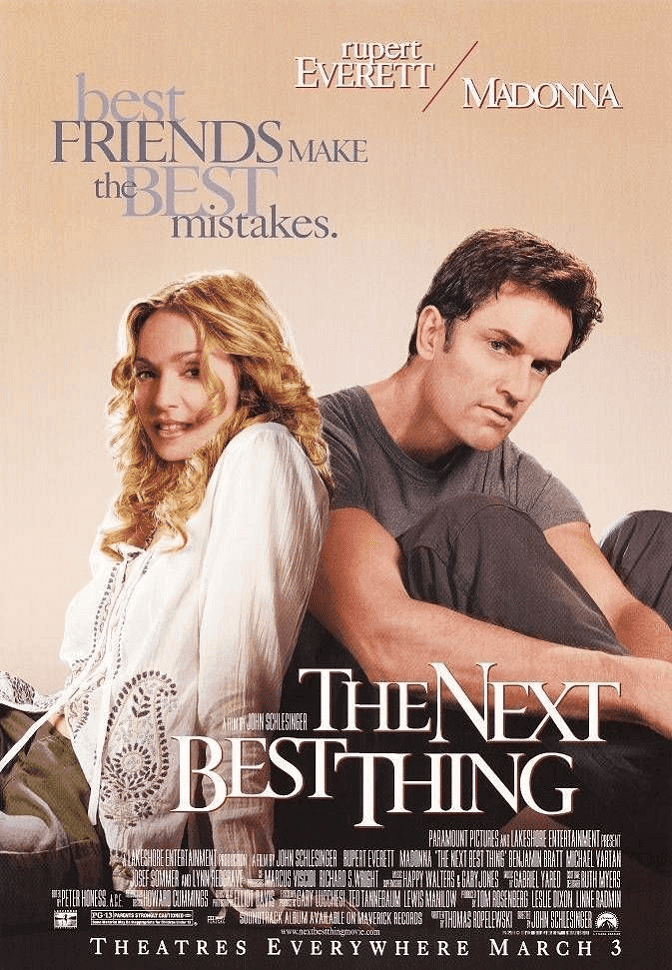
A single Los Angeles yoga instructor and her longtime gay best friend, both adrift in their late thirties, decide to raise a child together after a drunken one-night stand results in an unexpected pregnancy. Their experiment in chosen family works through the boy's early childhood until the appearance of a new heterosexual love interest puts both the friendship and the custody arrangement under acute strain.
What Is the Budget of The Next Best Thing (2000)?
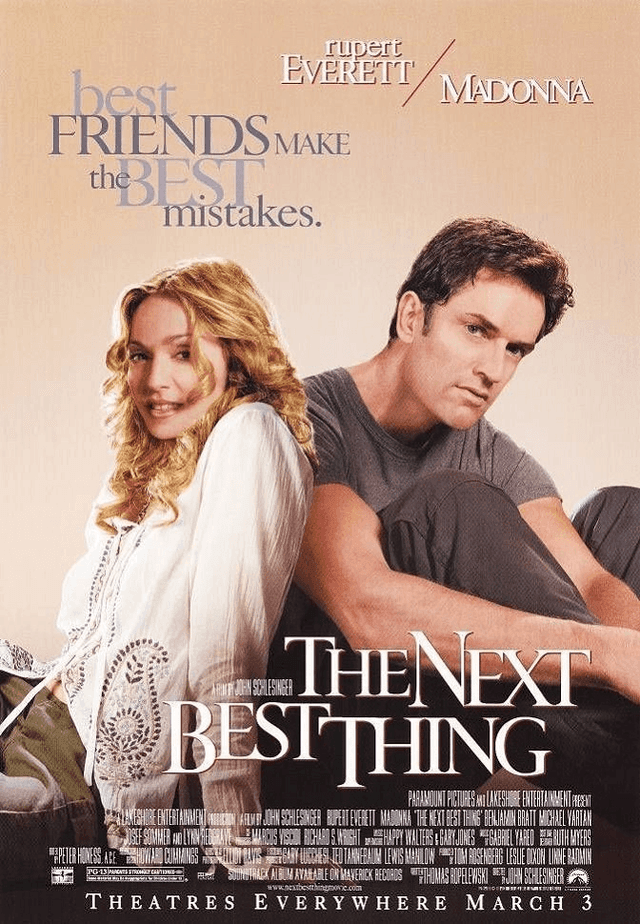
The Next Best Thing (2000), directed by John Schlesinger and distributed by Paramount Pictures, was produced on a reported budget of $25,000,000. The romantic comedy-drama starred Madonna and Rupert Everett as longtime friends, a single yoga instructor and her gay best friend, who decide to raise a child together after an unexpected pregnancy resulting from a drunken one-night stand. Lakeshore Entertainment and Tom Rosenberg produced the project, with Paramount Pictures handling theatrical distribution in North America and key international territories.
The investment reflected the cost of attaching Madonna in a lead role at the peak of her late-1990s reinvention cycle, with her above-the-line compensation absorbing a substantial share of the budget alongside director John Schlesinger, whose post-Marathon Man and Midnight Cowboy reputation commanded a senior-director fee. The film was conceived as an adult-skewing relationship dramedy with broad target demographics, and Paramount needed worldwide grosses of approximately $50,000,000 to clear marketing and distribution costs, a benchmark the film fell short of by a wide margin.
Key Budget Allocation Categories
The Next Best Thing's reported $25,000,000 budget was distributed across several core production areas:
- Above-the-Line Talent: Madonna, in one of her highest-profile film leads of the late 1990s and 2000s, commanded the largest single fee in the production. Rupert Everett, coming off his acclaimed supporting turn in My Best Friend's Wedding (1997) and An Ideal Husband (1999), received a co-lead salary appropriate to a Paramount-released romantic dramedy. Director John Schlesinger's fee reflected his standing as a two-time Oscar-nominated director with a fifty-year career.
- Los Angeles Location Shoot: Principal photography took place in and around Los Angeles, with practical-location work in Silver Lake, the Hollywood Hills, and West Hollywood standing in for the contemporary Los Angeles social and gay-community settings that anchor the film's tone. Permits, neighborhood location fees, and Los Angeles Teamsters and IATSE crew rates absorbed a substantial share of below-the-line spend.
- Original Music and Madonna Soundtrack Contributions: Composer Gabriel Yared, an Oscar winner for The English Patient, delivered the orchestral score, while Madonna contributed two original tracks to the soundtrack including the lead single "American Pie," a Don McLean cover that became a major worldwide hit on its own. Music licensing and original-composition rights absorbed an unusually large soundtrack budget for a mid-tier romantic dramedy.
- Production Design and Lifestyle Sets: Production designer Howard Cummings dressed the film's contemporary Los Angeles interiors with the elevated-lifestyle yoga-studio, gay-bachelor-pad, and family-home detail required to support the upmarket character arcs. The visual signature of the production leaned heavily into late-1990s California minimalism, which required custom set dressing rather than location interiors.
- Wardrobe and Madonna's Looks: Costume designer Bridget Kelly designed Madonna's multiple wardrobe arcs, with the yoga-instructor and pregnancy-progression looks requiring custom builds and continuity-pieces across the film's extended time-jump structure. Madonna's wardrobe spend was elevated relative to a standard romantic dramedy because of her input into the styling.
- Post-Production and Editorial: Editor Peter Honess worked through Schlesinger's longer assembly cut and reportedly clashed with the director and Paramount over the final theatrical version, with the studio pushing for a more conventional romantic-comedy structure than Schlesinger's original cut delivered. The compressed post window resulted in extended editorial and reshoot pickups in late 1999.
How Does The Next Best Thing's Budget Compare to Similar Films?
At a reported $25,000,000, The Next Best Thing was a contained mid-budget romantic dramedy compared with the broader-format comedies of the year. The comparison set below illustrates how its production scale stacked up against contemporaneous adult-skewing relationship films:
- My Best Friend's Wedding (1997): Budget $38,000,000 | Worldwide $299,288,605. TriStar's Julia Roberts and Rupert Everett romantic comedy cost roughly fifty percent more than The Next Best Thing and grossed roughly twenty times worldwide, providing the obvious peer for a gay-best-friend romantic dramedy and the benchmark The Next Best Thing failed to clear.
- Notting Hill (1999): Budget $42,000,000 | Worldwide $363,889,678. Universal's Richard Curtis-scripted Julia Roberts and Hugh Grant romance cost roughly seventy percent more than The Next Best Thing and grossed more than twenty times worldwide, demonstrating the upside available to upmarket adult-skewing romantic dramedy when the casting and tone aligned.
- Forces of Nature (1999): Budget $75,000,000 | Worldwide $93,907,000. DreamWorks's Sandra Bullock and Ben Affleck romantic comedy cost three times what The Next Best Thing did and grossed more than six times worldwide, illustrating the floor for star-led romantic comedy in the late 1990s.
- The Object of My Affection (1998): Budget $18,000,000 | Worldwide $32,000,000. Fox's Jennifer Aniston and Paul Rudd gay-best-friend romantic dramedy cost roughly seventy percent of The Next Best Thing and grossed more than twice as much, providing the closest direct creative peer and a closer commercial-floor benchmark.
- Stepmom (1998): Budget $50,000,000 | Worldwide $159,710,000. Columbia's Julia Roberts and Susan Sarandon family-drama-romance hybrid cost twice what The Next Best Thing did and grossed roughly ten times worldwide, demonstrating the broader appetite for upmarket relationship drama when the casting hook landed clearly.
The Next Best Thing Box Office Performance
The Next Best Thing opened on March 3, 2000 to $6,033,793 in the United States, finishing third on its opening weekend behind The Whole Nine Yards and The Beach. The film fell quickly after a soft second weekend, with negative reviews and lukewarm word of mouth limiting any sustained run. It ended its domestic run at $14,963,386 and added approximately $10,000,000 across limited international territories for a worldwide total of approximately $14,963,386 in tracked grosses, with some international figures unreported or rolled into Paramount's international division accounting. Here is the financial breakdown:
Box Office Breakdown
The Next Best Thing

The Next Best Thing returned approximately $0.30 to $0.33 in theatrical revenue for every $1 invested when measured against total estimated production and marketing spend, placing it among the clearest commercial underperformers of Paramount's 2000 release calendar. The almost entirely domestic gross signaled that the film did not travel, with international markets showing limited interest in the gay-best-friend romantic dramedy format outside the United States.
The Madonna soundtrack cover of "American Pie" became a major worldwide hit and topped the charts in multiple territories, partially offsetting the film's commercial profile in music-publishing terms even where the box office performance was a clear miss. The film's commercial collapse closed the door on Madonna as a feature-film romantic lead for the remainder of the 2000s.
The Next Best Thing Production History
Development began in 1998 when screenwriter Thomas Ropelewski sold his spec script to Lakeshore Entertainment and Tom Rosenberg, with John Schlesinger attaching to direct on the strength of his back catalog. Madonna signed on as a lead in early 1999, and Rupert Everett joined shortly after on the strength of his My Best Friend's Wedding profile. Producers Tom Rosenberg, Sigurjon Sighvatsson, Linne Radmin, and Leslie Dixon assembled the financing package around Paramount's domestic distribution commitment.
Casting was rounded out with Benjamin Bratt as Madonna's eventual love interest, Lynn Redgrave as Rupert Everett's mother, and Michael Vartan, Josef Sommer, and Malcolm Stumpf in supporting roles. Schlesinger, then 73 and in declining health, worked with cinematographer Elliot Davis to balance the demands of a contemporary Los Angeles romantic dramedy with his own preference for character-driven dramatic staging.
Principal photography ran from May to August 1999 in Los Angeles, with practical-location work in Silver Lake, the Hollywood Hills, West Hollywood, and at private homes standing in for the central yoga-instructor and gay-bachelor settings. The production was beset by reported creative tensions, with Madonna and Schlesinger clashing over the tone of multiple sequences and Paramount pushing for a more conventional commercial structure than the director's preferred dramatic approach.
Post-production extended into early 2000, with Paramount requesting additional reshoots and re-edits that altered the final structure from Schlesinger's assembly cut. The "American Pie" cover, recorded during post for the soundtrack, was promoted aggressively in late 1999 and early 2000 ahead of the film's release, with the single charting at number one in multiple international markets but failing to translate into theatrical interest. Schlesinger suffered a stroke shortly after the film's release and did not direct another feature before his death in 2003, making The Next Best Thing his final theatrical film.
Awards and Recognition
The Next Best Thing received no significant awards recognition. The film was not nominated at the Oscars, the Golden Globes, the Screen Actors Guild Awards, or the major guild ceremonies, and it did not register at the People's Choice Awards or Critics' Choice Awards.
At the Razzies, the film received five nominations at the 21st Golden Raspberry Awards in 2001, including Worst Actress for Madonna, Worst Screen Couple for Madonna and Rupert Everett, Worst Director for John Schlesinger, Worst Original Song for "Time Stood Still," and Worst Screenplay for Thomas Ropelewski. Madonna won the Razzie for Worst Actress for The Next Best Thing, her second Razzie win in the category and a particularly visible commercial-and-critical low point in her late-1990s and 2000s film career.
Critical Reception
The Next Best Thing received broadly negative reviews. The film holds a 19% approval rating on Rotten Tomatoes based on 96 critic reviews, with a critical consensus describing it as a misjudged and tonally inconsistent vehicle that wasted both leads. On Metacritic, the film scored 27 out of 100, indicating overwhelmingly negative reviews. Audiences surveyed by CinemaScore gave the film a B-, a forgiving grade given the critical reaction.
Critics broadly objected to the screenplay's tonal whiplash, Madonna's lead performance, and what they characterized as a misjudged third-act custody-battle pivot. Roger Ebert gave the film one and a half stars out of four, writing that "the screenplay seems to have been pieced together from the leftovers of better movies," and The New York Times's Stephen Holden called it "an unfocused, unsuccessful attempt to transplant the comic spirit of My Best Friend's Wedding into a dramatic key." Variety's Todd McCarthy noted the directorial inconsistency and called the film "an awkwardly conceived and executed romantic dramedy."
A handful of mainstream outlets were marginally more forgiving, with Entertainment Weekly noting Everett's performance as the principal saving grace, but the consensus across both trade press and mainstream outlets was unambiguously negative. The film stands as a frequently cited cautionary example of star-driven projects whose creative tensions in development and post-production produced a final product that satisfied no one, and it effectively ended Madonna's run as a Hollywood feature-film romantic lead.
Frequently Asked Questions
How much did it cost to make The Next Best Thing (2000)?
The reported production budget was $25,000,000, with the largest single line item going to above-the-line compensation for Madonna, Rupert Everett, and director John Schlesinger. Paramount Pictures distributed in North America with Lakeshore Entertainment producing alongside Tom Rosenberg, Sigurjon Sighvatsson, Linne Radmin, and Leslie Dixon.
How much did The Next Best Thing earn at the box office?
The film grossed $14,963,386 domestically. International grosses were limited and only partially reported by Paramount, with rough industry estimates placing the worldwide total in the $25,000,000 to $30,000,000 range. It opened to $6,033,793 in the United States on the weekend of March 3, 2000, finishing third behind The Whole Nine Yards and The Beach.
Was The Next Best Thing a box office flop?
Yes. Against a $25,000,000 production budget and an estimated $20,000,000 to $25,000,000 in marketing spend, the film returned approximately $0.30 to $0.33 in theatrical revenue for every $1 invested. It is among the clearest commercial underperformers in Paramount's 2000 release calendar.
Who directed The Next Best Thing?
John Schlesinger directed the film, his final theatrical feature before suffering a stroke later in 2000 and his death in 2003. Schlesinger was a two-time Oscar nominee best known for Midnight Cowboy (1969), Marathon Man (1976), and Pacific Heights (1990).
Where was The Next Best Thing filmed?
Principal photography ran from May to August 1999, with extensive location work in Los Angeles. Practical Silver Lake, Hollywood Hills, and West Hollywood locations stood in for the contemporary Los Angeles yoga-instructor and gay-community settings that anchor the film's tone.
How does The Next Best Thing compare to My Best Friend's Wedding?
The Next Best Thing cost about two thirds of My Best Friend's Wedding ($38 million in 1997) and grossed roughly five percent as much worldwide. Both films featured Rupert Everett in a gay-best-friend role, but where My Best Friend's Wedding leaned into broad romantic comedy, The Next Best Thing attempted a tonally complex dramedy that critics and audiences rejected.
Who stars in The Next Best Thing?
Madonna plays Abbie Reynolds, a Los Angeles yoga instructor, and Rupert Everett plays her gay best friend Robert Whittaker. Benjamin Bratt plays Abbie's eventual love interest, Lynn Redgrave plays Robert's mother, and Michael Vartan, Josef Sommer, Neil Patrick Harris, and Malcolm Stumpf appear in supporting roles.
Did The Next Best Thing win any awards?
The film received no significant industry recognition. At the 21st Golden Raspberry Awards in 2001 it earned five Razzie nominations, including Worst Actress for Madonna (which she won), Worst Director for John Schlesinger, Worst Screen Couple, Worst Original Song, and Worst Screenplay.
What did critics think of The Next Best Thing?
The film received overwhelmingly negative reviews. It holds a 19% approval rating on Rotten Tomatoes (96 critics) and a 27 out of 100 Metacritic score. Audiences gave it a B- CinemaScore. Critics broadly objected to the screenplay's tonal whiplash, Madonna's lead performance, and the third-act custody-battle pivot. Roger Ebert gave the film one and a half stars out of four.
Why did the "American Pie" cover succeed where the film failed?
Madonna's cover of Don McLean's "American Pie," recorded for the film's soundtrack, was promoted heavily in late 1999 and early 2000 and topped the charts in multiple international markets, becoming one of the year's biggest pop hits. The single succeeded as a freestanding music release while the film itself failed commercially and critically, with limited overlap between the music audience that bought the single and the moviegoing audience that ignored the film.
Filmmakers
The Next Best Thing

Build budgets like this one in Saturation
Start from an industry-standard feature film template, import the schedule and rates you already have, and let the cost report keep itself current as you spend. Real-time collaboration, no spreadsheets.