The Midnight Sky Budget
 Science FictionDrama1h 58m
Updated
Synopsis
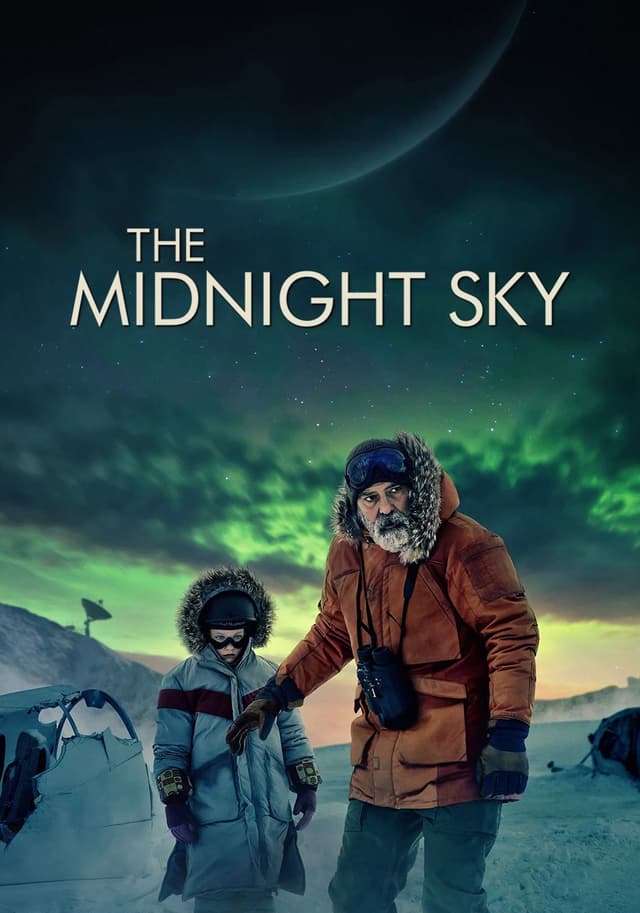
In the aftermath of a global catastrophe, Augustine (George Clooney), a lonely scientist in the Arctic, races to stop astronaut Sully (Felicity Jones) and her fellow crew members from returning home to a mysterious global catastrophe. Augustine must warn them from the Earth's last functioning observatory before they pass beyond communication range.
What Is the Budget of The Midnight Sky (2020)?
The Midnight Sky (2020), directed by and starring George Clooney from a screenplay by Mark L. Smith adapting Lily Brooks-Dalton's 2016 novel Good Morning, Midnight, was produced on an estimated budget of approximately $100,000,000. Netflix fully financed the picture as a year-end prestige sci-fi original through its Anonymous Content and Smokehouse Pictures partnership, with Grant Heslov producing alongside Clooney through their Smokehouse banner. The budget reflected the cost economics of a dual-narrative space-drama with extensive Iceland location shooting and full International Space Station-replica VFX construction.
At that scale, the budget covered roughly six months of principal photography across the United Kingdom and Iceland, the construction of full-scale spacecraft sets at Shepperton Studios, ILM and Framestore VFX work for the space sequences, and Alexandre Desplat's original score recorded with the London Symphony Orchestra. As a Netflix original, the picture bypassed theatrical breakeven and was measured against the streamer's year-end subscriber-acquisition and Oscar-cycle metrics.
Key Budget Allocation Categories
The Midnight Sky's estimated $100,000,000 budget was distributed across the following core production areas:
- Above-the-Line Talent: George Clooney directed and starred at his combined director-actor rate, with Felicity Jones (Rogue One, The Theory of Everything), David Oyelowo, Kyle Chandler, Demián Bichir, and Tiffany Boone leading the space-station ensemble at A-tier compensation. Grant Heslov's producer credit and Smokehouse Pictures' producer fee added to the above-the-line line.
- Shepperton Studios Shoot: Principal photography ran from October 2019 to February 2020 at Shepperton Studios outside London, with full-scale spacecraft sets including the Aether crew habitats, the cockpit, and the airlock. The UK Film Tax Relief covered up to 25% of qualifying UK spend, a critical financial lever against the high above-the-line costs.
- Iceland Location Shoot: A multi-week production block in Iceland in late 2019 covered Arctic observatory exteriors and the Augustine-and-Iris ice-traverse sequence. Iceland's 25% film production incentive reimbursement helped offset the international travel and lodging costs, but the location work was the picture's most expensive non-VFX sequence.
- Visual Effects: ILM and Framestore handled the bulk of space-sequence VFX, including the Aether spacecraft exterior shots, the spacewalk debris field sequence, and the Earth atmospheric reentry. The picture's VFX shot count exceeded 1,200, with Framestore's London team handling the Aether interiors and ILM's San Francisco team handling the exterior space shots.
- Production Design: Production designer Jim Bissell built the Aether spacecraft sets at Shepperton, working in collaboration with NASA consultants on a near-future spacecraft design. The Arctic observatory interior was built as a practical set at Shepperton with practical heating and lighting to support the Clooney-and-Iris scenes.
- Score and Music: Composer Alexandre Desplat scored the film with the London Symphony Orchestra, recorded at Abbey Road Studios. The picture's music budget was substantial, reflecting Desplat's tier rate and a full-orchestra recording commitment that was rare for streaming originals at the time.
How Does The Midnight Sky's Budget Compare to Similar Films?
At an estimated $100,000,000, The Midnight Sky sits in the upper range of Netflix streaming-original sci-fi films. The comparison set illustrates how budget tier and platform strategy interact:
- Bird Box (2018): Budget $19,800,000 | Worldwide $0 (Netflix). Susanne Bier's Sandra Bullock post-apocalyptic Netflix vehicle cost roughly 20% of The Midnight Sky and established the streamer's prior-benchmark for genre-original spend.
- The Cloverfield Paradox (2018): Budget $40,000,000 | Worldwide $0 (Netflix). Julius Onah's Netflix space-station drama operated at less than half of The Midnight Sky's budget and shows the streamer's earlier space-genre tier.
- Ad Astra (2019): Budget $80,000,000 | Worldwide $135,001,761. James Gray's Brad Pitt space-isolation drama cost roughly 80% of The Midnight Sky and offers the closest theatrical-release sibling for the form.
- Interstellar (2014): Budget $165,000,000 | Worldwide $701,800,000. Christopher Nolan's Paramount and Warner Bros. theatrical space epic cost roughly 65% more than The Midnight Sky and shows the upper boundary of the theatrical-release form.
The Midnight Sky Box Office Performance
The Midnight Sky received a limited theatrical release on December 11, 2020 in select North American theaters as part of Netflix's standard pre-streaming awards-qualifying window. Netflix does not disclose theatrical grosses for these limited platform releases, and the picture's primary distribution was via Netflix starting December 23, 2020, timed to the year-end and Christmas-week viewing window.
Against an estimated $100,000,000 budget, here is the financial structure:
Box Office Breakdown
The Midnight Sky

Netflix announced in late December 2020 that the picture had been viewed by more than 72 million households globally during its first 28 days, a figure that placed it within the top ten most-viewed Netflix original films of 2020 and well above the platform's typical year-end original release engagement. Internal Netflix reporting placed total view-hours in the hundreds of millions during the December 2020 and January 2021 window.
The picture's commercial value to Netflix combined subscriber retention, holiday-window engagement, and awards-cycle prestige. The Best Visual Effects Oscar nomination delivered the awards-circuit recognition Netflix had targeted, while the Christmas-week launch positioning aligned the release with the platform's strongest seasonal usage window.
The Midnight Sky Production History
Lily Brooks-Dalton published the novel Good Morning, Midnight in 2016, a literary post-apocalyptic two-narrative drama that follows an Arctic observatory scientist and a Mars-mission astronaut in parallel. Mark L. Smith (The Revenant, Overlord) adapted the novel into a feature screenplay across 2017 and 2018 with Anonymous Content, and George Clooney committed to direct and star in early 2019 after Anonymous Content brought the project to him through his Smokehouse Pictures partnership with Grant Heslov.
Netflix acquired the project in mid-2019 as a year-end prestige original positioned for the 2020 awards cycle, with Felicity Jones attaching to the lead Sully role in summer 2019. Jones was pregnant during the late 2019 portion of principal photography, a circumstance the production accommodated through script changes that integrated Sully's pregnancy into the Aether-crew storyline. David Oyelowo, Kyle Chandler, Demián Bichir, and Tiffany Boone filled out the space-station ensemble.
Principal photography ran from October 2019 to February 2020 at Shepperton Studios outside London, with a multi-week Iceland location block in late 2019 covering Arctic exteriors. The UK Film Tax Relief covered up to 25% of qualifying UK spend, and Iceland's 25% film production incentive offset international portion costs. Post-production extended through 2020, complicated by COVID-19 lockdown restrictions, with the picture premiering at the 2020 American Film Institute Fest on December 10, 2020 ahead of the Netflix global launch on December 23, 2020.
Awards and Recognition
The Midnight Sky received two Academy Award nominations: Best Visual Effects (Matt Kasmir, Christopher Lawrence, Max Solomon, David Watkins) and the picture was also recognized at the 2021 BAFTA Awards in the Best Special Visual Effects category. The picture also received a Critics Choice Movie Award nomination for Best Hair and Makeup at the 2021 ceremony.
The picture did not advance to the Best Picture, Best Director, or Best Actor cycles that Netflix had positioned it for, with Mank, The Trial of the Chicago 7, and Da 5 Bloods serving as the platform's primary Best Picture-cycle entries. Alexandre Desplat's score received a Hollywood Music in Media Award nomination for Best Original Score in a Film, but did not advance to the major awards in that category.
Critical Reception
The Midnight Sky received mixed reviews. The film holds a 51% approval rating on Rotten Tomatoes based on 305 critic reviews, with the critical consensus calling it "ambitious but emotionally muted." On Metacritic, the film scored 57 out of 100, indicating mixed or average reviews. The picture did not receive a CinemaScore polling due to its limited theatrical release.
Critics broadly praised the Iceland location cinematography, the spacecraft VFX, and Alexandre Desplat's score while raising concerns about the dual-narrative structure and the screenplay's reliance on a third-act twist some critics felt undercut the emotional payoff. The Hollywood Reporter's David Rooney wrote that the picture "boasts visual grandeur and a committed Clooney performance but never reconciles its two stories." Variety's Owen Gleiberman noted that "the spectacle is real, but the connective tissue between the Arctic and the Aether feels assembled rather than discovered."
More positive reviews praised the picture's ambition and the Felicity Jones spacewalk debris sequence, widely cited as one of the most accomplished space-sequence VFX of any film released in 2020. IndieWire's David Ehrlich gave the picture a B- overall, calling it "a swing for the fences that connects often enough to justify its scale." The picture's reception has settled into a mixed consensus in streaming life, with the VFX work earning durable industry praise even as the dramatic execution remains contested.
Frequently Asked Questions
How much did it cost to make The Midnight Sky (2020)?
The estimated production budget was approximately $100,000,000. Netflix fully financed the picture as a year-end prestige sci-fi original, with Grant Heslov producing alongside George Clooney through their Smokehouse Pictures banner in partnership with Anonymous Content.
How much did The Midnight Sky earn at the box office?
The picture received a limited theatrical release on December 11, 2020 in select North American theaters as part of Netflix's pre-streaming awards-qualifying window. Netflix does not disclose theatrical grosses for these releases. The picture launched globally on Netflix on December 23, 2020.
Did The Midnight Sky win any awards?
The picture received two Academy Award nominations: Best Visual Effects and a 2021 BAFTA nomination for Best Special Visual Effects. It also received a Critics Choice Movie Award nomination for Best Hair and Makeup at the 2021 ceremony. The picture did not win any major awards.
Who directed The Midnight Sky?
George Clooney directed and starred in the film, his seventh feature as director after Suburbicon (2017). The screenplay is by Mark L. Smith (The Revenant), adapting Lily Brooks-Dalton's 2016 novel Good Morning, Midnight.
Who stars in The Midnight Sky?
George Clooney stars as Augustine, a lonely Arctic observatory scientist. Felicity Jones plays astronaut Sully aboard the Aether spacecraft, with David Oyelowo, Kyle Chandler, Demián Bichir, and Tiffany Boone as the other Aether crew members. Caoilinn Springall plays the young Iris.
Where was The Midnight Sky filmed?
Principal photography ran from October 2019 to February 2020 at Shepperton Studios outside London, with a multi-week Iceland location block in late 2019 covering Arctic observatory exteriors. The shoot leveraged the UK Film Tax Relief (up to 25% of qualifying UK spend) and Iceland's 25% film production incentive.
Is The Midnight Sky based on a book?
Yes. The film is based on Lily Brooks-Dalton's 2016 novel Good Morning, Midnight, a literary post-apocalyptic two-narrative drama that follows an Arctic observatory scientist and a Mars-mission astronaut in parallel. Mark L. Smith adapted the novel across 2017 and 2018.
How many people watched The Midnight Sky?
Netflix announced in late December 2020 that the picture had been viewed by more than 72 million households globally during its first 28 days, placing it within the top ten most-viewed Netflix original films of 2020. Internal Netflix reporting placed total view-hours in the hundreds of millions during the December 2020 and January 2021 window.
What did critics think of The Midnight Sky?
The film received mixed reviews, with a 51% approval rating on Rotten Tomatoes (based on 305 critics) and a 57 out of 100 score on Metacritic. Critics broadly praised the Iceland location cinematography, the spacecraft VFX, and Alexandre Desplat's score while raising concerns about the dual-narrative structure.
Why did Felicity Jones appear pregnant in The Midnight Sky?
Felicity Jones was pregnant during the late 2019 portion of principal photography, a circumstance the production accommodated through script changes that integrated Sully's pregnancy into the Aether-crew storyline. The pregnancy became a central plot element of the film's third act.
Filmmakers
The Midnight Sky

Official Trailer
Build budgets like this one in Saturation
Start from an industry-standard feature film template, import the schedule and rates you already have, and let the cost report keep itself current as you spend. Real-time collaboration, no spreadsheets.