The Last Rodeo Budget
 Drama1h 56m
Updated
Synopsis
A retired rodeo legend risks it all to save his grandson. Facing his own painful past and the fears of his family, he enters a high-stakes bullriding competition as the oldest contestant ever. Along the way, he reconciles old wounds with his estranged daughter and proves that true courage is found in the fight for family.
What Is the Budget of The Last Rodeo (2025)?
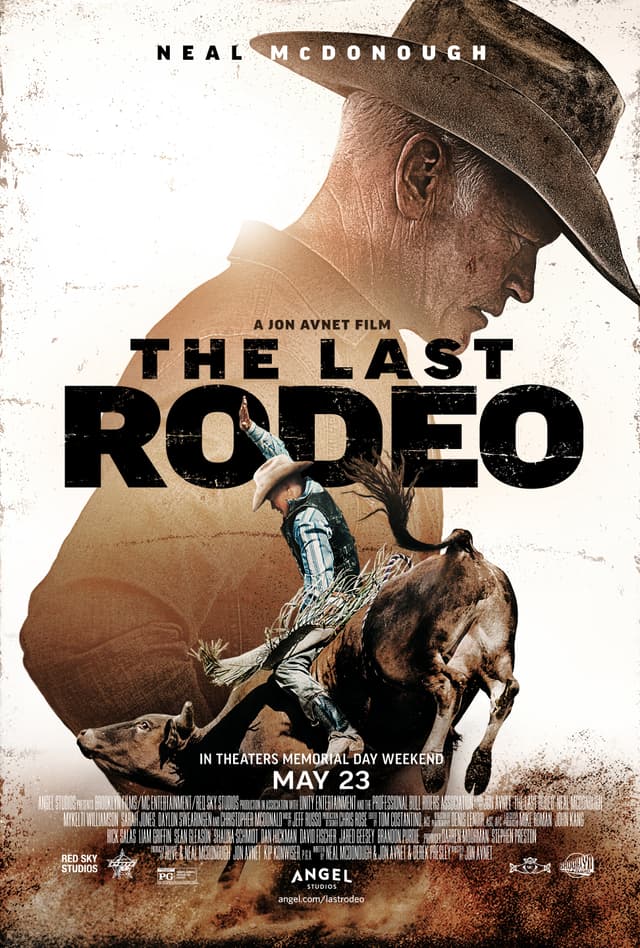
The Last Rodeo (2025) was produced on an $8 million budget by Angel Studios, the faith-focused distributor and production company that has built a model for releasing inspirational films directly to community audiences. Directed by Jon Avnet (Fried Green Tomatoes, Risky Business, Heat), the film stars Neal McDonough as Joe Wainwright, a retired bull-riding champion who broke his neck while riding drunk and now faces a new challenge: his grandson needs brain tumor surgery that Joe can only fund by attempting a professional rodeo comeback at age 57.
Principal photography took place in Owasso and Collinsville, Oklahoma from March to April 2024. These communities in northeastern Oklahoma, part of the state's rodeo and ranching heartland, provided authentic settings for the story's competitions and the Wainwright family's rural life.
Released on May 23, 2025, The Last Rodeo opened to $6.9 million during the Memorial Day weekend and ultimately earned $15.2 million at the domestic box office, nearly doubling its production budget in theatrical gross alone.
Key Budget Allocation Categories
- Above-the-Line Talent: Neal McDonough, a veteran character actor known for roles in Band of Brothers, Yellowstone, and numerous feature films, serves as the film's anchor. Mykelti Williamson (Forrest Gump, Justified), Sarah Jones, and Christopher McDonald provide strong supporting presence. For an $8 million production, this cast represents an efficient use of actor relationships in the faith-adjacent drama space.
- Rodeo Production and Stunt Work: Bull-riding sequences require professional rodeo performers, specialized camera equipment for arena shooting, and significant safety protocols. Daylon Swearingen, a real professional bull rider, was cast in a supporting role, bringing authenticity to the competition sequences. Professional rodeo coordination and stunt safety represented a meaningful portion of the physical production budget.
- Oklahoma Location Production: Filming in Owasso and Collinsville during March and April 2024 provided access to actual rodeo facilities and Oklahoma landscapes. The state has no specific film production incentive program at the scale offered by some neighboring states, meaning location costs were managed through efficient scheduling rather than tax incentive capture.
- Jon Avnet Direction: Hiring a director of Jon Avnet's experience (Fried Green Tomatoes, Risky Business) for an $8 million production represents a notable above-the-line investment that elevated the creative quality of the project relative to typical faith-based productions at this budget level.
How Does The Last Rodeo (2025)'s Budget Compare to Similar Films?
At $8 million, The Last Rodeo sits at the lower end of Angel Studios' theatrical releases and the broader faith-adjacent sports drama market. Its return of $15.2 million on an $8 million investment makes it one of the more efficient productions in the faith rodeo drama niche.
- 8 Seconds (1994): Budget $14M | Worldwide $10.2M. The Lane Frost story starring Luke Perry is the most recognizable bull-riding biographical film. Despite a higher production budget and a theatrical release at the height of country crossover popularity, it underperformed relative to The Last Rodeo's return on investment.
- Bull Rider (2008): Lower budget direct-to-video rodeo drama. The modest production demonstrates the difficulty of making rodeo content commercially viable without theatrical marketing muscle, which Angel Studios provided for The Last Rodeo.
- Fried Green Tomatoes (1991): Budget $11M | Worldwide $119M. Directed by Jon Avnet, this is the most commercially successful film in the director's catalog. The Last Rodeo did not achieve comparable results but shares Avnet's feel for Americana-infused character drama.
- Joe Bell (2020): Budget $12M | Worldwide $1.3M. A Mark Wahlberg-led drama about a father walking across America also released in the inspirational drama space. Its underperformance relative to its budget demonstrates how The Last Rodeo's Angel Studios distribution model can outperform traditional theatrical for this type of content.
The Last Rodeo (2025) Box Office Performance
The Last Rodeo (2025) earned $6.9 million during the Memorial Day weekend of May 23, 2025, finishing sixth at the domestic box office in its opening frame. The film's total theatrical gross reached approximately $15.2 million domestically. International box office data was not separately reported.
Against an $8 million production budget and an estimated P&A spend of $8 million for the Angel Studios theatrical release, the total investment was approximately $16 million. With theaters retaining around 50% of gross receipts, Angel Studios' share of the $15.2 million domestic gross was approximately $7.6 million. The film came close to recouping its total investment from theatrical receipts alone, with additional streaming and home video revenue expected to push it into clear profitability.
Box Office Breakdown
The Last Rodeo

The Last Rodeo earned roughly $1.90 for every $1 invested in production, one of the strongest returns in Angel Studios' 2025 theatrical slate. After accounting for theatrical splits and marketing, the film approached break-even from theatrical alone, with streaming and home video providing the expected path to full profitability.
The Last Rodeo (2025) Production History
The Last Rodeo was developed by Angel Studios as a faith-adjacent sports drama centered on the uniquely American rodeo tradition. Director Jon Avnet was brought on to give the project the craft of an experienced Hollywood filmmaker. Avnet's filmography spans Risky Business (1983), Fried Green Tomatoes (1991), and Heat (1995 as producer), representing a career in American storytelling that aligned with the film's Heartland setting and values.
Neal McDonough was cast as Joe Wainwright, the retired bull rider whose career-ending injury from drunk riding haunts him as he attempts a comeback to fund his grandson's surgery. The casting of McDonough, known for his work in Band of Brothers, Yellowstone, and his strong connection to faith-community audiences, was central to the film's marketing position. Daylon Swearingen, a real professional bull rider, was cast in a supporting role to bring authentic rodeo expertise to the production.
Principal photography took place from March to April 2024 in Owasso and Collinsville, northeastern Oklahoma communities that provided rodeo arenas and rural landscape appropriate to the story. The six-week shoot moved efficiently through the production schedule, keeping costs within the $8 million budget.
Angel Studios released the film on May 23, 2025, the Memorial Day weekend, competing with larger studio releases but finding its audience in the faith, family, and Western enthusiast communities. The film earned $6.9 million in its opening weekend and ultimately reached $15.2 million, a result that made The Last Rodeo one of Angel Studios' stronger theatrical performers of 2025. Critics gave it mixed-to-positive reviews, with Rotten Tomatoes showing 70% positive from a modest number of reviews.
Awards and Recognition
The Last Rodeo (2025) received an A audience grade from CinemaScore, indicating strong viewer satisfaction within its core demographic of faith, family, and Western audiences. Critics described the film as predictable yet heartfelt with old-fashioned charm, reflecting Avnet's approach to Americana storytelling. Neal McDonough's committed performance as Joe Wainwright was noted by reviewers as the film's emotional anchor.
Critical Reception
The Last Rodeo (2025) received mixed-to-positive critical reviews, with approximately 70% positive on Rotten Tomatoes. Metacritic assigned it 61/100 based on six critics. Reviewers generally found the film predictable in its narrative beats, following the familiar sports-comeback drama template without significant subversion, but credited Jon Avnet's assured direction and Neal McDonough's performance with elevating the material above typical faith-based drama conventions. The Owasso and Collinsville Oklahoma settings were praised for lending authenticity to the rodeo sequences. CinemaScore audiences awarded it an A grade, suggesting that the film's core audience, those who came specifically for the story of faith, family, and rodeo, found it fully satisfying despite the critical ambivalence.
Frequently Asked Questions
How much did it cost to make The Last Rodeo (2025)?
The production budget was $8,500,000, covering principal photography, cast and crew salaries, locations, sets, post-production, and music. Marketing and distribution (P&A) costs are estimated at an additional $4,250,000 - $6,800,000, bringing the total studio investment to approximately $12,750,000 - $15,300,000.
How much did The Last Rodeo (2025) earn at the box office?
The Last Rodeo grossed $15,201,659 domestic, $906 international, totaling $15,202,565 worldwide.
Was The Last Rodeo (2025) profitable?
The film did not break even theatrically, earning $15,202,565 against an estimated $21,250,000 needed. Ancillary revenue may have improved the picture.
What were the biggest costs in producing The Last Rodeo?
The primary cost drivers were above-the-line talent (Neal McDonough, Mykelti Williamson, Sarah Jones); talent compensation, authentic period production design, and meticulous post-production.
How does The Last Rodeo's budget compare to similar drama films?
At $8,500,000, The Last Rodeo is classified as a micro-budget production. The median budget for wide-release drama films in the 2020s ranges from $30 - 80M for mid-budget to $150M+ for tentpoles. Comparable budgets: All the President's Men (1976, $8,500,000); Train to Busan (2016, $8,500,000); Nightcrawler (2014, $8,500,000).
Did The Last Rodeo (2025) go over budget?
There are no widely reported accounts of significant budget overruns for this production. However, studios rarely disclose precise budget overrun figures publicly. The reported production budget reflects the final estimated cost.
What was the return on investment (ROI) for The Last Rodeo?
The theatrical ROI was 78.9%, calculated as ($15,202,565 − $8,500,000) ÷ $8,500,000 × 100. This measures gross revenue against production budget only - it does not account for P&A or exhibitor shares.
What awards did The Last Rodeo (2025) win?
1 win & 1 nomination total.
Who directed The Last Rodeo and who were the key crew members?
Directed by Jon Avnet, written by Neal McDonough, Jon Avnet, Derek Presley, shot by Denis Lenoir, with music by Jeff Russo, edited by Tom Costantino.
Where was The Last Rodeo filmed?
The Last Rodeo was filmed in United States of America.
Filmmakers
The Last Rodeo

Build budgets like this one in Saturation
Start from an industry-standard feature film template, import the schedule and rates you already have, and let the cost report keep itself current as you spend. Real-time collaboration, no spreadsheets.