The Jackal Budget
 Thriller/Suspense
Updated
Synopsis
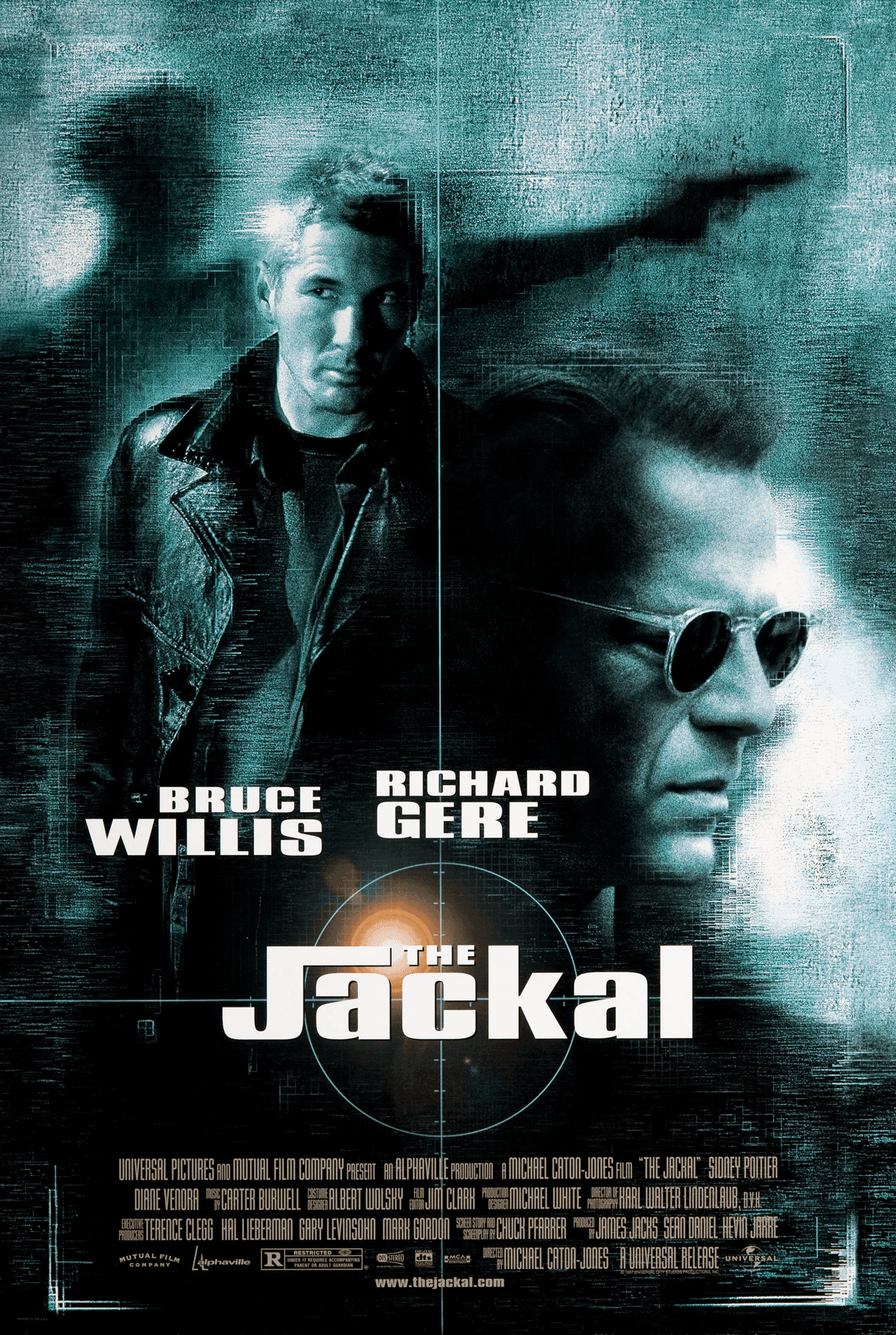
After a Russian Mafia kingpin's brother is killed in an FBI raid, he hires an elusive contract assassin known only as The Jackal for a $70 million revenge hit on a high-profile American target. With no leads on the killer's identity, FBI deputy director Carter Preston and Russian MVD Major Valentina Koslova strike a deal with imprisoned IRA sniper Declan Mulqueen, the only man who has ever crossed paths with the Jackal and survived. Michael Caton-Jones's loose remake of The Day of the Jackal (1973) stars Bruce Willis, Richard Gere, Sidney Poitier, and Diane Venora.
What Is the Budget of The Jackal (1997)?
The Jackal (1997), directed by Michael Caton-Jones and released by Universal Pictures, was produced on a reported budget of $60,000,000. Universal financed the picture as a loose remake of Fred Zinnemann's The Day of the Jackal (1973), with Mutual Film Company and Alphaville Films co-producing alongside Universal. The Chuck Pfarrer screenplay drew its central premise from Frederick Forsyth's 1971 novel while transposing the action from a 1963 plot against Charles de Gaulle to a contemporary American setting.
The investment reflected late-1990s star economics: Bruce Willis commanded a top-tier action-thriller rate, Richard Gere worked at his post-Pretty Woman and Primal Fear leading-man scale, Sidney Poitier returned to acting after a long absence at a substantial veteran rate, and Diane Venora played the Russian intelligence officer at a strong supporting fee. The picture was Universal's primary fall-1997 prestige thriller release, positioned to compete with the Christmas-corridor field led by Tomorrow Never Dies and Titanic.
Key Budget Allocation Categories
The Jackal's $60,000,000 budget was distributed across several major production areas:
- Above-the-Line Talent Bruce Willis (post-Twelve Monkeys, post-Die Hard with a Vengeance) commanded a $14,000,000-plus star fee as the Jackal, Richard Gere worked at his post-Primal Fear and Pretty Woman leading-man scale, Sidney Poitier returned to acting at a veteran rate as FBI deputy director Carter Preston, and Diane Venora played MVD Major Valentina Koslova at a strong supporting fee. Director Michael Caton-Jones worked at his post-Rob Roy directorial rate.
- Multi-Country Location Shoot Principal photography took place across Helsinki, Moscow, Montreal, Washington DC, Chicago, Virginia, and Porvoo (Finland), reflecting the screenplay's globe-trotting structure. Each location added substantial production cost, with the Helsinki and Moscow sequences requiring substantial local crew, set security, and Russian-language consultation.
- Action Set Pieces and Stunts The picture's action set pieces included the Moscow nightclub raid, the prison breakout, the Helsinki marina shootout, the Washington Metro pursuit, and the climactic Reagan Building sequence. Stunt coordinator Phil Neilson oversaw vehicle stunts, gunfights, and the picture's signature long-range sniper sequences.
- Weapons and Custom Gun-Mount The picture's signature custom Polish-built ZSU-23 anti-aircraft gun mount, central to the assassination plot, was engineered as a functional practical prop with full pivot and elevation capability. Multiple gun-mount builds were required for principal photography and stunt cover.
- Cinematography Cinematographer Karl Walter Lindenlaf delivered an architectural widescreen approach across multiple international locations. The picture's Helsinki marina, Washington Metro, and Reagan Building sequences required substantial lighting and grip packages.
- Score and Sound Composer Carter Burwell delivered an orchestral score with electronic elements that established each location's distinct musical identity. Sound design supervisor John Pospisil coordinated the picture's extensive gunfire, vehicle, and ambient location audio.
- Post-Production VFX Visual effects, supervised by Bruce Steinheimer, handled muzzle-flash augmentation, blood-squib enhancement, and minor environmental cleanup across the picture's multi-country location footage.
How Does The Jackal's Budget Compare to Similar Films?
At $60,000,000, The Jackal sits in the upper-mid-budget range for late-1990s star-driven action thrillers. The comparison set illustrates how its scale tracked against peer productions:
- The Day of the Jackal (1973): Budget approximately $3,000,000 | Worldwide approximately $16,000,000. Fred Zinnemann's source film starring Edward Fox cost a fraction of the 1997 remake and earned a similar inflation-adjusted return, providing the property template the 1997 picture reworked.
- Ronin (1998): Budget $55,000,000 | Worldwide $70,705,672. John Frankenheimer's Robert De Niro espionage thriller from the same period cost slightly less and earned less worldwide, providing the closest financial-template peer.
- Mercury Rising (1998): Budget $60,000,000 | Worldwide $93,107,289. Harold Becker's Bruce Willis vehicle from one year later cost identical to The Jackal and earned less worldwide, illustrating the inconsistency in Willis's mid-budget thrillers in the late 1990s.
- Conspiracy Theory (1997): Budget $80,000,000 | Worldwide $137,000,000. Richard Donner's Mel Gibson and Julia Roberts thriller from the same year cost 33% more and earned similar worldwide, illustrating the comparable financial dynamics of the period's prestige paranoia thrillers.
- Enemy of the State (1998): Budget $90,000,000 | Worldwide $250,649,836. Tony Scott's Will Smith surveillance thriller cost 50% more and earned over $90,000,000 more worldwide, illustrating the higher-tier financial outcome The Jackal aspired toward but did not reach.
The Jackal Box Office Performance
The Jackal opened on November 14, 1997 to a domestic weekend of $15,164,595, finishing first at the U.S. box office and toppling the previous week's holdovers. The opening was strong for a Bruce Willis adult-thriller release and the picture demonstrated solid early-corridor legs before fading in the Thanksgiving holiday window against The Rainmaker and Tomorrow Never Dies.
Against a $60,000,000 production budget, the film needed approximately $140,000,000 worldwide to reach profitability after marketing. Here is the financial breakdown:
Box Office Breakdown
The Jackal

The Jackal returned approximately $1.45 in theatrical revenue for every $1 invested when measured against total estimated production and marketing spend, putting it in the moderate-profit corridor for late-1990s prestige action thrillers. The domestic gross of $54,930,280 trailed the international take of $104,400,000, a 34/66 split that demonstrated the picture played stronger internationally than domestically, a pattern consistent with Bruce Willis's late-1990s international appeal.
Universal classified the picture as a solid commercial success, with home video sales further extending the picture's financial outcome. The picture's commercial performance contributed to Bruce Willis's sustained run as a top-tier action thriller lead through the late 1990s, with subsequent projects including Mercury Rising (1998), Armageddon (1998), and The Sixth Sense (1999).
The Jackal Production History
Universal Pictures developed The Jackal through the mid-1990s as a contemporary remake of Fred Zinnemann's The Day of the Jackal (1973), itself an adaptation of Frederick Forsyth's 1971 novel. Frederick Forsyth and Fred Zinnemann both publicly distanced themselves from the remake, with both men reportedly objecting to the substantial departures from the original property. Universal credited the picture as based on a screenplay by Kenneth Ross rather than directly on the Forsyth novel to navigate the licensing situation.
Chuck Pfarrer wrote the screenplay, reworking the original's 1963 anti-de Gaulle plot into a contemporary Russian Mafia revenge structure with an American assassination target. Michael Caton-Jones, fresh off Rob Roy (1995), came on as director after the project cycled through earlier development. Bruce Willis and Richard Gere were attached relatively early, with Sidney Poitier coming on as the FBI deputy director after a long acting hiatus.
Principal photography began in early 1997 across Helsinki and Porvoo, Finland (doubling for various international locations), continued in Moscow and Montreal, and concluded with the U.S. unit work in Washington DC, Chicago, and Virginia. The multi-country production base required substantial location-management logistics and local-crew coordination, with the Finnish and Russian units operating under particular weather and security constraints.
The picture's signature custom Polish-built anti-aircraft gun mount was engineered as a functional practical prop with full pivot and elevation capability, with multiple builds for principal photography and stunt cover. The climactic Reagan Building set piece was filmed using a partial standing set and matte-painting augmentation. Composer Carter Burwell delivered the orchestral-and-electronic score in late 1997 for the November 14 release.
Awards and Recognition
The Jackal received no significant industry awards recognition. The picture's late-1997 release positioned it outside the major awards corridor, and the mixed critical reception further limited its awards profile. The Saturn Awards considered the picture for genre recognition but no nominations followed.
Cinematographer Karl Walter Lindenlaf and composer Carter Burwell received scattered trade-press recognition for their respective contributions, particularly for the picture's distinctive multi-country visual identity, but neither received a major guild nomination. The picture's awards-season profile was effectively non-existent against the 1997 ceremony cycle dominated by Titanic, As Good as It Gets, and L.A. Confidential.
Critical Reception
The Jackal received mixed-to-negative reviews. The film holds a 14% approval rating on Rotten Tomatoes based on 51 critic reviews, with a critical consensus calling it a slick but vacant remake whose action set pieces cannot compensate for the screenplay's substantial departures from the original property. On Metacritic, the film scored 35 out of 100, indicating generally unfavorable reviews. Audiences surveyed by CinemaScore gave the film a B, indicating modest audience response.
The Washington Post's Stephen Hunter called the picture a brutally efficient piece of commercial filmmaking whose disregard for the source material verges on contemptuous. Roger Ebert gave the picture two stars, writing that the original Day of the Jackal was a great film because it was about something, and The Jackal is about gunfire. Variety's Todd McCarthy wrote that the picture was professionally assembled but emotionally inert.
Both Frederick Forsyth and Fred Zinnemann publicly disowned the remake, with Forsyth telling reporters at the time that the picture had no meaningful connection to his novel. The picture's critical reputation has stabilized at roughly its initial reception, with retrospective coverage tending to position it as a competently mounted but charmless late-1990s commercial thriller. The 1973 Zinnemann original remains the consensus superior work.
Frequently Asked Questions
How much did The Jackal (1997) cost to make?
The reported production budget was $60,000,000. Universal Pictures financed the picture through Mutual Film Company and Alphaville Films, with Michael Caton-Jones directing a loose remake of Fred Zinnemann's The Day of the Jackal (1973).
How much did The Jackal earn at the box office?
The film grossed $54,930,280 domestically and $104,400,000 internationally, for a worldwide total of $159,330,280. It opened to $15,164,595 over its first weekend, finishing first at the U.S. box office.
Was The Jackal a box office success?
Yes. Against a $60,000,000 production budget and approximately $45,000,000 in marketing, the worldwide gross of $159,330,280 returned approximately $1.45 for every $1 invested. Universal classified the picture as a solid commercial success.
Is The Jackal a remake?
Yes. The 1997 film is a loose remake of Fred Zinnemann's The Day of the Jackal (1973), itself adapted from Frederick Forsyth's 1971 novel. Both Forsyth and Zinnemann publicly distanced themselves from the remake, with Universal crediting the picture as based on a screenplay by Kenneth Ross rather than directly on the novel.
Who directed The Jackal (1997)?
Michael Caton-Jones directed the picture, working at his post-Rob Roy (1995) directorial scale. The Chuck Pfarrer screenplay reworked the original 1963 anti-de Gaulle plot into a contemporary Russian Mafia revenge structure with an American assassination target.
Where was The Jackal filmed?
Principal photography took place across Helsinki and Porvoo (Finland), Moscow, Montreal, Washington DC, Chicago, and Virginia in 1997. The multi-country production base required substantial location-management logistics and local-crew coordination across each unit.
Who stars in The Jackal?
Bruce Willis stars as the Jackal, Richard Gere as imprisoned IRA sniper Declan Mulqueen, Sidney Poitier as FBI deputy director Carter Preston, and Diane Venora as MVD Major Valentina Koslova. The cast included Mathilda May and J.K. Simmons in supporting roles.
Why did Frederick Forsyth disown the remake?
Frederick Forsyth publicly distanced himself from the picture because of its substantial departures from his 1971 novel. The remake transposed the action from a 1963 plot against Charles de Gaulle to a contemporary American setting with a Russian Mafia revenge structure. Fred Zinnemann similarly objected to the use of the original property as a reference for the remake.
How does The Jackal (1997) compare to The Day of the Jackal (1973)?
Comparative critical analyses consistently position Fred Zinnemann's 1973 original starring Edward Fox as the superior work. The 1973 picture's restrained procedural approach, Kenneth Ross's faithful adaptation of the Forsyth novel, and Fox's understated central performance are frequently cited as elements the 1997 remake did not reproduce.
What did critics think of The Jackal?
The Jackal received mixed-to-negative reviews. It holds a 14% approval rating on Rotten Tomatoes from 51 critics and a 35 out of 100 score on Metacritic. Audiences gave it a B CinemaScore. Roger Ebert gave the picture two stars, writing that the original Day of the Jackal was a great film because it was about something, and The Jackal is about gunfire.
Filmmakers
The Jackal

Build budgets like this one in Saturation
Start from an industry-standard feature film template, import the schedule and rates you already have, and let the cost report keep itself current as you spend. Real-time collaboration, no spreadsheets.