The Hours Budget
 Drama
DramaUpdated
Synopsis
Three women across three eras whose lives are connected by Virginia Woolf's novel Mrs Dalloway: Woolf herself in 1923 Richmond writing the book, a 1951 Los Angeles housewife reading it and contemplating suicide, and a 2001 New York editor preparing a party for a dying poet, all on a single day.
What Is the Budget of The Hours (2002)?
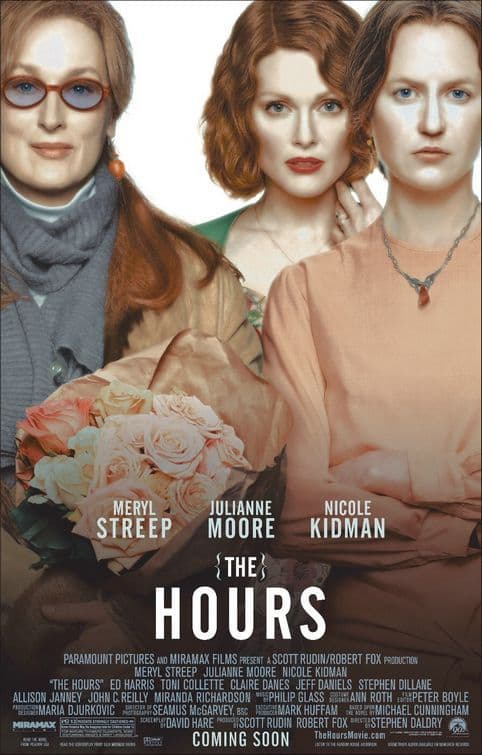
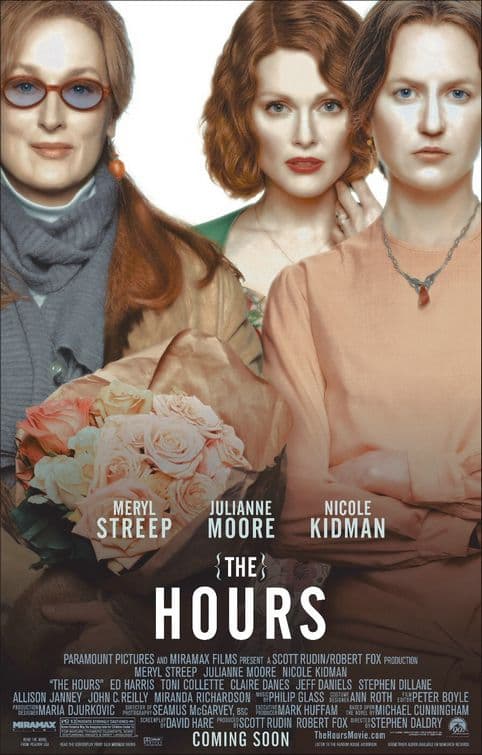
The Hours (2002), directed by Stephen Daldry and distributed by Paramount Pictures and Miramax Films, was produced on a reported budget of $25,000,000. The triptych literary drama, adapted by David Hare from Michael Cunningham's Pulitzer Prize winning 1998 novel, was financed by Paramount in partnership with Miramax Films and Scott Rudin Productions. The $25,000,000 commitment was substantial for an art-house literary adaptation, reflecting the three-lead ensemble of Meryl Streep, Julianne Moore, and Nicole Kidman, the multi-period production design, and the Philip Glass orchestral score.
The financial structure was built around a three-lead ensemble carrying near-equal narrative weight across three decades. Meryl Streep took the contemporary 2001 New York timeline, Julianne Moore the 1951 Los Angeles timeline, and Nicole Kidman the 1923 Richmond Virginia Woolf timeline with the prosthetic-nose transformation that would become the most-discussed aspect of the production. All three commanded prestige-feature compensation, with the actresses' rates structured to accommodate the modest budget by combining upfront fees with backend participation. The bulk of the remaining budget went to the multi-period production design, location shooting in New York, Los Angeles, and the United Kingdom, and Philip Glass's commissioned orchestral score.
Key Budget Allocation Categories
The $25,000,000 budget for The Hours was distributed across several core production areas:
- Above-the-Line Talent: Meryl Streep, Julianne Moore, and Nicole Kidman all took prestige-feature rates structured to accommodate the modest budget through combined upfront and backend participation. Supporting cast included Ed Harris as the dying poet Richard, Stephen Dillane as Leonard Woolf, John C. Reilly as Dan Brown, Toni Collette as Kitty, Claire Danes as Julia, Jeff Daniels as Louis, Allison Janney as Sally, and Miranda Richardson as Vanessa Bell. Director Stephen Daldry, fresh off Billy Elliot, commanded an auteur director rate.
- Multi-Period Production Design: Production designer Maria Djurkovic dressed the 1923 Richmond Virginia Woolf home, the 1951 Los Angeles middle-class household, and the contemporary 2001 New York apartment, each requiring period-correct dressing and a separate production-design vocabulary. The cross-period budget was the single largest below-the-line line item.
- Multi-Location Shooting: Principal photography moved across English locations (covering Woolf's Hogarth House in Richmond and the surrounding countryside), Los Angeles (1951 suburban-housewife sequences), and New York (contemporary editor sequences). The cross-Atlantic and cross-coast move forced substantial freight, lodging, and travel costs.
- Philip Glass Score: Composer Philip Glass delivered a commissioned orchestral score that became one of the most-discussed elements of the production, with the spare, looping minimalist material providing the connective tissue across the three timelines. The score required full orchestra recording and was released as a standalone Nonesuch soundtrack album that achieved substantial commercial success in classical and crossover charts.
- Prosthetics and Makeup: The Nicole Kidman prosthetic nose, designed by makeup designer Jo Allen and the makeup team led by Conor O'Sullivan, required daily application across the Virginia Woolf timeline shoot. The prosthetic became one of the most-discussed visual choices of the production and would ultimately be cited by the Academy in Kidman's Best Actress win.
- Marketing and Theatrical Release: Paramount and Miramax opened the film in limited release on December 27, 2002 in major U.S. markets, expanding gradually through the early-2003 Academy Awards campaign window. Marketing spend was modest by studio standards, in the $15,000,000 to $20,000,000 range domestically, with the Academy Awards campaign providing substantially more visibility than the marketing spend would otherwise have generated.
How Does The Hours's Budget Compare to Similar Films?
At $25,000,000, The Hours sits in the typical range for early-2000s prestige-literary adaptations. The comparison set illustrates how its commercial outcome compared with peers:
- Mrs. Dalloway (1997): Budget $7,000,000 | Worldwide $3,309,612. The previous direct Virginia Woolf adaptation cost less than a third of The Hours and grossed a tiny fraction worldwide, illustrating the substantial difference between a faithful single-novel adaptation and the cross-period, three-lead-ensemble approach of The Hours.
- Iris (2001): Budget $7,000,000 | Worldwide $16,200,000. The prior Judi Dench Iris Murdoch biographical drama cost less than a third of The Hours and grossed a fraction worldwide, providing a direct comparison for the literary-biographical prestige category.
- The Pianist (2002): Budget $35,000,000 | Worldwide $120,072,577. Roman Polanski's contemporaneous Adrien Brody Holocaust drama cost roughly 40% more than The Hours and grossed slightly more worldwide, providing a near-direct apples-to-apples comparison for the prestige-drama category.
- About Schmidt (2002): Budget $30,000,000 | Worldwide $105,834,556. Alexander Payne's contemporaneous Jack Nicholson character drama cost slightly more than The Hours and grossed roughly the same worldwide, showing what a single-lead prestige-comedy variant could deliver.
- Chicago (2002): Budget $45,000,000 | Worldwide $306,776,732. Rob Marshall's contemporaneous musical, which competed directly with The Hours at the 75th Academy Awards, cost roughly 80% more and grossed nearly three times worldwide, illustrating how a musical variant of prestige drama could substantially outperform.
The Hours Box Office Performance
The Hours opened in limited release on December 27, 2002 in eleven major U.S. markets, earning $338,331 in its opening weekend. The film expanded gradually through January 2003, reaching wide release on February 14, 2003 in approximately 1,003 theaters following the Academy Award nominations, where The Hours received nine nominations including Best Picture, Best Director, and Best Actress (Nicole Kidman). The post-nomination expansion drove the bulk of the eventual gross.
Against a $25,000,000 production budget, the film needed approximately $55,000,000 worldwide to reach profitability after marketing. Here is the financial breakdown:
Box Office Breakdown
The Hours

The Hours returned approximately $2.55 in worldwide theatrical revenue for every $1 invested when measured against total estimated production and marketing spend, making it a substantial theatrical success for Paramount and Miramax. The international share of $66,500,000 against a domestic share of $41,675,994 was a 61/39 split heavily weighted toward international markets, particularly in the United Kingdom, France, Germany, and Italy where Virginia Woolf's literary stature drove substantial art-house audience response.
The commercial success was substantially amplified by Nicole Kidman's Academy Award win for Best Actress in March 2003 and the film's nine Academy Award nominations overall. The post-Oscar theatrical run extended through April 2003, with home video and pay-television licensing through the late 2000s adding substantially to the eventual return. The Philip Glass soundtrack album also became one of the more commercially successful classical-crossover film soundtracks of the decade.
The Hours Production History
Development began at Scott Rudin Productions in 1999 immediately after the publication of Michael Cunningham's 1998 novel had won the Pulitzer Prize for Fiction and the PEN/Faulkner Award. Producer Scott Rudin acquired the screen rights and brought in playwright David Hare to adapt the screenplay, a deliberate choice to anchor the adaptation in Hare's theatrical sense of structure across the three intercut timelines. Hare's screenplay tracked Cunningham's novel's structure closely while compressing certain narrative elements for film duration.
Stephen Daldry was attached to direct in 2001 on the strength of Billy Elliot (2000), making The Hours his second feature. Casting Meryl Streep, Julianne Moore, and Nicole Kidman in early 2002 as the three leads anchored the project in three of the most-recognized prestige-drama actresses of the era. Kidman initially declined the role of Virginia Woolf, with the part reportedly going through a casting process that included consideration of several other actresses before Kidman committed in late 2001. The prosthetic-nose transformation was a deliberate choice by Daldry and makeup designer Jo Allen to disguise Kidman's recognizable features and allow her to disappear into the historical figure.
Principal photography ran from October 2001 to early 2002 across multiple locations. The Virginia Woolf 1923 Richmond sequences were shot in the United Kingdom in actual period-appropriate Sussex countryside locations and at a constructed replica of Hogarth House. The 1951 Los Angeles housewife sequences were shot in Pasadena and surrounding 1950s-suburban Los Angeles County locations. The contemporary 2001 New York editor sequences were shot in New York and Brooklyn in winter 2001 and early 2002, shortly after the September 11 attacks.
Philip Glass recorded the commissioned orchestral score in spring 2002, and the film was completed for a December 27, 2002 limited release. The 75th Academy Awards in March 2003 saw The Hours receive nine nominations and win one, with Nicole Kidman winning Best Actress for her Virginia Woolf performance. The film's post-Oscar theatrical run extended through April 2003, ultimately exceeding the studio's initial commercial expectations by a substantial margin.
Awards and Recognition
The Hours received nine Academy Award nominations at the 75th Academy Awards on March 23, 2003, winning one: Best Actress for Nicole Kidman for her performance as Virginia Woolf. The other nominations were Best Picture, Best Director (Stephen Daldry), Best Adapted Screenplay (David Hare), Best Supporting Actress (Julianne Moore), Best Supporting Actor (Ed Harris), Best Film Editing (Peter Boyle), Best Costume Design (Ann Roth), and Best Original Score (Philip Glass). The film lost Best Picture to Chicago.
At the 60th Golden Globe Awards in January 2003, The Hours won Best Motion Picture Drama and Best Actress in a Motion Picture Drama for Nicole Kidman. At the 56th British Academy Film Awards in 2003, the film won Best Actress for Nicole Kidman with additional nominations across categories. The Screen Actors Guild Awards saw the film win Outstanding Performance by a Cast in a Motion Picture, recognizing the ensemble work of Streep, Moore, and Kidman. Philip Glass's score, while nominated at the Academy Awards, won the BAFTA for Best Original Music.
Critical Reception
The Hours received overwhelmingly positive reviews. The film holds an 81% approval rating on Rotten Tomatoes based on 219 critic reviews, with a critical consensus that called the three-lead performances extraordinary and Stephen Daldry's direction patient and disciplined. On Metacritic, the film scored 79 out of 100, indicating generally favorable reviews. Audiences surveyed by CinemaScore gave the film a B-plus, the typical floor for prestige drama and a solid signal of audience appreciation in art-house theaters.
Critics broadly praised the three lead performances of Meryl Streep, Julianne Moore, and Nicole Kidman, Stephen Daldry's direction, David Hare's screenplay adaptation, Seamus McGarvey's cinematography, Philip Glass's commissioned score, and Maria Djurkovic's multi-period production design. Roger Ebert in the Chicago Sun-Times gave the film four stars and wrote that "the movie is sad almost beyond the saying of it, and yet it leaves you stronger." Manohla Dargis in The Los Angeles Times called Streep, Moore, and Kidman's ensemble work "one of the most accomplished pieces of acting on film in 2002."
Literary and theatrical-press response was particularly enthusiastic. The Guardian's Peter Bradshaw praised David Hare's adaptation as "the most successful translation of a literary novel to screen since The Hours's Pulitzer-winning source." The overwhelmingly positive critical reception combined with the Academy Award sweep at the supporting and lead-actress recognition has positioned The Hours as one of the defining prestige-literary films of the early 2000s, frequently cited in retrospective discussions of Nicole Kidman's career, Stephen Daldry's filmography, and the broader history of Michael Cunningham and Virginia Woolf screen adaptations.
Frequently Asked Questions
How much did The Hours (2002) cost to make?
The reported production budget was $25,000,000. Paramount Pictures and Miramax Films co-financed the film in partnership with Scott Rudin Productions. The budget covered the three-lead ensemble of Meryl Streep, Julianne Moore, and Nicole Kidman, the multi-period production design, the multi-location shooting in England, Los Angeles, and New York, and Philip Glass's commissioned orchestral score.
How much did The Hours earn at the box office?
The film grossed $41,675,994 domestically and $66,500,000 internationally, for a worldwide total of $108,175,994. It opened in limited release on December 27, 2002 in eleven major U.S. markets earning $338,331, expanded wide on February 14, 2003 to approximately 1,003 theaters following the Academy Award nominations announcement.
Was The Hours a box office success?
Yes. Against a $25,000,000 production budget and an estimated $15,000,000 to $20,000,000 in marketing spend, the film returned approximately $2.55 in worldwide gross for every $1 invested. Paramount and Miramax earned an estimated theatrical profit of around $65,000,000, with the Academy Award sweep and Nicole Kidman's Best Actress win substantially amplifying the commercial reach.
Who directed The Hours?
Stephen Daldry directed the film, working from a screenplay by David Hare. The Hours was Daldry's second feature after Billy Elliot (2000). David Hare adapted the screenplay from Michael Cunningham's Pulitzer Prize winning 1998 novel of the same name.
Where was The Hours filmed?
Principal photography took place from October 2001 to early 2002 across multiple locations. The Virginia Woolf 1923 Richmond sequences were shot in the United Kingdom in actual period-appropriate Sussex countryside locations. The 1951 Los Angeles housewife sequences were shot in Pasadena and surrounding 1950s-suburban Los Angeles County. The contemporary 2001 New York editor sequences were shot in New York and Brooklyn.
Did Nicole Kidman wear a prosthetic nose in The Hours?
Yes. The Nicole Kidman prosthetic nose, designed by makeup designer Jo Allen and applied daily by the makeup team led by Conor O'Sullivan, was a deliberate choice by Stephen Daldry to disguise Kidman's recognizable features and allow her to disappear into the historical figure of Virginia Woolf. The prosthetic became one of the most-discussed visual choices of the production and contributed to Kidman's Best Actress Academy Award win.
How many Oscars did The Hours win?
The Hours received nine Academy Award nominations at the 75th Academy Awards on March 23, 2003, winning one: Best Actress for Nicole Kidman for her performance as Virginia Woolf. The film lost Best Picture to Chicago. The Golden Globe Awards saw the film win Best Motion Picture Drama and Best Actress in a Motion Picture Drama for Kidman.
Who plays the three women in The Hours?
Meryl Streep plays the contemporary 2001 New York editor Clarissa Vaughan, Julianne Moore plays the 1951 Los Angeles housewife Laura Brown, and Nicole Kidman plays the 1923 Richmond writer Virginia Woolf. The three timelines are intercut throughout the film, with each lead carrying near-equal narrative weight.
Who scored The Hours?
Philip Glass scored the film with a commissioned orchestral score. The spare, looping minimalist material provided the connective tissue across the three timelines and became one of the most-discussed elements of the production. The standalone Nonesuch soundtrack album achieved substantial commercial success in classical and crossover charts. Glass's score won the BAFTA for Best Original Music.
What did critics think of The Hours?
The film received overwhelmingly positive reviews, with an 81% approval rating on Rotten Tomatoes and a 79 out of 100 score on Metacritic. Audiences gave it a B-plus CinemaScore. Roger Ebert gave it four stars, writing that "the movie is sad almost beyond the saying of it, and yet it leaves you stronger." Critics praised the three lead performances, Stephen Daldry's direction, and Philip Glass's commissioned score.
Filmmakers
The Hours

Build budgets like this one in Saturation
Start from an industry-standard feature film template, import the schedule and rates you already have, and let the cost report keep itself current as you spend. Real-time collaboration, no spreadsheets.