The Gold Rush Budget
Updated
Synopsis
A gold prospector in Alaska struggles to survive the elements and win the heart of a dance hall girl.
What Is the Budget of The Gold Rush?
The Gold Rush (1925) was produced for an estimated $923,000, a significant sum for the mid-1920s that reflected Charlie Chaplin's perfectionist approach to filmmaking. As writer, director, producer, and star, Chaplin maintained full creative control over every dollar spent, and his willingness to reshoot scenes dozens of times drove costs well above the original estimates.
The production ran for over 14 months, an unusually long shoot for the era. Chaplin's insistence on practical location work in the Sierra Nevada mountains, combined with elaborate studio-built sets and hundreds of extras, made The Gold Rush one of the most expensive comedies of the silent era. United Artists distributed the film, giving Chaplin the financial independence to spend as he saw fit without studio interference.
Key Budget Allocation Categories
The Gold Rush's $923,000 budget was shaped by Chaplin's demand for authenticity and his habit of extensive reshooting. Key cost drivers included:
- Location Filming Chaplin shot the opening Chilkoot Pass sequence on location near Truckee, California, in the Sierra Nevada mountains. Transporting cast, crew, and 600 extras to a remote snowbound location in 1924 was a major logistical expense, requiring temporary shelters, provisions, and specialized equipment for winter conditions.
- Set Construction The interior cabin scenes were built at Chaplin Studios in Hollywood, including the iconic teetering cabin perched on a cliff edge. This set required mechanical rigging to tilt and sway convincingly, with safety mechanisms to protect the actors during the physical comedy sequences.
- Extras and Crowd Scenes The Chilkoot Pass opening, depicting hundreds of prospectors climbing single file through the snow, required approximately 600 extras. Costuming, feeding, and coordinating this crowd on a mountain location consumed a substantial portion of the budget.
- Extended Production Schedule Principal photography stretched over 14 months (1924 to 1925). Chaplin was notorious for shooting massive amounts of footage and reworking scenes until they met his standards. The prolonged schedule multiplied costs for crew salaries, equipment rental, and studio overhead.
- Special Effects and Props Practical effects included the boot-eating scene (crafted from licorice), the bread roll dance sequence, and the cabin sliding toward a cliff precipice. Each required custom props, multiple takes, and careful choreography that extended shooting days.
- Talent Costs Georgia Hale replaced Lita Grey as the leading lady partway through production after Chaplin married Grey, forcing reshoots of completed scenes. Mack Swain and Tom Murray rounded out the principal cast. Chaplin himself drew no upfront salary, instead taking his share from profits as producer and distributor through United Artists.
How Does The Gold Rush's Budget Compare to Similar Films?
Placed alongside other major productions of the 1920s, The Gold Rush sat firmly among the era's most expensive comedies while remaining well below the decade's biggest spectacles:
- Ben-Hur: A Tale of the Christ (1925) Budget $3.9M | Worldwide $10.7M. MGM's biblical epic was the most expensive film of the silent era, dwarfing The Gold Rush's cost by more than four times. The comparison highlights how Chaplin achieved outsized returns on a relatively modest investment.
- The General (1926) Budget $750,000 | Worldwide $1.0M. Buster Keaton's Civil War comedy cost slightly less than The Gold Rush but performed poorly at the box office. The contrast underscores how Chaplin's star power and storytelling instincts translated budget into commercial dominance.
- Greed (1924) Budget $565,000 | Worldwide limited release. Erich von Stroheim's notoriously troubled production was cut from nine hours to two by the studio, and its commercial failure showed the risks of auteur ambition without Chaplin's audience appeal.
- The Phantom of the Opera (1925) Budget $632,000 | Worldwide $2.0M. Universal's horror landmark cost less than The Gold Rush and performed well, but Chaplin's film outearned it significantly, proving that comedy had the widest commercial ceiling in silent cinema.
- Safety Last! (1923) Budget $121,000 | Worldwide $1.6M. Harold Lloyd's thrill comedy delivered enormous returns on a fraction of The Gold Rush's budget, demonstrating that simpler productions could also succeed, though Chaplin's ambition created a more enduring cultural legacy.
The Gold Rush Box Office Performance
The Gold Rush was a massive commercial success upon its 1925 release, earning over $4,000,000 worldwide against its $923,000 production budget. In an era before standardized box office tracking, exact figures vary by source, but all accounts place it among the highest-grossing films of the 1920s. The film was the second-highest-grossing picture of 1925 in the United States, trailing only Ben-Hur.
Chaplin further extended the film's commercial life by re-releasing a shortened version in 1942 with his own recorded narration replacing the original intertitles and a new musical score. This re-release brought The Gold Rush to audiences who had never experienced silent cinema, generating additional revenue decades after the original run.
Box Office Breakdown
The Gold Rush

The Gold Rush Production History
Charlie Chaplin conceived The Gold Rush after viewing stereoscope photographs of prospectors climbing the Chilkoot Pass during the 1898 Klondike Gold Rush, and after reading accounts of the Donner Party's ill-fated 1846 expedition. The intersection of human desperation and dark comedy struck him as ideal material for The Tramp, and he began developing the story in late 1923.
Chaplin chose Truckee, California, near the summit of Donner Pass in the Sierra Nevada, for location filming. In early 1924, he transported a crew and roughly 600 extras to the snow-covered mountains to shoot the Chilkoot Pass sequence. Conditions were harsh: temperatures dropped well below freezing, equipment malfunctioned in the cold, and the logistics of feeding and housing hundreds of people in a remote location tested the production's resources. The footage Chaplin captured, showing a long single-file line of prospectors trudging upward through the snow, became one of the most recognizable images in cinema history.
Back at Chaplin Studios in Hollywood, production hit a personal complication. Chaplin had cast Lita Grey as his leading lady, but when she became pregnant and the two married in November 1924, he replaced her with Georgia Hale. Scenes already filmed with Grey had to be reshot, adding weeks and cost to an already extended schedule. Hale proved an effective screen partner, and her performance as the dance hall girl anchored the film's romantic subplot.
Chaplin's perfectionism defined the production rhythm. He shot an estimated 230,000 feet of film, roughly 40 hours of raw footage, for a final cut running 96 minutes. The boot-eating scene alone required multiple props made from licorice and dozens of takes. The bread roll dance, in which The Tramp spears two dinner rolls on forks and makes them "dance" on a tabletop, was rehearsed and filmed over three days. The climactic cabin sequence, where the shelter teeters on the edge of a cliff, used a combination of full-scale tilting sets and miniatures, requiring careful coordination between the actors' physical comedy and the mechanical rigging.
Principal photography wrapped in May 1925 after roughly 14 months of shooting. Chaplin edited the film himself and composed portions of the musical accompaniment. The Gold Rush premiered on June 26, 1925, at the Egyptian Theatre in Hollywood, to enthusiastic reviews and audiences. Chaplin later said it was "the picture I want to be remembered by."
Awards and Recognition
The Gold Rush predates the Academy Awards, which were not established until 1929, so the film was never eligible for Oscar consideration. However, its legacy of recognition spans nearly a century of retrospective honors:
- National Film Registry (1992) Selected by the Library of Congress for preservation as "culturally, historically, or aesthetically significant," recognizing The Gold Rush as one of the foundational works of American cinema.
- AFI's 100 Years...100 Movies (1998) Ranked number 74 on the American Film Institute's list of the greatest American films of all time.
- AFI's 100 Years...100 Laughs (2000) Ranked number 25 among the funniest American films, cementing its status as a comedy landmark.
- Sight & Sound Polls The Gold Rush has appeared consistently in the British Film Institute's decennial polls of the greatest films ever made, voted on by critics and directors worldwide.
- UNESCO Memory of the World The film's cultural significance has been acknowledged by international preservation bodies as part of the broader effort to safeguard early cinema heritage.
Critical Reception
The Gold Rush holds a 100% approval rating on Rotten Tomatoes, reflecting universal critical admiration across nearly a century of reviews. Contemporary critics in 1925 praised Chaplin's ability to extract both laughter and genuine pathos from extreme physical hardship, a balance that few filmmakers have matched since.
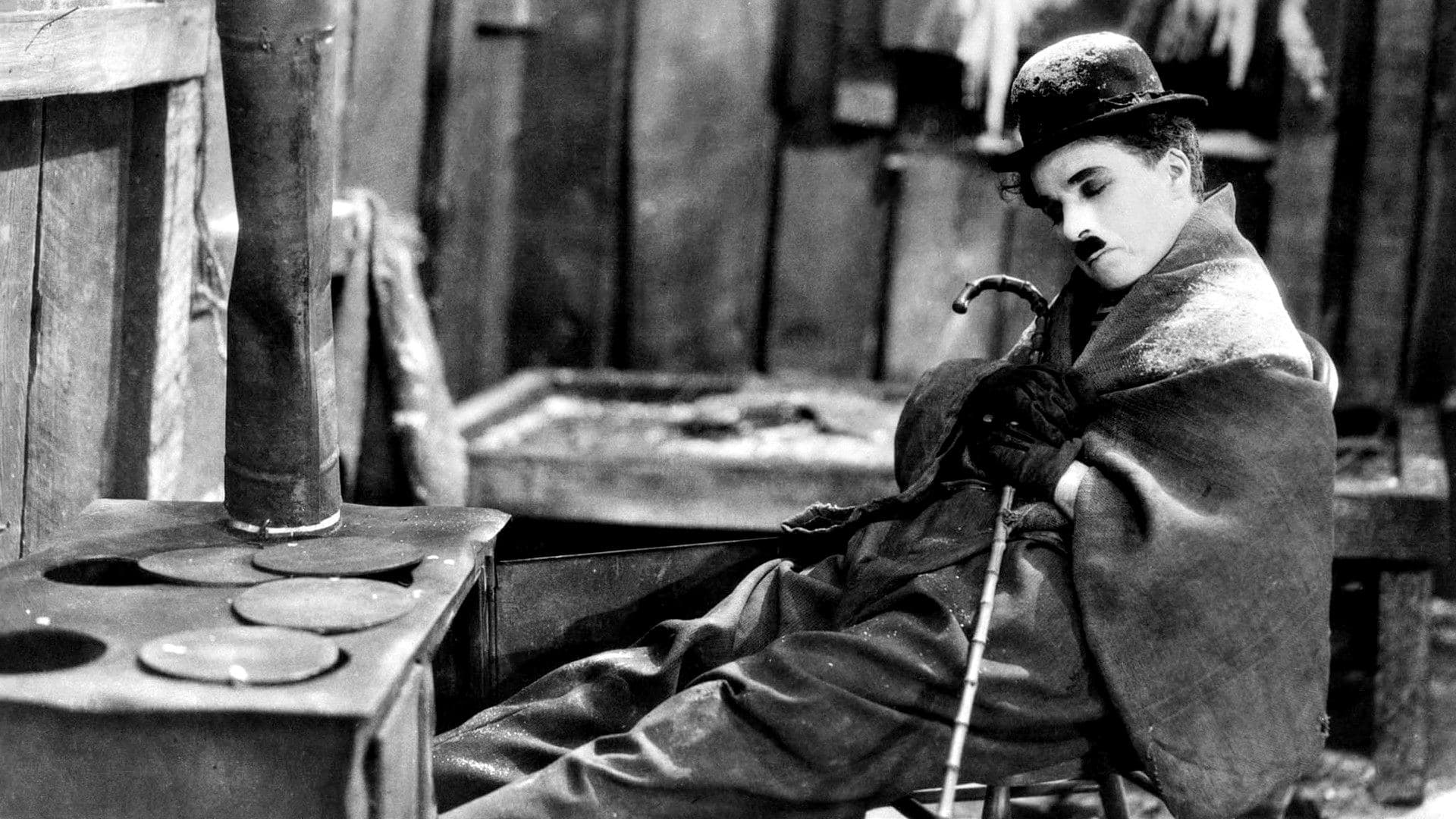
Critics have consistently highlighted the film's set pieces as masterclasses in physical comedy. The boot-eating scene, in which The Tramp carefully carves and eats a boiled boot as though it were a gourmet meal, twirling the shoelaces like spaghetti, is cited as one of the greatest comedy sequences ever filmed. The bread roll dance has been endlessly referenced and parodied. The teetering cabin scene is studied in film schools as an example of how to build sustained tension through physical gags.
Beyond the comedy, reviewers have noted the film's emotional depth. The New Year's Eve sequence, in which The Tramp sets a table for guests who never arrive, is frequently described as one of the most poignant moments in silent cinema. This ability to shift between slapstick and genuine heartbreak, without dialogue, is what elevates The Gold Rush from entertainment to art in the critical consensus.
The 1942 re-release, with Chaplin's narration, divided some purists who preferred the original silent version's visual storytelling. Modern critics generally recommend the 1925 cut for its purer cinematic language, though both versions remain widely available and highly regarded. The Gold Rush's influence on comedy filmmaking, from Jacques Tati to Wes Anderson, is a frequent theme in critical scholarship.
Frequently Asked Questions
How much did it cost to make The Gold Rush (1925)?
The production budget was $923,000, covering principal photography, cast and crew salaries, locations, sets, post-production, and music. Marketing and distribution (P&A) costs are estimated at an additional $461,500 - $738,400, bringing the total studio investment to approximately $1,384,500 - $1,661,400.
How much did The Gold Rush (1925) earn at the box office?
The Gold Rush grossed $2,500,000 domestic, $1,500,000 international, totaling $4,000,000 worldwide.
Was The Gold Rush (1925) profitable?
Yes. Against a production budget of $923,000 and estimated total costs of ~$2,307,500, the film earned $4,000,000 theatrically - a 333% ROI on production costs alone.
What were the biggest costs in producing The Gold Rush?
The primary cost drivers were above-the-line talent (Charlie Chaplin, Mack Swain, Tom Murray); visual effects, practical stunts, and A-list talent compensation.
How does The Gold Rush's budget compare to similar adventure films?
At $923,000, The Gold Rush is classified as a ultra-low-budget production. The median budget for wide-release adventure films in the era ranges from $30 - 80M for mid-budget to $150M+ for tentpoles. Comparable budgets: Double Indemnity (1944, $927,262); Paths of Glory (1957, $935,000); Casablanca (1943, $878,000).
Did The Gold Rush (1925) go over budget?
There are no widely reported accounts of significant budget overruns for this production. However, studios rarely disclose precise budget overrun figures publicly. The reported production budget reflects the final estimated cost.
What was the return on investment (ROI) for The Gold Rush?
The theatrical ROI was 333.4%, calculated as ($4,000,000 − $923,000) ÷ $923,000 × 100. This measures gross revenue against production budget only - it does not account for P&A or exhibitor shares.
What awards did The Gold Rush (1925) win?
Nominated for 2 Oscars. 7 wins & 3 nominations total.
Who directed The Gold Rush and who were the key crew members?
Directed by Charlie Chaplin, written by Charlie Chaplin, shot by Roland Totheroh, with music by Charlie Chaplin, William P. Perry, edited by Charlie Chaplin.
Where was The Gold Rush filmed?
The Gold Rush was filmed in United States of America.
Filmmakers
The Gold Rush

Official Trailer
Build budgets like this one in Saturation
Start from an industry-standard feature film template, import the schedule and rates you already have, and let the cost report keep itself current as you spend. Real-time collaboration, no spreadsheets.