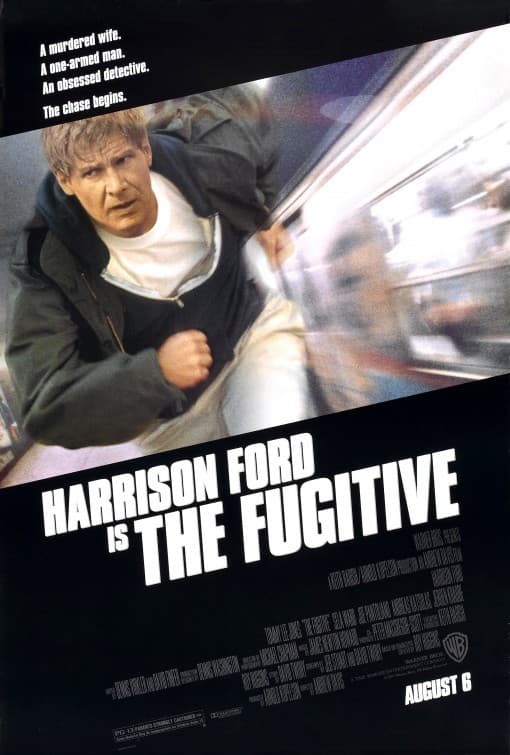
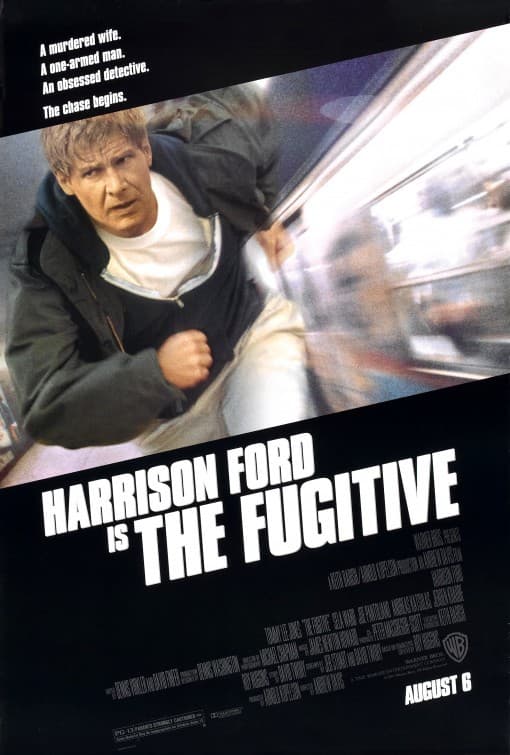
The Fugitive Budget
 Thriller/Suspense
Updated
Synopsis
Dr. Richard Kimble, a respected Chicago vascular surgeon, is wrongly convicted of murdering his wife and sentenced to death. After a bus crash en route to prison gives him an unexpected chance to escape, he sets out to find the one-armed man responsible while a relentless U.S. Marshal led by Samuel Gerard closes in on him.
What Is the Budget of The Fugitive (1993)?
The Fugitive (1993), directed by Andrew Davis and distributed by Warner Bros., was produced on a budget of $44,000,000. Arnold Kopelson produced through Kopelson Entertainment with Peter Macgregor-Scott serving as producer on set. The film was a feature adaptation of the 1963-1967 ABC television series created by Roy Huggins, repositioned as a star vehicle for Harrison Ford coming off the Indiana Jones and Jack Ryan cycles.
The budget reflected an aggressive bet on Ford's commercial pull combined with elaborate practical set pieces. Warner Bros. priced the film below the studio's top tentpole tier while still committing enough capital for an A-list lead, a high-profile veteran in Tommy Lee Jones, multiple Chicago location blocks, and the train-bus collision that anchored the first act. The math assumed The Fugitive would clear roughly $90,000,000 worldwide to break even after marketing, a target it cleared by an order of magnitude.
Key Budget Allocation Categories
The Fugitive's $44,000,000 budget was distributed across several core production areas:
- Above-the-Line Talent: Harrison Ford commanded a $14,000,000 lead fee plus back-end participation, his typical post-Patriot Games rate. Tommy Lee Jones, then a journeyman character actor coming off JFK and Under Siege, was paid a fraction of Ford's fee but received billing and the showcase role that would win him an Academy Award. Supporting players Sela Ward, Julianne Moore (in an early-career role), Joe Pantoliano, and Andreas Katsulas filled out the ensemble at standard guild rates.
- Chicago Location Shoot: The film was shot extensively on practical Chicago locations including the Pullman Yards, Daley Plaza, the Picasso sculpture, Cook County Hospital, the Hilton Chicago, and the Chicago River. Illinois did not yet offer a major film tax credit, so the location work was funded directly, but Chicago's deep crew base and Mayor Daley's production-friendly permitting kept costs manageable.
- Train-Bus Collision Sequence: The opening prison-bus-meets-locomotive crash was executed practically using a real freight train and a decommissioned prison bus on a stretch of track in Dillsboro, North Carolina. The single take cost an estimated $1,500,000 and required months of pre-production coordination with the Great Smoky Mountains Railroad. Producers retained the wreckage as a tourist attraction at the rail line after the shoot.
- Stunts and Stunt Coordination: Stunt coordinator Terry Leonard supervised the dam-jump sequence at the Cheoah Dam in North Carolina, Ford's rooftop pursuits, and multiple chase set pieces. Doubles, safety rigging, and water-stunt insurance pushed the stunt line significantly above the norm for a contemporary thriller.
- Score and Music: Composer James Newton Howard wrote the original score, earning an Academy Award nomination. The orchestral recording, music editorial, and licensing of needle drops added a meaningful music line.
- Editing and Post-Production: The film employed six credited editors (Dennis Virkler, David Finfer, Dean Goodhill, Don Brochu, Richard Nord, Dov Hoenig) working in parallel to assemble the dual storylines, an unusual structure that earned the editing team a shared Academy Award nomination.
How Does The Fugitive's Budget Compare to Similar Films?
At $44,000,000, The Fugitive sits in the mid-range of early-1990s star-driven thrillers. The comparison set illustrates how its commercial outcome positioned it among the most profitable films of the decade:
- Patriot Games (1992): Budget $42,000,000 | Worldwide $178,051,587. Ford's previous Jack Ryan entry cost roughly the same as The Fugitive but earned half as much worldwide.
- Cliffhanger (1993): Budget $70,000,000 | Worldwide $255,000,000. Sylvester Stallone's same-summer action vehicle cost 60% more and earned 30% less worldwide.
- In the Line of Fire (1993): Budget $40,000,000 | Worldwide $187,345,394. Clint Eastwood's contemporaneous thriller cost slightly less and earned roughly half The Fugitive's worldwide gross.
- A Few Good Men (1992): Budget $40,000,000 | Worldwide $243,240,178. Rob Reiner's Tom Cruise-Jack Nicholson courtroom drama from the prior year cost less and earned 66% of The Fugitive's worldwide haul.
- Jurassic Park (1993): Budget $63,000,000 | Worldwide $1,029,939,903. Spielberg's summer 1993 blockbuster, released two months ahead, set the commercial bar that The Fugitive's August release timed around.
The Fugitive Box Office Performance
The Fugitive opened on August 6, 1993, debuting to $23,758,855 in its opening weekend across 2,331 theaters, finishing first on the chart and significantly exceeding Warner Bros.'s pre-release tracking. The film benefited from a soft late-summer marketplace, exceptional word-of-mouth, and a marketing campaign that emphasized Ford's "I didn't kill my wife" line and the train-bus collision visual.
Against a $44,000,000 production budget, The Fugitive needed roughly $90,000,000 in worldwide gross to reach profitability when accounting for marketing and distribution costs. Here is the financial breakdown:
Box Office Breakdown
The Fugitive

The Fugitive returned approximately $4.45 in theatrical revenue for every $1 invested when measured against total estimated production and marketing spend, placing it among the most profitable studio films of 1993. The domestic share of the gross was $183,875,760 against an international share of $185,000,000, an almost perfectly even split that confirmed the property's broad commercial appeal across markets.
The strong commercial performance prompted Warner Bros. to develop U.S. Marshals (1998) as a Tommy Lee Jones-led spinoff continuing the Samuel Gerard character. Television revivals followed in 2000 (CBS, starring Tim Daly) and 2020 (Quibi, starring Boyd Holbrook). The Fugitive's success cemented Andrew Davis's reputation as a top-tier action director and validated Warner's strategy of repositioning vintage television properties as theatrical events.
The Fugitive Production History
Development began in the late 1980s at Warner Bros., with multiple writers cycling through drafts of the screenplay based on Roy Huggins's 1963 ABC series. Jeb Stuart and David Twohy received final credited screenplay credit, with Stuart's work emphasizing the procedural manhunt and Twohy's shaping the Kimble character. Andrew Davis was attached as director in 1992 after Walter Hill departed the project, and Davis brought significant rewriting input that focused the Chicago locations and the medical-conspiracy subplot.
Harrison Ford signed in 1992, choosing the project over several competing thriller offers. Tommy Lee Jones was cast as Deputy U.S. Marshal Samuel Gerard in early 1993 after a casting search that included consideration of several higher-profile names; Jones's commitment turned the marshal storyline from a procedural counterweight into a co-lead and ultimately drove the Best Supporting Actor Oscar campaign.
Principal photography ran from February to May 1993, primarily in Chicago, with North Carolina sequences at the Cheoah Dam and the Great Smoky Mountains Railroad for the bus-train collision. The dam-jump sequence used a stunt double for the high fall and Ford for in-water coverage. Producers worked Chicago locations during the late winter and early spring, capturing the city's distinctive low light. Pickup work in summer 1993 added scenes Davis felt the structure needed.
Post-production ran on a compressed schedule to meet the August 6, 1993 release date. Six editors worked in parallel on the dual Kimble-Gerard storylines, an unusual structure that produced the film's signature crosscutting and earned the editing team a shared Academy Award nomination. James Newton Howard scored the film in roughly six weeks, an aggressive timeline for a feature of this scale.
Awards and Recognition
The Fugitive received seven Academy Award nominations at the 66th Academy Awards, including Best Picture, Best Supporting Actor (Tommy Lee Jones), Best Cinematography, Best Film Editing, Best Original Score, Best Sound, and Best Sound Effects Editing. Jones won for Best Supporting Actor, becoming one of the rare action-thriller performances to take a major acting Oscar.
At the Golden Globes, the film received three nominations including Best Picture (Drama), Best Director, and Best Supporting Actor, with Jones winning Best Supporting Actor. The film also received four BAFTA nominations and a Writers Guild of America Award nomination for Best Adapted Screenplay. The American Film Institute later included The Fugitive on its lists of the greatest American thrillers and the most influential films of the 1990s.
Critical Reception
The Fugitive received overwhelmingly positive reviews. The film holds a 96% approval rating on Rotten Tomatoes based on 79 critic reviews, with a critical consensus that called it a "thrillingly mounted" reinvention of a classic television premise. On Metacritic, the film scored 87 out of 100, indicating universal acclaim. Audiences surveyed by CinemaScore gave the film an A, the rarefied tier reserved for genuine word-of-mouth phenomena.
Critics broadly praised Davis's direction, the Chicago-specific texture, the train-bus collision set piece, and the propulsive Kimble-Gerard cat-and-mouse structure, with particular attention to Tommy Lee Jones's scene-stealing supporting performance. Roger Ebert awarded the film four stars, writing that "this is one of the best entertainments of the year, a smart, swift, no-nonsense thriller." The New York Times' Janet Maslin called Jones "the surprise pleasure of the picture," anticipating his eventual Oscar win.
Among critics revisiting the film decades later, its reputation has only grown, with retrospective coverage treating it as one of the defining studio thrillers of the 1990s. The film's craftsmanship, structure, and Tommy Lee Jones's delivery of the "I don't care" line have become reference points in screenwriting and director's commentaries. The Fugitive's combination of critical acclaim, commercial dominance, and Academy Award recognition is rare for an August-release action picture and remains a textbook example of star vehicles executed at the highest level.
Frequently Asked Questions
How much did it cost to make The Fugitive (1993)?
The production budget was $44,000,000. The film was produced by Arnold Kopelson through Kopelson Entertainment, with Peter Macgregor-Scott serving as on-set producer, and distributed worldwide by Warner Bros.
How much did The Fugitive earn at the box office?
The film grossed $183,875,760 domestically and approximately $185,000,000 internationally, for a worldwide total of $368,875,760. It opened to $23,758,855 across 2,331 theaters on August 6, 1993, finishing first on the chart.
Was The Fugitive profitable?
Yes, dramatically so. Against a $44M production budget and an estimated $30M to $40M in marketing spend, the film returned approximately $4.45 in worldwide gross for every $1 invested, generating roughly $285M to $295M in theatrical profit before home entertainment and television.
Who directed The Fugitive (1993)?
Andrew Davis directed the film. Davis had previously directed Under Siege (1992), and The Fugitive cemented his reputation as a top-tier action filmmaker working from a screenplay by Jeb Stuart and David Twohy.
Where was The Fugitive filmed?
Principal photography took place primarily in Chicago, with extensive location work at Pullman Yards, Daley Plaza, Cook County Hospital, the Hilton Chicago, and the Chicago River. The train-bus collision was filmed in Dillsboro, North Carolina on the Great Smoky Mountains Railroad. The dam-jump sequence used the Cheoah Dam in North Carolina.
How did Tommy Lee Jones win an Oscar for The Fugitive?
Jones won Best Supporting Actor at the 66th Academy Awards for his portrayal of Deputy U.S. Marshal Samuel Gerard. The role had originally been conceived as a procedural counterweight to Kimble, but Jones's casting and committed performance turned it into a co-lead, with his "I don't care" delivery becoming one of the most-cited lines of 1990s cinema.
How does The Fugitive compare to other 1993 films?
The Fugitive earned $368.9M worldwide on a $44M budget. Jurassic Park (1993) earned $1.03B on $63M. Cliffhanger (1993) earned $255M on $70M. In the Line of Fire (1993) earned $187M on $40M. The Fugitive's ROI placed it among the most profitable studio films of the year.
Was The Fugitive based on a TV show?
Yes. The film is adapted from the 1963-1967 ABC television series The Fugitive, created by Roy Huggins and starring David Janssen as Dr. Richard Kimble. The film telescoped the series' four-year manhunt narrative into a feature structure focused on the medical-conspiracy reveal.
Did The Fugitive get a sequel?
Warner Bros. produced U.S. Marshals (1998) as a Tommy Lee Jones-led spinoff continuing the Samuel Gerard character, with Wesley Snipes as the fugitive. Television revivals followed in 2000 (CBS, starring Tim Daly) and 2020 (Quibi, starring Boyd Holbrook).
What did critics think of The Fugitive?
The film holds a 96% approval rating on Rotten Tomatoes (79 reviews) and scored 87 out of 100 on Metacritic. Audiences gave it an A CinemaScore. Roger Ebert awarded four stars, calling it "one of the best entertainments of the year." It received seven Academy Award nominations including Best Picture, winning one (Tommy Lee Jones, Best Supporting Actor).
Filmmakers
The Fugitive

Official Trailer
Build budgets like this one in Saturation
Start from an industry-standard feature film template, import the schedule and rates you already have, and let the cost report keep itself current as you spend. Real-time collaboration, no spreadsheets.