The End of the Affair Budget
 Drama
DramaUpdated
Synopsis
In post-war London, a novelist becomes obsessed with discovering why the woman he loved abruptly ended their wartime affair two years earlier. As he uncovers the truth, his investigation forces him to confront questions of love, faith, and divine providence that reshape his understanding of the past.
What Is the Budget of The End of the Affair (1999)?
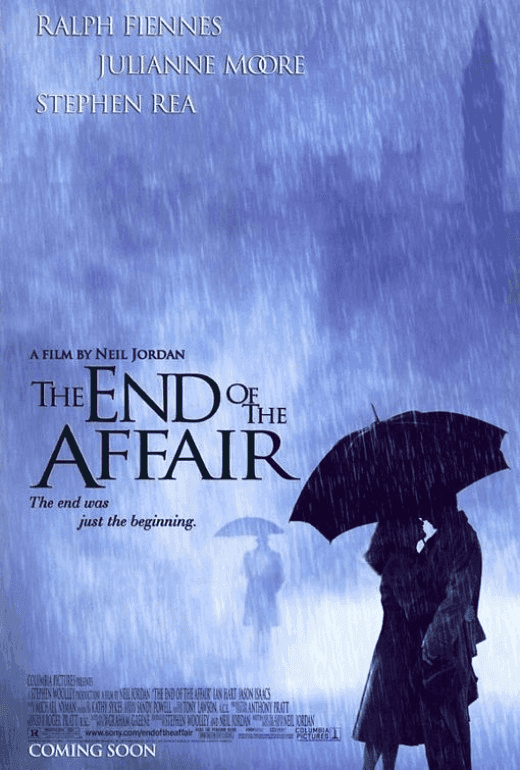
The End of the Affair (1999), directed by Neil Jordan and distributed by Columbia Pictures, was produced on a budget of $23,000,000. Stephen Woolley produced through Woolley's Coote Bell Productions banner, with Neil Jordan also serving as a producer. Columbia and Twentieth Century Fox's international division shared distribution, with Columbia handling North America and Fox the international rollout. The film was Neil Jordan's second Graham Greene adaptation following the unproduced screenplay he had worked on through the 1990s.
The budget reflected a prestige-drama tier appropriate to Jordan's post-Michael Collins career positioning and the Ralph Fiennes-Julianne Moore pairing's mid-tier leading-actor scale. Columbia priced the film as an awards-positioned literary adaptation, expecting modest commercial returns offset by potential Academy Award visibility. The math required the film to clear roughly $50,000,000 worldwide to break even after marketing, a target the film missed.
Key Budget Allocation Categories
The End of the Affair's $23,000,000 budget was distributed across several core production areas:
- Above-the-Line Talent: Ralph Fiennes and Julianne Moore each commanded mid-tier leading-actor fees consistent with their late-1990s positioning, with Fiennes coming off The English Patient (1996) and Moore having recently completed Boogie Nights (1997) and Magnolia (1999). Stephen Rea, a longtime Jordan collaborator, played the cuckolded husband Henry Miles at a featured-supporting rate.
- London Period Production: The film was set in two distinct periods (wartime 1940s London and post-war 1946), requiring substantial period-accurate location work in London, blackout-era street dressing, and 1940s-vintage automotive picture vehicles. Period accuracy was a defining production-design priority under Anthony Pratt.
- Costume Design: Costume designer Sandy Powell, a longtime Jordan and Scorsese collaborator, designed the period wardrobe across two timelines, with particular emphasis on Julianne Moore's Sarah Miles wardrobe as a visual register of her character's moral and spiritual evolution. Powell received an Academy Award nomination for Best Costume Design.
- Cinematography: Roger Pratt, who had shot The Fisher King for Terry Gilliam, served as cinematographer. The film's formal black-and-white-influenced photographic palette and rain-soaked London exteriors required extensive lighting setups and rain machines for the practical street work. Pratt received an Academy Award nomination for Best Cinematography.
- Score: Composer Michael Nyman wrote the original score, an unusual collaboration outside Nyman's typical Peter Greenaway-driven work. The score blended chamber-orchestra recordings with a propulsive minor-key main theme that became central to the film's emotional architecture.
- Source Material: The film is the second of two theatrical adaptations of Graham Greene's 1951 novel, following the 1955 Edward Dmytryk version with Deborah Kerr and Van Johnson. Rights acquisition and Greene-estate consultation contributed to a moderate screenplay line. Neil Jordan adapted the novel personally.
How Does The End of the Affair's Budget Compare to Similar Films?
At $23,000,000, The End of the Affair sits in the typical range for late-1990s literary-adaptation prestige dramas. The comparison set illustrates how the cycle's commercial outcomes varied with cast and source-material recognition:
- The English Patient (1996): Budget $27,000,000 | Worldwide $231,976,425. Anthony Minghella's Ralph Fiennes-led wartime adaptation cost $4M more than End of the Affair and earned roughly 10 times its worldwide gross, the cycle's clear commercial leader.
- The Wings of the Dove (1997): Budget $14,000,000 | Worldwide $26,000,000. Iain Softley's Henry James adaptation cost less than two thirds of End of the Affair and earned comparable worldwide totals, illustrating the genre's commercial ceiling.
- Howards End (1992): Budget $8,000,000 | Worldwide $34,090,071. James Ivory's E.M. Forster adaptation cost roughly one third of End of the Affair and earned more worldwide, the Merchant Ivory benchmark for the cycle.
- Sense and Sensibility (1995): Budget $16,000,000 | Worldwide $134,993,774. Ang Lee's Emma Thompson-led Jane Austen adaptation cost less than 70% of End of the Affair and earned nearly six times its worldwide gross.
- The Painted Veil (2006): Budget $19,400,000 | Worldwide $26,907,792. John Curran's Edward Norton-Naomi Watts W. Somerset Maugham adaptation came in $4M below End of the Affair and earned slightly more worldwide, the cycle's closest financial comparison.
The End of the Affair Box Office Performance
The End of the Affair opened in a platform release on December 3, 1999, debuting to just $45,793 across 4 theaters, an extremely strong per-theater average of $11,448 that signaled critical interest from the platform-release urban marketplace. Columbia expanded the film over the subsequent weeks, reaching its widest release of 484 theaters in late January 2000. The platform-release strategy was characteristic of awards-positioned dramas, prioritizing critical buzz and Academy Award visibility over wide commercial breakthrough.
Against a $23,000,000 production budget, The End of the Affair needed roughly $50,000,000 in worldwide gross to reach profitability when accounting for marketing and distribution costs. Here is the financial breakdown:
Box Office Breakdown
The End of the Affair (1999)

The End of the Affair returned approximately $0.55 in theatrical revenue for every $1 invested when measured against total estimated production and marketing spend. The domestic share of the gross was $10,839,938 against an international share of $12,775,737, a 46/54 split that leaned slightly international, reflecting the property's European prestige-literary positioning and Ralph Fiennes's post-English Patient international visibility.
Columbia and Sony recouped a meaningful share of the theatrical loss through home entertainment, television licensing, and the long-tail commercial life of the film among Graham Greene readers and Catholic literary audiences. The Academy Award nominations for Julianne Moore (Best Actress), Sandy Powell (Costume), and Roger Pratt (Cinematography) provided meaningful prestige value that justified Columbia's continued investment in literary-adaptation acquisitions through the early 2000s.
The End of the Affair Production History
Neil Jordan had circled a Graham Greene adaptation throughout the 1990s, with multiple Greene novels considered before settling on The End of the Affair in 1997. The novel's wartime love-triangle structure and theological undertow aligned naturally with Jordan's recurring interests in faith, betrayal, and emotional unreliability. Stephen Woolley, Jordan's long-running producing partner across Mona Lisa (1986), The Crying Game (1992), and Michael Collins (1996), shepherded the project through Columbia's development cycle.
Ralph Fiennes attached as the lead novelist Maurice Bendrix in 1998, with Julianne Moore signing on as Sarah Miles shortly after. Stephen Rea's casting as Henry Miles continued his decades-long collaboration with Jordan. Jordan adapted the novel personally, with a screenplay that compressed Greene's diary structure while retaining the second-half theological revelation that drives the novel's most distinctive narrative turn.
Principal photography took place in London in late 1998 and early 1999, with extensive period-accurate location work across South London (the Catholic neighborhoods where Greene himself had lived), Camden, and the Westminster precincts that doubled for the film's civil-service interiors. The wartime-blackout sequences required extensive period dressing of practical street locations, and the rain-soaked exteriors required continuous rain-machine coverage.
Post-production wrapped in mid-1999, and Columbia positioned the film for a platform-release qualifying run in December 1999 with a wider expansion in January 2000. The marketing campaign emphasized the literary prestige source, the Fiennes-Moore pairing, and the Neil Jordan brand following Michael Collins's prestige success. The platform-release strategy successfully positioned the film for awards consideration, with multiple Academy Award nominations validating Columbia's release approach.
Awards and Recognition
The End of the Affair received three Academy Award nominations at the 72nd Academy Awards: Best Actress (Julianne Moore), Best Cinematography (Roger Pratt), and Best Costume Design (Sandy Powell). The film did not win in any category, losing Best Actress to Hilary Swank for Boys Don't Cry and the technical categories to American Beauty and Topsy-Turvy respectively.
Julianne Moore additionally received Golden Globe, BAFTA, and Screen Actors Guild nominations for the role. The BAFTA Awards recognized the film with five nominations including Best Film, Best Direction (Neil Jordan), Best Actress (Moore), Best Adapted Screenplay (Jordan), and Best Cinematography (Pratt). Neil Jordan won the Best Adapted Screenplay BAFTA for the adaptation. The film also received recognition from the National Board of Review and the Los Angeles Film Critics Association.
Critical Reception
The End of the Affair received broadly positive reviews. The film holds a 77% approval rating on Rotten Tomatoes based on 110 critic reviews, with a critical consensus that praised Julianne Moore's performance and Neil Jordan's atmospheric direction. On Metacritic, the film scored 76 out of 100, indicating generally favorable reviews. The platform-release rollout precluded CinemaScore polling.
Critics broadly praised Julianne Moore's Sarah Miles, Roger Pratt's rain-soaked London cinematography, Sandy Powell's costume work, and the film's willingness to engage with the novel's theological core. Roger Ebert awarded the film four stars, calling it "a deeply felt, mournful film about love, betrayal, and the existence of God." The New York Times' Janet Maslin wrote that "Julianne Moore gives one of her finest performances in a film that treats adult emotional experience with the seriousness it deserves."
Comparative critical assessment against the 1955 Edward Dmytryk adaptation generated meaningful trade-press conversation, with most reviewers favoring the Jordan version for its willingness to engage with Greene's Catholic source material more directly than the Production Code-constrained earlier version could. The strong critical reception, the Academy Award nominations, and the Moore-Fiennes performances have cemented The End of the Affair as one of Neil Jordan's most respected films and a regular reference point in discussions of literary-adaptation prestige drama.
Frequently Asked Questions
How much did it cost to make The End of the Affair (1999)?
The production budget was $23,000,000. The film was produced by Stephen Woolley and Neil Jordan through Coote Bell Productions and distributed by Columbia Pictures in North America and Twentieth Century Fox internationally.
How much did The End of the Affair earn at the box office?
The film grossed $10,839,938 domestically and $12,775,737 internationally, for a worldwide total of $23,615,675. It opened in a platform release on December 3, 1999, debuting to $45,793 across 4 theaters before expanding to a maximum of 484 theaters in late January 2000.
Was The End of the Affair profitable?
The theatrical run posted a $14M to $19M loss against $38M to $43M total investment. The film recouped a meaningful share through home entertainment, television, and the long-tail commercial life among Graham Greene readers. The three Academy Award nominations provided prestige value that justified Columbia's continued literary-adaptation investment.
Who directed The End of the Affair (1999)?
Neil Jordan directed the film and adapted Graham Greene's 1951 novel personally. Jordan had previously directed Mona Lisa (1986), The Crying Game (1992), and Michael Collins (1996), all in long-running collaboration with producer Stephen Woolley.
Where was The End of the Affair filmed?
Principal photography took place in London in late 1998 and early 1999, with extensive period-accurate location work across South London (the Catholic neighborhoods where Greene himself had lived), Camden, and Westminster. The wartime-blackout sequences required extensive period dressing of practical street locations.
Is The End of the Affair based on a book?
Yes. The film is adapted from Graham Greene's 1951 novel of the same title, widely considered one of Greene's major novels alongside The Power and the Glory and The Heart of the Matter. It is the second theatrical adaptation, following the 1955 Edward Dmytryk version with Deborah Kerr and Van Johnson.
How many Academy Award nominations did The End of the Affair receive?
The film received three Academy Award nominations at the 72nd Academy Awards: Best Actress (Julianne Moore), Best Cinematography (Roger Pratt), and Best Costume Design (Sandy Powell). The film did not win in any category.
Who stars in The End of the Affair (1999)?
Ralph Fiennes stars as the novelist Maurice Bendrix, Julianne Moore as Sarah Miles, and Stephen Rea as the cuckolded husband Henry Miles. Ian Hart and Jason Isaacs appear in supporting roles.
How does The End of the Affair compare to other Graham Greene adaptations?
The Neil Jordan version is widely considered one of the strongest Greene adaptations, alongside Carol Reed's The Third Man (1949) and Fritz Lang's Ministry of Fear (1944). It earned $23.6M worldwide on a $23M budget, far below The English Patient (1996) which earned $232M on $27M but matching the typical platform-release prestige-drama range.
What did critics think of The End of the Affair?
The film holds a 77% approval rating on Rotten Tomatoes (110 reviews) and scored 76 out of 100 on Metacritic. Roger Ebert awarded four stars, and The New York Times' Janet Maslin called Julianne Moore's performance one of her finest. The Academy Award nominations and BAFTA wins confirmed the strong critical positioning.
Filmmakers
The End of the Affair (1999)

Build budgets like this one in Saturation
Start from an industry-standard feature film template, import the schedule and rates you already have, and let the cost report keep itself current as you spend. Real-time collaboration, no spreadsheets.