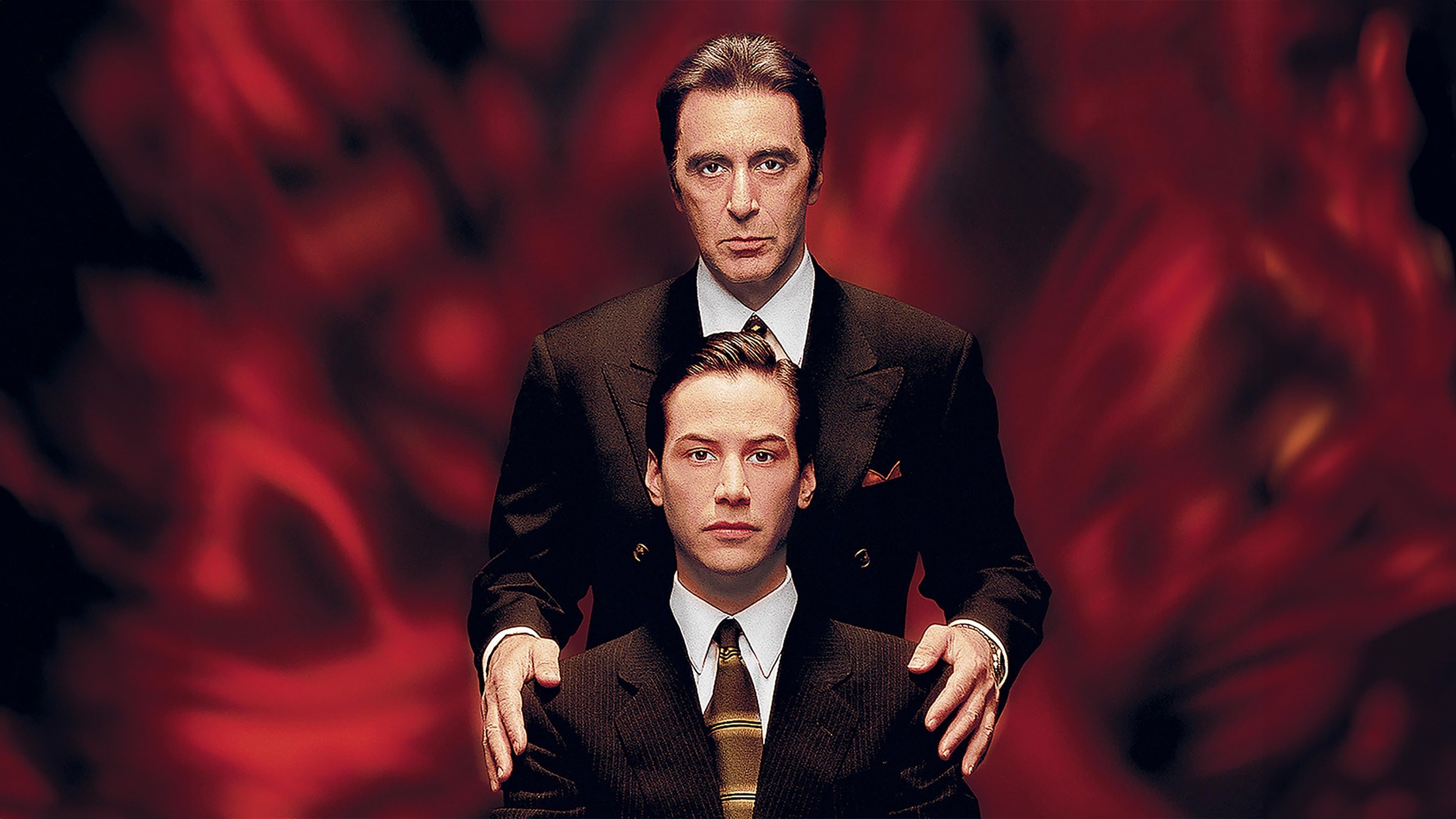
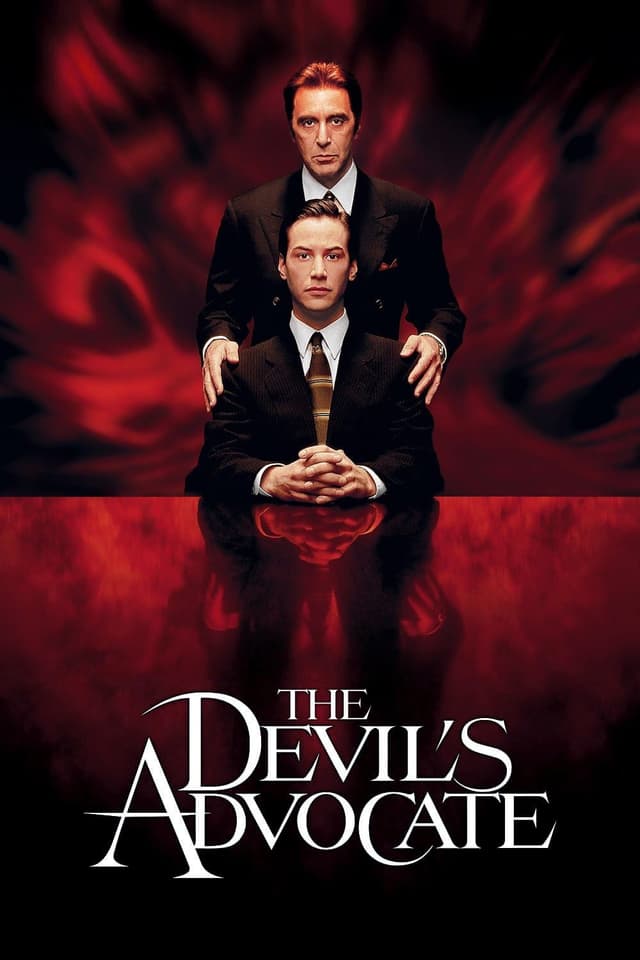
The Devil's Advocate Budget
 HorrorDramaMystery144 minutes
Updated
Synopsis
Aspiring Florida defense lawyer Kevin Lomax accepts a job at a New York law firm. With the stakes getting higher every case, Kevin quickly learns that his boss has something far more evil planned.
What Is the Budget of The Devil's Advocate?
The Devil's Advocate was produced on a reported budget of $57,000,000. Warner Bros. Pictures financed the film alongside Regency Enterprises and Kopelson Entertainment, with the studio taking on a supernatural legal thriller that required two A-list leads, elaborate New York City production design, and practical effects work for its demonic sequences.
For 1997, $57 million placed the film squarely in the upper-middle tier of studio productions. Keanu Reeves was fresh off Speed (1994) and had deliberately passed on Speed 2 to take a dramatic role, reportedly turning down an $11 million payday to join this project. Al Pacino commanded $8 million for his role as John Milton, his largest single-picture fee at that point. Combined, the two leads accounted for roughly a quarter of the total budget before a single frame was shot.
The remainder of the budget went toward building and dressing the film's centerpiece set: Milton's sprawling Manhattan penthouse, a set piece that required months of construction and incorporated custom sculptural art throughout. Location shooting in New York City, including a scene that required closing down a stretch of 57th Street on a Sunday morning, added further to the production's costs.
Key Budget Allocation Categories
- Talent: Al Pacino's reported $8M fee and Keanu Reeves's negotiated deal (he turned down $11M for Speed 2) together made star salaries the single largest line item on the budget.
- Production Design: Milton's penthouse set was a major build, featuring custom-commissioned sculptures and artwork created specifically for the film. The production design team spent months constructing and dressing the space.
- New York City Locations: Filming at 180 Maiden Lane, the Continental Club in Manhattan, and along 57th Street required city permits, overtime crew, and location fees that accumulated quickly across the shoot.
- Practical and Visual Effects: The film's supernatural sequences, including the transformation scenes and demonic imagery, relied on a blend of practical makeup effects and early CGI compositing.
- Supporting Cast: Charlize Theron was not yet a star at the time of casting, but her role as Mary Ann Lomax was a substantial supporting part with significant screen time, and her salary reflected the production's confidence in her performance.
- Score: Composer James Newton Howard delivered an orchestral score tailored to the film's tonal range from courtroom procedural to supernatural horror, an assignment that required a full orchestra recording budget.
How Does The Devil's Advocate Compare to Similar Films?
The Devil's Advocate occupies a specific niche: the supernatural legal thriller. Films in adjacent territory offer useful financial benchmarks.
- The Silence of the Lambs (1991) - Budget $19,000,000 | Worldwide $272,742,922. Jonathan Demme's thriller demonstrates how a modest budget and a sustained awards-season run can produce extraordinary returns. The Silence of the Lambs cost less than a third of The Devil's Advocate but earned nearly twice as much globally, setting a high bar for what the genre could achieve.
- Basic Instinct (1992) - Budget $49,000,000 | Worldwide $352,927,224. Paul Verhoeven's thriller had a comparable star-driven budget and proved that adult-oriented thrillers with sexual tension could outperform action blockbusters. Its worldwide success helped justify the premium spend on The Devil's Advocate five years later.
- Se7en (1995) - Budget $33,000,000 | Worldwide $327,311,859. David Fincher's serial killer procedural achieved over $327 million on a $33 million budget, underscoring that the thriller genre rewarded tight storytelling over spectacle. The Devil's Advocate cost 73 percent more but earned less globally, a gap largely explained by its niche supernatural premise.
- The Exorcist (1973) - Budget $12,000,000 | One of the highest-grossing horror films ever made. William Friedkin's possession film is the genre ancestor that made supernatural horror commercially viable at scale. The Devil's Advocate deliberately invoked its legacy by framing the story as a modern Faustian tale.
- Michael Clayton (2007) - Budget $25,000,000 | Worldwide $92,365,932. Tony Gilroy's directorial debut, written a decade after his Devil's Advocate screenplay, offers a direct line of comparison. Gilroy's later legal thriller ran on less than half the budget and earned comparable returns, reflecting both the shift toward smaller prestige films in the 2000s and Gilroy's growth as a storyteller.
The Devil's Advocate Box Office Performance
The Devil's Advocate opened on October 17, 1997, earning $12,177,089 in its first weekend across 2,161 theaters. The film finished second in its opening frame, behind I Know What You Did Last Summer, which had opened the same weekend and taken the top spot with $16.1 million. Despite the runner-up opening, the film showed solid legs, ultimately earning $61,007,424 domestically over its full theatrical run.
Box Office Breakdown
The Devil's Advocate (1997)

At nearly $1.87 for every $1 invested, The Devil's Advocate delivered a solid return for Warner Bros. but fell short of a genuine blockbuster. The domestic performance was underwhelming relative to the star power involved, with $61 million placing it well below what two A-list names typically generated in the late 1990s. The international market proved more receptive, contributing roughly $92 million to the total and keeping the film firmly in profit.
The international outperformance reflects a pattern common to supernatural thrillers of the era: genre audiences outside North America were enthusiastic about Al Pacino's theatrical performance and the film's operatic tone, both qualities that translated well across language barriers. Streaming and home video revenue in subsequent years have extended the film's commercial life considerably, particularly as its cult reputation grew.
The Devil's Advocate Production History
Andrew Neiderman's 1990 novel provided the source material, but the path from page to screen was far from straightforward. The project spent years in development, with various producers and studios circling it before Taylor Hackford secured control. The O.J. Simpson murder trial, which concluded in 1995, gave the project unexpected cultural momentum: its portrait of a charismatic defense lawyer who gets guilty clients acquitted felt newly urgent, and Hackford used that context to push the screenplay in a more morally complex direction.
Jonathan Lemkin wrote the initial adaptation, and Tony Gilroy, who would later write the Bourne series and direct Michael Clayton, came aboard to substantially rewrite the script. Together they made changes that departed significantly from the source novel: the revelation that Kevin Lomax is Milton's son, and the implication that Milton intends Kevin to sire the Antichrist, are both inventions of the screenplay. Gilroy has described the project as a formative one, a Faustian morality play set against the backdrop of 1990s legal culture and Manhattan excess.
Casting Kevin Lomax required someone capable of credibly playing both a hotshot defense attorney and a man in gradual moral collapse. Keanu Reeves had spent the mid-1990s largely in action films, and The Devil's Advocate represented a deliberate pivot. Reeves turned down Speed 2 at an $11 million offer to take the role, a decision that said as much about his desire to stretch dramatically as it did about the script's strength. Hackford has said that Al Pacino was the only actor he ever envisioned for John Milton: the character demanded the ability to be charming, frightening, funny, and monstrous within the same scene, a range Pacino had demonstrated across decades of work.
Charlize Theron was not yet an established name when she was cast as Mary Ann Lomax. The role, which required her to portray mental and physical deterioration across the film's second half, announced her as a serious actress willing to take risks. A work visa complication briefly forced her to leave the United States during production, creating scheduling disruptions that the crew had to work around. The incident did not affect the final cut but added stress to an already demanding shoot.
Filming took place primarily in New York City, with additional work in Florida. The production designer built Milton's penthouse from scratch, a set filled with custom-commissioned sculptures and art that became the visual centerpiece of the film's climactic scenes. Cinematographer Andrzej Bartkowiak, who had previously shot Speed, brought a kinetic visual style to the courtroom scenes that gradually gave way to a more ominous palette as the supernatural elements took hold. The production shut down a section of 57th Street early on a Sunday morning for a key exterior sequence, a logistical feat that required significant advance coordination with the city.
Awards and Recognition
The Devil's Advocate received recognition primarily from genre organizations, with its most significant win coming from the Academy of Science Fiction, Fantasy and Horror Films.
- Saturn Award for Best Horror Film (Won): The Academy of Science Fiction, Fantasy and Horror Films named it the year's best horror film at the 1998 Saturn Awards, the most prominent genre recognition the film received.
- MTV Movie Award for Best Villain (Nominated): Al Pacino received a nomination at the 1998 MTV Movie Awards for his performance as John Milton. The category, while not an industry accolade, reflected the cultural impact of his performance.
- Golden Satellite Award (Nominated): The International Press Academy nominated the film in relevant genre categories, acknowledging its crossover appeal between horror and prestige drama.
The film was not recognized by the Academy Awards or the Golden Globes, which was consistent with the treatment of supernatural thrillers during this period regardless of commercial performance. Al Pacino's performance was widely discussed in critical circles but fell outside the bounds of what the major guilds typically rewarded in the genre.
Critical Reception
The Devil's Advocate holds a 65% approval rating on Rotten Tomatoes based on 66 reviews, with an average score of 6.6 out of 10. On Metacritic, the film has a score of 60 out of 100 based on 19 critics, indicating mixed to average reviews. Audiences surveyed by CinemaScore gave the film a B grade.
The critical split ran almost entirely along one fault line: those who embraced Al Pacino's volcanic performance as Milton found the film exhilarating, while those who expected restraint found him overwhelming. Roger Ebert gave the film three stars, praising Pacino's audacity and noting that the film worked precisely because it did not try to compete with Pacino but instead built a world around him. Janet Maslin in the New York Times was less enthusiastic, finding the supernatural mechanics clunky but acknowledging that the film delivered on its promise of spectacle.
Keanu Reeves drew more divided notices. Critics who appreciated the contrast between his measured delivery and Pacino's intensity found the pairing effective. Others argued that Reeves was miscast in the dramatic scenes, though the courtroom sequences were generally praised. Charlize Theron's performance was singled out by several critics as the film's most emotionally credible element, a preview of the work she would go on to do in Monster (2003).
The film's reputation has grown considerably since its initial release. It is now widely regarded as one of the better supernatural thrillers of the 1990s, and Pacino's final monologue, concluding with the line 'Vanity, definitely my favorite sin,' has entered the canon of memorable villain speeches. Its IMDb score of 7.5 out of 10 reflects an audience that has reappraised it upward from its mixed critical reception on opening.
Frequently Asked Questions
What was the production budget for The Devil's Advocate?
The Devil's Advocate had a reported production budget of $57,000,000. Warner Bros. Pictures financed the film alongside Regency Enterprises and Kopelson Entertainment. The budget supported two major stars, elaborate New York City location shooting, a large custom-built penthouse set, and practical and visual effects for the film's supernatural sequences.
How much did The Devil's Advocate make at the box office?
The Devil's Advocate grossed $61,007,424 domestically and approximately $92,000,000 internationally, for a worldwide total of approximately $153,007,424. The film opened October 17, 1997, earning $12,177,089 in its first weekend across 2,161 theaters, finishing second at the box office behind I Know What You Did Last Summer. With an estimated $25 million in prints and advertising, the total investment was approximately $82 million, giving the film a return of roughly $1.87 for every dollar invested.
What is The Devil's Advocate about?
The Devil's Advocate follows Kevin Lomax (Keanu Reeves), a hotshot Florida defense attorney with an unbeaten record who accepts a job at a prestigious New York law firm run by the mysterious John Milton (Al Pacino). As Kevin takes on increasingly morally compromised cases, his wife Mary Ann (Charlize Theron) begins to deteriorate psychologically, and Kevin slowly realizes that his employer may be something far more dangerous than a corporate lawyer. The film is a Faustian allegory about ambition, free will, and the price of compromising one's ethics.
Was The Devil's Advocate a breakthrough role for Charlize Theron?
Yes. Charlize Theron was relatively unknown when she was cast as Mary Ann Lomax, and the role gave her a showcase that critics and audiences noticed. Her portrayal of a woman's gradual psychological and physical breakdown in the film's second half required a commitment and range that announced her as a serious dramatic actress. A work visa complication briefly forced her to leave the United States during production, but it did not affect her performance. The role foreshadowed the transformative work she would do years later in Monster (2003), for which she won the Academy Award for Best Actress.
Is The Devil's Advocate based on a book?
Yes. The film is based on Andrew Neiderman's 1990 novel of the same name. The screenplay by Jonathan Lemkin and Tony Gilroy departs significantly from the source material. The most notable additions are the revelation that Kevin Lomax is John Milton's biological son and the implication that Milton is planning for Kevin to sire the Antichrist, neither of which appear in Neiderman's novel. Gilroy and Lemkin also shaped the screenplay around contemporary themes connected to the O.J. Simpson trial era and the moral ambiguities of high-stakes criminal defense work.
What is the significance of Al Pacino's final monologue in The Devil's Advocate?
The film's climax features John Milton delivering an extended speech in which he reveals his true nature and articulates his philosophy of corruption. The monologue culminates in the line 'Vanity, definitely my favorite sin,' explaining that vanity is the one vice Milton can always count on to undo human beings. The speech is significant both as a piece of performance and as a thematic statement: it frames the entire film as a meditation on how self-interest and ambition make people complicit in their own destruction. Pacino's theatrical, operatic delivery of the speech has made it one of the most quoted villain monologues of the 1990s and a defining moment of his career in the decade.
Filmmakers
The Devil's Advocate (1997)

Official Trailer
Build budgets like this one in Saturation
Start from an industry-standard feature film template, import the schedule and rates you already have, and let the cost report keep itself current as you spend. Real-time collaboration, no spreadsheets.