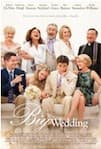
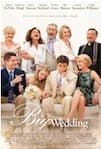
The Big Wedding Budget
 Romantic Comedy
Updated
Synopsis
A long-divorced couple, Don and Ellie Griffin, agree to pretend they are still married for the wedding weekend of their adopted son, whose devoutly Catholic biological mother is flying in from Colombia. The ruse is complicated by Don's current partner Bebe, the unannounced arrival of multiple grown children and their own romantic entanglements, and a Connecticut family compound that struggles to contain the resulting chaos across a single wedding weekend.
What Is the Budget of The Big Wedding (2013)?
The Big Wedding (2013), written and directed by Justin Zackham and distributed by Lionsgate, was produced on a reported budget of $35,000,000. The R-rated ensemble comedy assembled Robert De Niro, Diane Keaton, Susan Sarandon, Robin Williams, Katherine Heigl, Amanda Seyfried, Topher Grace, and Ben Barnes for a family wedding farce loosely adapted from the French film Mon frère se marie (2006). Lionsgate co-financed the production with Millennium Films and Two Ton Films, with Anthony Katagas, Harry J. Ufland, Justin Zackham, Clay Pecorin, and Richard Salvatore producing.
The investment reflected the unusual challenge of paying a deep ensemble of A-list stars on a mid-budget studio comedy, with above-the-line compensation absorbing the single largest share of the production cost. The $35,000,000 figure was modest by tentpole standards but considerable for an adult-skewing R-rated ensemble comedy, and Lionsgate needed worldwide grosses of approximately $70,000,000 to clear marketing and distribution costs, a benchmark the film failed to reach by the end of its theatrical window.
Key Budget Allocation Categories
The Big Wedding's reported $35,000,000 budget was distributed across several core production areas:
- Above-the-Line Ensemble: The four Oscar winners and nominees among the cast, Robert De Niro, Diane Keaton, Susan Sarandon, and Robin Williams, commanded the largest single share of the budget. Each came in at a discounted ensemble rate appropriate to a contained Connecticut shoot, but the cumulative star spend still represented a substantial portion of the production cost. Katherine Heigl, Amanda Seyfried, and Topher Grace filled out the younger generation in the cast at younger-star rates.
- Connecticut Location Shoot: Principal photography took place in Greenwich, Connecticut and surrounding areas during the summer of 2012, using practical estate locations for the central Griffin family compound. Connecticut's state film tax credit program provided a meaningful offset against location, lodging, and below-the-line costs, with the production registering as a qualifying Connecticut production to access the rebate.
- Production Design and the Griffin Estate: Production designer Andrew Jackness dressed the Griffin family lakeside compound across multiple practical locations, including custom-built wedding tent and outdoor reception sets that had to accommodate large-cast choreography. The wedding sequence required period-appropriate floral, tableware, and ceremonial detail across multiple days of contained shooting.
- Wardrobe and Hair: Costume designer Aude Bronson-Howard built distinct wardrobe arcs for each of the eight principal cast members, with multiple wedding-day looks for Heigl, Seyfried, Keaton, and Sarandon and parallel formalwear for De Niro, Williams, and Grace. Hair and makeup spend was elevated by the multi-day wedding sequence, which required continuity across what plays as a single afternoon and evening on screen.
- Music and Score: Composer Nathan Barr delivered the orchestral score, while music supervisor Jonathan Karp assembled the soundtrack of contemporary pop, classic standards, and original placements. The wedding ceremony and reception sequences required clearing multiple master and synchronization rights for needle drops used in dance and montage sequences.
- Post-Production and Editing: Editor Jon Corn worked through the unusually large ensemble in post, with the central wedding-weekend timeline requiring careful intercutting of multiple character arcs across compressed screen time. The cut-down from a longer assembly to the theatrical 89-minute running time involved significant restructuring of subplots.
How Does The Big Wedding's Budget Compare to Similar Films?
At a reported $35,000,000, The Big Wedding sat squarely in the mid-budget tier for adult ensemble comedies of the early 2010s. The comparison set below illustrates how its production scale stacked up against contemporaneous wedding and family-ensemble films:
- Bride Wars (2009): Budget $30,000,000 | Worldwide $114,724,000. Fox's Kate Hudson and Anne Hathaway PG-rated wedding comedy cost slightly less than The Big Wedding and grossed more than three times worldwide, demonstrating the wider audience reach available to a younger-skewing, broader-rated wedding film.
- It's Complicated (2009): Budget $85,000,000 | Worldwide $224,605,322. Universal's Nancy Meyers comedy with Meryl Streep, Alec Baldwin, and Steve Martin spent nearly two and a half times what The Big Wedding cost and grossed more than six times worldwide, providing the gold-standard benchmark for upmarket adult ensemble comedy that The Big Wedding consciously aimed for and missed.
- The Family Stone (2005): Budget $18,000,000 | Worldwide $92,884,880. Fox's Christmas family-ensemble dramedy cost roughly half what The Big Wedding spent and grossed more than two and a half times worldwide, illustrating the commercial track record for tightly budgeted holiday family ensembles.
- Last Vegas (2013): Budget $28,000,000 | Worldwide $134,408,479. CBS Films's Robert De Niro, Michael Douglas, Morgan Freeman, and Kevin Kline ensemble released six months after The Big Wedding cost twenty percent less and grossed almost four times worldwide, showing that the older-star ensemble formula could work when the marketing hook and the comedy register aligned with audience expectations.
- I Don't Know How She Does It (2011): Budget $24,000,000 | Worldwide $30,748,322. The Weinstein Company's Sarah Jessica Parker ensemble cost roughly seventy percent of The Big Wedding and grossed comparably, providing the closest direct underperformance peer.
The Big Wedding Box Office Performance
The Big Wedding opened on April 26, 2013 to $7,540,162 in the United States, finishing fourth on a competitive spring weekend dominated by Pain & Gain and Oblivion. The film fell sharply in its second weekend, dropping forty-seven percent, and never built positive word of mouth. It ended its domestic run at $21,815,267 and added $14,168,793 internationally for a worldwide total of $35,984,060. Here is the financial breakdown:
Box Office Breakdown
The Big Wedding

The Big Wedding returned approximately $0.55 to $0.60 in theatrical revenue for every $1 invested when measured against total estimated production and marketing spend, placing it among the clearest underperformers in Lionsgate's 2013 release calendar. The domestic share of the gross was $21,815,267 against an international share of $14,168,793, a 61/39 split heavily weighted toward North America and a clear signal that the comedy did not translate well outside the United States.
The collapse made the film a frequent point of reference in trade-press coverage of the 2013 spring box office, with Variety and The Hollywood Reporter citing it as evidence that an aging-star ensemble was not a guaranteed commercial formula in the absence of a strong hook. Home video, cable, and streaming windows partially recovered the investment over the ensuing two years, but the theatrical performance was an unambiguous miss.
The Big Wedding Production History
Development began in 2009 when Justin Zackham, writer of The Bucket List, optioned the French film Mon frère se marie (2006) and adapted it as an English-language ensemble comedy. The script was sold to Lionsgate and Millennium Films in 2011, with Anthony Katagas, Harry J. Ufland, and Justin Zackham producing alongside Clay Pecorin and Richard Salvatore.
Casting moved quickly through 2011 and into 2012, with Robert De Niro attaching first, followed by Diane Keaton, Susan Sarandon, and Robin Williams. The younger ensemble of Katherine Heigl, Amanda Seyfried, Topher Grace, and Ben Barnes joined in early 2012, with Christine Ebersole and Patricia Rae rounding out the supporting cast. Zackham, directing for only the second time after his 2002 debut Going Greek, assembled a Connecticut-friendly crew that included cinematographer Jonathan Brown and production designer Andrew Jackness.
Principal photography ran from July to September 2012, with extensive location work in Greenwich, Connecticut and surrounding towns. The Connecticut state film tax credit program provided a substantial offset against the location-heavy budget, and the production worked with the Connecticut Film Office to coordinate the multi-week wedding sequence that anchors the film's third act. Post-production ran through the autumn of 2012 and into early 2013, with Lionsgate setting an April 26, 2013 release date in a counter-programming slot against summer-tentpole season.
Marketing emphasized the four Oscar-winning principals and structured trailer beats around the wedding farce premise, but trade press at the time noted that the campaign struggled to find a clear audience hook. The R-rating, driven by frank language and adult sexual humor, limited the film's appeal to the older audience that the cast skewed toward, and the comedy never developed sustained word of mouth.
Awards and Recognition
The Big Wedding received no significant awards recognition. The film was not nominated at the Oscars, the Golden Globes, the Screen Actors Guild Awards, or the major guild ceremonies, and it did not register at the People's Choice Awards or Critics' Choice Awards.
At the Razzies, the film received two nominations at the 34th Golden Raspberry Awards in 2014, including Worst Supporting Actress for Katherine Heigl and Worst Screen Combo for the entire ensemble, but it did not win either category. The Razzie acknowledgement reflected the film's status as one of the more visible critical underperformers of 2013, with the broader awards conversation treating it as a non-factor.
Critical Reception
The Big Wedding received broadly negative reviews. The film holds a 7% approval rating on Rotten Tomatoes based on 124 critic reviews, one of the lowest scores ever recorded for a film starring four Oscar winners. On Metacritic, the film scored 21 out of 100, indicating overwhelming dislike, and audiences surveyed by CinemaScore gave the film a B-, a surprisingly forgiving grade given the critical reaction.
Critics broadly objected to the screenplay, the broad comedic register, and what they characterized as a wasted ensemble. Roger Ebert's site reviewer Christy Lemire wrote that the film "wastes a great cast on a mean-spirited, sloppy script," and The New York Times's A.O. Scott called it "a film that mistakes shouting for comedy and provocation for wit." Variety's Justin Chang said the film "trades on the star power of its leads without ever giving them anything to do," and The Hollywood Reporter's Todd McCarthy called it "an ungainly mash-up of farcical incident and unearned sentiment."
A handful of mainstream reviewers landed closer to neutral, with Entertainment Weekly noting that the cast occasionally rose above the material, but the consensus across both trade press and mainstream outlets was unambiguously negative. The film's 7% Rotten Tomatoes score remains one of the lowest for a wide-release adult comedy of the 2010s, and the production stands as a frequently cited cautionary example of all-star casting that did not translate to either critical or commercial returns.
Frequently Asked Questions
How much did it cost to make The Big Wedding (2013)?
The reported production budget was $35,000,000, with the largest single line item going to above-the-line compensation for the four Oscar-winning principals: Robert De Niro, Diane Keaton, Susan Sarandon, and Robin Williams. Lionsgate co-financed the film with Millennium Films and Two Ton Films, with Anthony Katagas, Harry J. Ufland, and Justin Zackham producing.
How much did The Big Wedding earn at the box office?
The film grossed $21,815,267 domestically and $14,168,793 internationally, for a worldwide total of $35,984,060. It opened to $7,540,162 in the United States, finishing fourth on the weekend of April 26, 2013 behind Pain & Gain, Oblivion, and 42.
Was The Big Wedding a box office flop?
Yes. Against a $35,000,000 production budget and an estimated $25,000,000 to $30,000,000 in marketing spend, the film returned approximately $0.55 to $0.60 in worldwide theatrical revenue for every $1 invested. It is among the clearest commercial underperformers in Lionsgate's 2013 release calendar, with home video and streaming windows only partially recovering the investment.
Who directed The Big Wedding?
Justin Zackham wrote and directed the film, his second feature as a director after the 2002 indie Going Greek. Zackham was best known as the screenwriter of The Bucket List (2007), and he adapted the script for The Big Wedding from the French-language film Mon frère se marie (2006) by Jean-Stéphane Bron and Karine Sudan.
Where was The Big Wedding filmed?
Principal photography ran from July to September 2012, with extensive location work in Greenwich, Connecticut and surrounding towns. The Connecticut state film tax credit program provided a substantial offset against the location-heavy production budget, and the Griffin family lakeside compound was assembled across multiple practical Connecticut estates.
How does The Big Wedding compare to other wedding comedies?
The Big Wedding cost about the same as Bride Wars (2009) at $30 million but grossed only one third as much worldwide. It cost a quarter of It's Complicated (2009) at $85 million and grossed only one sixth as much. Among recent four-Oscar-winner ensemble comedies, it is the clearest commercial underperformer in the modern era.
Who stars in The Big Wedding?
Robert De Niro plays Don Griffin, Diane Keaton plays his ex-wife Ellie, Susan Sarandon plays his current partner Bebe, and Robin Williams plays Father Moinighan. The younger ensemble includes Katherine Heigl, Amanda Seyfried, Topher Grace, and Ben Barnes, with Christine Ebersole and Patricia Rae in supporting roles.
Did The Big Wedding win any awards?
No. The film received no significant industry recognition. It earned two Razzie nominations at the 34th Golden Raspberry Awards in 2014, for Worst Supporting Actress (Katherine Heigl) and Worst Screen Combo (the entire ensemble), but did not win either category and was not in serious contention at any major industry ceremony.
What did critics think of The Big Wedding?
The film received overwhelmingly negative reviews. It holds a 7% approval rating on Rotten Tomatoes (124 critics), one of the lowest scores ever recorded for a film starring four Oscar winners, and a 21 out of 100 Metacritic score. Audiences gave it a B- CinemaScore. Critics broadly characterized the film as wasting its ensemble on a thin script and a misjudged comedic register.
Is The Big Wedding based on a true story?
No. The Big Wedding is a fictional ensemble comedy adapted from the 2006 Swiss-French film Mon frère se marie by Jean-Stéphane Bron and Karine Sudan. Justin Zackham retained the original's central premise of a divorced couple staging a pretend marriage for a wedding weekend to accommodate the biological mother of their adopted child, then expanded the ensemble around it.
Filmmakers
The Big Wedding

Build budgets like this one in Saturation
Start from an industry-standard feature film template, import the schedule and rates you already have, and let the cost report keep itself current as you spend. Real-time collaboration, no spreadsheets.