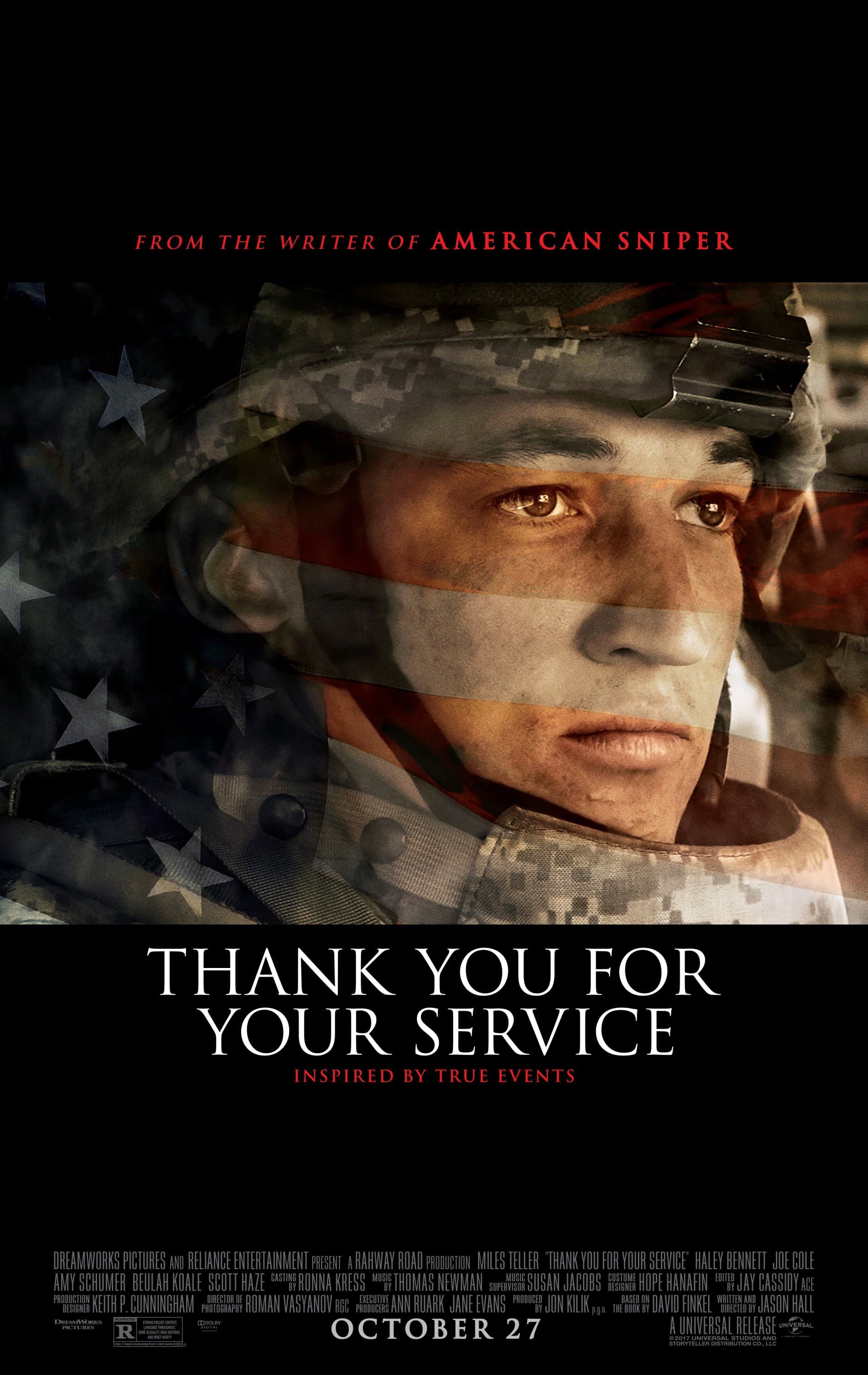
Thank You for Your Service Budget
 Drama
DramaUpdated
Synopsis
Three U.S. Army soldiers return to their Kansas homes after a 15-month deployment to Iraq and struggle to reintegrate with their wives, families, and a Veterans Administration overwhelmed by the demand for mental health care. Based on Washington Post reporter David Finkel's 2013 non-fiction book, Jason Hall's directorial debut follows real-life Sergeant Adam Schumann and his fellow Fort Riley veterans as they confront post-traumatic stress and the cost of survival.
What Is the Budget of Thank You for Your Service (2017)?
Thank You for Your Service (2017), directed by Jason Hall and distributed by Universal Pictures (DreamWorks), was produced on a reported budget of $20,000,000. The military drama, adapted from Washington Post reporter David Finkel's 2013 non-fiction book of the same name, was financed by DreamWorks Pictures and Reliance Entertainment. The film marked Jason Hall's feature directorial debut after his American Sniper (2014) screenwriting work earned him an Academy Award nomination for Best Adapted Screenplay.
The math required the film to earn roughly $50,000,000 worldwide to clear breakeven after marketing, a target it missed by a wide margin in what became one of DreamWorks' softer 2017 releases despite generally positive critical reception. The commercial disappointment reflected a broader audience resistance to military post-traumatic stress narratives in the Trump-era theatrical environment.
Key Budget Allocation Categories
Thank You for Your Service's $20,000,000 budget was distributed across several core production areas:
- Above-the-Line Talent: Miles Teller, coming off Whiplash, the Fantastic Four reboot, and War Dogs, took the lead role of Sergeant Adam Schumann at a market rate appropriate to his 2016 standing. Director Jason Hall worked at debut feature-director rates. Supporting cast members Beulah Koale, Joe Cole, Amy Schumer, Haley Bennett, and Scott Haze brought ensemble character-actor profiles. The supporting cast was deliberately assembled to reflect the actual demographic mix of the Fort Riley unit that Finkel had documented.
- Atlanta and Georgia Location Shoot: Principal photography ran from October to December 2016 across Atlanta and surrounding Georgia locations. Domestic suburban scenes anchored at homes in suburban Atlanta, with VA medical sequences filmed at the Atlanta VA Medical Center and the climactic Iraq combat sequences filmed at a Georgia military installation that doubled for the deployment setting. The Georgia Film Tax Credit covered a substantial share of below-the-line spend.
- Veteran Consulting and Authenticity Coordination: The production worked extensively with real-life Iraq War veteran Adam Schumann, whose post-deployment experience David Finkel had documented in the source book, and with other surviving members of the Fort Riley unit. Schumann served as an on-set consultant and Finkel as a creative consultant. The veteran consulting work was a meaningful and continuous line item across pre-production, principal photography, and post-production.
- Practical Combat and Military Sequences: The Iraq combat sequences required military-accurate uniforms, equipment, vehicles, and choreography. Military technical advisor Kevin Hicks oversaw the equipment authenticity, with multiple period-accurate Iraq War-era M4 carbines, Humvees, and Bradley fighting vehicles sourced for the principal photography. Stunt coordinator Ryan Watson supervised the action sequences.
- Visual Effects: Digital effects work was limited to the combat sequences and selective environmental enhancements. Vendors including Atomic Fiction handled the modest shot count, with the entire effects budget representing less than 5% of the total production budget. The film deliberately leaned on practical effects and grounded cinematography to maintain documentary-adjacent authenticity.
- Score and Music: Composer Thomas Newman scored the film with a restrained orchestral and electronic palette that emphasized character interiority over military-anthem scoring. Newman, the 14-time Oscar-nominated composer, had previously scored multiple Jason Reitman films and brought his characteristic understated approach. The needle-drop soundtrack featured contemporary American country and folk artists.
How Does Thank You for Your Service's Budget Compare to Similar Films?
At $20,000,000, Thank You for Your Service sat at the low-mid range of contemporary Iraq and Afghanistan war drama bracket:
- American Sniper (2014): Budget $58,000,000 | Worldwide $547,426,372. The Clint Eastwood-directed adaptation of the Chris Kyle memoir, which Jason Hall had scripted, cost roughly 3x Thank You for Your Service and earned 60x its worldwide gross.
- Lone Survivor (2013): Budget $40,000,000 | Worldwide $154,793,460. Peter Berg's contemporary Afghanistan combat drama cost 2x Thank You for Your Service and earned 17x its worldwide gross.
- Brothers (2009): Budget $26,000,000 | Worldwide $43,344,837. Jim Sheridan's contemporary Iraq-veteran homecoming drama cost 30% more than Thank You for Your Service and earned 4.8x its worldwide gross.
- Megan Leavey (2017): Budget $7,000,000 | Worldwide $14,167,247. Bleecker Street's contemporaneous war-dog drama cost 65% less than Thank You for Your Service and earned 56% more worldwide.
- In the Valley of Elah (2007): Budget $20,000,000 | Worldwide $29,540,255. Paul Haggis's earlier Iraq-veteran homecoming drama cost the same as Thank You for Your Service and earned roughly 3.3x its worldwide gross.
Thank You for Your Service Box Office Performance
Thank You for Your Service opened on October 27, 2017 to $3,728,815 across 2,054 theaters, finishing seventh for the weekend on a crowded fall corridor. The opening fell well below Universal's projections and the film struggled to find an audience beyond existing military-family and veterans-affairs demographics. Subsequent weeks saw steady but unspectacular contractions as the film closed with a domestic total of $9,001,016.
Against a $20,000,000 production budget the film needed approximately $50,000,000 worldwide to clear breakeven after marketing. Here is the financial breakdown:
Box Office Breakdown
Thank You for Your Service (2017)

Thank You for Your Service returned approximately $0.22 in theatrical revenue for every $1 invested when measured against total estimated production and marketing spend, placing it among the most decisive war-drama theatrical losses of 2017. The domestic share was $9,001,016 against an international share of just $1,328, an essentially complete failure to register overseas that reflected both the film's American-specific subject matter and Universal's deliberate decision to focus marketing on domestic veteran-community channels.
Home video and streaming revenue eventually delivered modest additional return through military-family and veterans-affairs distribution channels. The film became a recurring reference in subsequent discussions of post-9/11 war film commercial viability, with industry observers citing it as evidence that the post-traumatic stress narrative had limited theatrical appeal in the Trump-era environment.
Thank You for Your Service Production History
Development on Thank You for Your Service began at DreamWorks Pictures in 2014 when producer Jon Kilik acquired the screen rights to Washington Post reporter David Finkel's 2013 non-fiction book. Finkel had spent years embedded with members of the 2nd Battalion, 16th Infantry Regiment from Fort Riley, Kansas, both during their 2007 deployment to Iraq and during their homecoming and post-deployment lives. The book documented the post-traumatic stress, suicide risk, and reintegration challenges of multiple veterans across the unit.
Jason Hall attached as writer-director in 2015 on the strength of his American Sniper Best Adapted Screenplay Oscar nomination, making Thank You for Your Service his feature directorial debut. Hall worked extensively with real-life Iraq War veteran Adam Schumann, whose post-deployment experience Finkel had documented in the source book, and with other surviving members of the Fort Riley unit. Miles Teller committed to the lead role in early 2016.
Principal photography ran from October to December 2016 across Georgia, anchored in Atlanta and surrounding suburban locations. Domestic scenes filmed at homes in suburban Atlanta, with VA medical sequences at the Atlanta VA Medical Center and the climactic Iraq combat sequences at a Georgia military installation that doubled for the deployment setting. The Georgia Film Tax Credit covered a substantial share of below-the-line spend.
Post-production extended into mid-2017, with composer Thomas Newman delivering the score in summer 2017 ahead of the October 27, 2017 theatrical release. Universal coordinated extensive screenings for veterans-affairs and military-family advocacy organizations in the lead-up to release, building a targeted marketing campaign that mirrored the audience strategy that had worked for American Sniper three years earlier. The strategy failed to generate equivalent box office momentum.
Awards and Recognition
Thank You for Your Service received scattered awards recognition but no major wins. The film received a Hollywood Film Award for Best Hollywood Breakthrough Performance for Beulah Koale, the New Zealand actor who played fellow veteran Tausolo Aieti. The film also picked up a Cinema for Peace nomination for honoring veterans and a GI Film Festival recognition.
Despite generally positive critical reception, the film failed to register at the Academy Awards, Golden Globes, BAFTAs, or major guild ceremonies. Miles Teller's performance received some critical-circle attention but did not convert to nominations. The combination of soft commercial performance and limited awards traction effectively closed the cinematic conversation about the David Finkel source material, although the book itself remains a foundational reference in subsequent military journalism and veterans-affairs policy work.
Critical Reception
Thank You for Your Service received largely positive reviews. The film holds a 76% approval rating on Rotten Tomatoes based on 175 critic reviews, with a critical consensus that called it "a sobering and well-acted look at the aftermath of war." On Metacritic, the film scored 65 out of 100, indicating generally favorable reviews. Audiences surveyed by CinemaScore gave the film an A-, a strong response that did not translate to commercial momentum.
Critics praised Miles Teller's restrained lead performance, the ensemble work by Beulah Koale, Joe Cole, and Haley Bennett, and Jason Hall's deliberate refusal to manipulate audience emotion through manufactured drama. The Hollywood Reporter's Justin Chang wrote that the film "never strains for catharsis, which is exactly why its quiet moments land." Variety's Owen Gleiberman called it "the rare contemporary war film that resists both flag-waving and reflexive cynicism."
Veterans-affairs press received the film with notable enthusiasm. Multiple military publications and veterans organizations praised the film for its respectful depiction of post-traumatic stress, the Veterans Administration bureaucracy, and the suicide-risk narratives that surround Iraq War homecomings. The combination of strong critical reception, veterans-community endorsement, and minimal commercial traction made Thank You for Your Service a frequent reference in subsequent discussions of how war films can fail to convert critical success to ticket sales in an era of changing audience preferences.
Frequently Asked Questions
How much did it cost to make Thank You for Your Service (2017)?
The reported production budget was $20,000,000. The film was financed by DreamWorks Pictures and Reliance Entertainment, with Universal Pictures handling distribution. Producer Jon Kilik oversaw the project, and the film marked Jason Hall's feature directorial debut after his American Sniper (2014) Best Adapted Screenplay Oscar nomination.
How much did Thank You for Your Service earn at the box office?
The film grossed $9,001,016 domestically and just $1,328 internationally, for a worldwide total of $9,002,344. It opened to $3,728,815 in the United States, finishing seventh on its October 27, 2017 opening weekend. The essentially zero international gross reflected both the American-specific subject matter and Universal's decision to focus marketing on domestic veteran-community channels.
Was Thank You for Your Service a box office bomb?
Yes, decisively. Against a $20,000,000 production budget and an estimated $20,000,000 to $25,000,000 in marketing spend, the film returned approximately $0.22 in worldwide gross for every $1 invested. It was among the most decisive war-drama theatrical losses of 2017 and reflected a broader audience resistance to military post-traumatic stress narratives in the Trump-era theatrical environment.
Who directed Thank You for Your Service?
Jason Hall directed the film, his feature directorial debut. Hall had previously written the screenplay for American Sniper (2014), earning an Academy Award nomination for Best Adapted Screenplay. He also wrote the Thank You for Your Service screenplay based on David Finkel's 2013 non-fiction book of the same name.
Is Thank You for Your Service based on a true story?
Yes. The film is adapted from Washington Post reporter David Finkel's 2013 non-fiction book Thank You for Your Service, which documented the post-deployment lives of members of the 2nd Battalion, 16th Infantry Regiment from Fort Riley, Kansas, after their 2007 Iraq deployment. Real-life Sergeant Adam Schumann served as an on-set consultant.
Where was Thank You for Your Service filmed?
Principal photography ran from October to December 2016 across Atlanta and surrounding Georgia locations. Domestic scenes filmed at homes in suburban Atlanta, VA medical sequences at the Atlanta VA Medical Center, and Iraq combat sequences at a Georgia military installation that doubled for the deployment setting. The Georgia Film Tax Credit covered a substantial share of below-the-line spend.
Who plays Adam Schumann in Thank You for Your Service?
Miles Teller plays Sergeant Adam Schumann. Teller committed to the role in early 2016, coming off Whiplash, the Fantastic Four reboot, and War Dogs. He worked extensively with the real-life Schumann on character preparation. The supporting cast includes Beulah Koale as fellow veteran Tausolo Aieti, Joe Cole as Will Waller, Haley Bennett as Saskia Schumann, and Amy Schumer as Amanda Doster.
How does Thank You for Your Service compare to American Sniper?
Jason Hall wrote both screenplays. American Sniper (2014) cost $58M and earned $547M worldwide, becoming the highest-grossing war film of all time. Thank You for Your Service (2017) cost $20M and earned $9M worldwide. The gap reflected the difference between Clint Eastwood's directorial mass-appeal and Hall's quieter directorial debut, plus a changed audience environment three years later.
What did critics think of Thank You for Your Service?
The film received largely positive reviews, with a 76% approval rating on Rotten Tomatoes (based on 175 critics) and a 65 out of 100 score on Metacritic. Audiences gave it an A- CinemaScore. Critics praised Miles Teller's restrained lead performance, the ensemble work by Beulah Koale and Joe Cole, and Jason Hall's deliberate refusal to manipulate audience emotion.
Did Thank You for Your Service win any awards?
Scattered recognition but no major wins. The film received a Hollywood Film Award for Best Hollywood Breakthrough Performance for Beulah Koale, plus a Cinema for Peace nomination and GI Film Festival recognition. Despite the positive critical reception, the film failed to register at the Academy Awards, Golden Globes, BAFTAs, or major guild ceremonies.
Filmmakers
Thank You for Your Service (2017)

Build budgets like this one in Saturation
Start from an industry-standard feature film template, import the schedule and rates you already have, and let the cost report keep itself current as you spend. Real-time collaboration, no spreadsheets.