Stay Alive Budget
 Horror
Updated
Synopsis
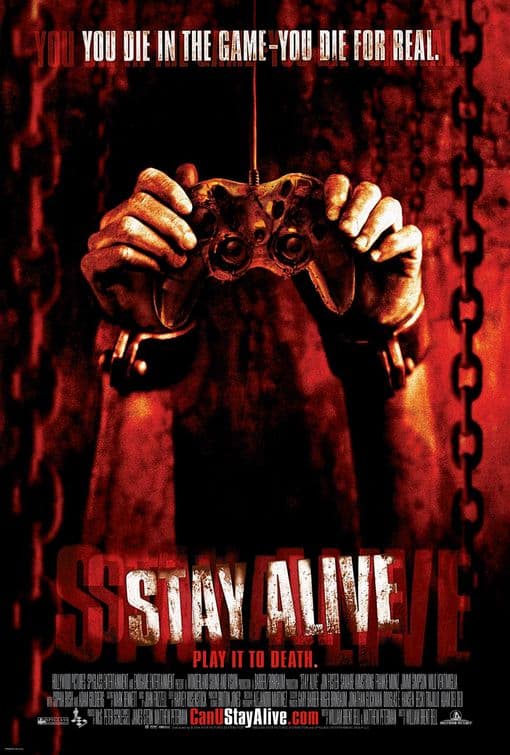
A group of friends in New Orleans receive an unreleased survival-horror video game named "Stay Alive," based on the seventeenth-century Hungarian noblewoman Elizabeth Báthory. After the friend who introduced them to the game is killed in the exact manner of his in-game death, the surviving players realize that anyone who dies in the game also dies in real life, and they must beat the game without being killed by the witch who haunts it.
What Is the Budget of Stay Alive (2006)?
Stay Alive (2006), directed by William Brent Bell and distributed by Hollywood Pictures (a Buena Vista Pictures distribution label owned by Disney), was produced on a budget of $20,000,000. McG and Peter Schwerin produced through McG's Wonderland Sound and Vision banner, with Buena Vista/Disney providing studio finance and theatrical distribution. The film was developed during the mid-2000s as Disney positioned the Hollywood Pictures label as its outlet for PG-13 contemporary genre programming aimed at teen audiences.
The budget reflected the cost discipline of a teen-skewing studio horror programmer. Disney priced the film well below the studio-tentpole tier, betting that the video-game premise, the PG-13 rating, and a cast of rising young actors (Frankie Muniz, Jon Foster, Sophia Bush, Adam Goldberg) could deliver an efficient theatrical opening ahead of substantial home-entertainment revenue. The math required the film to clear roughly $50,000,000 worldwide to break even after marketing, a target the film missed by a meaningful margin.
Key Budget Allocation Categories
Stay Alive's $20,000,000 budget was distributed across several core production areas:
- Above-the-Line Talent: The principal cast was assembled at relatively modest rates appropriate to a teen-skewing studio horror programmer. Jon Foster took the lead role of Hutch at a standard rising-young-actor rate. Frankie Muniz (then post-Malcolm in the Middle), Sophia Bush (One Tree Hill), Samaire Armstrong (The O.C.), and Milo Ventimiglia (Gilmore Girls, pre-Heroes) filled out the principal ensemble at television-recognizability premiums above guild scale. Adam Goldberg took the gaming-savvy role at his standard character-actor rate.
- New Orleans Location Shoot: Principal photography took place primarily in New Orleans and the surrounding Louisiana parishes during summer 2005, taking advantage of Louisiana's then-newly aggressive film production tax credit. The production wrapped just weeks before Hurricane Katrina struck New Orleans in late August 2005, and several of the film's New Orleans locations were subsequently damaged or destroyed by the storm. The film's release in March 2006 included acknowledgment of the production's pre-storm New Orleans setting.
- Production Design: Production designer Charles Daboub Jr. dressed the various New Orleans interiors, the gaming-club setting, the haunted Bathory mansion, and the multiple death set pieces. The Bathory mansion required practical set construction with period-appropriate furniture, lighting, and decay dressing to anchor the witch's seventeenth-century origin in present-day Louisiana.
- Visual Effects: The film required visual effects work for the video-game-within-a-film sequences, the witch's spectral manifestations, and various death set pieces including the famous wrought-iron-spike gate sequence. The VFX team handled both practical-effects integration and the rendered in-game sequences, with the gaming visuals deliberately styled to evoke contemporary mid-2000s survival-horror video games.
- Practical Death Sequences: The film's in-game-becomes-real-death set pieces required dedicated stunt coordination, weapons-and-blade handling, and SFX work. The wrought-iron-spike sequence, the drowning set piece, and the various witch-encounter beats each required specialized rigging. The R-rated theatrical version was ultimately released as PG-13 to broaden audience appeal, with substantial cutting from the unrated home-video version.
- Score and Music: Composer John Frizzell wrote the original score with a contemporary electronic-horror palette. The soundtrack featured several rock and metal needle drops including tracks from Eighteen Visions, In Flames, and other contemporary genre bands that drove the film's gaming-and-marketing aesthetic.
How Does Stay Alive's Budget Compare to Similar Films?
At $20,000,000, Stay Alive sits in the typical range of mid-2000s PG-13 teen-skewing studio horror programmers. The comparison set illustrates the cycle's commercial range:
- When a Stranger Calls (2006): Budget $15,000,000 | Worldwide $67,121,098. Sony's contemporaneous PG-13 teen-skewing remake cost 25% less than Stay Alive and earned more than 2.4x its worldwide gross, the cycle's commercial high-water mark.
- Cry_Wolf (2005): Budget $1,000,000 | Worldwide $15,135,915. Rogue Pictures' Wes Craven-adjacent teen horror cost 5% of Stay Alive and earned 54% of its worldwide gross, illustrating the cycle's commercial efficiency at the lower budget end.
- The Cave (2005): Budget $30,000,000 | Worldwide $32,910,180. Screen Gems' creature-feature cost 50% more than Stay Alive and earned just 18% more worldwide, a similar near-break-even outcome.
- Boogeyman (2005): Budget $20,000,000 | Worldwide $67,193,200. Screen Gems' contemporaneous PG-13 horror cost identically to Stay Alive and earned 2.4x its worldwide gross, the closest cost comparison and a clearer commercial winner.
- Pulse (2006): Budget $20,500,000 | Worldwide $29,931,894. Dimension Films's same-year PG-13 technology-horror remake cost essentially the same as Stay Alive and earned just slightly more worldwide, the closest commercial comparison.
Stay Alive Box Office Performance
Stay Alive opened on March 24, 2006, debuting to $10,762,884 in its opening weekend across 2,073 theaters, finishing third on the chart behind Inside Man and Larry the Cable Guy: Health Inspector. The film modestly underperformed Hollywood Pictures' pre-release tracking, which had projected an $11M to $13M opening, but held competitively for a teen-skewing PG-13 horror programmer in a quiet late-March marketplace.
Against a $20,000,000 production budget, Stay Alive needed roughly $50,000,000 in worldwide gross to reach profitability when accounting for marketing and distribution costs. Here is the financial breakdown:
Box Office Breakdown
Stay Alive (2006)

Stay Alive returned approximately $0.65 in theatrical revenue for every $1 invested when measured against total estimated production and marketing spend. The domestic share of the gross was $23,113,632 against an international share of just $4,691,561, an 83/17 split heavily weighted toward North America that confirmed the teen-skewing PG-13 video-game premise had limited commercial pull outside the United States.
Hollywood Pictures recouped a portion of the loss through home entertainment, with the unrated DVD release in summer 2006 providing additional revenue and reaching audiences who had aged out of the PG-13 theatrical version. The film became a fixture of mid-2000s home-video horror catalog and developed a modest cult reputation among gaming-and-horror crossover audiences. Stay Alive was the last theatrical release under the Hollywood Pictures label, with Disney quietly retiring the imprint shortly after the film's commercial collapse.
Stay Alive Production History
Development began in 2004, with McG's Wonderland Sound and Vision banner structuring the project as a PG-13 teen-skewing studio horror programmer leveraging the popularity of contemporary survival-horror video games. Matthew Peterman and William Brent Bell wrote the screenplay, with Bell attached to direct as his theatrical feature debut after a career in music videos and short films. The project landed at Hollywood Pictures in mid-2004, with Disney providing studio finance and Buena Vista handling theatrical distribution.
Casting was completed in early 2005, with Jon Foster (the older brother of Ben Foster) signing as the lead Hutch. The rising-young-actor ensemble was deliberately assembled from contemporary teen-and-young-adult television (Sophia Bush from One Tree Hill, Samaire Armstrong from The O.C., Milo Ventimiglia from Gilmore Girls) and recent feature work (Frankie Muniz from Agent Cody Banks, Adam Goldberg from Saving Private Ryan and a long character career). The Elizabeth Báthory historical hook was researched through Hungarian folklore consultants to anchor the witch's seventeenth-century origin.
Principal photography ran from June through August 2005 in New Orleans and the surrounding Louisiana parishes, taking advantage of the state's then-new aggressive film production tax credit. The production wrapped just weeks before Hurricane Katrina struck New Orleans in late August 2005, and several of the film's New Orleans locations were subsequently damaged or destroyed by the storm. The production was forced to relocate post-production resources from Louisiana to Los Angeles in the storm's aftermath.
Post-production extended through fall 2005 and early 2006, with extensive editorial work to trim the theatrical cut to a marketable PG-13 rating after the initial assembly had qualified for an R. Substantial gore and several death sequences were cut, restored, or modified to meet the PG-13 threshold. Hollywood Pictures positioned the film for a March 24, 2006 release, with marketing emphasizing the video-game premise, the rising-young-cast ensemble, and the PG-13 accessibility for teen audiences.
Awards and Recognition
Stay Alive received no positive industry awards recognition. It was not nominated at the Academy Awards, Golden Globes, BAFTAs, SAG Awards, or major critics' association awards.
At the Razzies, the film did not receive nominations, though several genre-press year-end lists treated it as a representative example of underperforming mid-2000s PG-13 horror programming. The film's significance has been retrospectively reframed by its status as the last theatrical release under the Hollywood Pictures label, with Disney quietly retiring the imprint shortly after the film's commercial collapse. The Hollywood Pictures shutdown has subsequently been cited in trade press as one of the early indicators of Disney's broader retreat from teen-skewing R- and PG-13 horror programming, a strategic shift that ultimately culminated in the studio's focus on family-and-tentpole production through the 2010s.
Critical Reception
Stay Alive received broadly negative reviews. The film holds an 11% approval rating on Rotten Tomatoes based on 89 critic reviews, with a critical consensus that called it a derivative PG-13 horror programmer with an unconvincing video-game premise. On Metacritic, the film scored 22 out of 100, indicating overwhelming dislike. Audiences surveyed by CinemaScore were not polled in the standard way for a PG-13 release of the period, with exit data suggesting a roughly C-to-C+ audience grade based on subsequent industry coverage.
Critics broadly objected to the screenplay's familiar video-game-becomes-real beats (Wes Craven's New Nightmare and the Final Destination cycle had thoroughly mapped similar territory), the comparatively underdeveloped lead characters, and the cuts required to meet the PG-13 rating. The New York Times' Nathan Lee called it "a routine teen horror programmer with neither the wit nor the gore necessary to distinguish itself." The Los Angeles Times' Mark Olsen wrote that "the central premise is exhausted by the second act, leaving only a procession of familiar set pieces." Variety's Joe Leydon noted that "the rising young cast deserve better material than this derivative ghost story can offer."
A minority of critics defended the film's pre-Hurricane Katrina New Orleans location work, the practical death sequences, and the rising-cast performances. The unrated DVD release in summer 2006 included approximately ten minutes of additional footage cut from the theatrical PG-13 version, which several genre-press reviewers argued improved the film's effectiveness. Stay Alive has subsequently developed a modest cult reputation among gaming-and-horror crossover audiences, with retrospective genre coverage treating the film as a representative mid-2000s artifact of the PG-13 studio-horror programmer cycle.
Frequently Asked Questions
How much did it cost to make Stay Alive (2006)?
The production budget was $20,000,000. The film was produced by McG's Wonderland Sound and Vision banner in association with Spyglass Entertainment, and distributed by Hollywood Pictures (a Buena Vista label owned by Disney). Stay Alive was the last theatrical release under the Hollywood Pictures label before Disney retired the imprint.
How much did Stay Alive earn at the box office?
The film grossed $23,113,632 domestically and $4,691,561 internationally, for a worldwide total of $27,805,193. It opened to $10,762,884 across 2,073 theaters on March 24, 2006, finishing third on the chart behind Inside Man and Larry the Cable Guy: Health Inspector.
Was Stay Alive a box office bomb?
Yes, a modest one. Against a $20M production budget and an estimated $20M to $25M in marketing spend, the film returned approximately $0.65 in worldwide gross for every $1 invested, generating roughly $12M to $17M in theatrical loss. Home entertainment revenue recouped a portion of the loss.
Who directed Stay Alive?
William Brent Bell directed the film as his theatrical feature debut. Bell came from a music video and short film background and would subsequently direct The Devil Inside (2012) and The Boy (2016). He also co-wrote the Stay Alive screenplay with Matthew Peterman.
Where was Stay Alive filmed?
Principal photography ran from June through August 2005 in New Orleans and the surrounding Louisiana parishes, taking advantage of Louisiana's then-newly aggressive film production tax credit. The production wrapped just weeks before Hurricane Katrina struck New Orleans in late August 2005, and several locations were subsequently damaged or destroyed by the storm.
What is the Stay Alive video game in the film?
The fictional in-film video game is a survival-horror title based on the historical seventeenth-century Hungarian noblewoman Elizabeth Báthory, whose recorded atrocities have inspired multiple horror works. In the film, anyone who dies in the game also dies in real life in the exact manner of their in-game death. There is no real Stay Alive video game; the film's gameplay sequences were created entirely for the production.
Who stars in Stay Alive?
Jon Foster (older brother of Ben Foster) stars as Hutch, with Samaire Armstrong as Abigail, Frankie Muniz as Swink, Sophia Bush as October, Jimmi Simpson as Phineus, and Adam Goldberg as Miller. Wendell Pierce and Milo Ventimiglia appear in supporting roles.
How does Stay Alive compare to other mid-2000s PG-13 horror films?
Stay Alive earned $27.8M worldwide on a $20M budget. When a Stranger Calls (2006) earned $67.1M on $15M. Boogeyman (2005) earned $67.2M on $20M. Pulse (2006) earned $29.9M on $20.5M. Stay Alive was a clear underperformer relative to the cycle's commercial benchmarks.
Was Stay Alive the last Hollywood Pictures film?
Yes. Stay Alive was the last theatrical release under the Hollywood Pictures label. Disney quietly retired the imprint shortly after the film's commercial collapse, with subsequent Hollywood Pictures branding limited to home-video catalog and library releases. The shutdown has been cited as an early indicator of Disney's broader retreat from teen-skewing horror programming.
What did critics think of Stay Alive?
The film holds an 11% approval rating on Rotten Tomatoes (89 reviews) and scored 22 out of 100 on Metacritic. The New York Times' Nathan Lee called it "a routine teen horror programmer with neither the wit nor the gore necessary to distinguish itself," and Variety's Joe Leydon noted that "the rising young cast deserve better material than this derivative ghost story can offer."
Filmmakers
Stay Alive (2006)

Build budgets like this one in Saturation
Start from an industry-standard feature film template, import the schedule and rates you already have, and let the cost report keep itself current as you spend. Real-time collaboration, no spreadsheets.