Star Wars Ep. V: The Empire Strikes Back Budget
 Adventure
Updated
Synopsis
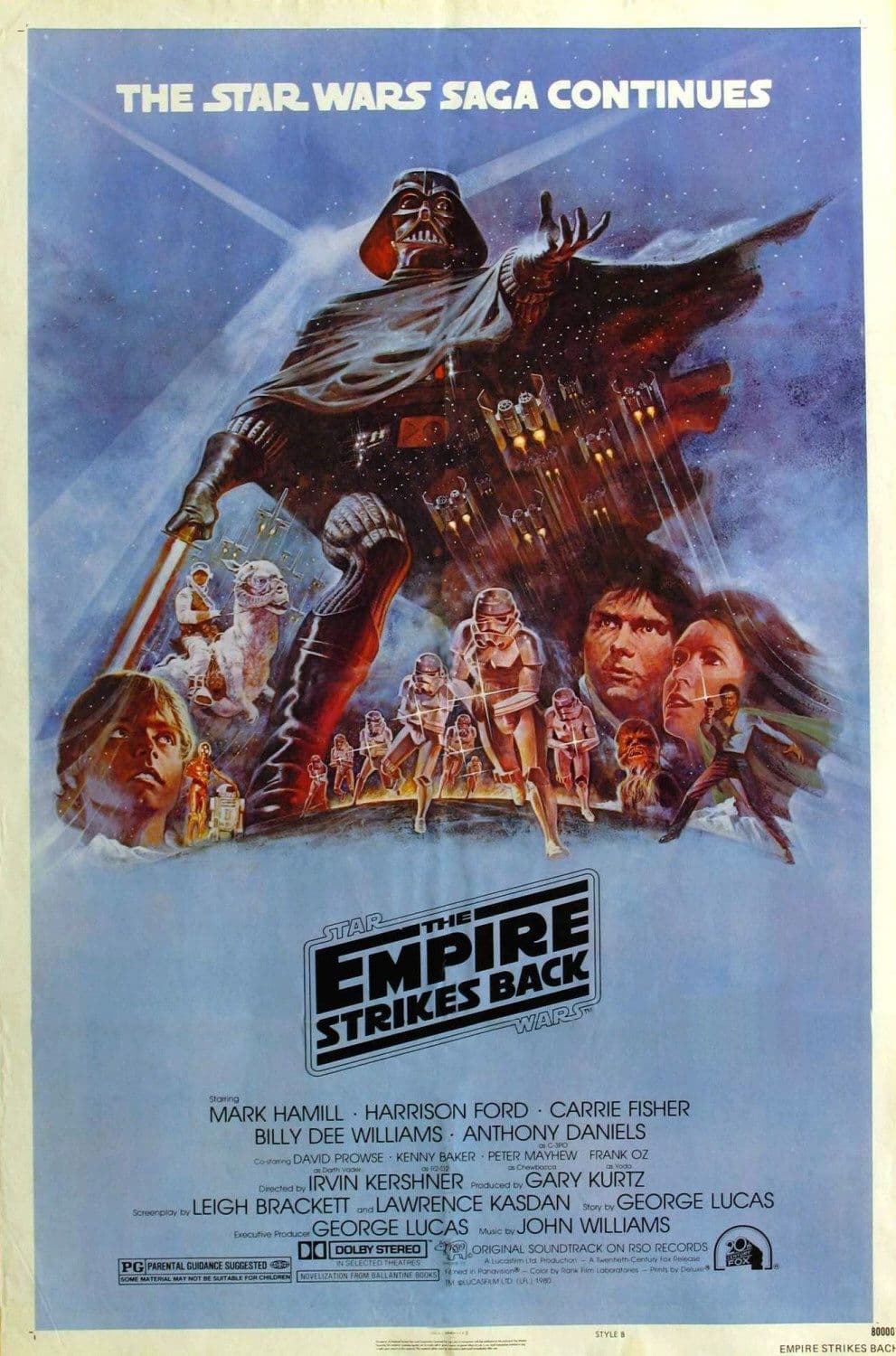
"Star Wars Episode V: The Empire Strikes Back," released in 1980, continues the epic saga of the Rebel Alliance's struggle against the oppressive Galactic Empire. Following the events of the first film, the Rebels have established a base on the icy planet of Hoth. However, their sanctuary is soon discovered by Darth Vader and his forces, leading to a fierce battle that forces the Rebels to flee.
As Luke Skywalker embarks on a journey to hone his Jedi skills, he seeks out the legendary Master Yoda on the swampy planet of Dagobah. Meanwhile, Han Solo, Princess Leia, Chewbacca, and C-3PO find themselves on the run from the Empire, ultimately captured by Vader. The film delves into themes of loyalty, sacrifice, and the struggle between good and evil, culminating in shocking revelations that will change the course of the saga forever. The Empire Strikes Back is renowned for its darker tone, character development, and iconic moments, solidifying its place as a cornerstone of cinematic history.
What Is the Budget of The Empire Strikes Back?
The Empire Strikes Back (1980), the second installment of the original Star Wars trilogy, was produced on a budget of approximately $18 million. That figure represented a significant step up from the original Star Wars (1977), which had been made for around $11 million, and reflected the expanding ambitions of George Lucas and Lucasfilm as they built out one of cinema's most ambitious franchises from scratch.
The $18 million budget was financed entirely by Lucasfilm, with Fox distributing. Lucas personally funded the production after the success of the original Star Wars, deliberately avoiding studio interference to maintain creative control. That gamble paid off at a scale few studios could have anticipated. In today's dollars, the budget is equivalent to roughly $65 to $70 million, making it one of the most efficiently produced blockbusters in film history given the visual scale it achieved.
The production ran over its original $15 million budget and over its initial shooting schedule, partly due to the ambitious practical effects work and location shooting challenges in Norway. The overrun was absorbed by Lucasfilm directly, underscoring the financial risk Lucas took on by self-financing.
Key Budget Allocation Categories
Several specific production decisions drove the budget of The Empire Strikes Back:
- Cast and Above-the-Line Talent: Mark Hamill, Harrison Ford, and Carrie Fisher reprised their roles from the original Star Wars; Billy Dee Williams joined as Lando Calrissian. Director Irvin Kershner was hired at Lucas's recommendation, freeing Lucas to focus on producing and creative oversight. The combined above-the-line package likely consumed $4 to $5 million of the budget.
- Visual Effects at ILM: Industrial Light and Magic, founded by Lucas for the original Star Wars, delivered the film's groundbreaking effects work under visual effects supervisors Brian Johnson and Richard Edlund. AT-AT walkers were realized as stop-motion models; the Cloud City sequences involved extensive matte paintings. ILM's work on the film earned a Special Achievement Academy Award and represented a substantial portion of production spend.
- Location Shooting in Finse, Norway: The Hoth ice planet sequences were filmed near Finse, Norway, during winter 1979. A blizzard struck during production, damaging equipment and complicating logistics, but also added an authentic texture to the Hoth battle sequences. The Norway shoot added significant cost in travel, crew accommodation, and weather-related delays.
- EMI Elstree Studios: Principal interior photography was completed at EMI Elstree Studios in Hertfordshire, England. Multiple large-scale sets were constructed, including the Millennium Falcon interior, the Dagobah swamp, and Cloud City interiors. Elstree became effectively a dedicated Star Wars facility during production.
- John Williams Score and Yoda Creation: John Williams returned to compose the score, recording with the London Symphony Orchestra. His new themes for Yoda, the Imperial March, and the love theme for Han and Leia became iconic. Frank Oz performed and voiced Yoda, with Jim Henson's team collaborating on the puppet's construction; the Yoda puppet and its operation represented a novel and costly practical effects investment.
How Does The Empire Strikes Back's Budget Compare to Similar Films?
Within the context of early 1980s blockbusters, The Empire Strikes Back's $18 million budget was at the high end of what studios were spending, though it was self-financed and notably efficient given the visual ambition it achieved:
- Star Wars (1977): Budget $11M | Worldwide $775M. The original film established the franchise and, on a lower budget, generated nearly $240 million more worldwide. The Empire Strikes Back's higher budget reflected the expanded scope, including the Hoth battle, the Dagobah sequences, and Cloud City.
- Return of the Jedi (1983): Budget $32.5M | Worldwide $475M. The trilogy closer cost nearly double The Empire Strikes Back and earned significantly less worldwide, illustrating how efficiently the middle film was made.
- Raiders of the Lost Ark (1981): Budget $18M | Worldwide $389M. Released the following year, Indiana Jones had the same production budget as Empire but earned roughly $150 million less worldwide, underlining Empire's extraordinary commercial performance.
- Superman II (1980): Budget $54M | Worldwide $190M. Released in the same year, Superman II cost three times as much as Empire and earned less than a third of its worldwide gross, a stark contrast in budget efficiency.
The Empire Strikes Back Box Office Performance
The Empire Strikes Back opened on May 21, 1980, distributed by Twentieth Century Fox. It debuted to $4.9 million on its opening day and $10.8 million over its opening weekend on just 126 screens in limited release, before expanding aggressively. The film went on to earn $290.2 million domestically and $248.2 million internationally across its original 1980 theatrical run and subsequent reissues, for a worldwide total of $538.4 million across all releases.
Lucasfilm self-financed the production at $18 million. Adding an estimated $8 million in prints and advertising, the total investment was approximately $26 million. Theatrical revenue is split roughly 50/50 between exhibitors and distributors, meaning the studio's share of the worldwide gross was approximately $269 million, well above the total investment. The film cleared break-even comfortably within its domestic run alone.
Box Office Breakdown
Star Wars Ep. V: The Empire Strikes Back (1980)

On a per-dollar basis, The Empire Strikes Back earned roughly $29.91 for every $1 invested in production. Even accounting for the P&A spend and theatrical splits, the film generated returns that dwarfed virtually every other production of its era. The self-financing model meant Lucasfilm retained the majority of profits, which funded the construction of Skywalker Ranch and future Lucasfilm operations.
The Empire Strikes Back Production History
Development of The Empire Strikes Back began almost immediately after the original Star Wars opened in May 1977. George Lucas, who had found directing the first film exhausting, made the decision not to direct the sequel himself. He approached Irvin Kershner, a filmmaker he had studied under at USC, and offered him the job. Kershner's background in character-driven drama was a deliberate choice; Lucas wanted the sequel to deepen the emotional story, not simply replicate the original's action spectacle. Leigh Brackett, a veteran Hollywood screenwriter and science fiction author, was hired to write the first draft of the screenplay. Brackett delivered her draft in early 1978 but died of cancer shortly afterward, before any revisions could be made. Lawrence Kasdan, then a relatively unknown screenwriter who had just finished Raiders of the Lost Ark for Lucas, was brought in to rewrite the script from scratch. Kasdan's screenplay introduced the film's most celebrated element: the revelation that Darth Vader is Luke Skywalker's father.
Principal photography began in March 1979. The production opened with location shooting near Finse, Norway, for the Hoth ice planet sequences. A severe blizzard hit the area during filming, confining the crew to the hotel for several days, but Mark Hamill managed to film the opening scene of Luke crawling through snow during the storm, adding genuine texture to the sequence. The Norway shoot was followed by the main block of studio work at EMI Elstree Studios in Hertfordshire, England, which ran through September 1979. An electrical fire at Elstree in January 1979, weeks before the Star Wars production moved in, damaged several stages, and the crew had to work around the aftermath. Despite the logistical complications, Kershner maintained a reputation for prioritizing character work with the actors; he was known for extended rehearsals and improvisation sessions, which contributed to the film's notably richer performances compared to the first film.
The film went significantly over its original budget of $15 million, escalating to approximately $18 million, and over its shooting schedule. The complexity of the practical effects work, particularly the AT-AT battle on Hoth realized through stop-motion animation by Phil Tippett, and the Cloud City sequences required more time than planned. Lucas oversaw post-production from California while Kershner remained in London, and the two maintained close communication throughout the editing process. John Williams recorded the score with the London Symphony Orchestra in early 1980, introducing the Imperial March, one of the most recognized musical themes in film history.
The film was completed in time for its May 21, 1980, release date. Twentieth Century Fox distributed the film, as with the original, under a profit-sharing deal with Lucasfilm that had proven enormously profitable for both parties. The Empire Strikes Back opened to immediate critical and commercial success. The revelation of Vader's paternity, kept secret throughout production with only a handful of people including Mark Hamill informed before the film's release, landed as one of the most discussed plot twists in cinema history.
Awards and Recognition
The Empire Strikes Back received five Academy Award nominations at the 53rd Academy Awards in 1981 and won in two categories. It won the Academy Award for Best Sound, awarded to Bill Varney, Steve Maslow, Gregg Landaker, and Peter Sutton. It also received a Special Achievement Award for visual effects, presented to Brian Johnson, Richard Edlund, Dennis Muren, and Bruce Nicholson, recognizing the groundbreaking ILM work that defined the film's visual language. The Special Achievement Award was the Academy's designation for effects work that did not fit neatly into the existing technical categories.
Beyond the Oscars, the film won the Hugo Award for Best Dramatic Presentation in 1981, one of the premier awards in science fiction. It also won the BAFTA Award for Best Sound and received nominations for Best Production Design and Best Costume Design. The Academy Award for Best Original Score nomination recognized John Williams's score, which introduced the Imperial March and became one of the most celebrated film scores of the era.
In 1997, the American Film Institute named The Empire Strikes Back to its list of the 100 greatest American films. It has consistently appeared on critics' and audiences' lists of the greatest films ever made, and specifically of the greatest sequels ever made, across multiple decades of retrospective assessment.
Critical Reception
The Empire Strikes Back holds a 94% approval rating on Rotten Tomatoes based on more than 100 reviews and an audience score of 97%. On Metacritic, it holds a score of 82 out of 100. At the time of its 1980 release, critical reception was strong but not uniformly ecstatic; some critics found the film's cliffhanger ending unsatisfying. The deeper appreciation for the film as the definitive entry in the saga, and as one of the greatest sequels ever made, solidified over subsequent decades.
Roger Ebert, initially less enthusiastic than some of his contemporaries, later revised his assessment and gave the film a four-star rating, calling it richer and more assured than the original. Vincent Canby of The New York Times praised the film's ambition and the decision to end on a note of unresolved tension, calling it a confident, adventurous piece of filmmaking. The New Yorker's Pauline Kael, who had been skeptical of the Star Wars phenomenon, acknowledged the film's superior craft relative to the first entry.
Retrospective criticism has been almost uniformly positive, with the film regularly cited as the definitive counterargument to the idea that blockbuster cinema cannot be emotionally complex. The 'I am your father' scene is consistently identified as one of the greatest plot twists in film history, and Irvin Kershner's direction is credited with giving the story a weight and emotional seriousness that distinguished it from the more purely adventurous tone of the original film.
Frequently Asked Questions
How much did The Empire Strikes Back cost to make?
The production budget was $33,000,000. Lucasfilm self-financed the sequel using profits from Star Wars (1977) along with bank loans secured against future Twentieth Century Fox distribution revenues, allowing George Lucas to retain unprecedented creative control.
How much did The Empire Strikes Back earn at the box office?
The film grossed $290,475,067 domestically and $248,000,000 internationally during its initial 1980 release and subsequent reissues, for an inflation-adjusted worldwide total exceeding $1,000,000,000 across its multi-decade theatrical history. Box Office Mojo lists the worldwide cumulative as approximately $549,000,000.
Who directed The Empire Strikes Back?
Irvin Kershner directed the film. Kershner was George Lucas's film-school instructor at the University of Southern California, an appointment that surprised industry observers given Kershner's background in smaller-scale character dramas including The Eyes of Laura Mars (1978).
Who wrote The Empire Strikes Back?
Leigh Brackett and Lawrence Kasdan share screenplay credit, working from a story by George Lucas. Brackett, the science-fiction author and Howard Hawks screenwriting collaborator, delivered an early draft before her death in March 1978. Kasdan revised the screenplay to its final form.
Where was The Empire Strikes Back filmed?
Principal photography took place at Elstree Studios in Hertfordshire, England, with location work for the Hoth ice planet sequences shot at the Hardangerjokulen glacier in Finse, Norway, and Dagobah swamp sequences shot entirely on sound stages.
Who stars in The Empire Strikes Back?
Mark Hamill returns as Luke Skywalker, Harrison Ford as Han Solo, and Carrie Fisher as Princess Leia. The film introduces Billy Dee Williams as Lando Calrissian, with Frank Oz performing Yoda for the first time and David Prowse and James Earl Jones continuing as Darth Vader.
Was the Vader-Luke twist in the original screenplay?
No. The "I am your father" reveal was developed by George Lucas during production and shared only with director Irvin Kershner, screenwriter Lawrence Kasdan, and actors Mark Hamill and James Earl Jones. David Prowse, on-set as Vader, read alternate dialogue and learned the true line only at the film's premiere.
What did critics think of The Empire Strikes Back?
The film received strong reviews, with a 94% approval rating on Rotten Tomatoes and an 82 out of 100 score on Metacritic. Initial 1980 reviews were more divided than subsequent reassessments, with several major critics initially complaining about the unresolved cliffhanger ending.
Did The Empire Strikes Back win any Academy Awards?
The film won the Academy Award for Best Sound and received a Special Achievement Award for Visual Effects. It received additional nominations for Best Art Direction and Best Original Score by John Williams. The Vietnam War film The Final Countdown and Raging Bull dominated the 53rd Academy Awards.
How does The Empire Strikes Back compare to the original Star Wars?
The Empire Strikes Back is widely considered the strongest entry in the original trilogy, outperforming Star Wars (1977, $11,000,000 budget, $775,000,000 worldwide across all releases) on critical reassessment despite a lower initial commercial gross. Return of the Jedi (1983, $32,500,000 budget, $475,000,000 worldwide) completed the trilogy at a higher initial gross.
Build budgets like this one in Saturation
Start from an industry-standard feature film template, import the schedule and rates you already have, and let the cost report keep itself current as you spend. Real-time collaboration, no spreadsheets.