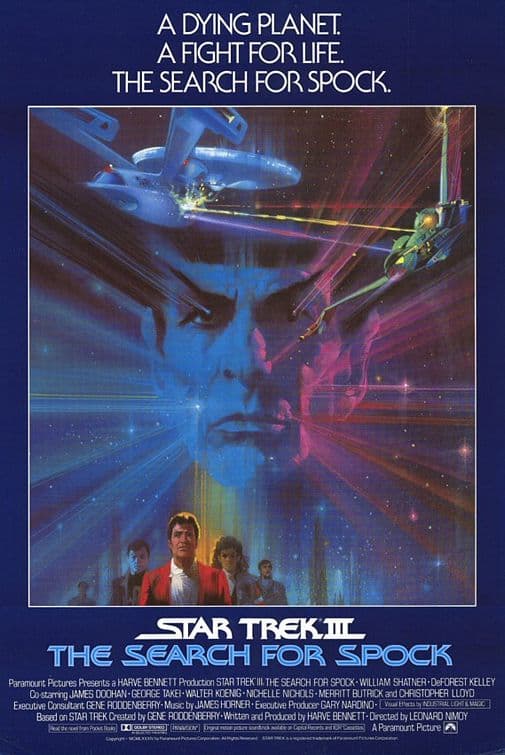
Star Trek III: The Search for Spock Budget
 Adventure
Updated
Synopsis
Determined to recover the body of his fallen friend Spock from the newly created Genesis planet, Admiral Kirk and his loyal Enterprise crew defy Starfleet orders to steal their own ship for a rescue mission that places them in direct conflict with a vengeful Klingon commander. Leonard Nimoy directs his first feature film as the third entry in the original Star Trek movie cycle.
What Is the Budget of Star Trek III: The Search for Spock (1984)?
Star Trek III: The Search for Spock was produced on a budget of approximately $18 million, a controlled increase over Star Trek II: The Wrath of Khan's $11 million. Paramount Pictures maintained the tight cost discipline that had revived the franchise on the prior film, with the additional budget supporting Leonard Nimoy's expanded scope as first-time director and the destruction of the original USS Enterprise.
Key Budget Allocation Categories
Above-the-Line Talent, salaries for William Shatner, Leonard Nimoy, DeForest Kelley, and the supporting ensemble accounted for a substantial share of the budget.
Visual Effects, ILM and Industrial Light and Magic delivered space sequences, the Enterprise destruction set piece, and the Genesis planet effects, requiring significant miniature and optical work.
Set Construction, detailed Genesis planet sets, Klingon Bird of Prey bridge interiors, and Vulcan temple sequences required new construction beyond the recycled Star Trek II sets.
Director Premium, Leonard Nimoy's directing fee and the longer pre-production needed for a first-time director added modest cost.
Music Score, James Horner returned from Star Trek II to compose a new score recorded with full orchestra.
Marketing Campaign, Paramount's marketing push capitalized on the franchise reawakening and the Spock cliffhanger from Star Trek II.
How Does Star Trek III: The Search for Spock's Budget Compare to Similar Films?
Star Trek II: The Wrath of Khan (1982), Budget $11,200,000 | Worldwide $97,000,000. The franchise revival entry produced for 38 percent less that grossed slightly more worldwide.
Star Trek IV: The Voyage Home (1986), Budget $24,000,000 | Worldwide $133,000,000. The subsequent entry produced for 33 percent more that significantly outperformed Star Trek III.
Star Trek: The Motion Picture (1979), Budget $46,000,000 | Worldwide $139,000,000. The original film franchise entry produced for 156 percent more that grossed 59 percent more.
2010 (1984), Budget $28,000,000 | Worldwide $40,400,000. A direct sci-fi sequel released the same year as Star Trek III at 56 percent higher budget with significantly weaker box office.
Star Trek III: The Search for Spock Box Office Performance
Star Trek III opened to $16.7 million in North America over its first three days of June 1984, a strong debut comparable to The Wrath of Khan's opening and one of the higher early-summer openings of the year.
Box Office Breakdown
Star Trek III: The Search for Spock

On theatrical revenue alone the film returned roughly $4.86 for every $1 invested at the production-budget level. After marketing and the studio share of box office, the film delivered a meaningful theatrical profit for Paramount.
International gross of $11 million produced a domestic-heavy split typical of the era for Star Trek, with the franchise less established in non-English-language markets at that point. The commercial success cemented Paramount's commitment to the original cast film cycle through Star Trek VI.
Star Trek III: The Search for Spock Production History
Star Trek III: The Search for Spock entered development almost immediately after the strong commercial reception of The Wrath of Khan in summer 1982. Paramount and producer Harve Bennett brought Leonard Nimoy back to the franchise with the explicit understanding that he would direct, with Nimoy having negotiated the directing role as a condition for returning as Spock following the prior film's climactic death scene.
Bennett wrote the screenplay himself, structuring the story around the resurrection of Spock through the Genesis planet introduced in The Wrath of Khan. The script also called for the destruction of the original USS Enterprise, a major franchise milestone that Paramount approved as necessary to push the original cast cycle forward narratively.
Principal photography took place across late 1983 at the Paramount Pictures lot in Los Angeles and at California state park locations standing in for the Genesis planet. Christopher Lloyd took the lead Klingon villain role between seasons of Taxi, with the production embracing prosthetic and costume design that became influential for the Klingon visual canon in subsequent Star Trek productions.
Post-production included extensive ILM visual effects work for the Enterprise destruction sequence, the Genesis planet exterior shots, and the Klingon Bird of Prey designs. James Horner returned to compose the score, building on themes established in The Wrath of Khan. Paramount placed the film into the early summer 1984 release window where it performed solidly through the season.
Awards and Recognition
Star Trek III received no major industry awards. The film was largely overlooked by the broader awards conversation, though it received Saturn Award recognition.
The film received Saturn Award nominations for Best Science Fiction Film, Best Director (Leonard Nimoy), Best Actor (William Shatner), Best Special Effects, and Best Music. The film won Best Special Effects from the Academy of Science Fiction, Fantasy and Horror Films.
Industry retrospectives place Star Trek III as the necessary middle chapter of the original cast's loose trilogy with The Wrath of Khan and The Voyage Home, with the destruction of the Enterprise widely cited as one of the most emotionally resonant set pieces in the original film cycle.
Critical Reception
Critical reception in 1984 was mixed to positive. Rotten Tomatoes settled at 79 percent positive reviews on aggregated retrospective coverage. Reviewers praised Leonard Nimoy's confident directing debut, the emotional core of the friendship-and-resurrection story, and the spectacle of the Enterprise destruction, while finding the screenplay less tightly constructed than The Wrath of Khan.
Roger Ebert awarded the film three stars and wrote that "Nimoy directs with genuine affection for these characters," while Janet Maslin at The New York Times praised the "well-paced adventure with a satisfying emotional payoff" while noting that the film "lacks the operatic intensity" of its predecessor.
Audience reception was strongly positive, particularly among existing Star Trek fans for whom the resurrection of Spock and the destruction of the Enterprise were defining franchise moments. The film's standing has improved further over the decades, with the original cast trilogy of Star Treks II, III, and IV now widely regarded as the strongest extended arc in the original film cycle.
Frequently Asked Questions
What is the budget of Star Trek III?
The film was produced on a budget of approximately $18 million, a slight increase over The Wrath of Khan's $11 million but still tightly controlled by Paramount.
Who directed Star Trek III?
Leonard Nimoy directed the film, his first feature directing assignment. He had explicitly negotiated the directing role as a condition for returning as Spock.
When was Star Trek III released?
Paramount Pictures released the film in North America on June 1, 1984.
Where was Star Trek III filmed?
Principal photography took place primarily at the Paramount Pictures lot in Los Angeles, with additional location shooting at California state park locations standing in for the Genesis planet.
How much did Star Trek III earn?
The film earned approximately $76.5 million domestically and $11 million internationally for a worldwide total of about $87.5 million.
Why does Spock die in Star Trek II?
Leonard Nimoy reportedly agreed to film Star Trek II only on the condition that Spock would be killed off, leaving open the possibility of resurrection. The result allowed Spock's return in Star Trek III to drive the central plot.
Was Star Trek III profitable?
Yes. On an $18 million budget and roughly $15 million in marketing, the $87.5 million worldwide gross delivered a strong theatrical profit and reinforced Paramount's commitment to the franchise.
Who plays the Klingon villain Kruge?
Christopher Lloyd plays Kruge, the Klingon commander obsessed with stealing the Genesis device. Lloyd took the role between seasons of Taxi.
Did Star Trek III destroy the Enterprise?
Yes. The film's third act features the destruction of the original USS Enterprise as Kirk activates the auto-destruct to kill boarding Klingons, a major emotional beat carried over into Star Trek IV.
How does Star Trek III compare to Star Trek II?
The Search for Spock grossed less than The Wrath of Khan and received cooler critical reception, but is widely considered the necessary middle entry of the original cast's loose trilogy with Star Trek IV.
Filmmakers
Star Trek III: The Search for Spock

Build budgets like this one in Saturation
Start from an industry-standard feature film template, import the schedule and rates you already have, and let the cost report keep itself current as you spend. Real-time collaboration, no spreadsheets.