
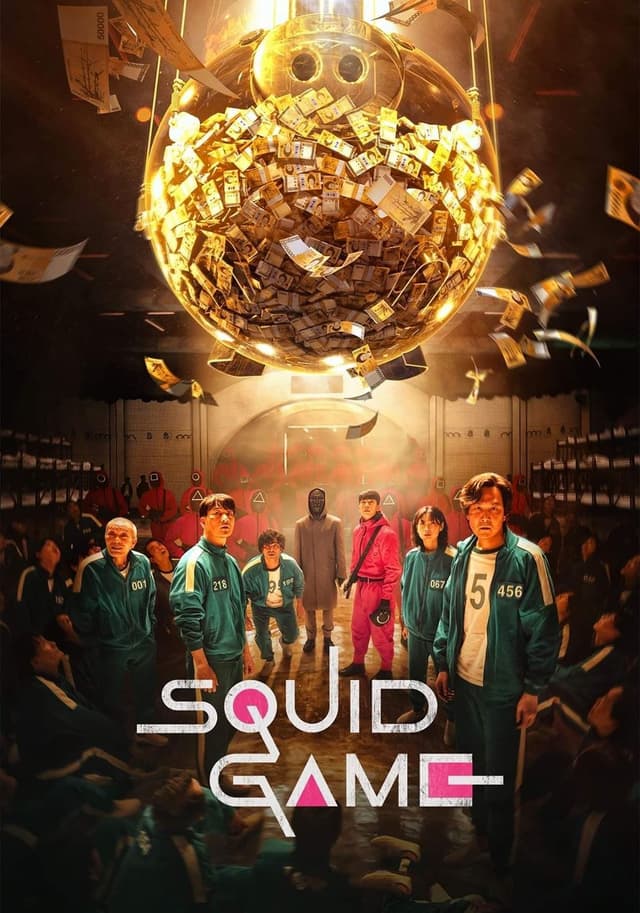
Squid Game Budget
Updated
Synopsis
Squid Game (2021), created, written, and directed by Hwang Dong-hyuk, follows 456 debt-ridden contestants who compete in lethal versions of Korean children's games for a 45,600,000,000-won prize. Lee Jung-jae plays Seong Gi-hun, a financially desperate divorced father drawn into the deadly tournament, with Park Hae-soo, Wi Ha-joon, Jung Ho-yeon, O Yeong-su, and Heo Sung-tae leading the ensemble. Netflix released all nine Season 1 episodes globally on September 17, 2021, and the series became the platform's most-watched original launch within 28 days.
What Is the Budget of Squid Game (2021)?
Squid Game (2021), the Korean Netflix limited series created, written, and directed by Hwang Dong-hyuk, was produced on a reported Season 1 budget of $21,400,000 across nine episodes, averaging approximately $2,400,000 per episode. The figure was confirmed by Netflix executives during the company's Q3 2021 earnings call after the series became the platform's most-watched original launch within 28 days of its September 17, 2021 global release. The total Season 1 production cost represented a modest investment by Hollywood premium-streaming standards but a meaningful expansion above the contemporaneous Korean broadcast-drama tariff, which typically ran roughly $500,000 to $800,000 per episode.
Siren Pictures, the Korean independent production company founded by Kim Ji-yeon, produced the series in-house for Netflix. The company secured Netflix's full Season 1 financing in early 2020 after Hwang spent more than a decade attempting to set up the project at Korean networks and theatrical studios, with multiple Korean broadcasters and film financiers having previously rejected the concept as too violent and commercially unviable. The pandemic-era Korean production environment, combined with Netflix's expanded Korean-language scripted-content investment beginning in 2019, made the $21,400,000 commitment commercially viable.
Key Budget Allocation Categories
Squid Game's reported $21,400,000 Season 1 budget broke down across the cost centers typical of a large-scale Korean limited series, with several show-specific items reflecting its game-arena production design and ensemble cast structure:
- Above-the-Line Cast: Lee Jung-jae as Seong Gi-hun, Park Hae-soo as Cho Sang-woo, Wi Ha-joon as Detective Hwang Jun-ho, Jung Ho-yeon as Kang Sae-byeok, O Yeong-su as Oh Il-nam, and Heo Sung-tae as Jang Deok-su anchored the regular cast. Lee Jung-jae, then established as a Korean film veteran (New World, Along With the Gods), commanded the largest above-the-line line item, with the broader ensemble cast budget reflecting standard Korean premium-drama rates rather than streaming-era inflation.
- Practical Set Construction at Cheonan and Daejeon: The series' signature game arenas (the pink-and-teal staircases, the Red Light/Green Light field with the animatronic Young-hee doll, the glass-bridge crossing, the hexagonal honeycomb playing field, and the final Squid Game pitch) were built as practical sets on soundstages in Cheonan and Daejeon, South Korea. Set construction across the nine episodes formed the largest single production-cost item.
- Ensemble Casting and Background Performers: The 456-contestant premise required 456 numbered tracksuit-clad participants in the opening dormitory scenes, with a substantial pool of background performers and stunt doubles maintained across the principal photography window. Background-performer compensation, costume duplication, and on-set choreography across the 456-person ensemble drove a substantial incremental cost above the standard Korean drama norm.
- Animatronic Young-hee Doll: The 4.8-meter-tall animatronic doll used in the Red Light/Green Light sequence was custom-built for the production, with motion-control mechanisms allowing the head-turning gesture central to the game's execution mechanic. The doll, alongside the synchronized track-and-trigger system used to identify movement during the freeze sequences, formed a discrete capex line item amortized across the episodes featuring the game.
- Visual Effects: While Squid Game was largely a practical production, the series required visual-effects work for the elimination kill sequences, the glass-bridge breaks, environmental enhancements for the wide-angle arena shots, and the digital expansions of the animatronic doll movement. Korean VFX vendor 4th Creative Party handled the bulk of the post-production VFX pipeline.
- Original Score and Sound Design: Composer Jung Jae-il, fresh off his work on Bong Joon-ho's Parasite (2019), scored the series with a string-and-piano-driven palette that became one of the year's most-referenced television scores. The "Pink Soldiers" theme and the recurring "Way Back Then" piano motif anchored the show's tonal identity. Music budget covered original composition, orchestra recording, and licensing of public-domain classical pieces used as recurring cues.
- Costume and Production Design: Costume designer Cho Sang-kyung's green tracksuit-and-numbered-jersey design for the contestants and the pink jumpsuits with geometric masks for the staff became immediate global cultural signifiers. Costume duplication across 456 contestants and 100+ pink-suited staff, alongside production design by Chae Kyoung-sun across the soundstage-built game arenas, drove the broader physical-production line items.
- Direction and Writing by Hwang Dong-hyuk: Hwang served as creator, writer, and director on all nine episodes, with his compensation reflecting both the showrunner workload and the project ownership he had carried since first drafting the concept in 2008 and 2009. The single-creator structure removed the cost of a writers room while concentrating creative-talent compensation in a single line item.
How Does Squid Game's Budget Compare to Similar Series?
At $21,400,000 for nine episodes (approximately $2,400,000 per episode), Squid Game Season 1 sat below the standard Hollywood premium-streaming-drama tariff but materially above the Korean broadcast norm. The comparison set below illustrates how its production scale stacked up:
- Stranger Things (Season 4): Estimated per-episode budget approximately $30,000,000. Netflix's flagship American sci-fi drama cost roughly 12 times Squid Game's per-episode spend by its fourth season, illustrating the cost gap between top-tier American streaming drama and even premium-scale Korean Netflix Original production.
- Kingdom (2019): Estimated per-episode budget approximately $1,800,000 to $2,000,000. Netflix's prior flagship Korean Original (Joseon-era zombie political thriller) ran on a smaller per-episode budget than Squid Game, with the gap reflecting Squid Game's more elaborate practical-set construction and larger ensemble cast.
- Sweet Home (2020): Estimated per-episode budget approximately $2,300,000 to $2,500,000. Netflix's contemporaneous Korean horror Original ran at a comparable per-episode budget, with comparable practical-set-and-VFX hybrid production design and a similar 10-episode-equivalent runtime.
- The Witcher (Season 1): Estimated per-episode budget approximately $10,000,000. Netflix's flagship English-language fantasy Original cost roughly four times Squid Game's per-episode spend, illustrating the standard gap between English-language and Korean-language Netflix Original drama economics in the early 2020s.
- Money Heist (Season 5): Estimated per-episode budget approximately $5,000,000 to $7,000,000. Netflix's flagship Spanish-language Original ran at roughly twice Squid Game's per-episode tariff in its later seasons, illustrating that even non-English-language Netflix Originals reached materially higher per-episode budgets once cultural-export momentum compounded across multiple seasons.
- Parasite (2019): Budget $11,400,000 | Worldwide $263,000,000. Bong Joon-ho's Best Picture-winning Korean theatrical feature cost roughly half of Squid Game's nine-episode total, with composer Jung Jae-il scoring both projects. The comparison illustrates the relative cost efficiency of Korean creative production across both theatrical and streaming formats.
Squid Game Season Performance and Cultural Impact
Squid Game premiered globally on Netflix on September 17, 2021, with all nine Season 1 episodes released simultaneously. The series became the streaming platform's most-watched original launch within 28 days of release, with Netflix self-reporting more than 1,650,000,000 hours of total viewing time across the first 28 days and 142,000,000 member households having watched at least two minutes of an episode. The Season 1 economic framework breaks down as follows:
- Per-Episode Budget: approximately $2,400,000 across nine Season 1 episodes
- Total Season 1 Investment: $21,400,000
- Network: Netflix global streaming (Korean original-language production)
- Audience/Ratings: 111,000,000 households streamed the series in the first 17 days; 142,000,000 households across the first 28 days; 1,650,000,000 total viewing hours across the first 28 days
- International Distribution: Netflix exclusive global streaming; dubbed and subtitled into 31 languages at launch
- Library/Syndication Value: Squid Game remained Netflix's most-watched non-English series; Season 2 launched in December 2024 with comparable global viewing impact; merchandising, theme-park experiences, and a US-format adaptation extended the franchise
Squid Game generated estimated revenue and franchise value of approximately $900,000,000 for Netflix across the first six months after launch, according to internal Netflix valuation documents leaked to Bloomberg in October 2021. The figure represented one of the most striking ROI multiples in modern streaming-television history: roughly 42x return on the Season 1 production budget across the first six months, before factoring in subscriber retention, merchandising, theme-park licensing, or Season 2 amortization.
The cultural impact extended well beyond the streaming metrics. The pink-jumpsuit-and-tracksuit-and-mask aesthetic became one of the most replicated Halloween costume sets of October 2021; "Squid Game challenge" social-media reproductions of the Red Light/Green Light and Dalgona-candy games trended globally; and Jung Ho-yeon, until then a fashion model with limited acting credit, was cast in subsequent international projects including The Governesses (2025) and signed with major American talent representation. Netflix renewed the series for Season 2 in June 2022 and for Season 3 in October 2023, with Season 2 launching in December 2024.
Squid Game Production History
Hwang Dong-hyuk, a Korean film director whose prior credits included Silenced (2011) and The Fortress (2017), first drafted the Squid Game concept in 2008 and 2009 as a feature film during the global financial crisis. The premise, hundreds of debt-ridden contestants competing in lethal versions of Korean children's games for a 45,600,000,000-won prize, was conceived during a period when Hwang was personally heavily indebted and reading manhwa survival-game comics to escape. Multiple Korean broadcasters and theatrical financiers rejected the project across the early 2010s as too violent, too dark, and commercially unviable.
Netflix's expanded Korean-language original-content investment, beginning with Kingdom (2019) and accelerating through 2020 and 2021, created the production environment in which Squid Game could finally enter active development. Netflix Korea, led by Don Kang and supported by Siren Pictures' Kim Ji-yeon, greenlit the nine-episode limited series in late 2019 with a $21,400,000 production commitment.
Casting Lee Jung-jae as Seong Gi-hun in early 2020 anchored the ensemble around an established Korean film veteran whose career stretched from City of the Rising Sun (1998) through New World (2013) and Along With the Gods (2017). Park Hae-soo (Prison Playbook), Wi Ha-joon (Romance Is a Bonus Book), and Heo Sung-tae (Beasts Clawing at Straws) brought additional Korean drama recognition. Jung Ho-yeon, then a Louis Vuitton runway model with no major acting credits, was cast as Kang Sae-byeok on the strength of her audition footage, in what became one of the most consequential casting decisions in modern streaming television.
Principal photography ran from June 2020 through October 2020 across Seoul, Cheonan, and Daejeon, with a multi-month pandemic pause partway through the schedule. The practical game-arena sets, including the pink-and-teal staircase, the Red Light/Green Light field with the animatronic Young-hee doll, the glass-bridge crossing, and the hexagonal honeycomb arena, were built on Cheonan and Daejeon soundstages. The Seongapdo island location in Ongjin County was used for the contestants' arrival-and-departure ferry sequences.
Editing through late 2020 and early 2021 compiled the nine episodes into the final cut. Jung Jae-il delivered the original score in mid-2021. Netflix executed the global launch on September 17, 2021 with simultaneous dubbing and subtitling into 31 languages, a marketing-and-localization scale that proved decisive in the series' subsequent global breakthrough. Hwang Dong-hyuk subsequently signed a multi-project deal with Netflix to write and direct Season 2 (premiered December 2024) and Season 3 (filming through 2024 and 2025).
Awards and Recognition
Squid Game became the first non-English-language series to win the Primetime Emmy Award for Outstanding Directing for a Drama Series (Hwang Dong-hyuk) and Outstanding Lead Actor in a Drama Series (Lee Jung-jae) at the 74th Primetime Emmy Awards in September 2022. The series won six Primetime Emmys in total, including Outstanding Guest Actress in a Drama Series (Lee You-mi), Outstanding Stunt Performance, Outstanding Production Design, and Outstanding Visual Effects.
At the 79th Golden Globe Awards in January 2022, O Yeong-su won Best Supporting Actor in a Series, Limited Series or Motion Picture for Television, becoming the first Korean actor to win a Golden Globe. The series additionally received the Outstanding Performance by an Ensemble in a Drama Series win at the 28th Screen Actors Guild Awards, with Lee Jung-jae and Jung Ho-yeon winning individual SAG Awards for Outstanding Performance by a Male and Female Actor in a Drama Series.
The cumulative awards recognition, which included BAFTA Television Awards, Critics Choice Television Awards, Hollywood Critics Association TV Awards, and multiple Korean industry ceremonies, cemented Squid Game's position as the defining international streaming-television breakthrough of the early 2020s. Hwang Dong-hyuk's Emmy directing win in September 2022 was the single most consequential awards-conversation moment for non-English-language television in the streaming era to date.
Critical Reception
Squid Game received overwhelmingly positive reviews. The series holds a 95% approval rating on Rotten Tomatoes based on 77 critic reviews for Season 1, with a critical consensus describing it as offering "sharp social commentary" and "unflinching brutality." On Metacritic, the series scored 69 out of 100 across 13 critic reviews, indicating generally favorable reviews. The gap between the two aggregators reflected near-universal critical praise alongside a smaller cluster of reviews that flagged the series' violence-and-spectacle balance.
Variety's Caroline Framke called Squid Game "a thoroughly compelling vision" while The New York Times' Mike Hale described it as "a smart, sometimes sour critique of Korean class anxiety." The Guardian's Stuart Heritage praised the production design and the ensemble cast, writing that the series "feels like an instant classic of the dystopian-game subgenre." The Hollywood Reporter's Daniel Fienberg flagged the late-season exposition as a structural weakness while broadly endorsing the series' tonal achievement.
Retrospective reception has been strongly positive. Squid Game has appeared on multiple "best television of the 2020s" lists, with The Atlantic, The Guardian, IndieWire, and Time all including the series in early-decade best-of compilations. The series' impact on the broader Korean-content streaming wave, alongside Netflix's subsequent investment in Hellbound (2021), All of Us Are Dead (2022), and The Glory (2022 to 2023), has been recognized as a defining factor in the international expansion of Korean television culture across the early 2020s.
Frequently Asked Questions
How much did Squid Game Season 1 cost to produce?
The reported Season 1 production budget was $21,400,000 across nine episodes, averaging approximately $2,400,000 per episode. The figure was confirmed by Netflix executives during the company's Q3 2021 earnings call after the series became the platform's most-watched original launch within 28 days of its September 17, 2021 global release.
How many episodes are in Squid Game Season 1?
Season 1 contains nine episodes, all released simultaneously on Netflix on September 17, 2021. Season 2 launched in December 2024 with seven episodes, and Season 3 launched in 2025.
Who created Squid Game?
Hwang Dong-hyuk created, wrote, and directed Squid Game. He first drafted the concept in 2008 and 2009 as a feature film during the global financial crisis. Multiple Korean broadcasters and theatrical financiers rejected the project across the early 2010s before Netflix Korea greenlit the nine-episode limited series in late 2019.
Where was Squid Game filmed?
Principal photography took place from June through October 2020 across Seoul, Cheonan, and Daejeon, South Korea. The practical game-arena sets were built on soundstages in Cheonan and Daejeon. The Seongapdo island location in Ongjin County was used for the contestants' arrival-and-departure ferry sequences. A multi-month pandemic pause interrupted the principal photography schedule.
How many people watched Squid Game?
Netflix self-reported more than 1,650,000,000 hours of total viewing time across the first 28 days and 142,000,000 member households having watched at least two minutes of an episode. The series became Netflix's most-watched original launch within 28 days of release, a record it held until Wednesday's November 2022 launch.
Who stars in Squid Game?
Lee Jung-jae plays Seong Gi-hun, the financially desperate divorced father drawn into the lethal tournament. Park Hae-soo plays Cho Sang-woo, Wi Ha-joon plays Detective Hwang Jun-ho, Jung Ho-yeon plays Kang Sae-byeok, O Yeong-su plays Oh Il-nam, and Heo Sung-tae plays Jang Deok-su. The Season 1 ensemble cast totals 456 contestants plus the pink-suited staff.
Did Squid Game win any Emmys?
Yes. Squid Game became the first non-English-language series to win the Primetime Emmy Award for Outstanding Directing for a Drama Series (Hwang Dong-hyuk) and Outstanding Lead Actor in a Drama Series (Lee Jung-jae) at the 74th Primetime Emmy Awards in September 2022. The series won six Primetime Emmys in total, including Outstanding Guest Actress in a Drama Series (Lee You-mi) and Outstanding Stunt Performance.
How does Squid Game compare to other Netflix originals?
Squid Game Season 1 cost approximately $2,400,000 per episode, well below the $10,000,000+ per-episode budgets of Netflix's flagship English-language originals. The Witcher Season 1 cost approximately $10,000,000 per episode; Stranger Things Season 4 reached approximately $30,000,000 per episode. Netflix's contemporaneous Korean originals Kingdom (2019) and Sweet Home (2020) ran at comparable approximately $1,800,000 to $2,500,000 per-episode tariffs.
What did critics think of Squid Game?
The series received overwhelmingly positive reviews, with a 95% approval rating on Rotten Tomatoes (77 critics) and a 69 out of 100 score on Metacritic. Variety called it "a thoroughly compelling vision," The New York Times described it as "a smart, sometimes sour critique of Korean class anxiety," and The Guardian called it "an instant classic of the dystopian-game subgenre."
Is there a Squid Game Season 2?
Yes. Netflix renewed the series for Season 2 in June 2022, with Hwang Dong-hyuk signing a multi-project deal to write and direct. Season 2 launched on Netflix in December 2024 with seven episodes and comparable global viewing impact to Season 1. Season 3 launched in 2025, completing the planned three-season arc.
Filmmakers
Squid Game

Official Trailer
Build budgets like this one in Saturation
Start from an industry-standard feature film template, import the schedule and rates you already have, and let the cost report keep itself current as you spend. Real-time collaboration, no spreadsheets.