Spider-Man 2 Budget
 ActionAdventureScience Fiction2h 7m
Updated
Synopsis
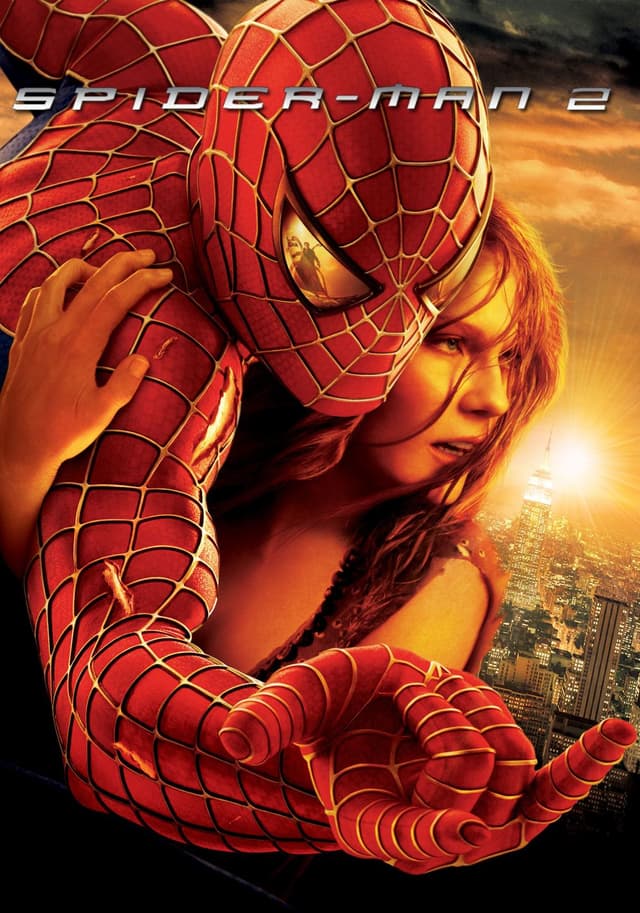
"Spider-Man 2," released in 2004, continues the story of Peter Parker, portrayed by Tobey Maguire, as he grapples with the duality of his life as a college student and a superhero. Struggling to balance his responsibilities, Peter faces personal challenges, including his feelings for Mary Jane Watson, played by Kirsten Dunst, who is moving on with her life.
The film introduces a formidable new villain, Dr. Otto Octavius, also known as Doc Ock, played by Alfred Molina. After a tragic accident during an experiment, Octavius becomes fused with mechanical tentacles that grant him incredible power but also drive him to madness. As he wreaks havoc on New York City, Peter must confront his own fears and insecurities to embrace his role as Spider-Man once again.
Amidst the chaos, Peter's relationships are tested, and he must make difficult choices that will impact not only his life but also the lives of those he loves. The film masterfully blends action, emotion, and moral dilemmas, showcasing the struggles of a hero who must learn that with great power comes great responsibility.
What is the budget of Spider-Man 2?
"Spider-Man 2," an action released in 2004, was directed by Sam Raimi and stars Tobey Maguire, Kirsten Dunst. The production budget was $200,000,000, placing it in the blockbuster range for action productions of its era.
Key Budget Allocation Categories
While specific budget breakdowns are not publicly available, typical cost drivers for an action production like this include:
- Stunts, Action Sequences & Visual Effects: Action films allocate a substantial portion of their budget to choreographing and executing practical stunts, pyrotechnics, and CGI-heavy sequences.
- Above-the-Line Talent (Cast & Director): A-list talent commands significant upfront fees plus backend participation.
- Production Design, Sets & Locations: Action films frequently require multiple international shooting locations, large-scale set construction, vehicle acquisitions and modifications, and specialized equipment , all of which drive production costs well above those of dialogue-driven genres.
How Does Spider-Man 2's Budget Compare to Similar Films?
At $200,000,000, Spider-Man 2 sits in the blockbuster range. Here is how it compares to productions with a similar budget:
- 2012 (2009): Budget $200,000,000, Worldwide Gross $791,217,826
- Alice in Wonderland (2010): Budget $200,000,000, Worldwide Gross $1,025,467,110
- Ant-Man and the Wasp: Quantumania (2023): Budget $200,000,000 , Gross $476,071,180
- Argylle (2024): Budget $200,000,000, Worldwide Gross $96,221,061
- Black Adam (2022): Budget $200,000,000, Worldwide Gross $393,452,111
The median budget for wide-release action films in the 2000s ranges from $30 to 80M for mid-budget to $150M+ for tentpoles.
Spider-Man 2 Box Office Performance
"Spider-Man 2" earned $373,585,825 domestically and $788,976,453 worldwide at the box office. Against a production budget of $200,000,000, the film performed strongly at the box office.
Box Office Breakdown
Spider-Man 2

At approximately +294%, Spider-Man 2 returned roughly $3.94 for every $1 of production budget invested during its theatrical run.
The 47/53 domestic-to-international split saw $373,585,825 from North America and $415,390,628 from overseas markets.
Awards and Recognition
Won 1 Oscar. 25 wins & 60 nominations total
- Academy Award for Best Visual Effects: John Frazier (77th Academy Awards)
- Academy Award for Best Visual Effects: Q568245 (77th Academy Awards)
- Academy Award for Best Visual Effects: Scott Stokdyk (77th Academy Awards)
- Academy Award for Best Visual Effects: Anthony LaMolinara (77th Academy Awards)
Production History
Sony announced the Spider-Man sequel in May 2002, shortly after the original's record-breaking $115 million opening weekend. Director Sam Raimi signed on immediately after completing the first film, with a target release date of May 7, 2004, and a $200 million budget. The project was initially titled The Amazing Spider-Man.
The screenplay went through multiple iterations. Sony hired Smallville alumni Alfred Gough and Miles Millar in April 2002, with David Koepp joining as co-writer in June. Michael Chabon was brought on in September 2002 to rewrite, but his draft, which featured a younger Doc Ock infatuated with Mary Jane, was rejected. Alvin Sargent ultimately crafted the final screenplay, drawing inspiration from Superman II and the "Spider-Man No More!" comic storyline.
Principal photography began on April 12, 2003, shooting in New York City and Chicago before relocating to Los Angeles on May 13. An eight-week hiatus occurred to construct Doc Ock's elaborate pier lair on Sony's Stage 30, measuring 60 by 120 feet. Reshoots wrapped in February 2004. A notable production challenge arose when Tobey Maguire's pre-existing back condition threatened his involvement after filming Seabiscuit in late 2002. Jake Gyllenhaal was briefly cast as his replacement, but Maguire ultimately reclaimed the role with intervention from Universal's Ronald Meyer, securing a $17 million salary.
Critical Reception
Spider-Man 2 received widespread critical acclaim. On Rotten Tomatoes, the film holds a 93% approval rating based on 276 reviews, with the consensus praising it as "a nimble sequel that improves upon the original" thanks to "an entertaining villain and deeper emotional focus." Metacritic assigned a score of 83 out of 100, indicating universal acclaim. Audiences gave the film an A- CinemaScore grade, matching the first film's reception.
Roger Ebert awarded the film four stars, calling it "the best superhero movie since the modern genre was launched with Superman (1978)." Critics particularly commended Alfred Molina's portrayal of Doctor Octopus as a "pleasingly complex" villain, Tobey Maguire's emotional depth, and Sam Raimi's assured direction. The American Film Institute selected Spider-Man 2 as one of the top ten films of 2004.
Some dissenting voices found fault with pacing issues. J. Hoberman described the first half as "talky bordering on tiresome," while Peter Bradshaw gave a mixed three-out-of-five-star review, noting the film occasionally "gets a little dull." Nevertheless, Spider-Man 2 is widely regarded as one of the finest superhero sequels ever produced.
Frequently Asked Questions
How much did Spider-Man 2 (2004) cost to make?
Spider-Man 2 had a production budget of $200,000,000. The budget covered extensive practical effects work, elaborate set construction, and advanced visual effects technology including the Spydercam aerial system.
How much did Spider-Man 2 (2004) make at the box office?
Spider-Man 2 earned $374,700,000 domestically and $421,200,000 internationally for a worldwide total of $795,900,000. The film was one of the highest-grossing releases of 2004.
Was Spider-Man 2 (2004) profitable?
Yes. Spider-Man 2 was highly profitable, earning nearly four times its production budget at the worldwide box office. With $795,900,000 in global receipts against a $200,000,000 budget, the film generated substantial returns for Sony Pictures even after marketing and distribution costs.
What were the biggest costs in the Spider-Man 2 (2004) budget?
Major expenses included the practical Doc Ock tentacles built by Edge FX (a 100-pound corset harness requiring four puppeteers per tentacle), the collapsed pier lair set on Sony's Stage 30 (which took 15 weeks to build), extensive Spydercam aerial photography systems, and advanced CGI rendering by Sony Imageworks.
How does the Spider-Man 2 (2004) budget compare to similar films?
At $200,000,000, Spider-Man 2 was significantly more expensive than the original Spider-Man (2002) at $139,000,000. It was also one of the most expensive films made at the time, comparable to Superman Returns (2006) at $204,000,000, though Spider-Man 2 was far more successful at the box office.
Did Spider-Man 2 (2004) go over budget?
There are no reports indicating Spider-Man 2 exceeded its $200,000,000 budget. Reshoots were completed by February 2004 as originally scheduled, and the production wrapped within the planned timeline.
What is the ROI of Spider-Man 2 (2004)?
Spider-Man 2 generated a strong ROI of approximately 298%. The formula: ($795,900,000 minus $200,000,000) divided by $200,000,000 equals 297.95%. Even after accounting for marketing and distribution expenses, the film was one of the most profitable superhero films of its era.
Did Spider-Man 2 (2004) win any awards?
Spider-Man 2 won the Academy Award for Best Visual Effects at the 77th Academy Awards, becoming one of the first superhero films to win an Oscar in a major technical category. It also won five Saturn Awards from the Academy of Science Fiction, Fantasy, and Horror Films.
Who directed Spider-Man 2 (2004)?
Sam Raimi directed Spider-Man 2, returning after the success of Spider-Man (2002). Raimi, known for the Evil Dead franchise and A Simple Plan (1998), brought his signature kinetic visual style to the sequel.
Where was Spider-Man 2 (2004) filmed?
Spider-Man 2 was filmed in New York City (starting April 12, 2003), Los Angeles (from May 13, 2003), and Chicago. The Chicago pre-shoot in November 2002 captured the subway sequence using authentic CTA 2200-series trains.
Filmmakers
Spider-Man 2

Official Trailer
Build budgets like this one in Saturation
Start from an industry-standard feature film template, import the schedule and rates you already have, and let the cost report keep itself current as you spend. Real-time collaboration, no spreadsheets.