Pirates of the Caribbean: Dead Men Tell No Tales Budget
 AdventureActionFantasy2h 9m
Updated
Synopsis
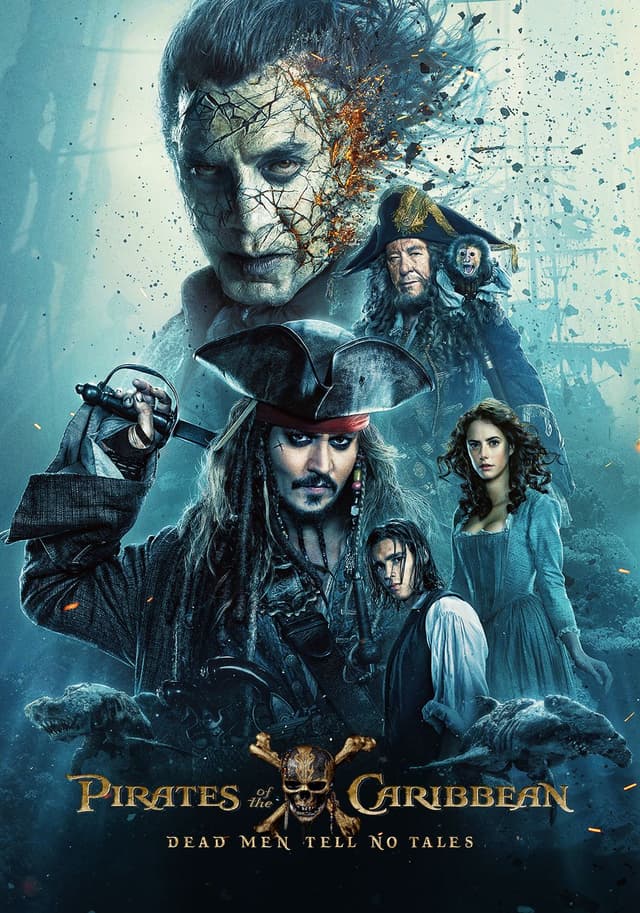
Henry Turner, the son of Will Turner, seeks the mythical Trident of Poseidon to break the curse that binds his father to the Flying Dutchman. His search leads him to the disgraced Captain Jack Sparrow and the brilliant astronomer Carina Smyth, whose diary holds the key to finding the Trident. But Captain Salazar, a ghostly pirate hunter trapped in the Devil's Triangle, has escaped and is hunting Jack across the seas, determined to kill the man who condemned him to an undead existence decades earlier.
What Is the Budget of Pirates of the Caribbean: Dead Men Tell No Tales?
Pirates of the Caribbean: Dead Men Tell No Tales (2017), directed by Joachim Ronning and Espen Sandberg and distributed by Walt Disney Studios Motion Pictures, was produced on a budget of $230,000,000. The fifth installment in the Pirates franchise introduced a new generation of characters alongside Johnny Depp's Captain Jack Sparrow, with Brenton Thwaites as Henry Turner (son of Will Turner and Elizabeth Swann) and Kaya Scodelario as the astronomer Carina Smyth. Javier Bardem starred as the ghostly Captain Salazar, a former pirate hunter seeking revenge on Sparrow from beyond the grave.
The $230 million budget reflected the franchise's continued status as a global tentpole property, though cost pressures were evident throughout the production. The shoot relocated from its traditional base in the Caribbean and Hollywood to Queensland, Australia, where significant tax incentives from the Australian government offset production costs. Despite the budget management efforts, the production faced challenges including Johnny Depp's on-set finger injury, weather delays, and the complexity of VFX-intensive ghost ship sequences.
Key Budget Allocation Categories
Pirates of the Caribbean: Dead Men Tell No Tales distributed its $230 million budget across the following production areas:
- Visual Effects and Ghost Ship Design: The film required extensive VFX work to realize Captain Salazar and his undead crew, whose decayed, gravity-defying appearance demanded complex digital character work. The Silent Mary, Salazar's ghost ship, breaks apart and reassembles throughout the film, requiring detailed fluid simulation and destruction effects. The Devil's Triangle sequence, the de-aging of Johnny Depp for a young Jack Sparrow flashback, and the climactic splitting of the sea demanded thousands of VFX shots handled by MPC, Atomic Fiction, and other vendors.
- Australian Production and Tax Incentives: The decision to film in Australia was driven primarily by financial incentives. The Queensland government offered a substantial production package through Screen Queensland, and the Australian federal government's location offset provided a 16.5% rebate on qualifying expenditure. Principal photography took place at Village Roadshow Studios on the Gold Coast and on location at various Queensland coastal sites. The relocation created the largest film production in Australian history at the time, employing thousands of local crew members.
- Practical Sets and Maritime Construction: Production designer Nigel Phelps built multiple full-scale ship sets, including the Dying Gull (Jack Sparrow's dilapidated vessel), portions of the Black Pearl, and the British naval ship. A massive water tank at Village Roadshow Studios hosted sea-level action sequences, while the Gold Coast shoreline was transformed into Caribbean port towns and island locations. The practical ship construction and maritime rigging represented a significant budget allocation.
- Cast and Above-the-Line Talent: Johnny Depp's salary reportedly reached $30 million for his role as Captain Jack Sparrow, making him one of the highest-paid actors in the production. Javier Bardem brought additional star power as Captain Salazar. Geoffrey Rush returned as Barbossa, and Orlando Bloom reprised Will Turner in a significant supporting role. Directors Joachim Ronning and Espen Sandberg, known for Kon-Tiki (2012), were hired to bring a fresh perspective to the franchise while working within producer Jerry Bruckheimer's established production framework.
- Action Sequences and Stunt Work: The film features several major set pieces, including the bank heist that drags an entire building through the streets of Saint Martin, the guillotine escape sequence, the Silent Mary's attack on the British fleet, and the climactic Trident of Poseidon sequence in which the ocean splits apart. Each required extensive pre-visualization, stunt coordination, practical effects, and VFX integration.
- Score and Sound Design: Geoff Zanelli composed the score, taking over from Hans Zimmer while maintaining the franchise's established musical themes. Zanelli, who had served as an additional music contributor on previous Pirates entries, expanded the sound palette with new themes for Salazar and the younger characters while preserving the iconic "He's a Pirate" motif.
How Does Dead Men Tell No Tales's Budget Compare to Similar Films?
At $230,000,000, Dead Men Tell No Tales continued the franchise's pattern of massive production budgets. Comparing it with other Pirates entries and competing franchises:
- Pirates of the Caribbean: On Stranger Tides (2011): Budget $379,000,000 | Worldwide $1,045,700,000. The fourth Pirates film cost 65% more, largely due to 3D conversion costs and London/Hawaii location work, but earned 32% more worldwide, reflecting the franchise's stronger commercial position earlier in the decade.
- Pirates of the Caribbean: At World's End (2007): Budget $300,000,000 | Worldwide $963,400,000. The third installment cost 30% more and earned 21% more, illustrating the franchise's gradual decline in both spending discipline and audience enthusiasm.
- Transformers: The Last Knight (2017): Budget $217,000,000 | Worldwide $605,400,000. Released the same summer, this rival franchise sequel cost slightly less and earned less, with both films representing the declining returns of long-running action franchises.
- Wonder Woman (2017): Budget $149,000,000 | Worldwide $822,900,000. The DC superhero origin film cost 35% less and earned 4% more worldwide, illustrating that fresh IP entries could outperform aging franchise sequels at lower cost.
- Guardians of the Galaxy Vol. 2 (2017): Budget $200,000,000 | Worldwide $863,800,000. Released a few weeks before Dead Men Tell No Tales, the Marvel sequel cost 13% less and earned 9% more, suggesting stronger audience appetite for the MCU brand versus the Pirates franchise.
Pirates of the Caribbean: Dead Men Tell No Tales Box Office Performance
Dead Men Tell No Tales opened in the United States on May 26, 2017, debuting to $62.6 million domestically over the three-day Memorial Day weekend. The opening was the lowest for the franchise, falling below all four previous Pirates films and signaling significant domestic audience erosion. The film had already opened internationally the previous weekend, earning $208.4 million overseas in its first frame, confirming the franchise's continued strength in international markets even as domestic interest waned.
Box Office Breakdown
Pirates of the Caribbean: Dead Men Tell No Tales

At approximately +246%, Pirates of the Caribbean: Dead Men Tell No Tales returned roughly $3.46 for every $1 of production budget invested during its theatrical run.
The fifth Pirates film continued the franchise's downward domestic trajectory, earning just $172.6 million in North America (22% of worldwide), the lowest domestic share of any film in the series. The international gross of $622.3 million (78% of worldwide) kept the film profitable, with China contributing $172.2 million as the largest overseas market, essentially matching the entire domestic run.
Pirates of the Caribbean: Dead Men Tell No Tales Production History
Development on a fifth Pirates film began shortly after On Stranger Tides (2011), with Disney recognizing the franchise's continued international earning power. Terry Rossio wrote an initial screenplay, but the studio ultimately moved in a different direction, hiring Jeff Nathanson to write a new script. Joachim Ronning and Espen Sandberg, the Norwegian directing duo behind the Academy Award-nominated Kon-Tiki (2012), were hired to bring fresh energy to the franchise while working under producer Jerry Bruckheimer's oversight.
The decision to film in Australia was confirmed in 2014, with the Queensland government providing a substantial incentive package that made the Gold Coast more economical than traditional Pirates locations. The relocation required building new port town sets, converting Australian coastline into Caribbean-style environments, and establishing the production infrastructure at Village Roadshow Studios.
Principal photography ran from February to July 2015 at Village Roadshow Studios on the Gold Coast and at various Queensland locations. Production was disrupted when Johnny Depp suffered a finger injury off-set in March 2015, requiring surgery and a two-week production hiatus. Weather delays also impacted the schedule, though the extended Australian summer provided generally favorable conditions for outdoor shoots.
The de-aging of Johnny Depp for the young Jack Sparrow flashback sequence represented one of the production's most technically ambitious undertakings. Using reference footage from Depp's early career and advanced facial reconstruction algorithms, the VFX team created a convincing 20-year-old version of the character for an extended scene. The sequence was both praised for its technical achievement and debated for the uncanny valley effect that de-aging technology sometimes produces.
Awards and Recognition
Dead Men Tell No Tales received limited awards attention, consistent with the franchise's later entries. The film's visual effects work, particularly the de-aging sequence and the Silent Mary ghost ship design, was recognized within the VFX industry but did not receive major nominations. The film was nominated for a few technical categories at genre awards ceremonies.
The film's most notable legacy contribution was its role as the largest film production ever mounted in Australia at the time, employing thousands of local crew members and demonstrating Queensland's capacity to host tentpole-scale productions. The economic impact of the production was cited by Australian screen industry advocates in subsequent lobbying for expanded tax incentives.
Critical Reception
Dead Men Tell No Tales earned a 30% approval rating on Rotten Tomatoes based on 296 reviews, the lowest score for any Pirates of the Caribbean film. The critics consensus described it as "an improvement over the previous installment but still too familiar and bloated to justify its existence." On Metacritic, the film scored 39 out of 100, indicating "generally unfavorable reviews." Audiences gave it a B+ on CinemaScore.
Positive reviews, where they existed, acknowledged Javier Bardem's committed villain performance, the de-aging VFX for young Jack Sparrow, and the sentimental closure provided to Will Turner and Elizabeth Swann's storyline. The bank heist sequence, in which Jack Sparrow and crew drag an entire bank vault through the streets, was cited as the film's most inventive practical set piece.
Negative reviews overwhelmingly targeted Johnny Depp's performance, which many critics described as a tired retread of Captain Jack's mannerisms without the spontaneity that made the character iconic in the original trilogy. The convoluted mythology involving the Trident of Poseidon, the relationship between the original trilogy's characters and their children, and the underdeveloped Salazar backstory drew criticism for prioritizing franchise mechanics over storytelling. The critical consensus reflected a broader exhaustion with the franchise formula, suggesting that audiences in international markets were sustaining a series that the creative establishment had largely moved past.
Frequently Asked Questions
How much did it cost to make Pirates of the Caribbean: Dead Men Tell No Tales?
The production budget was $230,000,000. While lower than On Stranger Tides ($379 million), costs were still substantial due to VFX-intensive ghost ship sequences, full-scale ship set construction, and Johnny Depp's $30 million salary. Australian tax incentives helped offset production costs.
How much did Dead Men Tell No Tales earn at the box office?
The film grossed $172,600,000 domestically and $622,300,000 internationally, totaling $794,900,000 worldwide. It opened with $62.6 million domestically over Memorial Day weekend, the lowest opening for the franchise.
Was Dead Men Tell No Tales profitable?
Yes. With a $230 million production budget and estimated $150 million in marketing, the film's $794.9 million worldwide gross comfortably exceeded the break-even threshold. However, with 78% of revenue coming from international markets, the domestic performance was disappointing.
Where was Dead Men Tell No Tales filmed?
Principal photography took place at Village Roadshow Studios on the Gold Coast, Queensland, Australia, with additional location work at various Queensland coastal sites. The production was the largest ever mounted in Australia at the time. The decision to film in Australia was driven by substantial tax incentives from the Queensland and federal governments.
Why was Johnny Depp's finger injured during filming?
Johnny Depp suffered a finger injury off-set in March 2015 during production in Australia, requiring surgery and a two-week production hiatus. The injury was unrelated to filming activities.
Who directed Dead Men Tell No Tales?
Norwegian directors Joachim Ronning and Espen Sandberg co-directed the film. They were known for Kon-Tiki (2012), which earned an Academy Award nomination for Best Foreign Language Film. Producer Jerry Bruckheimer selected them to bring fresh perspective to the franchise.
What is Dead Men Tell No Tales' Rotten Tomatoes score?
The film earned a 30% approval rating on Rotten Tomatoes, the lowest score for any Pirates of the Caribbean film. On Metacritic, it scored 39 out of 100. Audiences gave it a B+ on CinemaScore, suggesting more moderate audience reception than the critical response indicated.
How does Dead Men Tell No Tales compare to the first Pirates film?
The original Pirates of the Caribbean: The Curse of the Black Pearl (2003) earned $654.3 million worldwide on a $140 million budget with an 80% Rotten Tomatoes score. Dead Men Tell No Tales earned more worldwide ($794.9 million) but on a significantly higher budget ($230 million), with far weaker critical reception (30%).
What is the de-aging technology used for young Jack Sparrow?
The film used advanced facial reconstruction algorithms and reference footage from Depp's early career to create a convincing 20-year-old version of Captain Jack Sparrow for a flashback sequence. The technique was both praised for its technical achievement and debated for occasional uncanny valley effects.
Will there be another Pirates of the Caribbean film?
As of 2026, Disney has explored multiple approaches to continuing the franchise, including a reboot without Johnny Depp and a spin-off featuring Margot Robbie. No sixth film has been officially greenlit, reflecting uncertainty about the franchise's direction following Depp's departure and the mixed reception of Dead Men Tell No Tales.
Filmmakers
Pirates of the Caribbean: Dead Men Tell No Tales

Official Trailer
Build budgets like this one in Saturation
Start from an industry-standard feature film template, import the schedule and rates you already have, and let the cost report keep itself current as you spend. Real-time collaboration, no spreadsheets.