
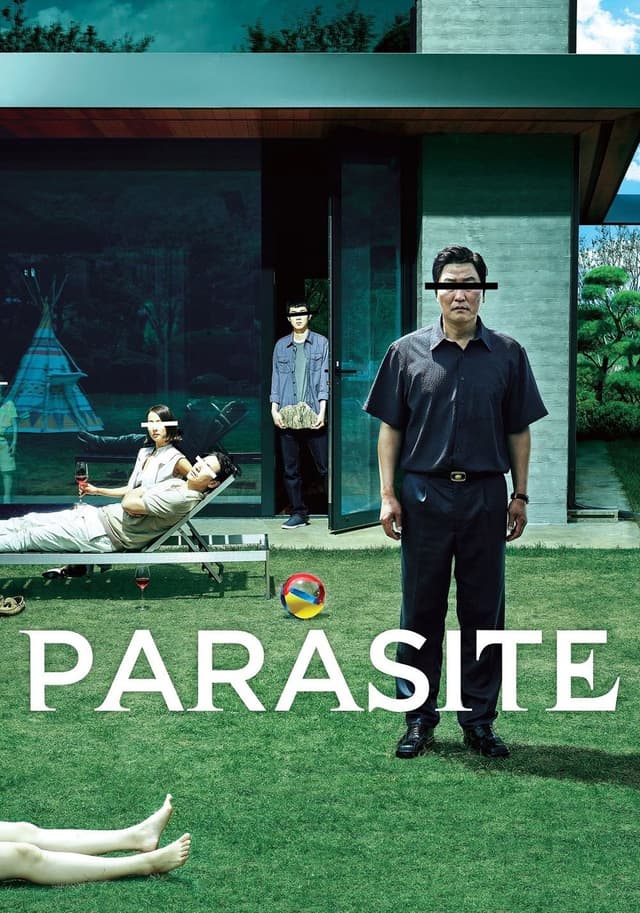
Parasite Budget
 ComedyThrillerDrama2h 13m
Updated
Synopsis
The Kims - mother and father Chung-sook and Ki-taek, and their young adult offspring, son Ki-woo and daughter Ki-jung - are a poor family living in a shabby and cramped half basement apartment in a busy lower working class commercial district of Seoul. Without even knowing it, they, especially Mr. and Mrs. Kim, literally smell of poverty. Often as a collective, they perpetrate minor scams to get by, and even when they have jobs, they do the minimum work required. Ki-woo is the one who has dreams of getting out of poverty by one day going to university. Despite not having that university education, Ki-woo is chosen by his university student friend Min, who is leaving to go to school, to take over his tutoring job to Park Da-hye, who Min plans to date once he returns to Seoul and she herself is in university. The Parks are a wealthy family who for four years have lived in their modernistic house designed by and the former residence of famed architect Namgoong. While Mr. and Mrs. Park are all about status, Mrs. Park has a flighty, simpleminded mentality and temperament, which Min tells Ki-woo to feel comfortable in lying to her about his education to get the job. In getting the job, Ki-woo further learns that Mrs. Park is looking for an art therapist for the Parks' adolescent son, Da-song, Ki-woo quickly recommending his professional art therapist friend "Jessica", really Ki-jung who he knows can pull off the scam in being the easiest liar of the four Kims. In Ki-woo also falling for Da-hye, he begins to envision himself in that house, and thus the Kims as a collective start a plan for all the Kims, like Ki-jung using assumed names, to replace existing servants in the Parks' employ in orchestrating reasons for them to be fired. The most difficult to get rid of may be Moon-gwang, the Parks' housekeeper who literally came with the house - she Namgoong's housekeeper when he lived there - and thus knows all the little nooks and crannies of it better than the Parks themselves. The question then becomes how far the Kims can take this scam in their quest to become their version of the Parks.
What is the budget of Parasite?
"Parasite," a comedy released in 2019, was directed by Bong Joon Ho and stars Song Kang-ho, Lee Sun-kyun. The production budget was $11,363,000, placing it in the low-budget range for comedy productions of its era.
Key Budget Allocation Categories
While specific budget breakdowns are not publicly available, typical cost drivers for a comedy production like this include:
- Talent Salaries & Producing Deals: Established comedic talent can command $15 to 20 million per film, with top-tier stars earning even more through producing credits and backend deals.
- Production & Location Filming: While comedies generally avoid the VFX costs of action films, location shooting in recognizable cities or exotic locales adds meaningful production expense.
- Marketing & P&A (Prints & Advertising): Comedies rely heavily on marketing to build opening-weekend momentum.
- Development: The idea for Parasite originated in 2013.
What were the major cost factors in Parasite?
Several factors contributed to the overall production costs of "Parasite."
- Talent Salaries: Talent Salaries & Producing Deals is one of the primary cost drivers in comedy productions of this scale.
- Production: Production & Location Filming is one of the primary cost drivers in comedy productions of this scale.
- Marketing: Marketing & P&A (Prints & Advertising) is one of the primary cost drivers in comedy productions of this scale.
How Does Parasite's Budget Compare to Similar Films?
At $11,363,000, Parasite sits in the low-budget range. Here is how it compares to productions with a similar budget:
- The Meyerowitz Stories (New and Selected) (2017): Budget $11,400,000
- Bottoms (2023): Budget $11,300,000, Worldwide Gross $12,976,079
- Troll 2 (2025): Budget $11,200,000
- Weathering with You (2019): Budget $11,100,000, Worldwide Gross $192,729,404
- Tell No One (2006): Budget $11,700,000
The median budget for wide-release comedy films in the 2010s ranges from $30 to 80M for mid-budget to $150M+ for tentpoles.
Parasite Box Office Performance
"Parasite" earned $53,369,749 domestically and $257,591,776 worldwide at the box office. Against a production budget of $11,363,000, the film performed strongly at the box office.
A film typically needs to earn approximately twice its production budget to cover marketing and distribution costs. For "Parasite," that break-even threshold was roughly $22,726,000. With worldwide earnings of $257,591,776, the film cleared that threshold comfortably.
Box Office Breakdown
Parasite

At 2166.9%, "Parasite" earned roughly $22.67 for every $1 invested in production.
Parasite Production History
The idea for Parasite originated in 2013. While working on Snowpiercer, Bong was encouraged by a theatre actor friend to write a play. He had been a tutor for the son of a wealthy family in Seoul in his early 20s and considered turning his experience into a stage production.
After completing Snowpiercer, Bong wrote a 15-page film treatment for the first half of Parasite, which his production assistant on Snowpiercer, Han Jin-won, turned into three different drafts of the screenplay. Bong further referenced the design of the wealthy protagonist's house in Kurosawa's 1963 film High and Low as an important visual influence, as was the incident of Christine and Léa Papin to the story,an event wherein two live-in maids murdered their employers in 1930s France. Bong had also tutored for a rich family himself.
Principal photography for Parasite began on 18 May 2018 and ended on 19 September. Filming took place around Seoul and in Jeonju. The director of photography was Hong Kyung-pyo, a well-known South Korean cinematographer who had worked with other well-known directors.
Awards and Recognition
Won 4 Oscars. 309 wins & 261 nominations total
- Academy Award for Best Writing, Original Screenplay: Bong Joon-ho (92nd Academy Awards)
- Academy Award for Best Writing, Original Screenplay: Han Jin-won (92nd Academy Awards)
- Academy Award for Best Director: Bong Joon-ho (92nd Academy Awards)
- Gilde Film Price
- BAFTA Award for Best Original Screenplay (73rd British Academy Film Awards)
- Screen Actors Guild Award for Outstanding Performance by a Cast in a Motion Picture (26th Screen Actors Guild Awards)
- Palme d'Or
- BAFTA Award for Best Film Not in the English Language (73rd British Academy Film Awards)
Critical Reception
On review aggregator Rotten Tomatoes, Parasite has an approval rating of based on 485 reviews. The website's critics consensus reads: "An urgent, brilliantly layered look at timely social themes, Parasite finds writer-director Bong Joon Ho in near-total command of his craft." The site ranked it fifth on their "300 Best Movies of All Time" list in 2025. On Metacritic, 56 compiled reviews from critics were identified as positive, giving the film a weighted average score of 97 out of 100.
Frequently Asked Questions
How much did it cost to make Parasite (2019)?
The production budget was $11,363,000, covering principal photography, cast and crew salaries, locations, sets, post-production, and music. Marketing and distribution (P&A) costs are estimated at an additional $5,681,500 - $9,090,400, bringing the total studio investment to approximately $17,044,500 - $20,453,400.
How much did Parasite (2019) earn at the box office?
Parasite grossed $53,369,749 domestic, $204,222,027 international, totaling $257,591,776 worldwide.
Was Parasite (2019) profitable?
Yes. Against a production budget of $11,363,000 and estimated total costs of ~$28,407,500, the film earned $257,591,776 theatrically - a 2167% ROI on production costs alone.
What were the biggest costs in producing Parasite?
The primary cost drivers were above-the-line talent (Song Kang-ho, Lee Sun-kyun, Cho Yeo-jeong); star comedian salaries, location filming, and aggressive marketing campaigns.
How does Parasite's budget compare to similar comedy films?
At $11,363,000, Parasite is classified as a low-budget production. The median budget for wide-release comedy films in the 2010s ranges from $30 - 80M for mid-budget to $150M+ for tentpoles. Comparable budgets: The Meyerowitz Stories (New and Selected) (2017, $11,400,000); Bottoms (2023, $11,300,000); Troll 2 (2025, $11,200,000).
Did Parasite (2019) go over budget?
There are no widely reported accounts of significant budget overruns for this production. However, studios rarely disclose precise budget overrun figures publicly. The reported production budget reflects the final estimated cost.
What was the return on investment (ROI) for Parasite?
The theatrical ROI was 2166.9%, calculated as ($257,591,776 − $11,363,000) ÷ $11,363,000 × 100. This measures gross revenue against production budget only - it does not account for P&A or exhibitor shares.
What awards did Parasite (2019) win?
Won 4 Oscars. 309 wins & 261 nominations total.
Who directed Parasite and who were the key crew members?
Directed by Bong Joon Ho, written by Bong Joon Ho, Han Jin-won, shot by Hong Kyung-pyo, with music by Jung Jae-il, edited by Yang Jin-mo.
Where was Parasite filmed?
Parasite was filmed in South Korea. Principal photography for Parasite began on 18 May 2018 and ended on 19 September. Filming took place around Seoul and in Jeonju.
Filmmakers
Parasite

Official Trailer
Build budgets like this one in Saturation
Start from an industry-standard feature film template, import the schedule and rates you already have, and let the cost report keep itself current as you spend. Real-time collaboration, no spreadsheets.