My Favorite Martian Budget
 Comedy
Updated
Synopsis
A struggling television news producer who has just been fired by his hard-nosed boss accidentally becomes the guardian of a marooned Martian visitor who can shape-shift, read minds, and produce a sentient gum-creature named Zoot. Their bumbling efforts to keep his alien identity hidden from the government draw a federal task force closer and closer.
What Is the Budget of My Favorite Martian (1999)?
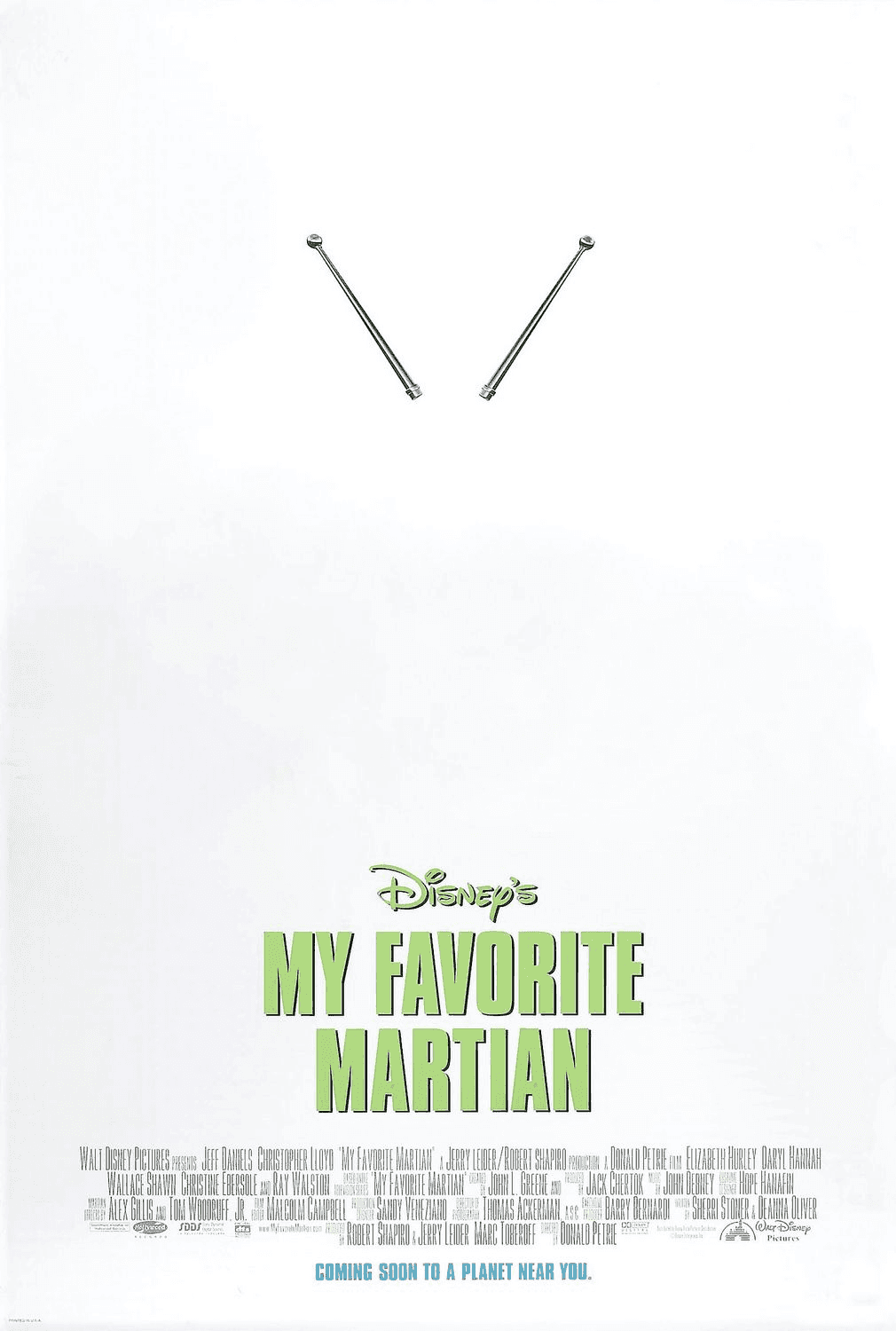
My Favorite Martian (1999), directed by Donald Petrie and distributed by Walt Disney Pictures, was produced on a budget of approximately $65,000,000. Robert Shapiro and Jerry Leider produced through their respective production companies, with Disney providing studio finance and full marketing support. The film was a contemporary feature reboot of the 1963-66 CBS television series of the same name, which had starred Ray Walston as the marooned Martian and Bill Bixby as his human host.
The budget reflected the cost of mounting an effects-heavy family comedy with practical Martian-creature work, alien-craft sequences, and the sentient gum character "Zoot." Jeff Daniels and Christopher Lloyd led the cast at mid-tier comedy-veteran rates, with Daryl Hannah, Elizabeth Hurley, and Wallace Shawn filling out a recognizable supporting tier. The math required the film to clear roughly $140,000,000 worldwide to break even after marketing, a target the film missed by a wide margin. The page's slug references 1963 (the year the original CBS television series debuted) but the actual entry covers the 1999 theatrical feature.
Key Budget Allocation Categories
My Favorite Martian's $65,000,000 budget was distributed across several core production areas:
- Above-the-Line Talent: Jeff Daniels led the cast as Tim O'Hara at a mid-tier leading-actor fee following his work on 101 Dalmatians and Pleasantville. Christopher Lloyd played Uncle Martin at a featured-veteran rate, with Daryl Hannah, Elizabeth Hurley, and Wallace Shawn each commanding standard supporting fees. Ray Walston, the star of the original 1963-66 CBS television series, appeared in a cameo for a separate negotiated fee.
- Visual Effects and Creature Work: The film required extensive VFX coverage for the Martian craft, the shape-shifting alien transformations, antenna gags, and the sentient gum creature Zoot. Industrial Light & Magic handled the bulk of the effects work, with practical creature and animatronic support from Jim Henson's Creature Shop. The VFX budget line was substantial relative to the film's comedic positioning.
- Production Design: The film required futuristic alien-craft interior sets, a network television-station setting (referencing the original series' newspaper-reporter framing while modernizing the lead's occupation), and various practical comedy sets. Production designer Sandy Veneziano led the design team.
- Costume Design and Practical Creature Suit: Costume designer Robert Turturice designed the antenna-bearing Martian costume that Christopher Lloyd wore through much of the film, plus various transformation-stage hybrid costumes for the shape-shifting sequences. The practical creature elements were a defining production design priority.
- Score: Composer John Debney wrote the original score. The soundtrack also featured needle drops including a contemporary remake of the original 1963 television series theme, with associated licensing and recording fees.
- Location and Stage Work: Principal photography took place in Los Angeles, with Disney's soundstages serving as primary studio facilities. The location work was relatively modest, with most major sequences shot on controlled studio environments to accommodate the heavy VFX-integration requirements.
How Does My Favorite Martian's Budget Compare to Similar Films?
At $65,000,000, My Favorite Martian sits in the typical range for late-1990s family-comedy adaptations of vintage television properties. The comparison set illustrates how the cycle's commercial outcomes diverged sharply:
- George of the Jungle (1997): Budget $55,000,000 | Worldwide $174,468,468. Disney's prior Brendan Fraser-led vintage-property adaptation cost $10M less than My Favorite Martian and earned more than four times its worldwide gross, the cycle's clear template success.
- Inspector Gadget (1999): Budget $90,000,000 | Worldwide $134,403,066. Disney's same-year Matthew Broderick-led vintage-property feature cost $25M more than My Favorite Martian and earned more than three times its worldwide gross while still being considered a commercial disappointment.
- The Flintstones (1994): Budget $46,000,000 | Worldwide $341,631,208. Universal's John Goodman-led Hanna-Barbera adaptation cost $19M less than My Favorite Martian and earned roughly eight times its worldwide gross, the cycle's commercial high-water mark.
- Lost in Space (1998): Budget $80,000,000 | Worldwide $136,159,423. New Line's contemporaneous Stephen Hopkins-directed feature reboot cost $15M more than My Favorite Martian and earned roughly 3.4x its worldwide gross.
- Wild Wild West (1999): Budget $175,000,000 | Worldwide $222,104,681. Warner Bros.' Will Smith-Kevin Kline same-year feature reboot cost nearly three times My Favorite Martian and earned 5.6x its worldwide gross, also widely considered a commercial disappointment.
My Favorite Martian Box Office Performance
My Favorite Martian opened on February 12, 1999, debuting to $10,403,121 in its opening weekend across 2,766 theaters, finishing third on the chart behind Message in a Bottle and Office Space's debuts. The opening was below Disney's tracking projections, which had targeted a $13M to $16M debut on the strength of the family-comedy positioning and the school-vacation marketing window. The film posted significant week-two erosion and exited the top ten by its third weekend.
Against a $65,000,000 production budget, My Favorite Martian needed roughly $140,000,000 in worldwide gross to reach profitability when accounting for marketing and distribution costs. Here is the financial breakdown:
Box Office Breakdown
My Favorite Martian

My Favorite Martian returned approximately $0.32 in theatrical revenue for every $1 invested when measured against total estimated production and marketing spend. The domestic share of the gross was $36,851,101 against an international share of just $2,670,063, a 93/7 split that confirmed the property had limited international resonance despite its science-fiction-comedy positioning.
Disney absorbed the substantial loss as part of the studio's broader late-1990s recalibration of its live-action family slate, which had also been disappointed by Inspector Gadget the same year. The combined commercial underperformance of these vintage-property feature reboots accelerated Disney's strategic shift toward animated-franchise extensions and CG-driven family films during the early 2000s.
My Favorite Martian Production History
Development began at Disney in the mid-1990s, building on the studio's success with George of the Jungle and Mr. Magoo as theatrical reboots of vintage television properties. Sherri Stoner and Deanna Oliver wrote the screenplay, with multiple drafts modernizing the original 1963-66 CBS series' newspaper-reporter framing into a contemporary television-news setting. Donald Petrie, coming off The Associate (1996) and earlier comedy work, attached as director in 1997.
Casting was completed in 1998, with Jeff Daniels signing as Tim O'Hara and Christopher Lloyd taking the Uncle Martin role. The casting of Ray Walston, the original 1963-66 series star, for a cameo role was a deliberate continuity gesture that ultimately became one of the film's few elements consistently praised in trade press. Daryl Hannah, Elizabeth Hurley, and Wallace Shawn rounded out the supporting cast through standard theatrical-comedy casting channels.
Principal photography took place in 1998 in California, primarily on Disney's Burbank soundstages with limited Los Angeles location work. The heavy VFX-integration requirements made stage-based production the natural choice for the bulk of the schedule. Industrial Light & Magic and Jim Henson's Creature Shop coordinated extensively with the production team on the practical-digital effects pipeline that would handle the Martian transformations and Zoot creature.
Post-production wrapped in late 1998, and Disney positioned the film for a February 12, 1999 release window timed to leverage Presidents' Day weekend and the late-winter family marketplace. The marketing campaign emphasized Christopher Lloyd's comic-veteran credentials (Back to the Future), the Ray Walston cameo, and the family-friendly science-fiction positioning. Audience tracking was soft throughout the marketing rollout.
Awards and Recognition
My Favorite Martian received no positive industry awards recognition. It was not nominated at the Academy Awards, Golden Globes, BAFTAs, or SAG Awards, and it did not appear in the Saturn Awards' science-fiction categories.
The film received two Razzie Award nominations at the 20th Golden Raspberry Awards, including Worst Remake or Sequel, though it won neither. The film's soundtrack album, anchored by a contemporary remake of the original 1963 television series theme, achieved modest sales in the soundtrack-album market but did not chart meaningfully. The film's legacy is primarily as a regular reference point in discussions of the late-1990s vintage-television-feature-reboot cycle and its consistently disappointing commercial outcomes.
Critical Reception
My Favorite Martian received broadly negative reviews. The film holds a 21% approval rating on Rotten Tomatoes based on 71 critic reviews, with a critical consensus that dismissed it as a noisy, joke-light reboot. On Metacritic, the film scored 30 out of 100, indicating generally unfavorable reviews. Audiences surveyed by CinemaScore gave the film a B-, below the B+ that typically signals viable word-of-mouth for a family release.
Critics broadly objected to the screenplay's reliance on broad slapstick gags, the visual-effects-heavy direction that subordinated the original series' character comedy to set-piece spectacle, and what Roger Ebert called "the regrettable decision to add a talking ball of gum as the film's second comic relief." Ebert awarded the film two stars, while Variety's Joe Leydon noted that "Christopher Lloyd brings considerable craft to a role that nonetheless reduces the original's wit to mugging and pratfalls."
Among family-film publications, the reception was somewhat more forgiving, with several reviewers acknowledging the film's technical effects competence and Jeff Daniels' grounded performance. The Ray Walston cameo received almost universal praise as the production's most touching element, with multiple critics noting the actor's warmth and the meta-textual weight of the original series star making a brief appearance in the feature reboot. The mixed-to-negative critical response, combined with the commercial collapse, has cemented My Favorite Martian as a regular reference point in discussions of the late-1990s vintage-television-feature-reboot cycle.
Frequently Asked Questions
How much did it cost to make My Favorite Martian (1999)?
The production budget was approximately $65,000,000. The film was financed by Walt Disney Pictures with producers Robert Shapiro and Jerry Leider attached, and distributed worldwide by Disney.
How much did My Favorite Martian earn at the box office?
The film grossed $36,851,101 domestically and $2,670,063 internationally, for a worldwide total of $39,521,164. It opened to $10,403,121 across 2,766 theaters on February 12, 1999, finishing third on the chart.
Was My Favorite Martian a box office bomb?
Yes. Against a $65M production budget and an estimated $50M to $60M in marketing spend, the film returned approximately $0.32 in worldwide gross for every $1 invested, generating a theatrical loss of roughly $75M to $85M. It is widely cited as one of the more decisive losses in Disney's late-1990s vintage-television feature reboot cycle.
Why does the slug say 1963 if the film is from 1999?
The slug references 1963, the year the original CBS television series My Favorite Martian debuted (running from 1963 to 1966 with Ray Walston). The CMS entry, the budget figure, the cast, and the box office data all refer to the 1999 theatrical feature directed by Donald Petrie. The slug is preserved for SEO continuity.
Who directed My Favorite Martian?
Donald Petrie directed the 1999 feature film. Petrie had previously directed Mystic Pizza (1988), Grumpy Old Men (1993), and The Associate (1996), and he would later direct How to Lose a Guy in 10 Days (2003).
Is the original Ray Walston in the 1999 film?
Yes. Ray Walston, the star of the original 1963-66 CBS television series My Favorite Martian, appeared in a cameo in the 1999 feature reboot. The casting was a deliberate continuity gesture that received almost universal critical praise as one of the production's most touching elements.
Where was My Favorite Martian (1999) filmed?
Principal photography took place in 1998 in California, primarily on Walt Disney Pictures' Burbank soundstages with limited Los Angeles location work. The heavy visual-effects-integration requirements made stage-based production the natural choice for the bulk of the schedule.
Who voices Zoot the gum in My Favorite Martian?
Wayne Knight (Seinfeld's Newman, the voice of Al McWhiggin in Toy Story 2) voiced the sentient gum creature Zoot. The Zoot character was a Disney-original creation for the feature and did not appear in the 1963-66 television series.
How does My Favorite Martian compare to other vintage-property reboots?
My Favorite Martian earned $39.5M worldwide on $65M. George of the Jungle (1997) earned $174.5M on $55M. The Flintstones (1994) earned $341.6M on $46M. Inspector Gadget (1999) earned $134.4M on $90M. My Favorite Martian was the cycle's most decisive commercial loss in this comparison set.
What did critics think of My Favorite Martian?
The film holds a 21% approval rating on Rotten Tomatoes (71 reviews) and scored 30 out of 100 on Metacritic. Audiences gave it a B- CinemaScore. Roger Ebert awarded two stars, objecting to the broad slapstick and "the regrettable decision to add a talking ball of gum as the film's second comic relief."
Filmmakers
My Favorite Martian

Official Trailer
Build budgets like this one in Saturation
Start from an industry-standard feature film template, import the schedule and rates you already have, and let the cost report keep itself current as you spend. Real-time collaboration, no spreadsheets.