
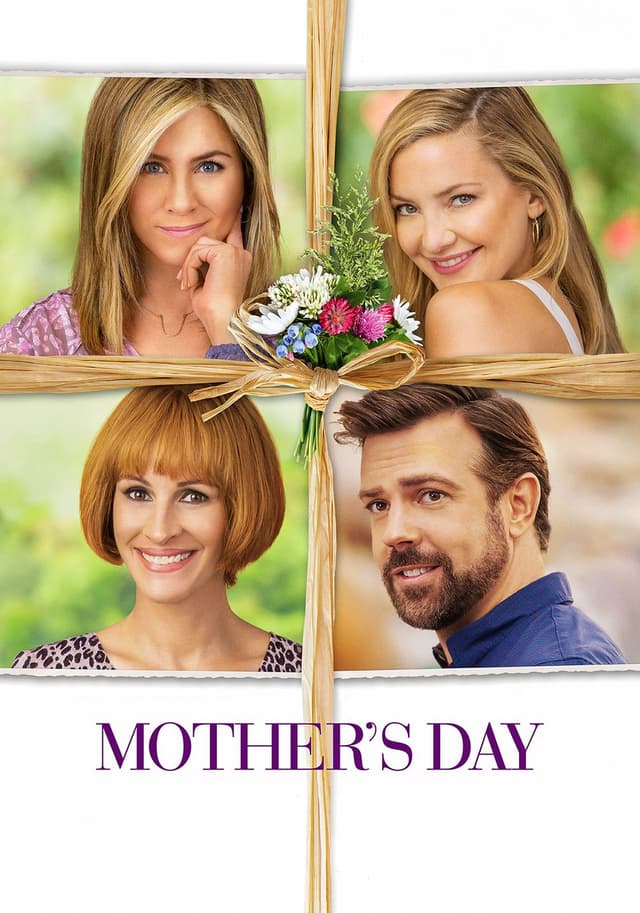
Mother’s Day Budget
 ComedyDramaRomance1h 58m
Updated
Synopsis
Intertwining stories revolve around a television host, a divorcee looking for love and a woman who wants to strengthen her relationship with her mother.
What Is the Budget of Mother's Day?
Mother's Day (2016), directed by Garry Marshall and distributed by Open Road Films, had a confirmed production budget of approximately $25,000,000. The film was produced by Rice Films, GulfStream Pictures, May Day Movies, and Triad Films as the third film in Garry Marshall's holiday ensemble series, following Valentine's Day (2010) and New Year's Eve (2011). The $25 million budget reflects the cost structure of an ensemble romantic comedy with three above-the-line stars, a large supporting cast, and the location production costs of filming across multiple settings.
At $25,000,000, Mother's Day is a modest investment for a star-driven ensemble comedy distributed through mainstream theatrical channels. The budget is lower than the two prior Marshall holiday films, reflecting both the diminishing commercial returns of the series after Valentine's Day's extraordinary performance and a discipline around production costs that the Open Road Films distribution deal required.
Key Budget Allocation Categories
Mother's Day's $25 million budget was distributed across the requirements of an ensemble romantic comedy with major above-the-line talent:
- Above-the-Line Cast — Jennifer Aniston, Julia Roberts, and Kate Hudson are the primary above-the-line investment, with three established comedy stars whose combined commercial profile drives the film's theatrical positioning. Jason Sudeikis adds a male lead of significant comedic credibility. At $25 million total, the ensemble cast compensation required meaningful trade-offs in production scale, with each star working at below-market rates relative to their individual drawing power.
- Location Production — The film was shot primarily in Atlanta, Georgia, doubling for Atlanta and other locations. Multiple distinct production environments representing the different characters' lives require location logistics, set dressing, and production design investment across a wide range of domestic settings. Georgia's film tax incentives reduced the effective cost of location production relative to filming in higher-cost markets.
- Multi-Strand Production Scheduling — An ensemble comedy with multiple intersecting storylines requires scheduling that efficiently captures each narrative thread while managing the availability of three above-the-line stars. The logistical complexity of coordinating Jennifer Aniston, Julia Roberts, and Kate Hudson across a single production is a meaningful cost driver that single-lead productions at this budget do not face.
- Garry Marshall's Production Infrastructure — Marshall's established production team, built across Valentine's Day and New Year's Eve, provided production efficiency that reduced costs relative to a first-time production of this scale. The repeat relationships with cinematographer Charles Minsky and editor Bruce Green reflect the experienced infrastructure that enables a $25 million budget to support a three-star ensemble.
How Does Mother's Day's Budget Compare to Similar Films?
At $25,000,000, Mother's Day is the lowest-budget entry in Garry Marshall's holiday ensemble trilogy and sits within the mid-budget range for star-driven romantic comedies. The relevant comparisons:
- Valentine's Day (2010) — Budget $52,000,000 | Worldwide $216,500,000. The first Garry Marshall holiday ensemble that defined the format. Valentine's Day spent more than twice as much and achieved nearly four and a half times the result, establishing the commercial ceiling for the format that Mother's Day could not replicate. The comparison illustrates the franchise fatigue that set in after New Year's Eve underperformed.
- New Year's Eve (2011) — Budget $56,000,000 | Worldwide $142,000,000. The second Marshall holiday ensemble that underperformed relative to Valentine's Day's extraordinary baseline. Mother's Day at less than half the budget produced a third of the gross, continuing the diminishing commercial returns of the holiday ensemble format with each successive entry.
- Bridesmaids (2011) — Budget $32,500,000 | Worldwide $288,400,000. The female-driven comedy that redefined what was commercially possible in the genre demonstrates the ceiling available to ensemble comedies when the premise achieves mainstream cultural resonance. Mother's Day's similar budget produced a dramatically smaller result, reflecting the difference between a culturally necessary film and a franchise installment.
- Book Club (2018) — Budget $14,000,000 | Worldwide $104,400,000. The female ensemble comedy at roughly half the budget that outperformed Mother's Day by more than twice demonstrates how a sharper premise and the right cultural moment can drive outsized returns on modest investment in the female-led comedy space.
- Bad Moms (2016) — Budget $20,000,000 | Worldwide $183,300,000. The female comedy released the same year that became a cultural event at a lower budget demonstrates the commercial opportunity in the female comedy market that Mother's Day, with its more conventional ensemble drama approach, could not access.
Mother's Day Box Office Performance
Mother's Day earned $32,492,859 domestically and $48,782,670 worldwide at the box office. The film opened in April 2016 to $8,374,914 in its opening weekend from 3,003 theaters, well below the opening weekend performance of Valentine's Day ($56,260,707) and New Year's Eve ($13,749,240). The film skewed heavily domestic, with 67% of its worldwide gross coming from North American theaters, reflecting the genre's limited international crossover appeal compared to event films.
A film typically needs to earn approximately twice its production budget to cover marketing and distribution costs. For Mother's Day, that break-even threshold was roughly $50,000,000. Based on its Open Road Films wide release, Prints and Advertising costs are estimated at approximately $18,000,000, bringing the total estimated investment to around $43,000,000. With worldwide earnings of $48,782,670, the film cleared that threshold marginally.
Box Office Breakdown
Mother’s Day

At approximately +13%, Mother's Day returned roughly $1.13 for every $1 invested during its theatrical run, a marginally profitable result that likely required home video, cable, and streaming revenue to fully clear its investment. The result confirmed the diminishing commercial returns of the Marshall holiday ensemble format and effectively ended the series, as no further installments have been produced.
Mother's Day Production History
Mother's Day was the third and final entry in Garry Marshall's holiday ensemble series, following Valentine's Day (2010) and New Year's Eve (2011). Marshall assembled a new roster of ensemble talent around Jennifer Aniston, Julia Roberts, and Kate Hudson, working with screenwriters Lily Hollander, Tom Hines, Anya Kochoff, and Matt Walker to build multiple intersecting storylines around the Mother's Day holiday. The production filmed primarily in Atlanta, Georgia, using the state's film tax credit infrastructure to manage costs on a budget lower than either prior Marshall holiday film.
The film was released on April 29, 2016, positioned in the weekend immediately preceding Mother's Day to capitalize on the holiday's emotional resonance with the female audience that had driven the series' commercial performance. Garry Marshall passed away in July 2016, making Mother's Day the final film of his career. The result, while modest relative to Valentine's Day's extraordinary performance, stands as the closing chapter of a director whose work defined the commercial ensemble romantic comedy for two decades.
Awards and Recognition
Mother's Day received 1 win and 6 nominations across awards circuits, primarily within genre categories recognizing female-led ensemble comedy. The film holds additional significance as the final directorial credit of Garry Marshall, whose career spanned Pretty Woman, Runaway Bride, and the holiday ensemble series. Julia Roberts received recognition from fan and genre awards for her performance as Miranda Collins. The film's legacy is primarily defined by its place as the closing work of a major Hollywood director rather than by its individual awards recognition.
Critical Reception
Critical reception for Mother's Day was largely negative. Critics pointed to the formula-driven ensemble structure, the thinness of the characters relative to the film's running time, and the feeling that the holiday ensemble format had exhausted its commercial logic by its third installment. The film's handling of its diverse ensemble drew particular critical attention, with reviewers noting that some of the storylines felt tonally disconnected from the warm holiday comedy the film was positioned as.
Audience reception was more favorable than critical scores, consistent with the ensemble romantic comedy genre where the core female audience responds to the cast and the emotional beats independently of formal critical assessment. The $48,782,670 worldwide result represents an audience that showed up for Jennifer Aniston, Julia Roberts, and Kate Hudson in a Garry Marshall film, even as the format's commercial peak had clearly passed. The result was sufficient to clear the production's investment, though not to sustain the franchise.
Frequently Asked Questions
How much did Mother's Day (2016) cost to make?
The production budget was $25,000,000. Open Road Films distributed the ensemble comedy, with Bonafide Films co-financing the project that completed Garry Marshall's informal trilogy of holiday-themed romantic comedies.
How much did Mother's Day earn at the box office?
Mother's Day grossed $32,500,000 domestically and $15,800,000 internationally, for a worldwide total of approximately $48,300,000. It opened to a soft $8,400,000 on April 29, 2016, finishing fourth behind Captain America: Civil War.
Who stars in Mother's Day?
The ensemble cast includes Jennifer Aniston as Sandy, Kate Hudson as Jesse, Julia Roberts as Miranda, Jason Sudeikis as Bradley, Britt Robertson as Kristin, Timothy Olyphant in a supporting role, and Margo Martindale in a notable supporting turn.
Was Mother's Day Garry Marshall's last film?
Yes. Mother's Day was Garry Marshall's final feature as director before his death from complications of pneumonia and a stroke on July 19, 2016, at age 81. The film was released approximately ten weeks before his death.
How does Mother's Day connect to Valentine's Day and New Year's Eve?
Mother's Day completed Garry Marshall's informal holiday-themed romantic-comedy trilogy. Valentine's Day (2010) grossed $216,500,000 worldwide against a $52,000,000 budget, and New Year's Eve (2011) grossed $142,000,000 worldwide against a $56,000,000 budget. Mother's Day was made for less than half their budgets but performed below either of them.
Where was Mother's Day filmed?
Principal photography took place in Atlanta, Georgia, taking advantage of the state's 30% film production tax credit. Atlanta doubled for the unnamed Texas city in the film's story, with practical exteriors selected to support the warm-climate setting.
What did critics think of Mother's Day?
Reviews were strongly negative, with a 7% approval rating on Rotten Tomatoes and an 18 out of 100 score on Metacritic. Critics objected to the disconnected storylines and tonal mismatches between the comedic and serious sub-plots. Audiences gave the film a B+ CinemaScore.
Was Mother's Day a box office bomb?
Yes. Against the $25,000,000 production budget and an estimated $25,000,000 to $30,000,000 in marketing spend, the worldwide gross of $48,300,000 fell well short of the 2.5x theatrical-profitability rule. Home video and cable broadcast revenue have brought the film closer to aggregate break-even, but the theatrical result ended the holiday-themed cycle.
Did Mother's Day win any awards?
The film received four nominations at the 37th Golden Raspberry Awards, including Worst Picture, Worst Director for Garry Marshall, and Worst Supporting Actor for Larry Miller. It did not receive nominations from mainstream award bodies.
Where can I stream Mother's Day (2016)?
The film is available for digital rental and purchase on Amazon Prime Video, Apple TV, and Google Play. It has periodically rotated through Netflix, Hulu, and Pluto TV on the subscription tier since its 2016 home video debut.
Official Trailer
Build budgets like this one in Saturation
Start from an industry-standard feature film template, import the schedule and rates you already have, and let the cost report keep itself current as you spend. Real-time collaboration, no spreadsheets.