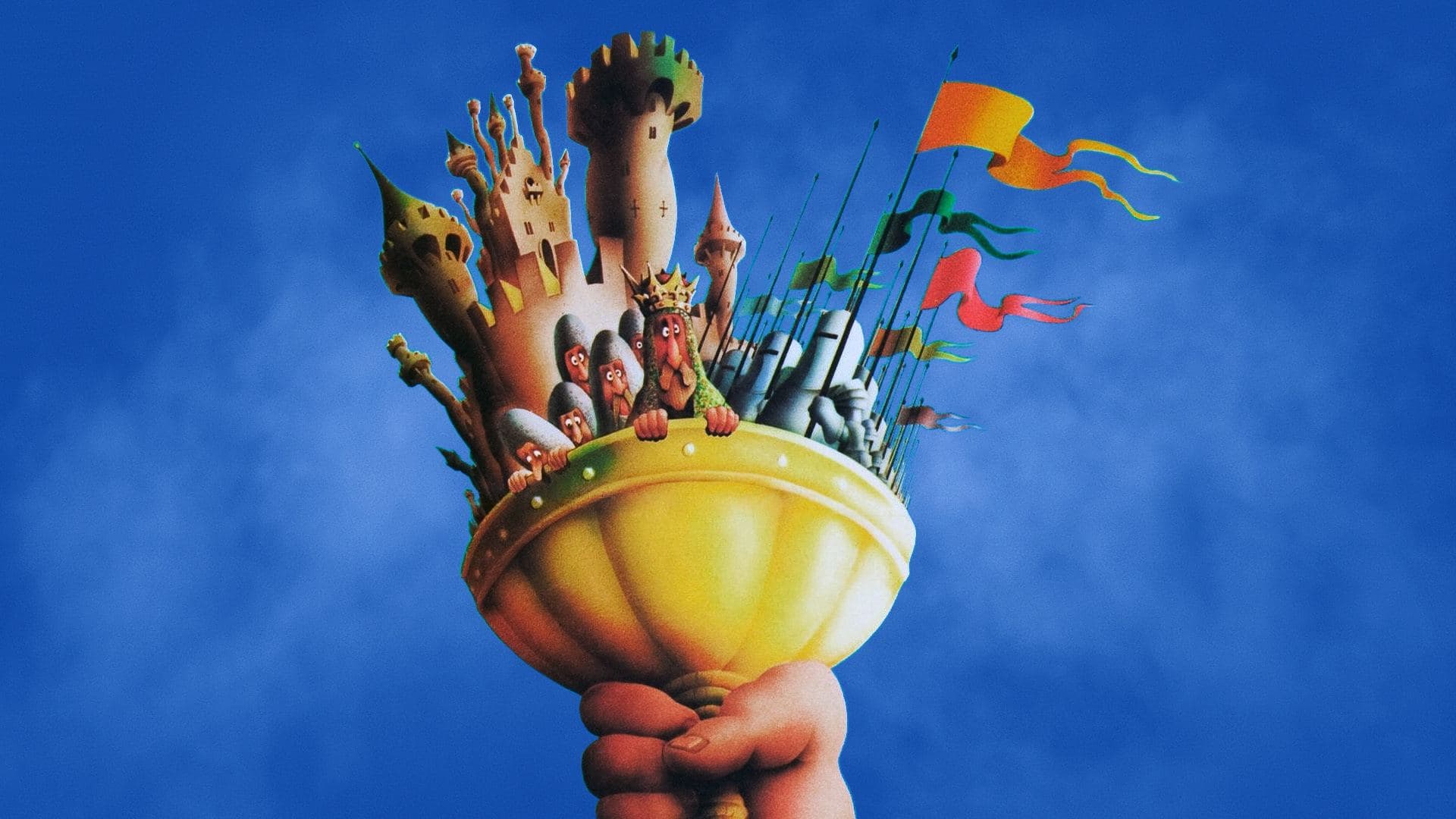
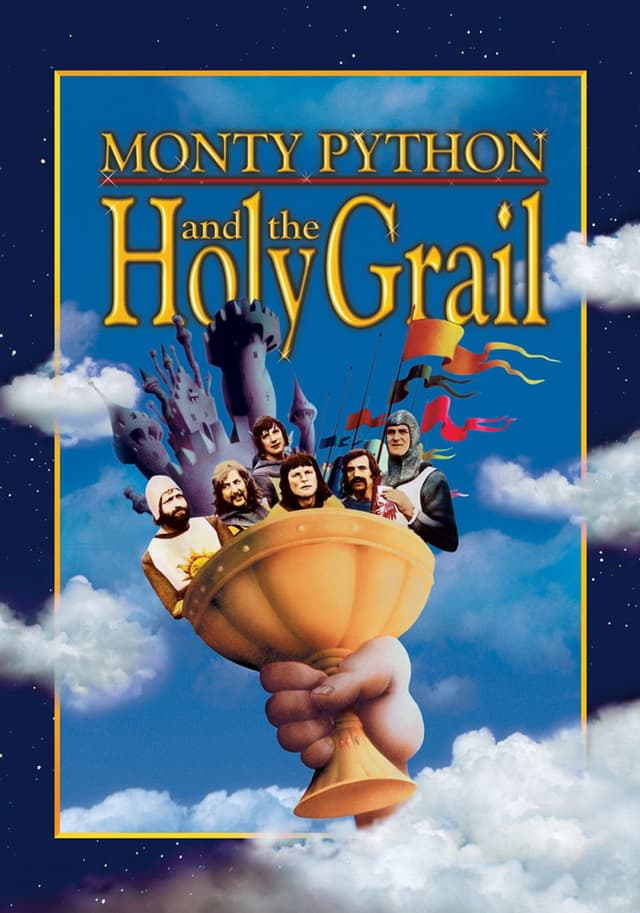
Monty Python and the Holy Grail Budget
 AdventureComedyFantasy1h 31m
Updated
Synopsis
History is turned on its comic head when, in tenth-century England, King Arthur travels the countryside to find knights who will join him at the Round Table in Camelot. Gathering up the men is a tale in itself but after a bit of a party at Camelot, many decide to leave only to be stopped by God, who sends them on a quest: to find the Holy Grail. After a series of individual adventures, the knights are reunited but must face a wizard named Tim the Enchanter, killer rabbits and lessons in the use of holy hand grenades. Their quest comes to an end however when the Police intervene - just what you would expect in a Monty Python movie.
What is the budget of Monty Python and the Holy Grail?
"Monty Python and the Holy Grail," an adventure released in 1975, was directed by Terry Gilliam, Terry Jones and stars Graham Chapman, John Cleese. The production budget was $400,000, placing it in the micro-budget range for adventure productions of the 1970s.
Key Budget Allocation Categories
While specific budget breakdowns are not publicly available, typical cost drivers for an adventure production like this include:
- Stunts, Action Sequences & Visual Effects: Action films allocate a substantial portion of their budget to choreographing and executing practical stunts, pyrotechnics, and CGI-heavy sequences.
- Above-the-Line Talent (Cast & Director): A-list talent commands significant upfront fees plus backend participation.
- Production Design, Sets & Locations: Action films frequently require multiple international shooting locations, large-scale set construction, vehicle acquisitions and modifications, and specialized equipment , all of which drive production costs well above those of dialogue-driven genres.
- Filming & Locations: Monty Python and the Holy Grail was mostly shot on location in Scotland, particularly around Doune Castle, Glen Coe, and the privately owned Castle Stalker.
What were the major cost factors in Monty Python and the Holy Grail?
Several factors contributed to the overall production costs of "Monty Python and the Holy Grail."
- Stunts: Stunts, Action Sequences & Visual Effects is one of the primary cost drivers in adventure productions of this scale.
- Above-the-Line Talent (Cast: Above-the-Line Talent (Cast & Director) is one of the primary cost drivers in adventure productions of this scale.
- Production Design: Production Design, Sets & Locations is one of the primary cost drivers in adventure productions of this scale.
How Does Monty Python and the Holy Grail's Budget Compare to Similar Films?
At $400,000, Monty Python and the Holy Grail sits in the micro-budget range. Here is how it compares to productions with a similar budget:
- Cries and Whispers (1972): Budget $400,000
- Napoleon Dynamite (2004): Budget $400,000, Worldwide Gross $46,118,097
- 12 Angry Men (1957): Budget $397,751, Worldwide Gross $4,360,000
- Threads (1985): Budget $420,000
- A Matter of Life and Death (1946): Budget $450,000, Worldwide Gross $1,750,000
The median budget for wide-release adventure films in the era ranges from $30 to 80M for mid-budget to $150M+ for tentpoles.
Monty Python and the Holy Grail Box Office Performance
"Monty Python and the Holy Grail" earned $2,562,392 domestically and $5,763,644 worldwide at the box office. Against a production budget of $400,000, the film performed strongly at the box office.
A film typically needs to earn approximately twice its production budget to cover marketing and distribution costs. For "Monty Python and the Holy Grail," that break-even threshold was roughly $800,000. With worldwide earnings of $5,763,644, the film cleared that threshold comfortably.
Box Office Breakdown
Monty Python and the Holy Grail

At 1340.9%, "Monty Python and the Holy Grail" earned roughly $14.41 for every $1 invested in production.
Monty Python and the Holy Grail Production History
Monty Python and the Holy Grail was mostly shot on location in Scotland, particularly around Doune Castle, Glen Coe, and the privately owned Castle Stalker. The many castles seen throughout the film were mainly either Doune Castle shot from different angles or hanging miniatures. There are several exceptions to this: the first exterior shot of a castle at the beginning of the film is Kidwelly Castle in South Wales, and the single exterior shot of the Swamp Castle during "Tale of Sir Lancelot" is Bodiam Castle in East Sussex; all subsequent shots of the exterior and interior of those scenes were filmed at Doune Castle.
In addition to several songs written by Python regular Neil Innes, several pieces of music were licensed from De Wolfe Music Library. These include: * "Wide Horizon", composed by Pierre Arvay; used during the opening titles. * "Ice Floe 9", composed by Pierre Arvay; used during the opening titles.
Awards and Recognition
2 wins & 2 nominations total
Critical Reception
Contemporary reviews were mixed. Vincent Canby of The New York Times wrote in a favourable review that the film had "some low spots," but had gags which were "nonstop, occasionally inspired and should not be divulged, though it's not giving away too much to say that I particularly liked a sequence in which the knights, to gain access to an enemy castle, come up with the idea of building a Trojan rabbit." Charles Champlin of the Los Angeles Times was also positive, writing that the film, "like Mad comics, is not certain to please every taste.
Frequently Asked Questions
How much did it cost to make Monty Python and the Holy Grail (1975)?
The production budget was $400,000, covering principal photography, cast and crew salaries, locations, sets, post-production, and music. Marketing and distribution (P&A) costs are estimated at an additional $200,000 - $320,000, bringing the total studio investment to approximately $600,000 - $720,000.
How much did Monty Python and the Holy Grail (1975) earn at the box office?
Monty Python and the Holy Grail grossed $2,562,392 domestic, $3,201,252 international, totaling $5,763,644 worldwide.
Was Monty Python and the Holy Grail (1975) profitable?
Yes. Against a production budget of $400,000 and estimated total costs of ~$1,000,000, the film earned $5,763,644 theatrically - a 1341% ROI on production costs alone.
What were the biggest costs in producing Monty Python and the Holy Grail?
The primary cost drivers were above-the-line talent (Graham Chapman, John Cleese, Eric Idle); visual effects, practical stunts, and A-list talent compensation.
How does Monty Python and the Holy Grail's budget compare to similar adventure films?
At $400,000, Monty Python and the Holy Grail is classified as a ultra-low-budget production. The median budget for wide-release adventure films in the era ranges from $30 - 80M for mid-budget to $150M+ for tentpoles. Comparable budgets: Cries and Whispers (1972, $400,000); Napoleon Dynamite (2004, $400,000); 12 Angry Men (1957, $397,751).
Did Monty Python and the Holy Grail (1975) go over budget?
There are no widely reported accounts of significant budget overruns for this production. However, studios rarely disclose precise budget overrun figures publicly. The reported production budget reflects the final estimated cost.
What was the return on investment (ROI) for Monty Python and the Holy Grail?
The theatrical ROI was 1340.9%, calculated as ($5,763,644 − $400,000) ÷ $400,000 × 100. This measures gross revenue against production budget only - it does not account for P&A or exhibitor shares.
What awards did Monty Python and the Holy Grail (1975) win?
2 wins & 2 nominations total.
Who directed Monty Python and the Holy Grail and who were the key crew members?
Directed by Terry Gilliam, Terry Jones, written by Graham Chapman, John Cleese, Eric Idle, Terry Gilliam, shot by Terry Bedford, edited by John Hackney.
Where was Monty Python and the Holy Grail filmed?
Monty Python and the Holy Grail was filmed in United Kingdom. Monty Python and the Holy Grail was mostly shot on location in Scotland, particularly around Doune Castle, Glen Coe, and the privately owned Castle Stalker. The many castles seen throughout the film were mainly either Doune Castle shot from different angles or hanging miniatures.
Filmmakers
Monty Python and the Holy Grail

Official Trailer
Build budgets like this one in Saturation
Start from an industry-standard feature film template, import the schedule and rates you already have, and let the cost report keep itself current as you spend. Real-time collaboration, no spreadsheets.