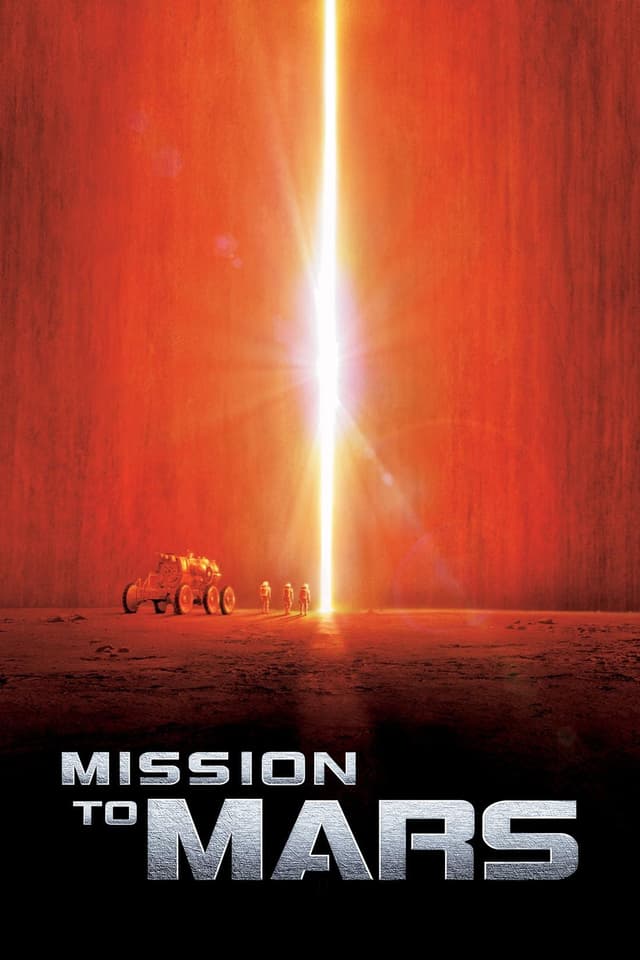
Mission to Mars Budget
 Science FictionAdventureMystery1h 54m
Updated
Synopsis
When the first manned mission to Mars meets with a catastrophic and mysterious disaster after reporting an unidentified structure, a rescue mission is launched to investigate the tragedy and bring back any survivors. Commander Jim McConnell leads a team of astronauts on a perilous journey across the void of space, only to discover that the truth about Mars and humanity's origins is far stranger than they imagined.
What Is the Budget of Mission to Mars (2000)?
Mission to Mars (2000), directed by Brian De Palma and released by Touchstone Pictures, carried a production budget of $100,000,000. The film was one of two competing Mars-themed science fiction productions released in 2000, alongside Warner Bros.' Red Planet, and both studios committed substantial resources to capture the post-Apollo nostalgia that had re-ignited with the success of films such as Apollo 13 and Contact.
De Palma's project was set up at Disney's Touchstone banner, giving it the marketing machinery of a major studio tentpole. The $100 million budget reflected the scale of the visual effects ambition: over 400 visual effects technicians across multiple houses including Industrial Light and Magic, Dream Quest Images, and Tippett Studio contributed to the film's alien landscapes, zero-gravity sequences, and climactic DNA helix imagery. Unlike many effects-heavy productions of the era, Mission to Mars leaned on practical models and photorealistic compositing alongside computer-generated imagery.
Key Budget Allocation Categories
The $100,000,000 production budget was allocated across several high-cost departments:
- Visual Effects: The single largest cost center. Over 400 VFX artists contributed to sequences including zero-gravity environments, Mars surface exploration, a massive sandstorm sequence, and the film's signature DNA strand reveal. Multiple effects houses were used simultaneously.
- Cast and Above-the-Line Talent: The ensemble included Gary Sinise, Tim Robbins, Don Cheadle, Connie Nielsen, and Jerry O'Connell, all established names requiring competitive compensation.
- Production Design and Sets: The team constructed elaborate interior spacecraft sets, Mars surface environments, and the iconic Mission Control rooms. Much of the filming took place on stages in Vancouver, British Columbia.
- Practical Effects and Zero-G Simulation: Wirework, gimbal rigs, and underwater filming simulated weightlessness for astronaut sequences, adding significantly to below-the-line costs.
- Location Shooting: Unit photography in Jordan's Wadi Rum desert and the Canary Islands supplemented stage work to achieve authentic alien-world textures.
- Score and Sound Design: Ennio Morricone composed the film's orchestral score, his first full Hollywood studio assignment in several years, commanding commensurate fees.
How Does Mission to Mars's Budget Compare to Similar Films?
At $100 million, Mission to Mars stood among the most expensive science fiction films of its era. Its commercial outcome placed it in a cautionary tier of over-budgeted spectacles that failed to find mainstream audiences:
- Contact (1997): Budget $90M | Worldwide $171.1M. Robert Zemeckis's adaptation of Carl Sagan's novel used a similar hard-science approach and generated a much stronger return, suggesting that intellectual science fiction could succeed commercially.
- Mission to Mars (2000): Budget $100M | Worldwide $111.0M. The film barely covered its production cost at the worldwide box office, with marketing and distribution costs pushing it firmly into loss territory.
- Red Planet (2000): Budget $80M | Worldwide $17.4M. The competing Mars film released the same year performed even worse, losing nearly all of its investment.
- Armageddon (1998): Budget $140M | Worldwide $553.7M. Michael Bay's more visceral take on space disaster showed how action-driven spectacle could turn massive budgets into massive profits.
- Interstellar (2014): Budget $165M | Worldwide $701.7M. Christopher Nolan's cerebral space epic demonstrated that thoughtful science fiction could dominate the box office when executed with emotional storytelling.
Mission to Mars Box Office Performance
Mission to Mars opened on March 10, 2000, across 2,751 North American theaters, earning $22,855,247 in its opening weekend. That represented one of the stronger March opening weekends of its era, ranking behind only Teenage Mutant Ninja Turtles and Liar Liar at that time. However, the film dropped approximately 50% in its second weekend, a steep decline that indicated weak audience enthusiasm and limited repeat viewing potential.
Box Office Breakdown
Mission to Mars

Mission to Mars generated approximately $1.11 for every $1 invested in production, but when marketing expenditures are included, the film operated at a significant deficit. Domestic receipts of $60.88 million and international receipts of $50.1 million were both insufficient to cover the combined production and marketing outlay. The film ranked 41st at the 2000 box office.
A notable cultural footnote: while American and British critics largely dismissed the film, French cinephile publication Cahiers du Cinema ranked Mission to Mars fourth in its list of the ten best films of 2000, and the film screened out of competition at the Cannes Film Festival. De Palma has defended the project as a work of personal cinema that was mishandled by studio marketing.
Mission to Mars Production History
Mission to Mars originated as an original screenplay developed in-house at Touchstone Pictures during the late 1990s, when Hollywood studios were competing to capitalize on renewed public interest in Mars exploration following the 1997 Mars Pathfinder mission. Director Gore Verbinski was originally attached to helm the project but departed when budget constraints made it impossible to realize his vision for the material.
Brian De Palma, who had not directed a large-scale science fiction film since his career beginnings, took over the project with the script and cast already substantially finalized. De Palma noted publicly that the production required additional financing beyond initial estimates, with much of the overage absorbed by the visual effects pipeline. De Palma was drawn to the project's visual possibilities, particularly the opportunity to craft extended sequences of silent, contemplative space travel in homage to Stanley Kubrick's 2001: A Space Odyssey.
Principal photography took place primarily in Vancouver, British Columbia, using extensive stage work complemented by location photography in Jordan and the Canary Islands. The production employed more than 400 visual effects artists across ILM, Dream Quest Images, and Tippett Studio simultaneously. The cage-like DNA helix sequence at the film's climax required months of development and was the most technically demanding single set piece. Composer Ennio Morricone scored the film, lending a lyrical, melancholic quality that critics noted was often at odds with the film's pacing.
Casting went through several iterations. Tim Robbins and Gary Sinise were confirmed early, while Don Cheadle was cast as the stranded astronaut Luke Graham. The film's script was revised multiple times during production, with De Palma pushing for a slower, more meditative structure that Disney executives were skeptical would attract mainstream audiences. Those tensions between commercial expectations and De Palma's artistic instincts contributed to a film that satisfied neither camp fully.
Awards and Recognition
Mission to Mars received limited awards recognition, with most formal nominations arriving in technical categories:
- Saturn Award nomination, Best Science Fiction Film (2001): Nominated by the Academy of Science Fiction, Fantasy and Horror Films.
- Visual Effects Society: The film's effects work was recognized by industry professionals, particularly the zero-gravity sequences and the Mars surface environments.
- Cahiers du Cinema Top 10 (2000): The French film journal ranked Mission to Mars fourth among the best films of 2000, a distinction that distinguished it from American critical consensus.
- Cannes Film Festival (2000): The film screened out of competition, giving it a degree of prestige exposure despite its mixed commercial and critical reception.
The film received a Golden Raspberry nomination for Worst Director for De Palma, though he lost that dubious honor to Roger Christian for Battlefield Earth. Mission to Mars has since accumulated a degree of cult appreciation among fans of De Palma's filmography and devotees of old-fashioned, effects-driven science fiction.
Critical Reception
Mission to Mars was broadly panned by American critics on release. On Rotten Tomatoes the film holds a 24% approval rating based on 115 reviews, with an average score of 4.1 out of 10. Metacritic assigned a score of 34 out of 100 based on 36 reviews. Audiences at CinemaScore gave the film a notably rare C-, indicating widespread disappointment among general moviegoers.
Common criticisms focused on the screenplay's dialogue and the uneven pacing. Reviewers noted that an accomplished ensemble including Tim Robbins, Gary Sinise, and Don Cheadle was given stilted astronaut jargon that many compared to parody. One widely cited review observed that the performers were 'asked to speak some awfully clunky lines' that undercut the film's otherwise impressive visual achievements.
Positive notices, though rare among mainstream English-language critics, came from unexpected quarters. Cahiers du Cinema's favorable placement reflected a view held by some cinephiles that De Palma's formal visual control, his use of widescreen compositions and extended single-take sequences, represented a genuine artistic statement regardless of the script's failings. De Palma himself has said that Mission to Mars is one of his personal favorites among his own films, and a reassessment has gradually emerged in retrospective criticism that focuses on its visual ambition rather than its narrative shortcomings.
Frequently Asked Questions
What was the production budget for Mission to Mars (2000)?
Mission to Mars had a production budget of $100,000,000, making it one of the most expensive science fiction films of its era. The budget was driven primarily by extensive visual effects work involving over 400 technicians across multiple studios including Industrial Light and Magic and Tippett Studio.
How much did Mission to Mars make at the box office?
Mission to Mars earned $110,983,407 worldwide, consisting of $60,883,407 domestically and $50,100,000 internationally. The film opened to $22.8 million in its first weekend but dropped sharply in subsequent weeks. Against a $100 million production budget plus significant marketing costs, the film was a financial disappointment for Disney's Touchstone Pictures.
Was Mission to Mars a box office flop?
Yes. While Mission to Mars technically earned more than its $100 million production budget at the worldwide box office, the combined production and marketing costs of approximately $140 million meant the film lost money in theatrical release. It ranked 41st at the 2000 box office and is widely considered a commercial failure.
Who directed Mission to Mars?
Mission to Mars was directed by Brian De Palma, who took over the project after Gore Verbinski departed due to budget constraints. De Palma has cited the film as a personal favorite in his filmography, though it received negative reviews from most American critics. The film screened out of competition at Cannes and was ranked fourth on Cahiers du Cinema's list of the best films of 2000.
What is Mission to Mars's Rotten Tomatoes score?
Mission to Mars holds a 24% approval rating on Rotten Tomatoes based on 115 reviews, with an average score of 4.1 out of 10. Its Metacritic score is 34 out of 100. The CinemaScore from opening weekend audiences was C-, indicating widespread disappointment among general moviegoers.
Where was Mission to Mars filmed?
Mission to Mars was filmed primarily on stages in Vancouver, British Columbia, which served as the main production base for the spacecraft interiors and simulated Mars environments. Additional location photography was conducted in Jordan's Wadi Rum desert and the Canary Islands, both chosen for their otherworldly terrain. The film employed over 400 visual effects artists across multiple studios for its digital environments.
Filmmakers
Mission to Mars

Official Trailer
Build budgets like this one in Saturation
Start from an industry-standard feature film template, import the schedule and rates you already have, and let the cost report keep itself current as you spend. Real-time collaboration, no spreadsheets.