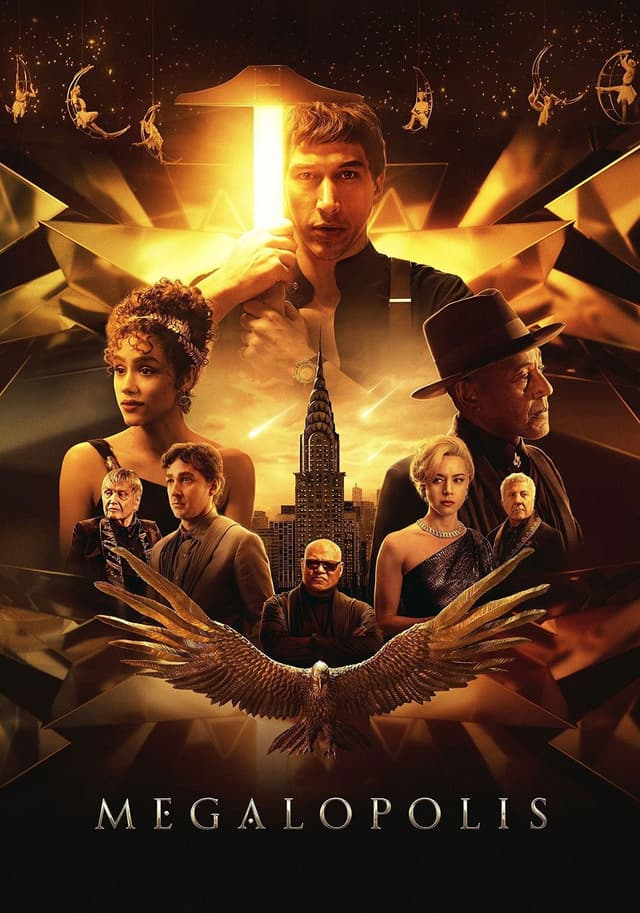
Megalopolis Budget
 Science FictionDramaFantasy2h 18m
Updated
Synopsis
The city of New Rome faces the duel between Cesar Catilina, a brilliant artist in favor of a Utopian future, and the greedy mayor Franklyn Cicero. Between them is Julia Cicero, with her loyalty divided between her father and her b...
What is the budget of Megalopolis?
"Megalopolis," a science fiction released in 2024, was directed by Francis Ford Coppola and stars Adam Driver, Giancarlo Esposito. The production budget was $120,000,000, placing it in the high-budget range for science fiction productions of its era.
Key Budget Allocation Categories
While specific budget breakdowns are not publicly available, typical cost drivers for a science fiction production like this include:
- Visual Effects & CGI Pipeline: Sci-fi films are among the most VFX-intensive productions in Hollywood.
- Production Design & World-Building: Creating a believable sci-fi world required significant investment in set construction, prop fabrication, and conceptual design , from physical environments through LED volume stages and virtual production technology.
- Technology & Camera Systems: Cutting-edge camera rigs, motion capture stages, LED volume stages (virtual production), and proprietary rendering technology often push the technical budget far beyond conventional filming costs.
- Pre-Production: On April 3, 2019, the day before his 80th birthday, Coppola announced his return to the project, having completed the script and approached Jude Law and Shia LaBeouf for lead roles.
What were the major cost factors in Megalopolis?
Several factors contributed to the overall production costs of "Megalopolis."
- Visual Effects: Visual Effects & CGI Pipeline is one of the primary cost drivers in science fiction productions of this scale.
- Production Design: Production Design & World-Building is one of the primary cost drivers in science fiction productions of this scale.
- Technology: Technology & Camera Systems is one of the primary cost drivers in science fiction productions of this scale.
How Does Megalopolis's Budget Compare to Similar Films?
At $120,000,000, Megalopolis sits in the high-budget range. Here is how it compares to productions with a similar budget:
- Charlie's Angels: Full Throttle (2003): Budget $120,000,000 , Gross $259,175,788
- Frankenstein (2025): Budget $120,000,000, Worldwide Gross $480,678
- Geostorm (2017): Budget $120,000,000, Worldwide Gross $221,600,160
- How Do You Know (2010): Budget $120,000,000, Worldwide Gross $48,668,907
- I, Robot (2004): Budget $120,000,000, Worldwide Gross $347,234,916
The median budget for wide-release science fiction films in the 2020s ranges from $30 to 80M for mid-budget to $150M+ for tentpoles.
Megalopolis Box Office Performance
"Megalopolis" earned $7,629,085 domestically and $14,387,154 worldwide at the box office. Against a production budget of $120,000,000, the film faced challenges in theatrical release. Home video, streaming, and ancillary revenue may have contributed to its overall performance.
A film typically needs to earn approximately twice its production budget to cover marketing and distribution costs. For "Megalopolis," that break-even threshold was roughly $240,000,000. With worldwide earnings of $14,387,154, the film did not reach break-even in theatrical release.
Box Office Breakdown
Megalopolis

At -88%, "Megalopolis" did not recoup its production budget through theatrical release alone.
Megalopolis Production History
Principal photography began on November 7, 2022, in Fayetteville, Georgia, at Trilith Studios and concluded on March 11, 2023. Filming also took place in Atlanta. The decision to film in Georgia over the film's setting of New York was due to available tax benefits, studio facilities, local crews, and classical buildings to act as sets.
Awards and Recognition
3 wins & 18 nominations total
Critical Reception
Audiences polled by CinemaScore gave the film an average grade of "D+" on an A+ to F scale, while those surveyed by PostTrak were 45% positive (with an average rating of one star out of five).
Frequently Asked Questions
How much did it cost to make Megalopolis (2024)?
The production budget was $120,000,000, covering principal photography, visual effects, cast and crew salaries, locations, sets, post-production, and music. Marketing and distribution (P&A) costs are estimated at an additional $60,000,000 - $96,000,000, bringing the total studio investment to approximately $180,000,000 - $216,000,000.
How much did Megalopolis (2024) earn at the box office?
Megalopolis grossed $7,629,085 domestic, $6,758,069 international, totaling $14,387,154 worldwide.
Was Megalopolis (2024) profitable?
The film did not break even theatrically, earning $14,387,154 against an estimated $300,000,000 needed. Ancillary revenue may have improved the picture.
What were the biggest costs in producing Megalopolis?
The primary cost drivers were above-the-line talent (Adam Driver, Giancarlo Esposito, Nathalie Emmanuel); visual effects pipelines, virtual production technology, and speculative world-building.
How does Megalopolis's budget compare to similar science fiction films?
At $120,000,000, Megalopolis is classified as a big-budget production. The median budget for wide-release science fiction films in the 2020s ranges from $30 - 80M for mid-budget to $150M+ for tentpoles. Comparable budgets: Charlie's Angels: Full Throttle (2003, $120,000,000); Frankenstein (2025, $120,000,000); Geostorm (2017, $120,000,000).
Did Megalopolis (2024) go over budget?
There are no widely reported accounts of significant budget overruns for this production. However, studios rarely disclose precise budget overrun figures publicly. The reported production budget reflects the final estimated cost.
What was the return on investment (ROI) for Megalopolis?
The theatrical ROI was -88.0%, calculated as ($14,387,154 − $120,000,000) ÷ $120,000,000 × 100. This measures gross revenue against production budget only - it does not account for P&A or exhibitor shares.
What awards did Megalopolis (2024) win?
3 wins & 18 nominations total.
Who directed Megalopolis and who were the key crew members?
Directed by Francis Ford Coppola, written by Francis Ford Coppola, shot by Mihai Malaimare Jr., with music by Osvaldo Golijov, Grace VanderWaal, edited by Cam McLauchlin, Glen Scantlebury.
Where was Megalopolis filmed?
Megalopolis was filmed in United States of America. Principal photography began on November 7, 2022, in Fayetteville, Georgia, at Trilith Studios and concluded on March 11, 2023. Filming also took place in Atlanta.
Filmmakers
Megalopolis

Official Trailer
Build budgets like this one in Saturation
Start from an industry-standard feature film template, import the schedule and rates you already have, and let the cost report keep itself current as you spend. Real-time collaboration, no spreadsheets.