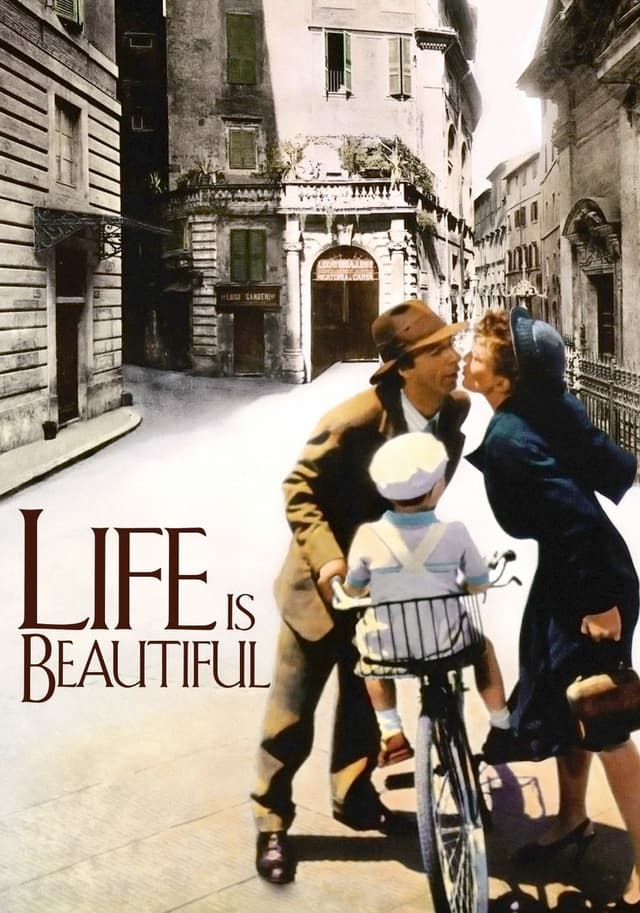
La vita è bella
Synopsis
A touching story of an Italian book seller of Jewish ancestry who lives in his own little fairy tale. His creative and happy life would come to an abrupt halt when his entire family is deported to a concentration camp during World War II. While locked up he tries to convince his son that the whole thing is just a game.
Production Budget Analysis
What was the production budget for Life Is Beautiful?
Directed by Roberto Benigni, with Roberto Benigni, Nicoletta Braschi, Giorgio Cantarini leading the cast, Life Is Beautiful was produced by Mario e Vittorio Cecchi Gori - C.E.I.A.D. with a confirmed budget of $20,000,000, placing it in the low-budget category for comedy films.
At $20,000,000, Life Is Beautiful was produced on a modest budget. Lower-budget films benefit from reduced break-even thresholds, with profitability achievable at approximately $50,000,000.
Budget Comparison — Similar Productions
• 12 Years a Slave (2013): Budget $20,000,000 | Gross $187,000,000 → ROI: 835% • 21 Grams (2003): Budget $20,000,000 | Gross $60,427,839 → ROI: 202% • 3 Ninjas Kick Back (1994): Budget $20,000,000 | Gross $11,798,854 → ROI: -41% • A Guy Thing (2003): Budget $20,000,000 | Gross $17,400,000 → ROI: -13% • A Most Violent Year (2014): Budget $20,000,000 | Gross $12,007,070 → ROI: -40%
Key Budget Allocation Categories
▸ Talent Salaries & Producing Deals Established comedic talent can command $15–20 million per film, with top-tier stars earning even more through producing credits and backend deals. Comedy ensembles multiply this cost across several well-known performers.
▸ Production & Location Filming While comedies generally avoid the VFX costs of action films, location shooting in recognizable cities or exotic locales adds meaningful production expense.
▸ Marketing & P&A (Prints & Advertising) Comedies rely heavily on marketing to build opening-weekend momentum. Studios typically spend 50–100% of the production budget on marketing, with comedy trailers and social media campaigns being particularly expensive.
Key Production Personnel
CAST: Roberto Benigni, Nicoletta Braschi, Giorgio Cantarini, Giustino Durano, Sergio Bini Bustric Key roles: Roberto Benigni as Guido; Nicoletta Braschi as Dora; Giorgio Cantarini as Giosué; Giustino Durano as Zio
DIRECTOR: Roberto Benigni CINEMATOGRAPHY: Tonino Delli Colli MUSIC: Nicola Piovani EDITING: Simona Paggi PRODUCTION: Mario e Vittorio Cecchi Gori - C.E.I.A.D., Melampo Cinematografica FILMED IN: Italy
Box Office Performance
Life Is Beautiful earned $57,563,264 domestically and $172,535,489 internationally, for a worldwide total of $230,098,753. International markets drove the majority of revenue (75%), indicating strong global appeal.
Break-Even Analysis
Using the industry-standard 2.5x multiplier (P&A + exhibitor shares of 40–50% + distribution fees), Life Is Beautiful needed approximately $50,000,000 to break even. The film surpassed this threshold by $180,098,753.
Return on Investment (ROI)
Revenue: $230,098,753 Budget: $20,000,000 Net: $210,098,753 ROI: 1050.5%
Profitability Assessment
VERDICT: Highly Profitable
Life Is Beautiful was a clear financial success, generating $230,098,753 worldwide against a $20,000,000 production budget — a 1050% ROI. After estimated marketing costs, the film still delivered substantial profit to Mario e Vittorio Cecchi Gori - C.E.I.A.D..
INDUSTRY IMPACT
The outsized success of Life Is Beautiful likely influenced studio greenlight decisions for similar comedy projects.
PRODUCTION NOTES
▸ Production
Director Roberto Benigni, who wrote the screenplay with Vincenzo Cerami, was inspired by the story of Rubino Romeo Salmonì and his book In the End, I Beat Hitler, which incorporates elements of irony and black comedy. Salmoni was an Italian Jew who was deported to Auschwitz, survived and was reunited with his parents, but found his brothers were murdered. Benigni stated he wished to commemorate Salmoni as a man who wished to live in the right way. He also based the story on that of his father Luigi Benigni, who was a member of the Italian Army after Italy became a co-belligerent of the Allies in 1943. Luigi Benigni spent two years in a Nazi labour camp, and to avoid scaring his children, told about his experiences humorously, finding this helped him cope. Roberto Benigni explained his philosophy, "to laugh and to cry comes from the same point of the soul, no? I'm a storyteller: the crux of the matter is to reach beauty, poetry, it doesn't matter if that is comedy or tragedy. They're the same if you reach the beauty." The names of the protagonists are instead taken from Dora De Giovanni and Guido Vittoriano Basile, uncles of Nicoletta Braschi. Dora's life was turned upside down when Guido, arrested for his anti-fascist activity, died in the Mauthausen concentration camp, a fate similar to that of the film's protagonist.
Benigni's friends advised against making the film, as he is a comedian and not Jewish, and the Holocaust was not of interest to his established audience. Because he is Gentile, Benigni consulted with the Center for Documentation of Contemporary Judaism, based in Milan, throughout production. Benigni incorporated historical inaccuracies in order to distinguish his story from the true Holocaust, about which he said only documentaries interviewing survivors could provide "the truth". The concentration camp was set in an old abandoned factory near Papigno (Terni) that was converted into a concentration camp for filming. The "prize" tank is an M4 Sherman.
▸ Music & Score
The original score to the film was composed by Nicola Piovani, with the exception of a classical piece which figures prominently: the barcarolle "Belle nuit, ô nuit d'amour" by Jacques Offenbach. The soundtrack album won the Academy Award for Best Original Dramatic Score and was nominated for a Grammy Award for Best Instrumental Composition Written for a Motion Picture, Television or Other Visual Media.
AWARDS & RECOGNITION
Awards Won: ★ Academy Award for Best Actor — Roberto Benigni (71st Academy Awards) ★ Academy Award for Best Original Dramatic Score — Nicola Piovani (71st Academy Awards) ★ Cannes Film Festival Grand Prix ★ European Film Award for Best Actor — Roberto Benigni (11th European Film Awards) ★ Academy Award for Best International Feature Film (71st Academy Awards) ★ European Film Award for Best Film — Roberto Benigni (11th European Film Awards) ★ European Film Award for Best Film — Cecchi Gori Group (11th European Film Awards) ★ European Film Award for Best Film — Melampo Cinematografica (11th European Film Awards) ★ David di Donatello for Best Film ★ César Award for Best Foreign Film
Nominations: ○ Academy Award for Best Film Editing (71st Academy Awards) ○ European Film Award for Best Film (11th European Film Awards) ○ Academy Award for Best Actor (71st Academy Awards) ○ International Submission to the Academy Awards ○ Academy Award for Best Original Dramatic Score (71st Academy Awards) ○ David di Donatello for Best Director (43rd David di Donatello Awards) ○ European Film Award for Best Actor (11th European Film Awards) ○ Academy Award for Best Director (71st Academy Awards) ○ Academy Award for Best International Feature Film (71st Academy Awards) ○ Academy Award for Best Picture (71st Academy Awards) ○ Academy Award for Best Writing, Original Screenplay (71st Academy Awards)
Additional Recognition: Life Is Beautiful was shown at the 1998 Cannes Film Festival, and went on to win the Grand Prix. Upon receiving the award, Benigni kissed the feet of jury president Martin Scorsese. Benigni jumped on top of the seats as he made his way to the stage to accept his first award, and upon accepting his second, said, "This is a terrible mistake because I used up all my English!"
! scope="col"| Award ! scope="col"| Date of ceremony ! scope="col"| Category ! scope="col"| Recipient(s) ! scope="col"| Result ! scope="col" class="unsortable"|
!scope="row" rowspan=7| Academy Awards
!scope="row" rowspan=3| BAFTA Awards
! scope="row"| Cannes Film Festival
!scope="row" rowspan=2| Critics' Choice Awards
!scope="row" rowspan=13| David di Donatello Awards
!scope="row" rowspan=2| European Film Awards
! scope="row"| Jerusalem Film Festival
! scope="row"| Toronto International Film Festival
CRITICAL RECEPTION
The film was praised by the Italian press, with Benigni treated as a "national hero." Metacritic assigned the film a weighted average score of 58 out of 100, based on 32 critics, indicating "mixed or average reviews".
Roger Ebert gave the film 3.5/4 stars, stating: "[According to Benigni] the movie has stirred up venomous opposition from the right wing in Italy [and at] Cannes, it offended some left-wing critics with its use of humor in connection with the Holocaust. What may be most offensive to both wings is its sidestepping of politics in favor of simple human ingenuity. The film finds the right notes to negotiate its delicate subject matter ... The movie actually softens the Holocaust slightly, to make the humor possible at all. In the real death camps there would be no role for Guido. But Life Is Beautiful is not about Nazis and Fascists, but about the human spirit. It is about rescuing whatever is good and hopeful from the wreckage of dreams. About hope for the future. About the necessary human conviction, or delusion, that things will be better for our children than they are right now." Michael Wilmington of the Chicago Tribune gave the movie a score of 100/100, calling it: "A deeply moving blend of cold terror and rapturous hilarity. Lovingly crafted by Italy's top comedian and most popular filmmaker, it's that rare comedy that takes on a daring and ambitious subject and proves worthy of it."
Richard Schickel, writing for Time, argued, "There are references to mass extermination, but that brutal reality is never vividly presented". He concluded that "even a hint of the truth about the Holocaust would crush [Benigni]'s comedy." Owen Gleiberman of Entertainment Weekly gave it a B−, calling it "undeniably some sort of feat—the first feel-good Holocaust weepie. It's been a long time coming." However, Glieberman stated: "There's only one problem. As shot, it looks like a game".





























Budget Templates
Build your own production budget
Create professional budgets with industry-standard feature film templates. Real-time collaboration, no spreadsheets.
Start Budgeting Free