Knock Knock Budget
 HorrorThriller1h 39m
Updated
Synopsis
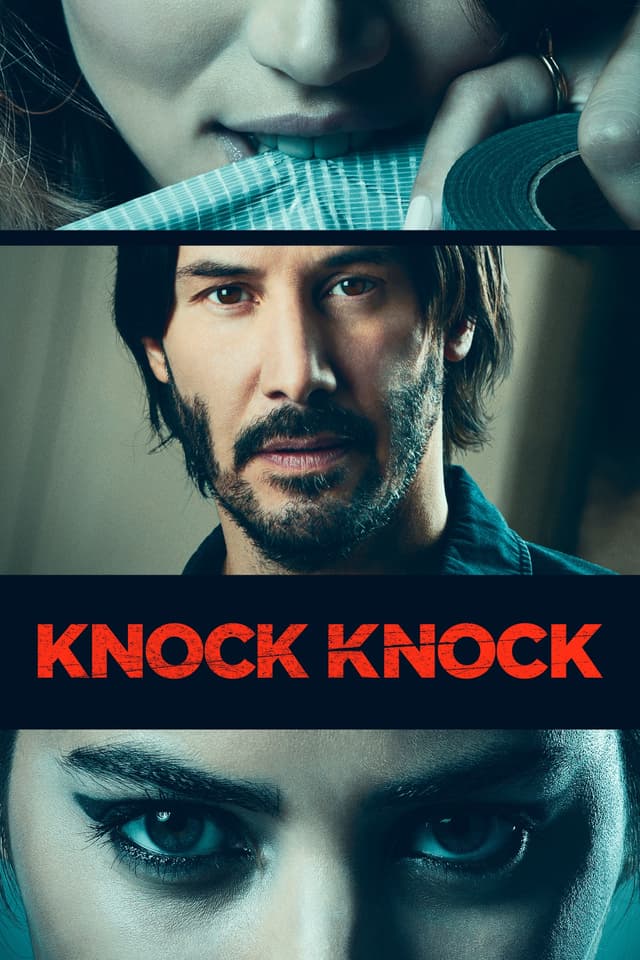
A devoted husband and father is home alone for the weekend when two stranded young women knock on his door for help. What starts as a kind gesture results in a dangerous seduction and a deadly game of cat and mouse, as the strangers slowly take over his home and reveal the true sadistic motivation behind their visit.
What Is the Budget of Knock Knock (2015)?
Knock Knock (2015), directed by Eli Roth and starring Keanu Reeves, was produced on a reported budget of approximately $2,500,000. The home-invasion thriller was financed independently through Black Bear Pictures, Camp Grey Productions, Dragonfly Entertainment, and Sobras International Pictures, with Lionsgate Premiere acquiring North American distribution rights for a limited theatrical and video-on-demand release. The lean budget reflected the film's contained single-location premise, compressed three-week shoot in Santiago, Chile, and a small principal cast of three.
As a loose remake of the 1977 exploitation thriller Death Game starring Sondra Locke and Colleen Camp (both of whom received producer credits and cameo appearances in the remake), Knock Knock leaned on a proven low-cost genre formula: one house, three actors, a single night of escalating menace. Roth co-wrote the screenplay with Nicolas Lopez and Guillermo Amoedo and shot the picture back-to-back with The Green Inferno using overlapping crews to amortize production overhead.
Key Budget Allocation Categories
Knock Knock's reported $2,500,000 budget broke down across the following production areas:
- Above-the-Line Talent: Keanu Reeves took a reduced rate in exchange for a producer credit and back-end participation, a common arrangement for stars headlining genre indies between major franchise commitments. Co-leads Lorenza Izzo (Roth's then-wife) and Ana de Armas, who was still pre-Knives Out and pre-No Time to Die, were cast on emerging-actor rates well below their later-career fees.
- Single-Location Shoot: Roughly 90% of the film takes place inside a Hollywood Hills-style modernist house. The production rented a single private residence in Santiago's Lo Curro district for the entire shoot, eliminating company moves, location permits across multiple sites, and the logistical overhead of a road movie or city-set thriller.
- Chile Production Base: Filming in Chile through Sobras International Pictures, the local outfit Roth co-founded with Nicolas Lopez, allowed the production to access below-the-line crew at rates significantly lower than Los Angeles or Vancouver. The favorable peso-to-dollar exchange in 2014 further stretched the budget across art department, grip and electric, and post-production sound.
- Compressed Schedule: Principal photography wrapped in roughly 25 days during October and November 2014. A tight schedule on a single set kept overtime, catering, and per diem costs flat, and the limited number of setups allowed cinematographer Antonio Quercia to light scenes for continuity rather than full daily relights.
- Minimal Effects and Stunts: Knock Knock relies on psychological tension and physical performance rather than gore or pyrotechnics. There are no significant visual effects shots, no large stunt set pieces, and limited prosthetics work, all of which would have inflated the line item totals on a Roth horror project like Hostel.
- Music and Score: Composers Manuel Riveiro and Aaron Levy delivered a tense electronic and orchestral score recorded with a small ensemble. The needle-drop soundtrack relied on tracks licensed at independent-feature rates rather than top-tier pop placements.
- Post-Production and VOD Mastering: Editorial and sound work happened in Chile and Los Angeles. Because Lionsgate Premiere positioned the film as a day-and-date theatrical and VOD release, deliverables included multiple digital masters and a streamlined DCP package rather than the wide-release print costs of a major theatrical play.
How Does Knock Knock's Budget Compare to Similar Films?
At approximately $2,500,000, Knock Knock sits at the lower end of mainstream-distributed home-invasion and erotic thrillers, where the genre's contained settings reward lean budgets. Comparing it to other low-budget home-invasion films, Eli Roth's earlier work, and Keanu Reeves' mid-2010s output illustrates the economic logic of the production:
- You're Next (2011): Budget $1,000,000 | Worldwide $26,887,177. Adam Wingard's home-invasion thriller cost less than half of Knock Knock and earned ten times its theatrical haul, the model for a profitable indie genre play that Lionsgate Premiere did not replicate with its smaller theatrical footprint.
- The Strangers (2008): Budget $9,000,000 | Worldwide $82,400,000. Bryan Bertino's masked-intruder thriller cost 3.6x what Knock Knock spent and out-grossed it by more than 30x at the box office, demonstrating the gap between a wide theatrical release and a day-and-date VOD play.
- Hostel (2005): Budget $4,800,000 | Worldwide $80,578,934. Roth's breakout horror feature cost roughly double Knock Knock and grossed 30x as much, illustrating how Roth's earlier studio-backed wide releases out-earned his later independent work despite similar contained-location economics.
- Cabin Fever (2002): Budget $1,500,000 | Worldwide $30,569,917. Roth's directorial debut cost less than Knock Knock and out-grossed it twelvefold worldwide, the Lionsgate cult success that established his career and that the studio implicitly hoped to recapture with Knock Knock's small-room horror premise.
- Funny Games (2007): Budget $15,000,000 | Worldwide $7,776,393. Michael Haneke's English-language home-invasion remake cost six times Knock Knock and lost money worldwide, evidence that the subgenre's economic floor is unforgiving when a film is positioned as an art-house provocation rather than a genre play.
- John Wick (2014): Budget $20,000,000 | Worldwide $86,011,000. Reeves' other 2014 production, shot immediately before Knock Knock, cost 8x more and launched a franchise grossing over $1 billion across four films, the career bridge that defined his decade while Knock Knock served as a one-off indie detour.
Knock Knock Box Office Performance
Knock Knock premiered at the Sundance Film Festival in January 2015 and received a day-and-date limited theatrical and video-on-demand release through Lionsgate Premiere on October 9, 2015. The film opened on 21 screens and grossed approximately $36,176 in its opening weekend, a routine result for a VOD-first release where the streaming and digital rental window drives the bulk of revenue. Domestic theatrical receipts ended at roughly $66,468, with international theatrical adding a few hundred thousand more across selective territories.
Against the reported $2,500,000 production budget, the film needed limited additional spend to reach profitability through home-entertainment revenue. Here is the financial breakdown:
Box Office Breakdown
Knock Knock

Knock Knock returned approximately $1.03 in theatrical gross for every $1 of production budget, but theatrical was never the primary revenue channel. VOD rentals, digital sell-through, premium cable licensing, and international territory sales (the film opened theatrically across Latin America and parts of Europe through local distributors) carried the financial load. Industry estimates pegged the film's total revenue across all windows in the $5,000,000 to $8,000,000 range, enough to clear the production and marketing investment and deliver modest profit to Black Bear Pictures and its co-financiers.
The performance was emblematic of the mid-2010s Lionsgate Premiere model: contained-budget genre films built around a recognizable star, released day-and-date to leverage VOD economics, with theatrical positioning as a marketing event rather than the main commercial play. The model has since been displaced by direct-to-streaming acquisitions, but in 2015 it was the dominant exit for $2-5 million genre productions.
Knock Knock Production History
Development on Knock Knock began in 2013 when Eli Roth, fresh off producing duties on The Last Exorcism Part II and The Sacrament, agreed to direct a remake of Peter S. Traynor's 1977 exploitation thriller Death Game. The original starred Sondra Locke and Colleen Camp as two women who invade the home of a wealthy married man (Seymour Cassel) and spend a single night torturing him for a perceived moral failure. Roth had championed the film for years as an unjustly forgotten genre piece and secured remake rights with Locke and Camp attached as producers, both of whom appear in cameo roles in the remake.
Roth co-wrote the screenplay with longtime collaborators Nicolas Lopez and Guillermo Amoedo, the Chilean writer-director team behind Aftershock (2012) and The Green Inferno (2013). The script updated the premise from 1970s San Francisco to a modern Hollywood Hills home and added contemporary anxieties around social media, identity, and the performative provocation of younger millennial characters. Casting Keanu Reeves came together after the actor wrapped John Wick in late 2013; Reeves agreed to the role for a reduced fee in exchange for a producer credit and a back-end participation deal.
Lorenza Izzo, Roth's then-wife and the lead of Aftershock and The Green Inferno, was cast as Genesis. Ana de Armas, who had appeared in Aftershock and was at the time a Chilean-Cuban actress still years away from her Hollywood breakthrough in Blade Runner 2049, was cast as Bel. Principal photography took place in Santiago, Chile, over approximately 25 days in October and November 2014, shot back-to-back with The Green Inferno using overlapping Sobras International Pictures crew. The single Santiago home that served as the primary location was redressed by production designer Marichi Palacios to evoke a Los Angeles modernist residence.
Roth and cinematographer Antonio Quercia shot the film on the Arri Alexa in 2K, designing the lighting to support continuous coverage in confined spaces. Editor Diego Macho cut the film in Santiago and Los Angeles. The Sundance Film Festival accepted Knock Knock for its 2015 Midnight section, where it premiered on January 23, 2015. Lionsgate Premiere acquired distribution rights immediately after the screening and set the October 2015 day-and-date release. The film served as a transitional credit for several involved parties: Reeves between the first and second John Wick films, de Armas before her US studio breakthroughs, and Roth before his return to studio horror with Death Wish (2018) and Thanksgiving (2023).
Awards and Recognition
Knock Knock's awards footprint was limited. The film premiered in the Sundance Film Festival's 2015 Midnight section but did not win the Midnight Audience Award or any competitive Sundance prize. It subsequently screened at the SXSW Film Festival in March 2015 in the Midnighters program, again without a competitive win, and at the Sitges Film Festival in Spain in October 2015, where genre cinema is more centrally programmed; it did not place in the Official Fantastic Competition jury awards.
Ana de Armas received scattered recognition on the festival circuit, including notice from Spanish and Latin American press, but no major industry nominations followed Knock Knock specifically. The film was not nominated at the Saturn Awards, the Fangoria Chainsaw Awards, or any of the recognized genre-cinema ceremonies. Razzie nominations also passed it by, despite the polarizing critical reception, because the 2016 ceremony focused on higher-profile commercial flops like Fantastic Four and Pixels. Its primary legacy lies in being an early career credit for Ana de Armas and a contained mid-career exercise for Reeves rather than an awards contender.
Critical Reception
Knock Knock received mixed-to-negative reviews. The film holds a 36% approval rating on Rotten Tomatoes based on 113 critic reviews, with a critical consensus calling it provocative in concept but tonally uneven and unconvincing in execution. On Metacritic, the film scored 53 out of 100, indicating mixed or average reviews. The film did not receive a CinemaScore rating because its limited theatrical footprint did not meet the exit-polling firm's release threshold, which is typical for VOD-first Lionsgate Premiere titles.
Critics divided sharply over Roth's tonal choices. Variety's Justin Chang called the film "a smutty, sour, finally enervating jape" that wastes a promising premise on broad performances. The New York Times' Jeannette Catsoulis wrote that the film "never decides whether it's a feminist provocation, a misogynist fantasy, or a goof," landing in an uncomfortable middle. Some genre publications were more receptive: Bloody Disgusting praised Roth's commitment to discomfort and Reeves' willingness to play against type, and IndieWire highlighted Lorenza Izzo's and Ana de Armas' committed performances as the film's strongest element.
Reeves' performance drew particular focus, especially a now-meme-famous monologue in which his character Evan rages about a "free pizza" delivered to his door, an extended improvised scene that became one of the film's most widely shared moments on social media and arguably the single piece of cultural memory most viewers retain from the picture. In the years since release, Knock Knock has acquired a modest cult reputation as a Reeves curio and an early showcase for Ana de Armas, even as its core critical reputation has remained polarized.
Frequently Asked Questions
How much did it cost to make Knock Knock (2015)?
The reported production budget was approximately $2,500,000. The film was independently financed through Black Bear Pictures, Camp Grey Productions, Dragonfly Entertainment, and Sobras International Pictures, with Lionsgate Premiere acquiring North American distribution rights for a limited theatrical and video-on-demand release.
How much did Knock Knock earn at the box office?
The film grossed approximately $66,468 domestically and roughly $2,503,250 internationally, for a worldwide theatrical total of $2,569,718. Theatrical was a secondary revenue channel; the film generated additional income through video-on-demand rentals, digital sell-through, premium cable licensing, and international territory sales.
Was Knock Knock a box office success?
Theatrically, no. With a worldwide gross of $2,569,718 against a $2,500,000 production budget and an estimated $1,500,000 to $2,500,000 in marketing spend, the theatrical release alone returned roughly $1.03 per dollar of production cost. Including video-on-demand and international sales revenue, industry estimates suggest the film recouped its full investment and delivered modest profit to its independent financiers.
Who directed Knock Knock (2015)?
Eli Roth directed the film, working from a screenplay he co-wrote with Nicolas Lopez and Guillermo Amoedo. Roth is best known for directing Cabin Fever (2002), Hostel (2005), Hostel Part II (2007), The Green Inferno (2013), Death Wish (2018), and Thanksgiving (2023).
Where was Knock Knock filmed?
Principal photography took place in Santiago, Chile, over approximately 25 days in October and November 2014. The production used a single private residence in the Lo Curro district as the primary location, redressed to evoke a Hollywood Hills modernist house. The film was shot back-to-back with The Green Inferno (2013) using overlapping Sobras International Pictures crew.
Is Knock Knock a remake?
Yes. Knock Knock is a loose remake of Death Game (1977), a Peter S. Traynor exploitation thriller starring Sondra Locke and Colleen Camp as two women who invade the home of a married man. Both Locke and Camp received producer credits on the 2015 remake and appear in cameo roles. Eli Roth had championed the original for years as an unjustly forgotten genre piece before securing remake rights.
Who stars in Knock Knock?
Keanu Reeves stars as Evan Webber, a devoted husband and father who lets two young stranded women into his home. Lorenza Izzo and Ana de Armas play Genesis and Bel, the two women whose visit turns sadistic. Izzo, Eli Roth's then-wife, had previously starred in Aftershock (2012) and The Green Inferno (2013). De Armas was a Chilean-Cuban actress years before her Hollywood breakthrough in Blade Runner 2049 (2017) and Knives Out (2019).
How does Knock Knock compare to other Eli Roth films?
Knock Knock is one of Roth's smallest productions by budget. Cabin Fever (2002) cost $1,500,000 and grossed $30,569,917 worldwide. Hostel (2005) cost $4,800,000 and grossed $80,578,934 worldwide. Knock Knock's $2,500,000 budget falls between the two, but its theatrical worldwide gross of $2,569,718 is dramatically below either film. The difference reflects Lionsgate Premiere's day-and-date VOD strategy versus the wide theatrical release model behind Roth's earlier hits.
Why did Keanu Reeves make Knock Knock between John Wick films?
Reeves shot Knock Knock in late 2014 immediately after wrapping John Wick (2014) and before committing to John Wick: Chapter 2 (2017). The actor took a reduced fee for a producer credit and back-end participation, a common arrangement for established stars headlining genre indies between major franchise commitments. The film served as a contained-budget creative detour during the year that effectively relaunched his Hollywood career.
What did critics think of Knock Knock?
The film received mixed-to-negative reviews, with a 36% approval rating on Rotten Tomatoes (based on 113 critics) and a 53 out of 100 score on Metacritic. Critics were divided on Eli Roth's tonal choices, with some calling the premise provocative but its execution muddled. Reeves' performance drew particular attention, especially a now-meme-famous improvised monologue about a "free pizza" delivered to his door, which became the single most widely shared moment from the film on social media.
Filmmakers
Knock Knock

Official Trailer
Build budgets like this one in Saturation
Start from an industry-standard feature film template, import the schedule and rates you already have, and let the cost report keep itself current as you spend. Real-time collaboration, no spreadsheets.