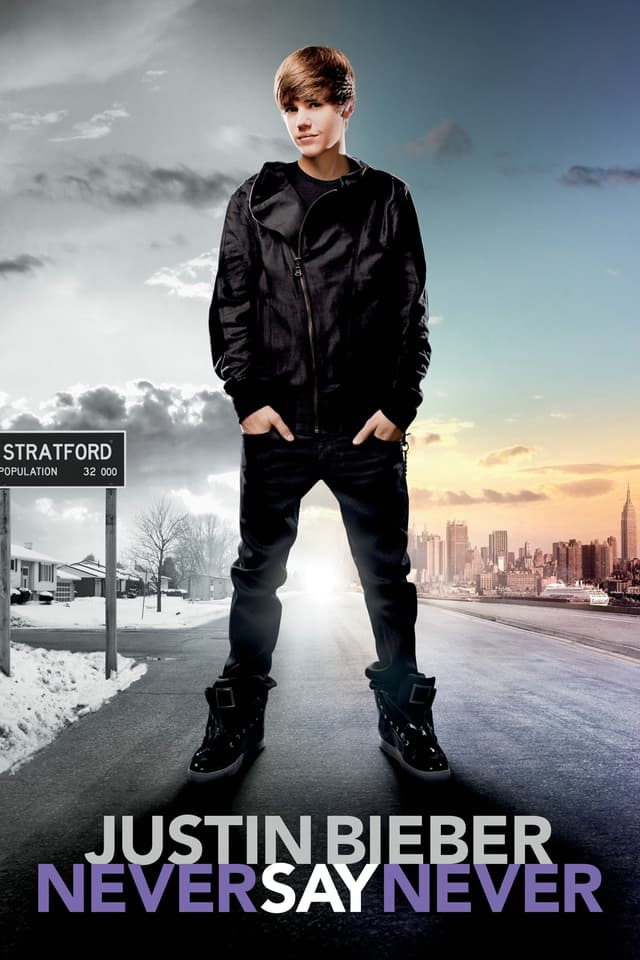
Justin Bieber: Never Say Never Budget
 MusicDocumentaryFamily105 minutes
Updated
Synopsis
The camera follows Justin Bieber (1994- ) during the ten days leading up to his August, 2010, sold-out show at Madison Square Garden. Footage of these ten days of concerts, rehearsals, and down time with boyhood friends, his mom, and his entourage is inter-cut with home movies, old photos, and interviews showing a musical prodigy who loves to perform, comes to the attention of an Atlanta agent via YouTube, impresses Usher, and rockets to international stardom soon after his 15th birthday. His manager emphasizes the importance of social media and of Justin's work ethic and personality in making him a star; the camera emphasizes Bieber's look. His mom and grandparents shine.
What Is the Budget of Justin Bieber: Never Say Never?
Justin Bieber: Never Say Never was produced on a budget of approximately $13 million, jointly financed by Paramount Pictures and AEG Live in partnership with Bieber's manager Scooter Braun. The film was shot in 3D using high-definition concert footage and documentary material captured during Bieber's 2010 My World Tour, culminating in a sold-out show at Madison Square Garden in New York City on August 31, 2010.
The $13 million budget was modest by studio standards for a wide theatrical release, but the economics made sense: Bieber's fan base, known as "Beliebers," had already proven their purchasing power through album sales and tour tickets, and the 3D premium format added several dollars to each ticket price. Paramount bet on built-in demand rather than costly mass-market advertising.
Key Budget Allocation Categories
- Concert Footage and Production Photography: Cameras followed the My World Tour across North America in 2010. Multiple camera crews captured each performance, backstage moments, and behind-the-scenes access, requiring significant on-location production costs across dozens of cities over several months.
- 3D Conversion and Post-Production: Converting and processing high-volume concert footage into theatrical 3D was a major line item, estimated to have consumed $3 to $4 million. The 3D format was central to the theatrical pitch and drove the premium ticket pricing that made the release profitable.
- Director Jon Chu and Creative Team: Jon Chu (Step Up 2, Step Up 3D) directed the film, bringing experience with 3D dance and performance filmmaking. His fee, along with the creative team handling the narrative documentary framing of Bieber's rise from YouTube to Madison Square Garden, was part of the above-the-line budget.
- Licensed Music and Archival Material: The film incorporates Bieber's catalog tracks, plus footage from early YouTube videos and childhood home recordings submitted by his family. Music licensing costs for theatrical and home video exhibition rights were factored into the production budget.
- Marketing and Prints (P&A): Paramount allocated an estimated $20 million in prints and advertising, targeting Bieber's core teenage demographic through social media, radio, and MTV-adjacent placements. The campaign leaned heavily on YouTube and Twitter, channels where Bieber himself had outsized reach.
How Does Justin Bieber: Never Say Never's Budget Compare to Similar Films?
Concert films occupy a niche category where budgets are modest and audience specificity is extreme. The closest comparable releases illustrate how Never Say Never outperformed its peers and set a new standard for the genre.
- Hannah Montana and Miley Cyrus: Best of Both Worlds Concert Tour (2008): Budget ~$7M | Worldwide $72.2M. The closest direct precedent: a Disney Channel star in 3D concert format targeting the same teenage demographic. Never Say Never outgrossed it worldwide by more than $26 million on a similar release strategy.
- This Is It (2009): Budget ~$60M | Worldwide $261.2M. Michael Jackson's posthumous concert documentary was the gold standard for concert film grosses at the time. Never Say Never cleared $98.7M, an impressive figure for a non-posthumous music film.
- Katy Perry: Part of Me (2012): Budget ~$12M | Worldwide $32.6M. A direct competitor in the 3D pop-star documentary format released the following year. Never Say Never's $98.7M worldwide demonstrates that Bieber's fan engagement at the time was significantly higher than Perry's theatrical draw.
- One Direction: This Is Us (2013): Budget ~$14M | Worldwide $68.5M. The format Never Say Never pioneered was replicated for the world's next generation of boy-band stars. Never Say Never still outgrossed it by $30 million, reflecting Bieber's singular cultural dominance in 2011.
Justin Bieber: Never Say Never Box Office Performance
Justin Bieber: Never Say Never opened February 11, 2011, across 3,105 theaters in the United States and Canada, grossing $29.5 million in its opening weekend, which broke the opening-weekend record for a music documentary at the time. The domestic run finished at $73.0 million. International markets added $25.7 million, bringing the worldwide total to $98.7 million. Paramount distributed the film globally.
Against a $13 million production budget and an estimated $20 million in prints and advertising, Paramount's total investment was approximately $33 million. With theaters retaining roughly 50 percent of gross, the studio's share of the worldwide theatrical gross was approximately $49.4 million, covering the full investment and generating a meaningful profit before home video, digital, and television licensing revenue.
Box Office Breakdown
Justin Bieber: Never Say Never

For every dollar invested in production, Never Say Never returned roughly $7.59 at the worldwide box office. Even accounting for P&A spend, the theatrical run alone covered total costs and generated a profit. Home video and digital sales, where concert films have long tails, added substantially to the final return.
Justin Bieber: Never Say Never Production History
The film grew from a strategic decision by AEG Live and Scooter Braun to document the My World Tour as it happened. Braun had discovered Bieber on YouTube in 2008 and managed his ascent from a twelve-year-old singing covers online to a global pop phenomenon by age sixteen. The tour, which ran from June 2010 through late 2010, sold out arenas across North America, and Braun recognized that the story of Bieber's rise was as marketable as the concerts themselves.
Jon Chu was brought on to direct based on his work on Step Up 2: The Streets and Step Up 3D, where he had developed a fluency with capturing live performance in 3D. Production crews embedded with the tour, capturing performances, bus rides, rehearsals, and candid moments with Bieber's family, particularly his mother Pattie Mallette, whose faith and sacrifice are central to the film's narrative arc. The footage of Bieber's early YouTube videos was sourced from family archives and fan recordings.
The centerpiece of the film is Bieber's sold-out show at Madison Square Garden on August 31, 2010, which had originally sold out in twenty-two minutes. When Bieber fell ill in the days before the show, the documentary captured the medical uncertainty and the pressure of delivering for 20,000 fans, adding genuine dramatic stakes to what could have been a straightforward concert film. The MSG show was shot with multiple high-definition 3D camera rigs across the venue.
Post-production ran through late 2010 and into early 2011, with the 3D conversion and edit completed in time for a Valentine's Day weekend launch. Paramount positioned the release to target Bieber's teenage female fan base, scheduling it for a Friday the eleventh to capture the pre-Valentine's Day social event dynamic. The film opened to the largest weekend gross ever recorded for a music documentary at that point in time.
Awards and Recognition
Justin Bieber: Never Say Never was not a significant awards contender at major film academies, though its commercial achievements were recognized within the entertainment industry. The film set an opening-weekend record for music documentaries in North America at the time of its release, a record that stood until subsequent concert films redefined the genre's commercial ceiling.
The film was nominated for a Teen Choice Award for Choice Movie: Drama, reflecting its primary audience. Its soundtrack was also commercially successful, with the Never Say Never EP featuring Jaden Smith reaching the top ten on the Billboard Hot 100. The film's cultural significance was its validation of YouTube-native celebrity as a commercially viable theatrical draw, a template that influenced how music industry executives approached the concert film format going forward.
Critical Reception
Justin Bieber: Never Say Never received a divided critical response that broke predictably along lines of who the film was made for. On Rotten Tomatoes, the film holds a 64% approval rating, with critics largely acknowledging the technical competence of the 3D production while questioning whether the hagiographic framing of Bieber's story offered anything beyond fan service. Metacritic scored it 50 out of 100.
Professional critics who approached the film on its own terms as a music documentary tended to acknowledge Jon Chu's skill with the concert sequences and the genuine emotional appeal of Bieber's YouTube-to-Madison-Square-Garden origin story. Critics who were outside the target demographic found the uncritical portrait of Bieber's rise unconvincing as a documentary. The IMDb rating of 3.1 out of 10 reflects organized downvoting campaigns by users hostile to Bieber's celebrity, and is not representative of the film's actual audience reception.
Among its target audience, the film was a cultural event. Box office data tells the cleaner story: a $13 million investment generating $98.7 million worldwide made Never Say Never one of the most profitable entertainment investments of 2011 on a percentage-return basis. Subsequent music documentaries in the 3D format, from Katy Perry to One Direction, were greenlit directly because of Never Say Never's commercial proof of concept.
Frequently Asked Questions
How much did Never Say Never cost to make?
The production budget was approximately $13,000,000. Paramount Pictures and MTV Films co-financed the 3D concert documentary, with Bieber's manager Scooter Braun producing through his SB Projects banner.
How much did Never Say Never earn at the box office?
The film grossed $73,013,910 domestically and $25,800,000 internationally, for a worldwide total of approximately $98,800,000. It opened to $29,514,000 on February 11, 2011, finishing second behind Just Go With It in a strong Valentine's Day weekend.
Who directed Never Say Never?
Jon M. Chu directed the film, his second concert documentary feature after Step Up 3D (2010). Chu went on to direct Crazy Rich Asians (2018, $30,000,000 budget, $238,500,000 worldwide), In the Heights (2021), and Wicked (2024).
What does Never Say Never document?
The film documents Justin Bieber's early career, culminating in his August 31, 2010 sold-out concert at Madison Square Garden, which he sold out in 22 minutes upon release. The film alternates between concert footage, behind-the-scenes vignettes, and home video from Bieber's childhood in Stratford, Ontario.
Was Never Say Never released in 3D?
Yes. The film was released in both 2D and 3D formats, with the 3D version filmed natively rather than post-converted. Approximately 67% of opening-weekend ticket sales were 3D, contributing significantly to the film's strong per-theater average.
Where was Never Say Never filmed?
Concert sequences were filmed at Madison Square Garden in New York City, with additional concert footage from other stops on the My World Tour across the United States. Personal interview and behind-the-scenes sequences were shot at Bieber's home, recording studios, and Atlanta-based rehearsal facilities.
What did critics think of Never Say Never?
Reviews were surprisingly positive, with a 64% approval rating on Rotten Tomatoes and a 52 out of 100 score on Metacritic. Roger Ebert gave the film three out of four stars, praising the access provided to Bieber's management and the film's ability to make a non-fan understand his appeal.
How does Never Say Never compare to other concert films?
Never Say Never was the highest-grossing concert documentary at the time of its release, surpassing Hannah Montana and Miley Cyrus: Best of Both Worlds Concert (2008, $7,000,000 budget, $70,600,000 worldwide). It was later eclipsed by Taylor Swift: The Eras Tour (2023, $15,000,000 budget, $267,100,000 worldwide).
Was Never Say Never profitable?
Yes, substantially. Against the $13,000,000 production budget and an estimated $30,000,000 in marketing spend, the worldwide gross of $98,800,000 produced one of Paramount's strongest percentage-return releases of 2011. Strong home video and streaming revenue extended profitability further.
Was there a sequel to Never Say Never?
Yes. Believe (2013), directed by Jon M. Chu and released by Open Road Films, served as a follow-up but grossed only $8,000,000 worldwide against a similar budget. The dramatic decline reflected Bieber's 2013 personal-life controversies and a softer commercial moment.
Official Trailer
Build budgets like this one in Saturation
Start from an industry-standard feature film template, import the schedule and rates you already have, and let the cost report keep itself current as you spend. Real-time collaboration, no spreadsheets.