Inglourious Basterds Budget
 DramaThrillerWar2h 33m
Updated
Synopsis
In German-occupied France, young Jewish refugee Shosanna Dreyfus witnesses the slaughter of her family by Colonel Hans Landa. Narrowly escaping with her life, she plots her revenge several years later when German war hero Fredrick Zoller takes a rapid interest in her and arranges an illustrious movie premiere at the theater she now runs. With the promise of every major Nazi officer in attendance, the event catches the attention of the "Basterds", a group of Jewish-American guerrilla soldiers led by the ruthless Lt. Aldo Raine. As the relentless executioners advance and the conspiring young girl's plans are set in motion, their paths will cross for a fateful evening that will shake the very annals of history.
What is the budget of Inglourious Basterds?
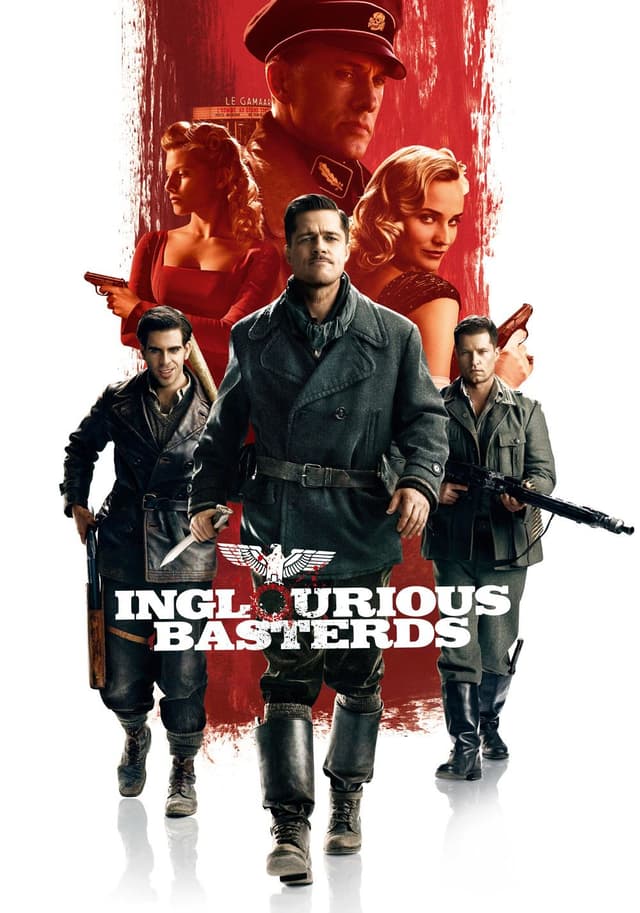
"Inglourious Basterds," a drama released in 2009, was directed by Quentin Tarantino and stars Brad Pitt, Mélanie Laurent. The production budget was $70,000,000, placing it in the high-budget range for drama productions of its era.
Key Budget Allocation Categories
While specific budget breakdowns are not publicly available, typical cost drivers for a drama production like this include:
- Above-the-Line Talent: Drama films live or die on the strength of their performances.
- Location Filming & Period Production Design: Authentic locations , whether contemporary or historical , require scouting, permits, travel, lodging, and often significant dressing to match the story's time period.
- Post-Production, Color Grading & Score: The editorial process for dramas is typically longer than genre films, with careful attention to pacing and tone.
- Casting: Tarantino originally sought Leonardo DiCaprio to be cast as Hans Landa, before deciding to have the character played by a native German-speaking actor.
What were the major cost factors in Inglourious Basterds?
Several factors contributed to the overall production costs of "Inglourious Basterds."
- Above-the-Line Talent: Above-the-Line Talent is one of the primary cost drivers in drama productions of this scale.
- Location Filming: Location Filming & Period Production Design is one of the primary cost drivers in drama productions of this scale.
- Post-Production: Post-Production, Color Grading & Score is one of the primary cost drivers in drama productions of this scale.
How Does Inglourious Basterds's Budget Compare to Similar Films?
At $70,000,000, Inglourious Basterds sits in the high-budget range. Here is how it compares to productions with a similar budget:
- A Civil Action (1998): Budget $70,000,000, Worldwide Gross $56,709,981
- Babylon A.D. (2008): Budget $70,000,000, Worldwide Gross $72,109,200
- Beowulf (2007): Budget $70,000,000, Worldwide Gross $195,735,876
- Couples Retreat (2009): Budget $70,000,000, Worldwide Gross $171,844,840
- Dudley Do-Right (1999): Budget $70,000,000, Worldwide Gross $10,000,000
The median budget for wide-release drama films in the 2000s ranges from $30 to 80M for mid-budget to $150M+ for tentpoles.
Inglourious Basterds Box Office Performance
"Inglourious Basterds" earned $120,540,719 domestically and $321,457,747 worldwide at the box office. Against a production budget of $70,000,000, the film performed strongly at the box office.
A film typically needs to earn approximately twice its production budget to cover marketing and distribution costs. For "Inglourious Basterds," that break-even threshold was roughly $140,000,000. With worldwide earnings of $321,457,747, the film cleared that threshold comfortably.
Box Office Breakdown
Inglourious Basterds

At 359.2%, "Inglourious Basterds" earned roughly $4.59 for every $1 invested in production.
Inglourious Basterds Production History
Tarantino originally sought Leonardo DiCaprio to be cast as Hans Landa, before deciding to have the character played by a native German-speaking actor. The role ultimately went to Austrian Christoph Waltz who, according to Tarantino, "gave me my movie" as he feared the part was "unplayable". Brad Pitt and Tarantino had wanted to work together for a number of years, but they were waiting for the right project.
Tarantino teamed with the Weinstein Company to prepare what he planned to be his film for production. In July 2008, Tarantino and executive producers Harvey and Bob Weinstein set up an accelerated production schedule to be completed for release at the Cannes Film Festival in 2009, where the film would compete for the Palme d'Or. The Weinstein Company co-financed the film and distributed it in the United States, and signed a deal with Universal Pictures to finance the rest of the film and distribute it internationally.
Tarantino originally wanted Ennio Morricone to compose the film's soundtrack. However, Tarantino did use eight tracks composed by Morricone in the film, with four of them included on the CD. The opening theme is taken from the pseudo-folk ballad "The Green Leaves of Summer", which was composed by Dimitri Tiomkin and Paul Francis Webster for the opening of the 1960 film The Alamo.
Awards and Recognition
Won 1 Oscar. 134 wins & 173 nominations total
- Academy Award for Best Supporting Actor: Christoph Waltz (82nd Academy Awards)
- National Board of Review: Top Ten Films
Critical Reception
Review aggregator Rotten Tomatoes reports that 89% of 332 critics have given the film a positive review, with a rating average of 7.8/10. The site's critical consensus reads: "A classic Tarantino genre-blending thrill ride, Inglourious Basterds is violent, unrestrained, and thoroughly entertaining." Metacritic, which assigns a rating on reviews, gives the film a weighted average score of 69 out of 100, based on 36 critics, indicating "generally favorable" reviews. Audiences surveyed by CinemaScore gave the film an average grade of "A-" on an A+ to F scale.
Frequently Asked Questions
How much did it cost to make Inglourious Basterds (2009)?
The production budget was $70,000,000, covering principal photography, cast and crew salaries, locations, sets, post-production, and music. Marketing and distribution (P&A) costs are estimated at an additional $35,000,000 - $56,000,000, bringing the total studio investment to approximately $105,000,000 - $126,000,000.
How much did Inglourious Basterds (2009) earn at the box office?
Inglourious Basterds grossed $120,540,719 domestic, $200,917,028 international, totaling $321,457,747 worldwide.
Was Inglourious Basterds (2009) profitable?
Yes. Against a production budget of $70,000,000 and estimated total costs of ~$175,000,000, the film earned $321,457,747 theatrically - a 359% ROI on production costs alone.
What were the biggest costs in producing Inglourious Basterds?
The primary cost drivers were above-the-line talent (Brad Pitt, Mélanie Laurent, Christoph Waltz); talent compensation, authentic period production design, and meticulous post-production; international production across Germany, United States of America.
How does Inglourious Basterds's budget compare to similar drama films?
At $70,000,000, Inglourious Basterds is classified as a mid-budget production. The median budget for wide-release drama films in the 2000s ranges from $30 - 80M for mid-budget to $150M+ for tentpoles. Comparable budgets: A Civil Action (1998, $70,000,000); Babylon A.D. (2008, $70,000,000); Beowulf (2007, $70,000,000).
Did Inglourious Basterds (2009) go over budget?
There are no widely reported accounts of significant budget overruns for this production. However, studios rarely disclose precise budget overrun figures publicly. The reported production budget reflects the final estimated cost.
What was the return on investment (ROI) for Inglourious Basterds?
The theatrical ROI was 359.2%, calculated as ($321,457,747 − $70,000,000) ÷ $70,000,000 × 100. This measures gross revenue against production budget only - it does not account for P&A or exhibitor shares.
What awards did Inglourious Basterds (2009) win?
Won 1 Oscar. 134 wins & 173 nominations total.
Who directed Inglourious Basterds and who were the key crew members?
Directed by Quentin Tarantino, written by Quentin Tarantino, shot by Robert Richardson, edited by Sally Menke.
Where was Inglourious Basterds filmed?
Inglourious Basterds was filmed in Germany, United States of America. Tarantino teamed with the Weinstein Company to prepare what he planned to be his film for production. In July 2008, Tarantino and executive producers Harvey and Bob Weinstein set up an accelerated production schedule to be completed for release at the Cannes Film Festival in 2009, where the film would compete for the Palme d'Or. The Weinstein Company co-financed the film and distributed it in the United States, and signed a deal with Universal Pictures to finance the rest of the film and distribute it internationally.
Filmmakers
Inglourious Basterds

Official Trailer
Build budgets like this one in Saturation
Start from an industry-standard feature film template, import the schedule and rates you already have, and let the cost report keep itself current as you spend. Real-time collaboration, no spreadsheets.