Homestead Budget
 Action1h 52m
Updated
Synopsis
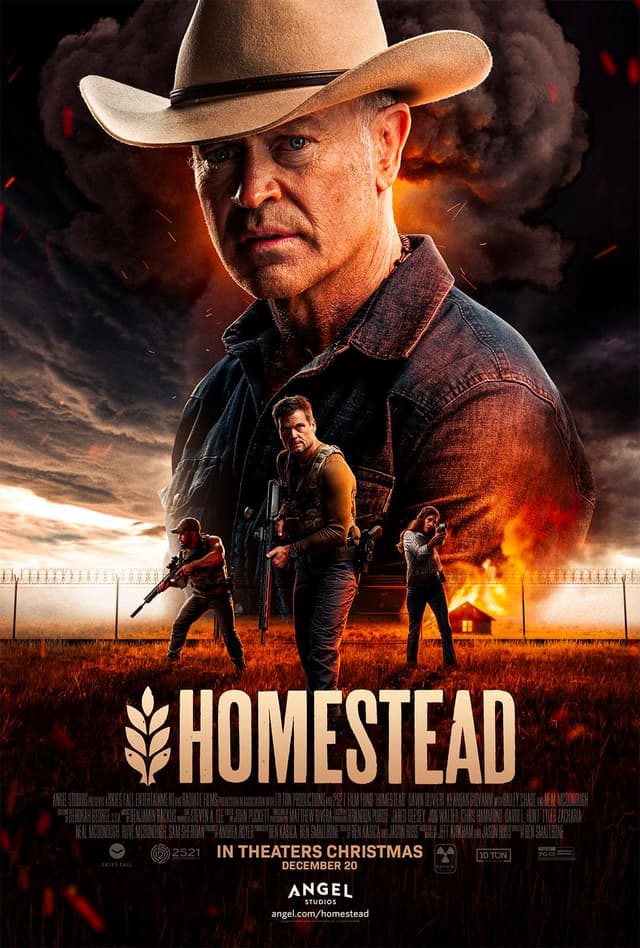
A nuclear bomb is detonated in Los Angeles, and the nation devolves into unprecedented chaos. Ex-Green Beret Jeff Eriksson and his family escape to The Homestead, an eccentric prepper’s fortress nestled in the mountains. As violent threats and apocalyptic conditions creep toward their borders, the residents of The Homestead are left to wonder: how long can a group of people resist both the dangers of human nature and the bloodshed at their doorstep?
What Is the Budget of Homestead?
Homestead (2024), distributed by Angel Studios, was produced on a budget of approximately $5,000,000. The film's contained environments, practical location approach, and emphasis on performance over spectacle reflect a production strategy designed to maximize storytelling impact within a disciplined budget.
The project appears to have been financed through a combination of private investment and independent production backing rather than large-scale public crowdfunding. This places it within a mid-budget independent category, where financing is secured through a smaller number of capital sources rather than broad audience participation. The contained nature of the story and its emphasis on practical locations helped maintain cost discipline throughout production.
Key Budget Allocation Categories
Homestead's budget was shaped by a deliberate strategy of contained storytelling over visual spectacle. The primary cost centers reflect this approach:
- Location and Production Design — A significant portion of the film takes place within a single fortified environment, requiring detailed set construction and practical design to create a believable post-collapse world. Contained productions like this allow for cost control while still delivering a sense of scale through atmosphere, texture, and environmental storytelling.
- Cast and Performance — The ensemble-driven narrative relies heavily on character dynamics and emotional stakes rather than spectacle. Strong performances are the primary vehicle for tension in this type of film, which typically increases above-the-line costs but reduces dependency on expensive technical elements.
- Action and Stunt Coordination — The film includes moments of conflict and survival-driven tension that require careful planning, choreography, and safety measures. While not effects-heavy, these sequences add production complexity and specialized crew requirements that contribute meaningfully to the overall budget.
- Post-Production — Achieving the right tonal balance for a post-apocalyptic drama, grim but grounded rather than heightened, requires careful work in color grading, sound design, and score to build the atmosphere that location work and practical sets establish on set.
How Does Homestead's Budget Compare to Similar Films?
At $5,000,000, Homestead sits at the lean end of the post-apocalyptic survival drama budget spectrum. Films in this genre typically require significantly more to achieve comparable production values, making Homestead's box office performance particularly notable in context:
- A Quiet Place (2018) — Budget $17,000,000 | Worldwide $340,000,000. The gold standard for contained survival horror, A Quiet Place operated on more than three times Homestead's budget and achieved one of the genre's all-time best returns. Both films center on a family's survival in a hostile world, but the supernatural threat element and Paramount's distribution infrastructure gave A Quiet Place a far wider commercial ceiling.
- 10 Cloverfield Lane (2016) — Budget $15,000,000 | Worldwide $108,000,000. Another contained bunker-survival thriller with a small cast and a single primary location. At three times the budget, it achieved five times Homestead's worldwide gross, partly through the Cloverfield brand and Paramount marketing muscle. Homestead's performance at a third of the budget is proportionally strong.
- The Road (2009) — Budget $25,000,000 | Worldwide $27,000,000. Cormac McCarthy's acclaimed post-apocalyptic novel adaptation spent five times what Homestead cost and barely broke even theatrically, a useful reminder that prestige pedigree and a bigger budget are no guarantee of commercial success in this genre.
- Greenland (2020) — Budget $35,000,000 | Worldwide $52,000,000. Gerard Butler's survival disaster film invested $35 million and earned $52 million worldwide, a modest multiple on a much larger outlay. Homestead's $20.8 million worldwide against a $5 million budget represents a significantly more efficient deployment of capital.
- His Only Son (2023) — Budget $250,000 | Worldwide $13,817,186. The Angel Studios comparison that set the template. His Only Son achieved its returns through an entirely different mechanism, community-driven distribution and a biblically resonant subject. Homestead earns its box office through genre appeal rather than faith-community mobilization, broadening the audience base and demonstrating the range of Angel Studios' distribution capability.
Homestead Box Office Performance
Homestead earned $20,811,864 domestically and $20,815,384 worldwide at the box office. Against a production budget of $5,000,000, the film delivered a strong theatrical performance, earning more than four times its production cost in worldwide revenue.
A film typically needs to earn approximately twice its production budget to cover marketing and distribution costs. For Homestead, that break-even threshold was roughly $10,000,000. Based on industry norms for a release of this scale, Prints and Advertising costs are estimated at approximately $3,000,000, bringing the total estimated investment to around $8,000,000. With worldwide earnings of $20,815,384, the film cleared that threshold by a significant margin.
Box Office Breakdown
Homestead

At approximately +160%, Homestead returned roughly $2.60 for every $1 invested, making it one of the stronger theatrical ROI performers in Angel Studios' independent slate. The result demonstrates that a disciplined budget, a commercially viable genre, and audience-driven distribution can combine to generate meaningful returns without requiring blockbuster-scale infrastructure.
Homestead Production History
The development of Homestead reflects a growing interest in survival-driven narratives that explore societal collapse through a personal lens rather than large-scale spectacle. The film was designed as a contained story that could be produced efficiently while still tapping into the broader appeal of post-apocalyptic themes. Production focused on practical locations and contained environments, allowing for a controlled shooting schedule and reduced logistical complexity relative to larger-scale genre productions.
Unlike Cabrini and Bonhoeffer, which required extensive period recreation and international shoots, Homestead's contemporary post-collapse setting enabled more efficient use of existing practical locations. This approach is common among mid-budget independent films that aim to balance genre appeal with financial constraints, and it directly contributed to the film's strong ROI by keeping the denominator low while the story did the commercial work.
The film was released theatrically in 2024, continuing Angel Studios' expansion into genre filmmaking beyond its faith-based biographical drama roots. Homestead's performance within that genre demonstrates the distribution model's ability to reach audiences motivated by story and theme rather than purely by faith community affiliation.
Awards and Recognition
Homestead received attention within independent and genre film communities, particularly among audiences drawn to survival narratives and character-driven thrillers. While it has not emerged as a major awards contender, it has been noted for its grounded approach to a genre that frequently opts for scale over character, and for delivering a credible post-collapse world within a tightly managed production budget.
Critical Reception
Critical reception for Homestead has been mixed, with some reviewers praising its tension, character focus, and willingness to treat its premise with moral seriousness rather than genre convention. The film's emphasis on realism and ethical conflict has been highlighted as a strength, particularly among audiences drawn to intimate, character-driven survival storytelling.
Other critics noted that the film's contained scope limits its ability to fully explore the scale of its post-collapse premise, and that some narrative threads feel underdeveloped relative to the world the film implies. These are common critiques of contained genre films working against budget constraints, and they do not significantly diminish what Homestead achieves within them. The film reflects solid execution of a mid-budget survival drama with a commercial outcome that validates the production approach.
Frequently Asked Questions
How much did it cost to make Homestead (2024)?
The production budget was $5,000,000, covering principal photography, cast and crew salaries, locations, sets, post-production, and music. Marketing and distribution (P&A) costs are estimated at an additional $2,500,000 - $4,000,000, bringing the total studio investment to approximately $7,500,000 - $9,000,000.
How much did Homestead (2024) earn at the box office?
Homestead grossed $20,811,864 domestic, totaling $20,811,864 worldwide.
Was Homestead (2024) profitable?
Yes. Against a production budget of $5,000,000 and estimated total costs of ~$12,500,000, the film earned $20,811,864 theatrically - a 316% ROI on production costs alone.
What were the biggest costs in producing Homestead?
The primary cost drivers were above-the-line talent (Dawn Olivieri, Neal McDonough, Susan Misner); talent compensation, authentic period production design, and meticulous post-production.
How does Homestead's budget compare to similar drama films?
At $5,000,000, Homestead is classified as a micro-budget production. The median budget for wide-release drama films in the 2020s ranges from $30 - 80M for mid-budget to $150M+ for tentpoles. Comparable budgets: Come and See (1985, $5,000,000); Cinema Paradiso (1988, $5,000,000); Mishima: A Life in Four Chapters (1985, $5,000,000).
Did Homestead (2024) go over budget?
There are no widely reported accounts of significant budget overruns for this production. However, studios rarely disclose precise budget overrun figures publicly. The reported production budget reflects the final estimated cost.
What was the return on investment (ROI) for Homestead?
The theatrical ROI was 316.2%, calculated as ($20,811,864 − $5,000,000) ÷ $5,000,000 × 100. This measures gross revenue against production budget only - it does not account for P&A or exhibitor shares.
What awards did Homestead (2024) win?
N/A.
Who directed Homestead and who were the key crew members?
Directed by Ben Smallbone, written by Jason Ross, shot by Matthew Rivera, with music by Benjamin Backus, edited by John Puckett.
Where was Homestead filmed?
Homestead was filmed in United States of America.
Filmmakers
Homestead

Build budgets like this one in Saturation
Start from an industry-standard feature film template, import the schedule and rates you already have, and let the cost report keep itself current as you spend. Real-time collaboration, no spreadsheets.