Hillbilly Elegy Budget
 Drama
DramaUpdated
Synopsis
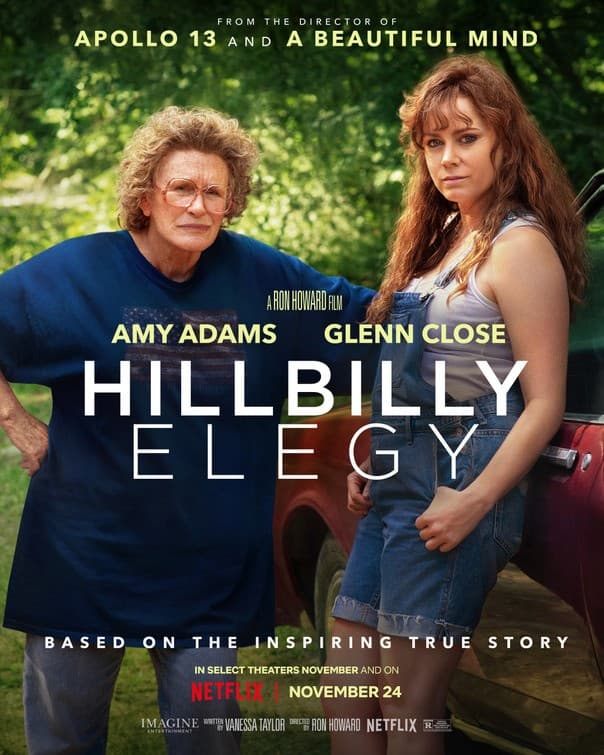
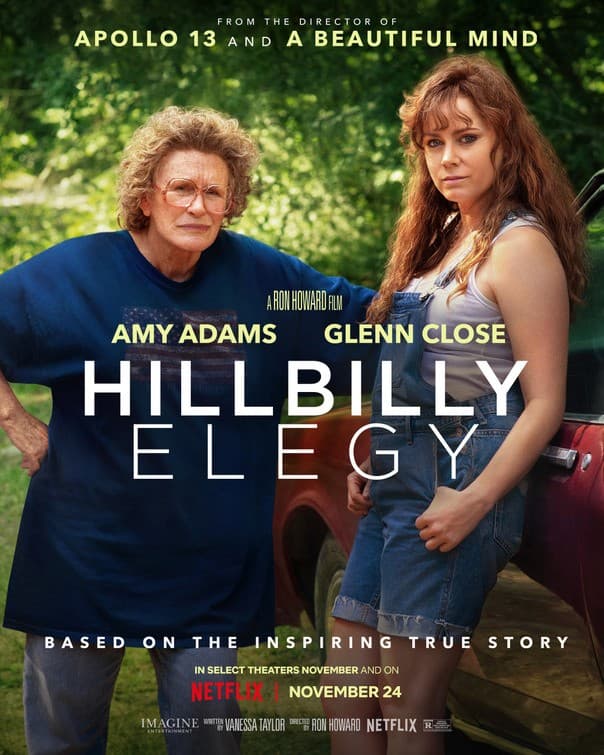
Yale Law School student J.D. Vance is on the verge of a critical job interview when a family crisis pulls him back to his hometown of Middletown, Ohio. As he confronts his mother Bev's spiraling drug addiction and the lifelong influence of his fierce grandmother Mamaw, the picture cuts between his Appalachian childhood and his striving adult present, tracing the cycles of poverty, addiction, and resilience that shaped his rise. Ron Howard's adaptation of J.D. Vance's 2016 memoir stars Glenn Close, Amy Adams, Gabriel Basso, Haley Bennett, and Owen Asztalos.
What Is the Budget of Hillbilly Elegy (2020)?
Hillbilly Elegy (2020), directed by Ron Howard and released by Netflix, was produced on a reported budget of $45,000,000 as an adaptation of J.D. Vance's 2016 memoir Hillbilly Elegy: A Memoir of a Family and Culture in Crisis. Imagine Entertainment (Brian Grazer and Ron Howard's production banner) developed the project for several years before Netflix attached as financier and distributor, with the streaming platform's prestige-original strategy positioning the picture for the awards corridor of late 2020 alongside contemporaneous Netflix prestige releases including Mank, The Trial of the Chicago 7, and Pieces of a Woman.
The investment reflected Netflix's deliberate prestige-original commercial model: a leading-lady pairing of Glenn Close (seven-time Academy Award nominee at that point) as Mamaw and Amy Adams (six-time Academy Award nominee at that point) as Bev, with both performances positioned for awards-cycle consideration. The picture was Imagine Entertainment's principal Netflix project of the period, with director Ron Howard's prestige-mainstream-Americana profile fitting the streaming platform's broader prestige-investment strategy.
Key Budget Allocation Categories
Hillbilly Elegy's $45,000,000 budget was distributed across several major production areas:
- Above-the-Line Talent Glenn Close commanded a seven-time-Academy-Award-nominee veteran rate as Mamaw, with Amy Adams (six-time Academy Award nominee) at a comparable leading-lady scale as Bev. Gabriel Basso played adult J.D. Vance, Owen Asztalos played young J.D. Vance, Haley Bennett played J.D.'s sister Lindsay, and Freida Pinto played J.D.'s girlfriend Usha Chilukuri. Director Ron Howard worked at his prestige-mainstream-Americana directorial scale, with producer Brian Grazer through Imagine Entertainment.
- Atlanta and Macon, Georgia Location Shoot Principal photography took place primarily across Georgia, with Atlanta and Macon doubling for Middletown, Ohio, and the broader Appalachian and Rust Belt settings of the screenplay. The Georgia Film Tax Credit (30% transferable tax credit) materially reduced the picture's effective production cost. Additional location work took place in Middletown, Ohio for select establishing sequences.
- Period-Authentic Production Design Production designer Molly Hughes rendered the elaborate multi-period production design encompassing 1990s and 2000s Middletown, Ohio, the broader Appalachian and Rust Belt context, and the Yale Law School-and-Washington-DC sequences of the picture's adult present-day timeline. The substantial production-design budget covered period vehicles, period set dressing, and contained Yale establishing sequences.
- Practical Prosthetic Aging Effects The picture's elaborate practical prosthetic-aging work for Glenn Close (Mamaw) was the principal makeup-department investment, with multi-stage prosthetic builds transforming Close into the deliberately frumpy and aged Mamaw character. Amy Adams's transformation into the drug-addicted Bev was similarly supported by elaborate practical makeup work.
- Cinematography Cinematographer Maryse Alberti delivered a naturalistic Appalachian-mainstream-Americana visual approach with deliberately desaturated palette for the Middletown sequences and brighter palette for the Yale-and-Washington sequences. The cinematographic approach supported the picture's two-timeline visual identity.
- Costume Costume designer Virginia Johnson dressed the cast across multiple 1990s and 2000s contexts, including elaborate Mamaw frumpy housewife costume work for Glenn Close, Bev addiction-era costume work for Amy Adams, and the J.D. Vance Yale-Law-School professional wardrobe.
- Score and Sound Composers Hans Zimmer and David Fleming delivered a restrained orchestral score with prominent strings and prominent Appalachian-folk-music influences. Hans Zimmer's involvement was the principal score-department prestige investment, with his prestige-mainstream-cinema reputation bringing additional awards-cycle visibility to the picture's score component.
How Does Hillbilly Elegy's Budget Compare to Similar Films?
At $45,000,000, Hillbilly Elegy sits in the upper-tier range for prestige Netflix originals from the late 2020 corridor. The comparison set illustrates how its scale tracked against peer productions:
- Mank (2020): Budget approximately $25,000,000 | Netflix streaming exclusive. David Fincher's prestige Citizen Kane backstory cost roughly half of Hillbilly Elegy and earned 10 Academy Award nominations including Best Picture, providing the direct prestige-Netflix-streaming-exclusive template that Hillbilly Elegy aspired toward but did not match in awards traction.
- The Trial of the Chicago 7 (2020): Budget $35,000,000 | Netflix streaming exclusive. Aaron Sorkin's contemporaneous Netflix prestige original cost less than Hillbilly Elegy and earned 6 Academy Award nominations including Best Picture, providing the direct contemporaneous prestige-Netflix-streaming peer.
- Marriage Story (2019): Budget $18,000,000 | Netflix streaming exclusive. Noah Baumbach's Netflix prestige original from the year before Hillbilly Elegy cost less than half and earned 6 Academy Award nominations including Best Actress (Scarlett Johansson) and Best Supporting Actress (Laura Dern won), providing the prestige-Netflix-streaming template against which Hillbilly Elegy was being positioned.
- Pieces of a Woman (2020): Budget approximately $7,000,000 | Netflix streaming exclusive. Kornel Mundruczo's contemporaneous Netflix prestige drama cost a fraction of Hillbilly Elegy and earned a Best Actress Academy Award nomination for Vanessa Kirby, providing the contemporaneous lower-budget Netflix prestige template.
- Manchester by the Sea (2016): Budget $9,000,000 | Worldwide $79,213,153. Kenneth Lonergan's Amazon Studios prestige drama cost a fraction of Hillbilly Elegy and earned 2 Academy Awards (Best Actor Casey Affleck and Best Original Screenplay), providing the streaming-era prestige-drama template that Hillbilly Elegy's significantly larger budget aimed to match commercially.
Hillbilly Elegy Box Office Performance
Hillbilly Elegy received a deliberately limited theatrical release on November 11, 2020, in approximately 81 cinemas (a meaningful theatrical footprint constrained by the contemporaneous COVID-19 pandemic theatrical-shutdown context), ahead of its global Netflix streaming launch on November 24, 2020. The limited theatrical run reported negligible domestic theatrical gross. The picture's commercial proposition resided entirely in Netflix streaming engagement, with the platform reporting strong viewership in the initial weeks following the November 24 launch.
Against a $45,000,000 production budget, the financial breakdown reflects the Netflix prestige-streaming commercial model:
Box Office Breakdown
Hillbilly Elegy

Hillbilly Elegy's commercial performance is opaque by design as a Netflix streaming exclusive. Netflix reported the picture as one of its most-watched releases of the November 2020 corridor, with the picture earning strong household viewership across the COVID-era streaming-content peak. The picture's commercial outcome is best understood as part of Netflix's broader prestige-original investment strategy alongside contemporaneous prestige Netflix releases including Mank (2020), The Trial of the Chicago 7 (2020), and Pieces of a Woman (2020).
The picture's awards-cycle outcome substantially fell short of expectations. Glenn Close's Best Supporting Actress and Amy Adams's Best Actress positioning did not earn formal Academy Award nominations in the year, though Glenn Close received both a Razzie nomination and an Academy Award nomination for the same performance (Razzie for Worst Supporting Actress, Academy nomination for Best Supporting Actress, an unprecedented split that itself became a substantial cultural conversation). The mixed-to-negative critical reception substantially constrained the picture's commercial and prestige-cultural visibility relative to expectations.
Hillbilly Elegy Production History
J.D. Vance published Hillbilly Elegy: A Memoir of a Family and Culture in Crisis in June 2016, with the memoir becoming a major bestseller and a substantial cultural conversation piece during the late-2016 presidential election cycle. Imagine Entertainment (Brian Grazer and Ron Howard's production banner) acquired adaptation rights shortly after the memoir's publication, with Vanessa Taylor (a frequent Guillermo del Toro and Game of Thrones screenwriter) attached to write the screenplay.
Multiple potential distributors and financiers cycled through the project across 2017 and 2018 before Netflix attached as financier and distributor in 2019, positioning the picture for the platform's broader prestige-original strategy. Casting brought Glenn Close (seven-time Academy Award nominee at that point) as Mamaw and Amy Adams (six-time Academy Award nominee at that point) as Bev, with both performances positioned for awards-cycle consideration. Gabriel Basso, Haley Bennett, Owen Asztalos, and Freida Pinto completed the principal ensemble.
Principal photography took place across summer and fall 2019 primarily in Georgia, with Atlanta and Macon doubling for Middletown, Ohio, and the broader Appalachian and Rust Belt settings of the screenplay. The Georgia Film Tax Credit (30% transferable tax credit) materially reduced the picture's effective production cost. Additional location work took place in Middletown, Ohio for select establishing sequences. The substantial practical prosthetic-aging work for Glenn Close (Mamaw) was the picture's principal makeup-department production-cost line item.
Post-production was completed across 2020, with the picture's release timing adjusted multiple times due to the contemporaneous COVID-19 pandemic theatrical-shutdown context. The eventual November 11, 2020 limited theatrical release and November 24, 2020 Netflix streaming launch positioned the picture for the late-2020 awards corridor, though the COVID-disrupted ceremony cycle and the picture's mixed critical reception substantially limited its awards traction. Composers Hans Zimmer and David Fleming delivered the orchestral score in summer and fall 2020.
Awards and Recognition
Hillbilly Elegy received unusually divided industry awards recognition. At the 93rd Academy Awards (2021), Glenn Close received a nomination for Best Supporting Actress for her Mamaw performance, with Yuh-Jung Youn ultimately winning the category for Minari. The picture also received an Academy Award nomination for Best Makeup and Hairstyling for the elaborate practical prosthetic-aging work supporting Glenn Close's Mamaw transformation, with Ma Rainey's Black Bottom ultimately winning the category.
At the same ceremony cycle, Glenn Close also received a Razzie Award (Golden Raspberry Award) for Worst Supporting Actress for the identical performance, an unprecedented split between the Academy Award nomination and the Razzie win that itself became a substantial cultural conversation in the spring 2021 awards corridor. Glenn Close subsequently attended both ceremonies in the same evening. At the Golden Globe Awards, Glenn Close received a nomination for Best Supporting Actress in a Motion Picture. The picture's mixed-to-negative critical reception substantially constrained its overall awards-cycle traction.
Critical Reception
Hillbilly Elegy received mixed-to-negative reviews. The film holds a 24% approval rating on Rotten Tomatoes based on 235 critic reviews, with a critical consensus calling it 'an earnest but emotionally unrewarding adaptation whose strong central performances cannot fully compensate for its flattened source-material treatment.' On Metacritic, the film scored 38 out of 100, indicating generally unfavorable reviews. As a streaming exclusive, the picture did not receive CinemaScore polling.
The New York Times's A.O. Scott called the picture 'an unconvincing adaptation that flattens a complex memoir into family-melodrama beats,' and Variety's Owen Gleiberman wrote that the picture was 'an emotionally calibrated misfire whose strong central performances cannot rescue the screenplay's flattened source-material treatment.' The Guardian's Peter Bradshaw gave the picture two out of five stars. IndieWire's David Ehrlich called the picture 'a glaringly tone-deaf prestige adaptation whose political contradictions cannot be smoothed over by Glenn Close's prosthetic-heavy central performance.'
Comparative critical analyses with J.D. Vance's source memoir consistently positioned the book as the substantially superior work, with the picture's removal of the memoir's broader sociological and political context cited as the principal adaptation challenge. The picture's critical reputation has remained negative across the years since release, particularly following J.D. Vance's subsequent political career (J.D. Vance was elected Vice President of the United States in 2024). The picture has become an unusually politically inflected cultural conversation piece in retrospect, with critical reception substantially diverging across political lines.
Frequently Asked Questions
How much did Hillbilly Elegy (2020) cost to make?
The reported production budget was $45,000,000. Imagine Entertainment (Brian Grazer and Ron Howard's production banner) developed the project for several years before Netflix attached as financier and distributor, with the streaming platform's prestige-original strategy positioning the picture for the late-2020 awards corridor.
How much did Hillbilly Elegy earn at the box office?
Hillbilly Elegy received a deliberately limited theatrical release on November 11, 2020, in approximately 81 cinemas (constrained by the COVID-19 pandemic theatrical-shutdown context), ahead of its global Netflix streaming launch on November 24, 2020. The limited theatrical run reported negligible domestic theatrical gross. Netflix did not disclose viewership or streaming-revenue figures.
Is Hillbilly Elegy on Netflix?
Yes. Netflix launched Hillbilly Elegy on its global streaming platform on November 24, 2020, as the picture's exclusive worldwide distribution. Netflix reported the picture as one of its most-watched releases of the November 2020 corridor, with strong household viewership across the COVID-era streaming-content peak.
Who directed Hillbilly Elegy?
Ron Howard directed the picture, working at his prestige-mainstream-Americana directorial scale. Howard developed the project with Brian Grazer through Imagine Entertainment after the production company acquired adaptation rights to J.D. Vance's 2016 memoir.
Is Hillbilly Elegy based on a true story?
Yes. The picture is an adaptation of J.D. Vance's 2016 memoir Hillbilly Elegy: A Memoir of a Family and Culture in Crisis. The memoir became a major bestseller and a substantial cultural conversation piece during the late-2016 presidential election cycle. Vanessa Taylor wrote the adapted screenplay for Imagine Entertainment and Netflix.
Where was Hillbilly Elegy filmed?
Principal photography took place across summer and fall 2019 primarily in Georgia, with Atlanta and Macon doubling for Middletown, Ohio, and the broader Appalachian and Rust Belt settings of the screenplay. The Georgia Film Tax Credit (30% transferable tax credit) materially reduced the picture's effective production cost. Additional location work took place in Middletown, Ohio for select establishing sequences.
Who stars in Hillbilly Elegy?
Glenn Close stars as Mamaw and Amy Adams stars as Bev, J.D. Vance's mother. Gabriel Basso plays adult J.D. Vance, Owen Asztalos plays young J.D. Vance, Haley Bennett plays J.D.'s sister Lindsay, and Freida Pinto plays J.D.'s girlfriend Usha Chilukuri. The casting positioned both Close and Adams for awards-cycle consideration.
Did Glenn Close win awards for Hillbilly Elegy?
Glenn Close received an Academy Award nomination for Best Supporting Actress at the 93rd Academy Awards (2021), with Yuh-Jung Youn ultimately winning for Minari. Close also received a Razzie Award (Golden Raspberry Award) for Worst Supporting Actress for the identical performance, an unprecedented split that became a substantial cultural conversation in the spring 2021 awards corridor.
What did critics think of Hillbilly Elegy?
Hillbilly Elegy received mixed-to-negative reviews. It holds a 24% approval rating on Rotten Tomatoes from 235 critics and a 38 out of 100 score on Metacritic. The New York Times's A.O. Scott called it 'an unconvincing adaptation that flattens a complex memoir into family-melodrama beats,' and IndieWire's David Ehrlich called it 'a glaringly tone-deaf prestige adaptation.'
How does Hillbilly Elegy compare to the memoir?
Comparative critical analyses with J.D. Vance's source memoir consistently positioned the book as the substantially superior work, with the picture's removal of the memoir's broader sociological and political context cited as the principal adaptation challenge. The memoir's substantial cultural and political significance, particularly following J.D. Vance's subsequent election as Vice President of the United States in 2024, has substantially exceeded the picture's standalone cultural impact.
Filmmakers
Hillbilly Elegy

Official Trailer
Build budgets like this one in Saturation
Start from an industry-standard feature film template, import the schedule and rates you already have, and let the cost report keep itself current as you spend. Real-time collaboration, no spreadsheets.