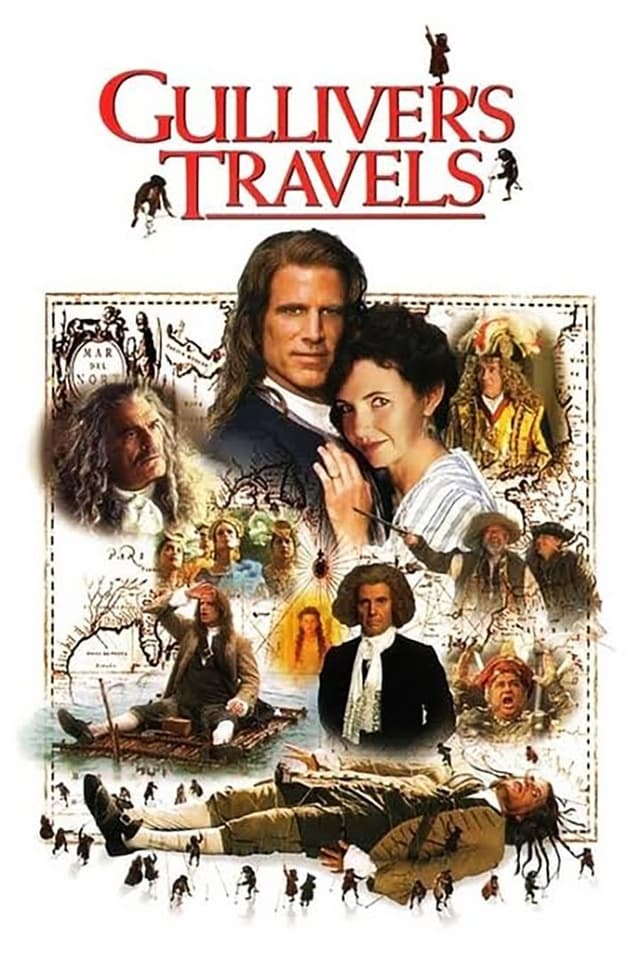
Gulliver's Travels Budget
Updated
Synopsis
Lemuel Gulliver, a New York mailroom clerk with a lifetime of unfulfilled ambitions, talks his way into a freelance travel-writing assignment to the Bermuda Triangle. A storm shipwrecks him on the island of Lilliput, where he is captured as a giant by the tiny inhabitants, befriends a humble Lilliputian named Horatio, and inadvertently becomes a hero of the kingdom by saving the princess from invading neighbors.
What Is the Budget of Gulliver's Travels (2010)?
Gulliver's Travels (2010), directed by Rob Letterman and distributed by 20th Century Fox, was produced on a reported budget of $112,000,000. The Jonathan Swift adaptation cast Jack Black as Lemuel Gulliver, a New York mailroom clerk who washes ashore on the island of Lilliput and discovers himself a giant among its tiny inhabitants. The project was Fox's December 2010 family-tentpole gamble, designed to convert Jack Black's School of Rock and Kung Fu Panda popularity into a Christmas-week theatrical event.
Fox co-financed the production with Davis Entertainment, John Davis's longtime Fox-based label, and routed equity through Dune Entertainment. The $112,000,000 figure covered Jack Black's quote (estimated in the $15M to $20M range after backend), extensive visual effects to scale Black against the Lilliputian world, location and stage work in the United Kingdom, and a 3D conversion completed in post-production to capture the format premium then dominant at the multiplex.
Key Budget Allocation Categories
The $112,000,000 budget broke down across these primary line items:
- Jack Black Salary: Black commanded a leading-man quote in the $15,000,000 to $20,000,000 range plus backend gross participation, reflecting his post-Kung Fu Panda standing as a Fox-friendly franchise lead. Supporting performers Emily Blunt, Jason Segel, Amanda Peet, Billy Connolly, and Chris O'Dowd were cast at considerably lower rates appropriate to a Fox family tentpole ensemble.
- Visual Effects: The scale-disparity effects between Jack Black and the Lilliputian cast were the film's primary technical and budgetary lift. Multiple vendor houses including Tippett Studio, Rhythm & Hues, and MPC delivered shots requiring forced perspective, motion-capture-driven crowd simulations, and seamless composites of Black with miniature actors and environments. Visual effects spend is estimated to have exceeded $35,000,000.
- UK Production Base: Principal photography ran at Pinewood Studios outside London with location work across the United Kingdom, including Hampton Court Palace, Greenwich Naval College, and Blenheim Palace doubling for Lilliputian estates and palace exteriors. UK production benefited from the British Film Tax Relief.
- 3D Conversion: Gulliver's Travels was shot in 2D and converted to 3D in post-production by Stereo D and Prime Focus, a then-standard post-Avatar premium-format approach. The conversion added several million dollars to the negative cost but enabled the $3 to $4 per-ticket 3D surcharge that Fox marketing leaned on heavily.
- Production Design: Production designer Norman Garwood, an Oscar nominee for Brazil and Hook, built large-scale Lilliputian palace, harbor, and forest sets at Pinewood with practical miniatures designed for forced-perspective photography against full-size Jack Black plates. Costume designer Jenny Beavan dressed the Lilliputian court in elaborate period-baroque silhouettes that required hundreds of bespoke garments.
- Music and Soundtrack: Henry Jackman composed the orchestral score. The soundtrack featured prominent needle drops including Edwin Starr's War, played during the Gulliver-versus-Blefuscu sea-battle sequence, with licensing fees adding to the music budget.
How Does Gulliver's Travels' Budget Compare to Similar Films?
At $112,000,000, Gulliver's Travels sits in the upper-mid bracket of early-2010s family fantasy adaptations. The comparison set:
- Night at the Museum: Battle of the Smithsonian (2009): Budget $150,000,000 | Worldwide $413,106,170. Fox's contemporaneous family-led VFX comedy spent 1.3x more than Gulliver's Travels and earned nearly twice as much worldwide, illustrating the studio's preferred template for the genre and the gap Gulliver's failed to close.
- Yogi Bear (2010): Budget $80,000,000 | Worldwide $201,584,141. Warner Bros.' contemporaneous live-action talking-animal release cost less, earned more, and shared the Christmas 2010 family-tentpole calendar slot, an unfavorable head-to-head for Gulliver's Travels.
- Nanny McPhee Returns (2010): Budget $35,000,000 | Worldwide $93,000,000. Universal's UK-shot family sequel cost roughly one-third of Gulliver's Travels and earned 40% of its worldwide gross, a better ROI on a far smaller investment.
- Alice in Wonderland (2010): Budget $200,000,000 | Worldwide $1,025,491,110. Disney's Tim Burton fantasy demonstrated the ceiling for the live-action-fantasy 3D-era family blockbuster and made the Gulliver's Travels strategy of mid-tier scale look misaligned with where audiences were spending.
- The Spiderwick Chronicles (2008): Budget $90,000,000 | Worldwide $164,000,000. Paramount's earlier family fantasy adaptation cost less and earned less, sitting in the same risk-reward bracket and confirming the difficulty of converting non-Harry-Potter literary kid properties into theatrical hits at this scale.
Gulliver's Travels Box Office Performance
Gulliver's Travels opened wide on December 25, 2010 to a soft $7,221,000 first-day domestic gross and a four-day Christmas weekend total of $24,891,118, finishing fourth behind Little Fockers, True Grit, and Tron: Legacy. The film never recovered its momentum and lost screens quickly through January as new releases arrived. Worldwide, the picture leaned heavily on international territories where Jack Black's Kung Fu Panda profile traveled, particularly Latin America and Asia-Pacific.
Against a $112,000,000 production budget, the film needed approximately $250,000,000 worldwide to reach profitability when accounting for marketing and distribution. The financial breakdown:
Box Office Breakdown
Gulliver's Travels

Gulliver's Travels returned approximately $1.24 in theatrical revenue for every $1 invested when measured against total estimated production and marketing spend. The domestic share was a disappointing $42,779,261 against an international share of $194,603,463, an 18/82 split that ranked among the most lopsided foreign-leaning ratios of any major 2010 release. Strong international receipts allowed Fox to recoup the negative cost theatrically, though margins were thin and the planned sequel never materialized.
Domestic underperformance and middling reviews ended Jack Black's run as a Fox live-action family lead. The studio pivoted Black back to Kung Fu Panda voice work and dropped further Swift adaptation development. The film performed well on cable and home video, particularly on Disney Channel and FX cable runs, where it became a perennial mid-tier family-comedy time-filler through the mid-2010s.
Gulliver's Travels Production History
Development began at Fox in 2006 with screenwriters Nicholas Stoller and Joe Stillman tasked with modernizing Swift's 1726 satirical novel for a contemporary family audience. The project floated through several director attachments before Rob Letterman, fresh off DreamWorks's Monsters vs. Aliens, came aboard in 2009. Jack Black was attached from the outset, with the producers building the modernization around his persona as an underachieving everyman thrust into a high-stakes adventure.
Principal photography ran from March to July 2009 in the United Kingdom, based at Pinewood Studios outside London with extensive location work at Hampton Court Palace, Greenwich Naval College, and Blenheim Palace standing in for Lilliputian palaces and harbors. The UK production took advantage of the British Film Tax Relief. A second-unit Bermuda location shoot captured the framing sequences set in the Bermuda Triangle.
Visual effects work continued at Tippett Studio, Rhythm & Hues, and MPC through 2009 and 2010, with the scale-disparity composites requiring extensive forced-perspective plate photography that Letterman shot on motion-controlled rigs at Pinewood. The film was converted to 3D in post-production by Stereo D and Prime Focus. Fox initially planned a Father's Day 2010 release before pushing the film to Christmas Day 2010 to capitalize on the family-tentpole window. Reshoots in spring 2010 added comedic set pieces in response to test-screening feedback that the film leaned too heavily on Swift's narrative structure and too lightly on Jack Black's improvisational energy.
Awards and Recognition
Gulliver's Travels received no major awards recognition. Jack Black was nominated for the Razzie Award for Worst Actor at the 2011 ceremony, ultimately losing to Ashton Kutcher's combined performances in Killers and Valentine's Day. The film also received Razzie nominations for Worst Picture, Worst Director (Rob Letterman), and Worst Screen Couple, though it did not win any of those categories.
The picture was not nominated at the Saturn Awards or the Visual Effects Society Awards, an unusual omission for a 2010 effects-heavy fantasy release. Its absence from VES recognition was widely interpreted as a verdict on the unevenness of the scale-disparity work. Gulliver's Travels did receive a Kids' Choice Award nomination in the Favorite Movie Actor category for Jack Black, who had been a previous winner for Kung Fu Panda.
Critical Reception
Gulliver's Travels received broadly negative reviews from critics. The film holds a 21% approval rating on Rotten Tomatoes based on 142 critic reviews, with a critical consensus calling it lazily modernized and tonally inconsistent. On Metacritic, the film scored 36 out of 100, indicating generally unfavorable reviews. Audiences gave the film a B CinemaScore on opening weekend, a soft result for a family release where A-range scores are the typical standard.
Manohla Dargis of The New York Times wrote that the film "reduces Swift's satire to a fart-joke delivery system that doesn't even bother to honor its own premise." Variety's Justin Chang called it "a high-concept package that confuses cleverness with cynicism," while Owen Gleiberman of Entertainment Weekly conceded that Black"s charm remained intact while objecting that "the screenplay can"t decide if Gulliver is a hero, a fraud, or a cautionary tale." Roger Ebert, in one of the warmer notices, gave the film two stars and called it "a watchable trifle for kids who have never read a word of Swift."
Genre press was harsher. The Guardian's Peter Bradshaw wrote that "the film treats one of the great works of English satire like a costume to be discarded the moment Jack Black opens his mouth." Time Out London called it "a missed opportunity rendered with surprising visual flatness for a 3D release." The film's reputation has not improved with hindsight, and it is now most frequently cited in retrospectives about the early-2010s 3D-conversion bubble and the limits of grafting modern comedic personas onto canonical literary properties.
Frequently Asked Questions
How much did it cost to make Gulliver's Travels (2010)?
The reported production budget was $112,000,000. 20th Century Fox co-financed the production with Davis Entertainment and Dune Entertainment, with extensive UK studio shooting at Pinewood Studios benefiting from British Film Tax Relief.
How much did Gulliver's Travels earn at the box office?
The film grossed $42,779,261 domestically and $194,603,463 internationally, for a worldwide total of $237,382,724. It opened to $24,891,118 over the four-day Christmas 2010 holiday weekend, finishing fourth behind Little Fockers, True Grit, and Tron: Legacy.
Was Gulliver's Travels a box office success?
Marginally. Against a $112M production budget and an estimated $60M to $80M in marketing spend, the film grossed $237M worldwide, returning approximately $1.24 for every $1 invested. The result was below studio expectations but international receipts allowed Fox to clear the negative cost theatrically. The planned sequel was never produced.
Who directed Gulliver's Travels?
Rob Letterman directed the film, working from a screenplay by Joe Stillman and Nicholas Stoller based on Jonathan Swift's 1726 novel. Letterman had previously co-directed DreamWorks Animation's Shark Tale (2004) and Monsters vs. Aliens (2009).
Where was Gulliver's Travels filmed?
Principal photography took place at Pinewood Studios outside London from March to July 2009, with location work at Hampton Court Palace, Greenwich Naval College, and Blenheim Palace doubling for Lilliputian palaces and harbors. A second-unit shoot in Bermuda captured the framing sequences. The UK production leveraged British Film Tax Relief.
Why was Gulliver's Travels in 3D?
The film was shot in 2D and converted to 3D in post-production by Stereo D and Prime Focus, a then-standard post-Avatar premium-format strategy. The 3D conversion added several million dollars to the negative cost but enabled the $3 to $4 per-ticket 3D surcharge that Fox's marketing campaign leaned on heavily during the Christmas 2010 family-tentpole window.
What did critics think of Gulliver's Travels?
The film received broadly negative reviews, holding a 21% approval rating on Rotten Tomatoes from 142 critics and a Metacritic score of 36 out of 100. Audiences gave it a B CinemaScore. Manohla Dargis of The New York Times called it "a fart-joke delivery system that doesn't even bother to honor its own premise." Roger Ebert was warmer, awarding two stars and calling it watchable for kids unfamiliar with Swift.
Did Gulliver's Travels receive any Razzie nominations?
Yes. Jack Black was nominated for the Razzie Award for Worst Actor at the 2011 ceremony, and the film received additional Razzie nominations for Worst Picture, Worst Director, and Worst Screen Couple. It did not win in any category, with Ashton Kutcher taking Worst Actor for his combined work in Killers and Valentine's Day.
How does Gulliver's Travels compare to other 2010 family fantasy releases?
It significantly underperformed Alice in Wonderland ($200M budget, $1.025B worldwide) and Disney's tentpole bracket, and it lost the Christmas 2010 head-to-head with Yogi Bear ($80M budget, $201M worldwide). Compared with Fox's own Night at the Museum: Battle of the Smithsonian ($150M budget, $413M worldwide) from the previous year, Gulliver's Travels demonstrated that the family-VFX-comedy formula did not transfer reliably between Ben Stiller and Jack Black personas.
Who stars opposite Jack Black in Gulliver's Travels?
Jason Segel plays Horatio, the humble Lilliputian who befriends Gulliver. Emily Blunt plays Princess Mary, Amanda Peet plays Darcy Silverman (Gulliver's editor crush in the New York framing story), Billy Connolly plays King Theodore, and Chris O'Dowd plays the villainous General Edward. T.J. Miller and James Corden round out the supporting Lilliputian ensemble.
Filmmakers
Gulliver's Travels

Official Trailer
Build budgets like this one in Saturation
Start from an industry-standard feature film template, import the schedule and rates you already have, and let the cost report keep itself current as you spend. Real-time collaboration, no spreadsheets.