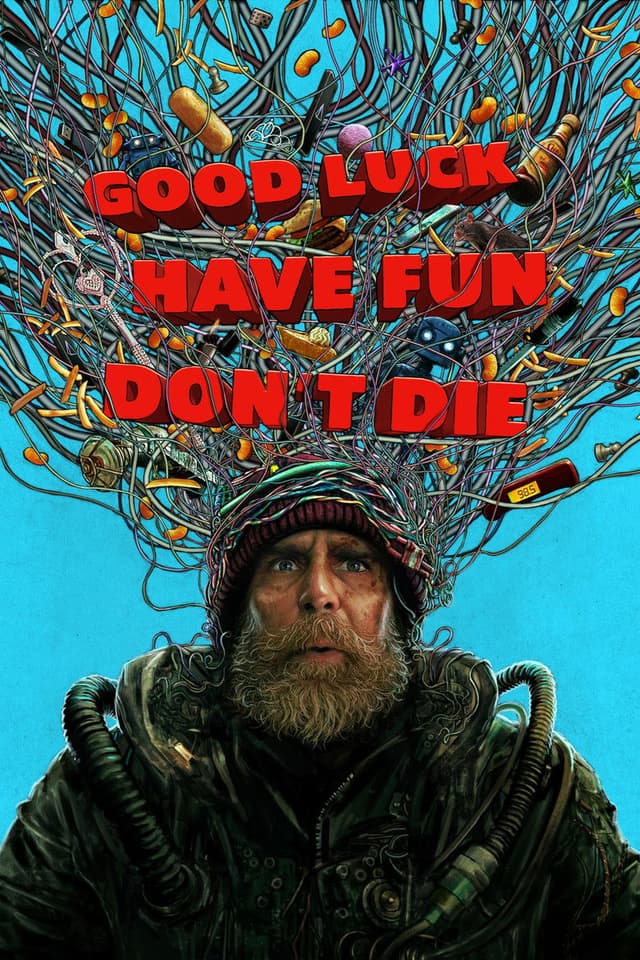
Good Luck, Have Fun, Don't Die Budget
 Science FictionActionComedy2h 14m
Updated
Synopsis
A "Man From the Future" arrives at a diner in Los Angeles where he must recruit the precise combination of disgruntled patrons to join him on a one-night quest to save the world from the terminal threat of a rogue artificial intel...
What Is the Budget of Good Luck, Have Fun, Don't Die?
Good Luck, Have Fun, Don't Die (2026) was produced on a budget of $20 million, a mid-budget sci-fi action comedy directed by Gore Verbinski, whose career spans The Ring, the Pirates of the Caribbean trilogy, Rango, and A Cure for Wellness. The film stars Sam Rockwell as a time-traveling 'Man from the Future' who arrives at an LA diner and must assemble an unlikely group of strangers to stop a rogue artificial intelligence from destroying civilization.
The film grossed $9.5 million worldwide against its $20 million budget, a significant theatrical underperformance for a director of Verbinski's profile. However, the film's streaming performance through its distribution deal was expected to substantially improve the overall return for production company Constantin Film.
Key Budget Allocation Categories
- Above-the-Line Talent: Sam Rockwell (Three Billboards Outside Ebbing, Missouri, Jojo Rabbit) leads a cast that includes Juno Temple (Ted Lasso, Dirty John), Haley Lu Richardson (Five Feet Apart, The White Lotus), Michael Pena (Ant-Man, End of Watch), and Zazie Beetz (Atlanta, Deadpool 2). The ensemble represents strong critical-darling pedigree concentrated into a tight budget, with Rockwell's fee likely consuming $4 to 6 million of the above-the-line allocation.
- Single-Location Production Design: The film is primarily set in an LA diner over the course of one night, a constrained production design that kept location costs manageable while requiring the diner set to carry significant visual weight across 134 minutes. Production designer's approach transformed the diner into a space that shifts registers from comedy to action without feeling cramped.
- Director Fee: Gore Verbinski commands significant fees for his directing work; his return to mid-budget filmmaking after high-profile projects likely reflected a deliberate creative choice. His involvement as a creative driver rather than a franchise executor shaped the production's risk profile.
- Score and Sound: Geoff Zanelli, who has composed for Pirates of the Caribbean: Dead Men Tell No Tales and Into the Storm, scored the film. His existing relationship with Verbinski's creative world allowed for efficient collaboration within the budget constraints.
- Constantin Film International Structure: As a Constantin Film and Blind Wink (Verbinski's production company) co-production, the film accessed German production incentives through the Constantin structure and 3 Arts Entertainment's talent relationships, keeping overall costs below what a pure studio production would require.
How Does Good Luck, Have Fun, Don't Die's Budget Compare to Similar Films?
The film occupies the micro-to-mid-budget original sci-fi comedy space, comparable to creator-driven genre films that rely on ensemble chemistry rather than franchise IP.
- Free Guy (2021): Budget $100M | Worldwide $331M. Another AI-adjacent action comedy with a similar "ordinary people saving the world" premise; Good Luck operated at 20% of that budget with a much tighter scope.
- Rango (2011): Budget $135M | Worldwide $245M. Verbinski's animated Oscar winner; the contrast with this $20M live-action film shows the director operating in a radically different budget register.
- The Nice Guys (2016): Budget $50M | Worldwide $62M. A comparable ensemble comedy-action film that underperformed theatrically but became a cult classic on streaming; Good Luck may follow a similar post-theatrical trajectory.
- Don't Worry Darling (2022): Budget $35M | Worldwide $68M. Another mid-budget original thriller with a strong ensemble; Good Luck's $20M is more efficiently scaled for its single-location premise.
Good Luck, Have Fun, Don't Die Box Office Performance
Good Luck, Have Fun, Don't Die opened on February 13, 2026, through its distribution partners. The film grossed $9,538,776 worldwide, well below the theatrical break-even threshold for its production and marketing investment. The opening weekend failed to generate the audience enthusiasm needed to sustain the film in a competitive February marketplace that also saw other major releases competing for screens.
With a $20 million production budget and estimated P&A of $15 million for its release, total investment reached approximately $35 million. At a 50% studio share of worldwide gross, the theatrical recovery was approximately $4.8 million against $35 million invested.
Box Office Breakdown
Good Luck, Have Fun, Don't Die

The film earned roughly $0.48 for every $1 invested in production at the theatrical window. Given the quality of the ensemble and Verbinski's direction, the film was widely expected to follow the trajectory of similarly underperforming mid-budget originals that find substantial audiences on streaming platforms after theatrical.
Good Luck, Have Fun, Don't Die Production History
Good Luck, Have Fun, Don't Die was developed as Gore Verbinski's return to live-action feature filmmaking after A Cure for Wellness (2016), his stylistically ambitious horror film that also underperformed commercially. The screenplay by Matthew Robinson (Monster Trucks) centers on a single night at an LA diner where a time traveler from the future arrives to recruit precisely the right combination of disgruntled, overlooked people to stop a rogue AI from ending civilization.
The concept allowed Verbinski to work with a strong ensemble in a contained space, a deliberate counter-programming choice against the franchise-dominated 2026 release calendar. Sam Rockwell was attached as the Man from the Future, his physicality and comedic timing central to the film's shifting register between absurdist comedy and genuine urgency. Juno Temple, Haley Lu Richardson, Michael Pena, Zazie Beetz, Asim Chaudhry, and Tom Taylor were cast as the diner's assembled strangers.
Constantin Film, the German production company whose projects have included Monster Hunter and various co-productions, provided the primary production infrastructure alongside Verbinski's Blind Wink company and Robert Kulzer Productions. James Whitaker served as director of photography, working with Verbinski to develop a visual grammar that could shift from the film's opening comedy registers to its action climax without losing the diner's intimate scale.
The film premiered on February 13, 2026, the same date as Nirvanna the Band the Show the Movie, in a crowded mid-February marketplace. The theatrical performance failed to match the ambition of the production, though critical response was warmer than the box office suggested.
Awards and Recognition
Good Luck, Have Fun, Don't Die received attention for Sam Rockwell's performance and Verbinski's direction of the ensemble comedy elements. The film's original concept and the quality of its cast prevented it from being dismissed despite its commercial underperformance. No major awards nominations were received in the initial release window, though the film's streaming afterlife was expected to sustain its critical reputation.
Critical Reception
Critics responded positively to Good Luck, Have Fun, Don't Die as an original, director-driven film that reminded audiences what mid-budget studio filmmaking could achieve. Sam Rockwell received near-universal praise for his comic and physical performance, and the ensemble chemistry was cited as the film's primary pleasure. Verbinski's direction was praised for maintaining tonal control across a premise that could easily have collapsed into chaos.
The consensus positioned the film as better than its box office indicated, a common critical verdict for mid-budget originals that fail to find their audience in the theatrical window. Comparisons to The Nice Guys and other underperforming cult comedies were common, with several reviewers predicting the film would find its audience on streaming over time.
Frequently Asked Questions
How much did it cost to make Good Luck, Have Fun, Don't Die (2026)?
The production budget was $20,000,000, covering principal photography, visual effects, cast and crew salaries, locations, sets, post-production, and music. Marketing and distribution (P&A) costs are estimated at an additional $10,000,000 - $16,000,000, bringing the total studio investment to approximately $30,000,000 - $36,000,000.
How much did Good Luck, Have Fun, Don't Die (2026) earn at the box office?
Good Luck, Have Fun, Don't Die grossed $4,777,845 domestic, $4,543,411 international, totaling $9,321,256 worldwide.
Was Good Luck, Have Fun, Don't Die (2026) profitable?
The film did not break even theatrically, earning $9,321,256 against an estimated $50,000,000 needed. Ancillary revenue may have improved the picture.
What were the biggest costs in producing Good Luck, Have Fun, Don't Die?
The primary cost drivers were above-the-line talent (Sam Rockwell, Juno Temple, Haley Lu Richardson); visual effects pipelines, virtual production technology, and speculative world-building; international production across United States of America, Germany.
How does Good Luck, Have Fun, Don't Die's budget compare to similar science fiction films?
At $20,000,000, Good Luck, Have Fun, Don't Die is classified as a low-budget production. The median budget for wide-release science fiction films in the 2020s ranges from $30 - 80M for mid-budget to $150M+ for tentpoles. Comparable budgets: 12 Years a Slave (2013, $20,000,000); 21 Grams (2003, $20,000,000); 3 Ninjas Kick Back (1994, $20,000,000).
Did Good Luck, Have Fun, Don't Die (2026) go over budget?
There are no widely reported accounts of significant budget overruns for this production. However, studios rarely disclose precise budget overrun figures publicly. The reported production budget reflects the final estimated cost.
What was the return on investment (ROI) for Good Luck, Have Fun, Don't Die?
The theatrical ROI was -53.4%, calculated as ($9,321,256 − $20,000,000) ÷ $20,000,000 × 100. This measures gross revenue against production budget only - it does not account for P&A or exhibitor shares.
What awards did Good Luck, Have Fun, Don't Die (2026) win?
N/A.
Who directed Good Luck, Have Fun, Don't Die and who were the key crew members?
Directed by Gore Verbinski, written by Matthew Robinson, shot by James Whitaker, with music by Geoff Zanelli, edited by Craig Wood.
Where was Good Luck, Have Fun, Don't Die filmed?
Good Luck, Have Fun, Don't Die was filmed in United States of America, Germany.
Filmmakers
Good Luck, Have Fun, Don't Die

Official Trailer
Build budgets like this one in Saturation
Start from an industry-standard feature film template, import the schedule and rates you already have, and let the cost report keep itself current as you spend. Real-time collaboration, no spreadsheets.