Fast X Budget
 ActionCrimeThriller2h 22m
Updated
Synopsis
Dom Toretto and his family face their most lethal adversary yet when Dante Reyes, the son of Brazilian drug lord Hernan Reyes from Fast Five, emerges with an elaborate revenge plot years in the making. As Dante systematically dismantles everything Dom has built, the crew is scattered across the globe, racing against time through Rome, Portugal, and beyond in a desperate fight for survival that ends on a devastating cliffhanger.
What Is the Budget of Fast X?
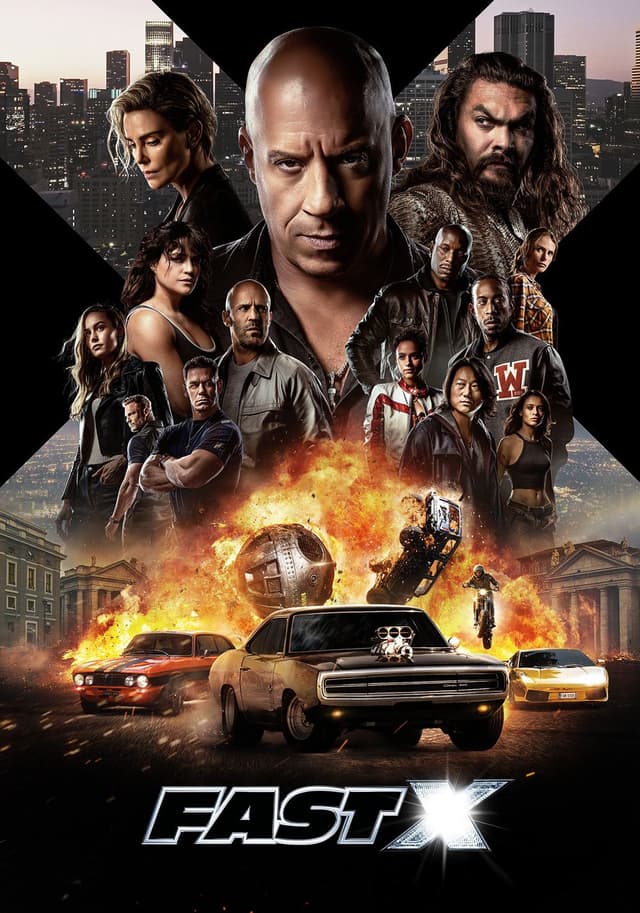
Fast X (2023), directed by Louis Leterrier and released by Universal Pictures, was produced on a budget of $340 million. The tenth mainline entry in the Fast & Furious franchise became one of the most expensive films ever made, with costs inflated by a mid-production director change, an expansive international shoot, and the franchise's escalating appetite for spectacle. Justin Lin, who directed five previous entries in the series, departed ten days into principal photography over creative differences, forcing Universal to hire Leterrier as a replacement while the production was already in motion.
The budget reflects a franchise that had evolved from its $38 million street-racing origins into a globe-spanning action spectacle rivaling James Bond and Mission: Impossible in scope. Fast X was conceived as the first of a planned three-part conclusion to the saga, with Universal betting that the franchise's proven international appeal would justify the massive investment. The ensemble cast, led by Vin Diesel, expanded to include newcomers Jason Momoa, Brie Larson, and Alan Ritchson alongside returning series veterans.
Key Budget Allocation Categories
The $340 million budget was distributed across several major production areas:
- Ensemble Cast Compensation: The Fast franchise carries one of the most expensive casts in Hollywood. Vin Diesel, as both star and producer, commands a significant share. Jason Momoa, joining as the film's villain, Brie Larson, Jason Statham, John Cena, Charlize Theron, and the extended ensemble all represent substantial above-the-line costs that have ballooned across the franchise's two-decade run.
- Director Transition and Production Disruption: Justin Lin's departure ten days into filming created significant financial waste. Sets and sequences designed around Lin's vision had to be reconceived, schedules were rearranged to accommodate the transition, and crew availability during the gap period generated overhead costs. Louis Leterrier inherited a production already in motion, requiring rapid creative adaptation.
- International Location Filming: Fast X filmed extensively across Italy (Rome, Turin, and Sardinia), Portugal (Lisbon and the Algarve), and the United Kingdom. The Rome sequences, which include a massive chase involving a rolling bomb through the city's historic streets, required extensive permits, road closures, and coordination with Italian authorities. Each country's production infrastructure had to be established independently.
- Action Set Pieces and Vehicle Stunts: The franchise's signature vehicle-based action requires enormous practical investment. Custom vehicles, crash rigs, precision driving teams, and the destruction of purpose-built props all carry heavy costs. The Rome chase, the Portugal dam sequence, and multiple explosion-driven set pieces each represented individually expensive production blocks.
- Visual Effects: While the Fast franchise emphasizes practical vehicle work, the scale of Fast X's action demanded extensive digital augmentation. The rolling bomb sequence in Rome, large-scale environmental destruction, and the film's climactic set pieces required thousands of VFX shots from multiple vendors.
How Does Fast X's Budget Compare to Similar Films?
At $340 million, Fast X sits among the most expensive productions in cinema history. Comparing it with franchise peers and action contemporaries:
- F9: The Fast Saga (2021): Budget $200,000,000 | Worldwide $726,229,501. The previous entry cost 41% less and earned modestly more worldwide, illustrating the diminishing returns of escalating franchise budgets. F9's release during the COVID-19 pandemic recovery makes direct comparison difficult.
- Furious 7 (2015): Budget $190,000,000 | Worldwide $1,515,341,399. The franchise's peak performer cost 44% less than Fast X and earned more than double, driven by audience goodwill following Paul Walker's death and a satisfying emotional conclusion.
- Mission: Impossible - Dead Reckoning Part One (2023): Budget $291,000,000 | Worldwide $571,810,492. Released the same summer as Fast X, this fellow blockbuster faced similar escalating-cost challenges and similarly underperformed relative to its budget, reflecting a broader industry reckoning with $300M+ production budgets.
- The Fate of the Furious (2017): Budget $250,000,000 | Worldwide $1,236,005,118. The eighth film cost $90 million less than Fast X and grossed 73% more, representing the last time the franchise delivered genuinely strong returns relative to investment.
- Jurassic World Dominion (2022): Budget $185,000,000 | Worldwide $1,001,978,080. Universal's other legacy franchise conclusion cost 46% less and grossed 40% more, though it too faced diminishing returns relative to earlier installments.
Fast X Box Office Performance
Fast X opened in the United States on May 19, 2023, earning $67.5 million in its domestic opening weekend. The film faced an uphill battle toward profitability given its enormous production and marketing costs.
Box Office Breakdown
Fast X

At approximately +107%, Fast X returned roughly $2.07 for every $1 of production budget invested during its theatrical run.
With a worldwide gross of $714.5 million against a $340 million production budget, Fast X delivered a 110% ROI against the production cost alone. However, this figure does not account for the estimated $175-200 million in marketing costs or theatrical distribution fees. Industry analysts estimated the film needed between $700 million and $850 million to break even on its theatrical run, placing it in a gray zone where the theatrical window likely produced minimal profit or a modest loss.
The domestic performance of $146.1 million was particularly disappointing, representing the lowest domestic gross for a mainline Fast entry since 2 Fast 2 Furious (2003). The international/domestic split of 80/20 was heavily skewed, meaning Universal retained a smaller percentage of overall revenue. China, historically a stronghold for the franchise, contributed a reduced share relative to previous entries.
Fast X Production History
Universal Pictures announced in April 2021 that the Fast & Furious franchise would conclude with a final trilogy beginning with Fast X. Justin Lin, who had directed five previous entries (including Tokyo Drift, Fast & Furious, Fast Five, Fast & Furious 6, and F9), signed on to direct the final chapter. Dan Mazeau wrote the screenplay, building on story elements and character arcs established across the series' 20-year run.
Principal photography began in late April 2022 in London, with plans for an extensive international shoot across Europe. However, just ten days into filming, Justin Lin departed the production. Reports attributed the departure to creative differences, with multiple sources pointing to on-set conflicts. Universal moved quickly to hire Louis Leterrier, whose background in action filmmaking (The Transporter, Now You See Me, The Incredible Hulk) made him a natural fit for the franchise's demands.
Leterrier inherited a production that was simultaneously in motion and in crisis. He reworked the shooting schedule and adapted Lin's planned sequences to his own sensibilities, bringing a European action cinema energy to the franchise. Filming continued across Italy (Rome, Turin, Sardinia), Portugal (Lisbon, the Algarve region), and the United Kingdom. The Rome sequences required weeks of shooting in the Italian capital, including extensive night work through the city's historic center.
Jason Momoa's performance as the villain Dante Reyes became a focal point of the production, with the actor bringing an unpredictable, flamboyant energy that Leterrier encouraged and amplified. The film's narrative structure, designed as the first of three concluding chapters, meant the story deliberately ended on a cliffhanger, a decision that would divide audiences accustomed to the franchise's self-contained entries.
Awards and Recognition
Fast X received minimal awards attention, consistent with the franchise's historical relationship with award bodies. The film was nominated for several Razzie Awards, including Worst Picture, reflecting the critical establishment's dismissal of the franchise's later entries. The stunt coordination work received recognition within the industry's action filmmaking community, with the Taurus World Stunt Awards acknowledging the Rome chase and vehicle sequences.
Jason Momoa's villainous performance, the film's most praised element, earned him nominations at fan-voted ceremonies including the People's Choice Awards and the Kids' Choice Awards. The film's cultural impact was more significant in franchise discourse than in traditional awards circles, as audiences debated the cliffhanger ending and speculated about the saga's conclusion.
Critical Reception
Fast X received mixed reviews, earning a 56% approval rating on Rotten Tomatoes and a 56 out of 100 on Metacritic. The critical response reflected fatigue with the franchise's formula alongside appreciation for specific elements of this installment.
Jason Momoa's performance as Dante Reyes drew the strongest praise, with critics highlighting his campy, theatrical villainy as the film's most entertaining element. Momoa brought a self-aware flamboyance to the role that contrasted effectively with the franchise's typically stoic masculine energy. Louis Leterrier's direction of the action sequences, particularly the Rome chase, was generally praised as competent and energetic, if not revolutionary.
The primary criticisms targeted the film's bloated ensemble (with too many characters competing for screen time), its reliance on increasingly implausible action physics, and the cliffhanger ending that denied audiences a satisfying resolution. Several reviewers noted that at 141 minutes, the film struggled to justify its runtime while simultaneously failing to resolve its storyline. The franchise's ongoing escalation from street racing to global espionage to near-superhero spectacle continued to divide opinion, with some critics embracing the absurdity and others viewing it as evidence of creative bankruptcy.
Frequently Asked Questions
How much did it cost to make Fast X (2023)?
Fast X had a production budget of $340 million. The extraordinary cost was driven by the large ensemble cast, a mid-production director change from Justin Lin to Louis Leterrier, extensive location filming across Italy, Portugal, and the UK, and the franchise's signature vehicle stunts and action set pieces.
Why did Justin Lin leave Fast X?
Justin Lin departed the production just ten days into principal photography, reportedly over creative differences. Lin had directed five previous entries in the franchise. Universal hired Louis Leterrier as his replacement, though the transition added significant costs as planned sequences were reworked.
How much did Fast X earn at the box office?
The film grossed $146,126,015 domestically and $568,417,565 internationally for a worldwide total of $714,543,580. The domestic gross was the lowest for a mainline Fast entry since 2 Fast 2 Furious (2003).
Was Fast X profitable?
Barely. With a $340 million production budget and an estimated $175-200 million in marketing costs, the break-even point was approximately $700-850 million. The $714.5 million worldwide gross placed it in a gray zone where the theatrical run likely produced minimal profit or a modest loss.
Who directed Fast X?
Louis Leterrier directed the film after Justin Lin's departure. Leterrier, known for The Transporter, The Incredible Hulk, and Now You See Me, brought a European action cinema sensibility to the franchise and was hired while the production was already underway.
Where was Fast X filmed?
The film was shot across multiple European locations including Rome, Turin, and Sardinia in Italy; Lisbon and the Algarve in Portugal; and various locations in the United Kingdom. The Rome sequences required extensive permits and road closures through the city's historic center.
What did critics think of Fast X?
The film received mixed reviews: 56% on Rotten Tomatoes and 56 on Metacritic. Jason Momoa's flamboyant villain performance was widely praised, but critics faulted the bloated ensemble, implausible action physics, and the cliffhanger ending that denied audience resolution.
Why does Fast X end on a cliffhanger?
Fast X was designed as the first of a planned three-part conclusion to the Fast & Furious saga. The cliffhanger ending was an intentional narrative choice, though it divided audiences who were accustomed to the franchise's traditionally self-contained stories.
How does Fast X compare to other Fast & Furious films at the box office?
Fast X ranks among the lower performers in the franchise. It earned $714.5 million worldwide, compared to Furious 7's $1.515 billion and The Fate of the Furious' $1.236 billion. The significant budget increase without corresponding revenue growth illustrated the franchise's diminishing returns.
Is Fast X the most expensive Fast & Furious film?
Yes. At $340 million, Fast X is the most expensive film in the franchise by a wide margin. The previous highest was The Fate of the Furious at $250 million. The 36% budget increase did not translate to higher box office returns.
Filmmakers
Fast X

Official Trailer
Build budgets like this one in Saturation
Start from an industry-standard feature film template, import the schedule and rates you already have, and let the cost report keep itself current as you spend. Real-time collaboration, no spreadsheets.