Facing the Giants Budget
 Drama1h 51m
Updated
Synopsis
A losing coach with an underdog football team faces their giants of fear and failure on and off the field to surprising results.
What Is the Budget of Facing the Giants?
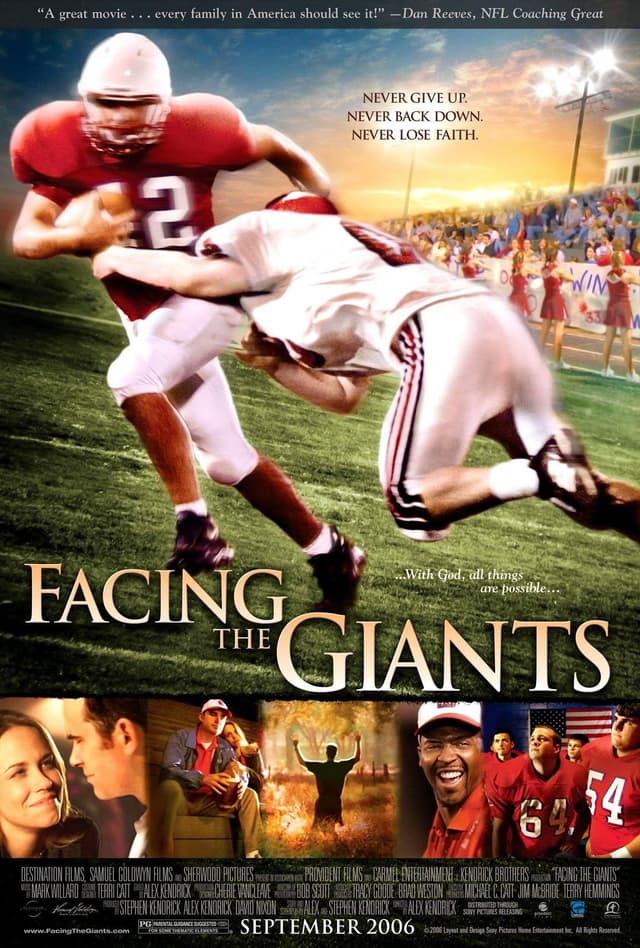
Facing the Giants (2006), directed by Alex Kendrick and produced by Sherwood Pictures, the film ministry of Sherwood Baptist Church in Albany, Georgia, had a production budget of approximately $100,000. This places it among the most successful micro-budget theatrical releases in American film history. The film was made almost entirely by church volunteers, with congregation members serving as cast, crew, and production support, making the $100,000 figure represent primarily equipment and technical costs rather than labor.
The $100,000 budget is one of the most remarkable production cost figures in commercial film history relative to its commercial outcome: $10,178,331 worldwide against a $100,000 investment represents a return of more than one hundred times the production cost. No comparable result exists in mainstream theatrical history at this production scale.
Key Budget Allocation Categories
At $100,000, Facing the Giants was produced with production constraints that would be unworkable for any professional film production. The budget was concentrated in the essentials that a volunteer production cannot provide through donated labor:
- Equipment and Camera — The film was shot on a consumer-level digital video camera, which was one of the primary technical investments at this budget level. The decision to use accessible digital technology rather than film stock was both a necessity and a production philosophy: make the story accessible, not the production impressive. The visual quality reflects these constraints in ways that the film's commercial success demonstrates the audience was willing to accept.
- Football Facilities and Locations — Filming at Sherwood Baptist Church's real-world community locations, including actual high school football fields, reduced location costs to near zero while providing authentic environments. The community's ownership of these locations is a production advantage that professional productions cannot replicate.
- Distribution Rights and Post-Production — Securing the Samuel Goldwyn Films and Provident Films distribution deal required the film to meet technical delivery standards that the initial budget could not fully support. Post-production investment including color correction and audio work represented the gap between the production's volunteer-made quality and theatrical release standards.
- Volunteer Cast and Crew — The overwhelming majority of the production's labor was donated by Sherwood Baptist Church congregation members, who served without pay as actors, camera operators, grips, production assistants, and every other production role. This community production model is the only reason the $100,000 budget was sufficient to produce a feature-length film.
How Does Facing the Giants' Budget Compare to Similar Films?
At $100,000, Facing the Giants is one of the most extreme outliers in the ratio of production cost to commercial result in film history. The comparisons that contextualize this:
- God's Not Dead (2014) — Budget $2,000,000 | Worldwide $64,700,000. The Pure Flix faith drama that followed Facing the Giants' model on twenty times the budget, demonstrating how the church distribution mechanism scales with modest production investment. Both films rely on the same faith community mobilization engine; God's Not Dead simply had more professional production infrastructure behind it.
- Fireproof (2008) — Budget $500,000 | Worldwide $33,400,000. The Kendrick Brothers' follow-up to Facing the Giants, made with five times the budget and more than three times the commercial result, demonstrates that the Sherwood Pictures model scales meaningfully with modest additional investment. The pattern holds: small budget, faith community distribution, extraordinary proportional return.
- The Blair Witch Project (1999) — Budget $60,000 | Worldwide $248,600,000. The micro-budget horror film that defined what was commercially possible at near-zero production cost demonstrates that the Facing the Giants result, while extraordinary for a faith film, is not without precedent in indie distribution history. Both films prove that community mobilization, whether through viral marketing or church group engagement, can amplify a minimal budget into mainstream commercial scale.
- El Mariachi (1992) — Budget $7,000 | Worldwide $2,000,000. Robert Rodriguez's debut film on a near-zero budget represents the extreme micro-budget narrative feature that launched a major director. Facing the Giants' result dwarfs El Mariachi's commercial outcome at a slightly higher budget, reflecting the advantage of community distribution over traditional theatrical marketing.
- Napoleon Dynamite (2004) — Budget $400,000 | Worldwide $46,100,000. The micro-budget comedy that became a cultural phenomenon through word-of-mouth is the closest structural comparison in distribution dynamics: a film made outside the mainstream, with minimal resources, that found its audience through community enthusiasm rather than marketing spend. Facing the Giants' faith community played the same role that Napoleon Dynamite's fan community played, concentrating commercial returns without conventional advertising.
Facing the Giants Box Office Performance
Facing the Giants earned $10,000,000 domestically and $10,178,331 worldwide at the box office. The film opened in September 2006 across approximately 441 theaters and expanded to over 1,000 screens based on extraordinary opening weekend performance, achieving one of the highest per-screen averages of its opening weekend across all films in release. The distribution deal with Samuel Goldwyn Films and Provident Films gave the film professional theatrical infrastructure that its volunteer production could not have secured independently.
A film typically needs to earn approximately twice its production budget to cover marketing and distribution costs. For Facing the Giants, that break-even threshold was a trivial $200,000. Based on its theatrical run, Prints and Advertising costs are estimated at approximately $3,000,000 given the distribution partnership, bringing the total estimated investment to around $3,100,000. With worldwide earnings of $10,178,331, the film cleared that threshold by an extraordinary margin.
Box Office Breakdown
Facing the Giants

At approximately +228%, Facing the Giants returned roughly $3.28 for every $1 invested in the total production and distribution budget. If measured only against the $100,000 production cost, the return is more than 101 times the investment, making it one of the most extreme production-cost-to-gross ratios in commercial film history. The film established the commercial framework that all subsequent faith-based theatrical distribution has operated within.
Facing the Giants Production History
Facing the Giants was produced by Sherwood Pictures, the film ministry of Sherwood Baptist Church in Albany, Georgia, as the congregation's second feature film following Flywheel (2003). The church's senior pastor and director Alex Kendrick, working with his brother Stephen Kendrick as co-writer and producer, led a production that enlisted the congregation as its entire cast and crew. Real Sherwood Baptist Church members played every role, from the lead to the smallest extra, with no professional actors hired for the production.
The film's commercial distribution was secured through Samuel Goldwyn Films and Provident Films, giving the church-made film access to mainstream theatrical distribution infrastructure that Flywheel had lacked. This distribution partnership is the key difference between Facing the Giants' extraordinary commercial result and the self-distributed performance of the Kendricks' prior work. The film was released in September 2006 and expanded rapidly based on word-of-mouth among Christian audiences, establishing the church group theatrical event model that Pure Flix, Kingdom Story Company, and Angel Studios have each built on in subsequent years.
Awards and Recognition
Facing the Giants received the Movieguide Award for Most Inspiring Film of 2006 and won multiple GMA Dove Awards, including recognition for its music, which was integral to the film's emotional impact. The film's commercial performance is the most significant form of recognition it received: $10 million from a $100,000 production by a church congregation without professional filmmaking infrastructure is an outcome that no award category adequately captures. The Kendrick Brothers' subsequent career, from Fireproof to War Room to Overcomer, is itself the longest-running acknowledgment of what Facing the Giants demonstrated was possible.
Critical Reception
Critical reception for Facing the Giants was largely negative outside faith circles. Critics pointed to the volunteer cast's limited acting experience, the consumer-grade visual quality, the simplistic plotting, and the film's direct equation of Christian faith with athletic success as weaknesses that limited its appeal to audiences not predisposed to its message. These criticisms are accurate observations about the film as a formal production.
What criticism cannot fully account for is the phenomenon that produced $10 million from a $100,000 investment. The faith community that organized church group screenings, returned multiple times, brought their youth groups, and told everyone they knew about this film was not evaluating production quality. They were responding to a story about faith, surrender, and unexpected victory that spoke directly to their own experience and values. That audience response, and not any formal measure of quality, is what Facing the Giants actually means in film history.
Frequently Asked Questions
How much did it cost to make Facing the Giants (2006)?
The production budget was $100,000, covering principal photography, cast and crew salaries, locations, sets, post-production, and music. Marketing and distribution (P&A) costs are estimated at an additional $50,000 - $80,000, bringing the total studio investment to approximately $150,000 - $180,000.
How much did Facing the Giants (2006) earn at the box office?
Facing the Giants grossed $10,178,331 domestic, $129,656 international, totaling $10,307,987 worldwide.
Was Facing the Giants (2006) profitable?
Yes. Against a production budget of $100,000 and estimated total costs of ~$250,000, the film earned $10,307,987 theatrically - a 10208% ROI on production costs alone.
What were the biggest costs in producing Facing the Giants?
The primary cost drivers were above-the-line talent (Alex Kendrick, Shannen Fields, Bill Butler); talent compensation, authentic period production design, and meticulous post-production.
How does Facing the Giants's budget compare to similar drama films?
At $100,000, Facing the Giants is classified as a ultra-low-budget production. The median budget for wide-release drama films in the 2000s ranges from $30 - 80M for mid-budget to $150M+ for tentpoles. Comparable budgets: Winnie the Pooh: Blood and Honey (2023, $100,000); Host (2020, $100,000); The Open House (2018, $100,000).
Did Facing the Giants (2006) go over budget?
There are no widely reported accounts of significant budget overruns for this production. However, studios rarely disclose precise budget overrun figures publicly. The reported production budget reflects the final estimated cost.
What was the return on investment (ROI) for Facing the Giants?
The theatrical ROI was 10208.0%, calculated as ($10,307,987 − $100,000) ÷ $100,000 × 100. This measures gross revenue against production budget only - it does not account for P&A or exhibitor shares.
What awards did Facing the Giants (2006) win?
N/A.
Who directed Facing the Giants and who were the key crew members?
Directed by Alex Kendrick, written by Alex Kendrick, Stephen Kendrick, with music by Alex Kendrick, edited by Alex Kendrick.
Where was Facing the Giants filmed?
Facing the Giants was filmed in United States of America.
Filmmakers
Facing the Giants

Official Trailer
Build budgets like this one in Saturation
Start from an industry-standard feature film template, import the schedule and rates you already have, and let the cost report keep itself current as you spend. Real-time collaboration, no spreadsheets.