Everything Everywhere All at Once Budget
 ActionAdventureScience Fiction2h 20m
Updated
Synopsis
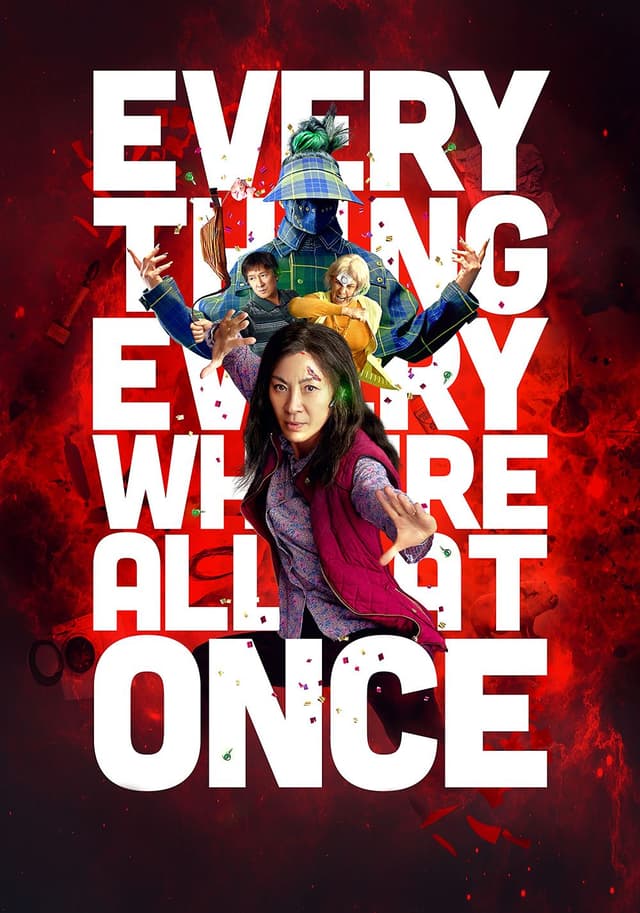
A middle-aged Chinese immigrant is swept up into an insane adventure in which she alone can save existence by exploring other universes and connecting with the lives she could have led.
What is the budget of Everything Everywhere All at Once?
"Everything Everywhere All at Once," an action released in 2022, was directed by Daniel Scheinert, Daniel Kwan and stars Michelle Yeoh, Stephanie Hsu. The production budget was $25,000,000, placing it in the mid-budget range for action productions of its era.
Key Budget Allocation Categories
While specific budget breakdowns are not publicly available, typical cost drivers for an action production like this include:
- Stunts, Action Sequences & Visual Effects: Action films allocate a substantial portion of their budget to choreographing and executing practical stunts, pyrotechnics, and CGI-heavy sequences.
- Above-the-Line Talent (Cast & Director): A-list talent commands significant upfront fees plus backend participation.
- Production Design, Sets & Locations: Action films frequently require multiple international shooting locations, large-scale set construction, vehicle acquisitions and modifications, and specialized equipment , all of which drive production costs well above those of dialogue-driven genres.
- Casting: The script was written for Jackie Chan until Kwan and Scheinert reconceived the protagonist as a woman, feeling it would make the husband,wife dynamic in the story more relatable.
What were the major cost factors in Everything Everywhere All at Once?
Several factors contributed to the overall production costs of "Everything Everywhere All at Once."
- Stunts: Stunts, Action Sequences & Visual Effects is one of the primary cost drivers in action productions of this scale.
- Above-the-Line Talent (Cast: Above-the-Line Talent (Cast & Director) is one of the primary cost drivers in action productions of this scale.
- Production Design: Production Design, Sets & Locations is one of the primary cost drivers in action productions of this scale.
How Does Everything Everywhere All at Once's Budget Compare to Similar Films?
At $25,000,000, Everything Everywhere All at Once sits in the mid-budget range. Here is how it compares to productions with a similar budget:
- 1408 (2007): Budget $25,000,000, Worldwide Gross $133,000,000
- A Journal for Jordan (2021): Budget $25,000,000, Worldwide Gross $6,700,000
- Abandon (2002): Budget $25,000,000, Worldwide Gross $10,719,357
- All My Life (2020): Budget $25,000,000, Worldwide Gross $2,000,000
- August Rush (2007): Budget $25,000,000, Worldwide Gross $66,122,026
The median budget for wide-release action films in the 2020s ranges from $30 to 80M for mid-budget to $150M+ for tentpoles.
Everything Everywhere All at Once Box Office Performance
"Everything Everywhere All at Once" earned $69,908,189 domestically and $139,200,000 worldwide at the box office. Against a production budget of $25,000,000, the film performed strongly at the box office.
A film typically needs to earn approximately twice its production budget to cover marketing and distribution costs. For "Everything Everywhere All at Once," that break-even threshold was roughly $50,000,000. With worldwide earnings of $139,200,000, the film cleared that threshold comfortably.
Box Office Breakdown
Everything Everywhere All at Once

At 456.8%, "Everything Everywhere All at Once" earned roughly $5.57 for every $1 invested in production.
Everything Everywhere All at Once Production History
The script was written for Jackie Chan until Kwan and Scheinert reconceived the protagonist as a woman, feeling it would make the husband,wife dynamic in the story more relatable. The new script's lead character was initially named Michelle Wang, after the film's lead actress Michelle Yeoh, who said, "If you ask the Daniels, when they started on this draft, they focused on, 'Well, we are doing this for Michelle Yeoh.'" The character's name was eventually changed to Evelyn. With her resemblance to the version of Evelyn as a martial artist and film star, Yeoh opposed naming the character Michelle.
Principal photography began in January 2020, with A24 announcing that it would finance and distribute the film, while Scott Rudin was originally going to be an executive producer on the film, but left because of allegations involving his behavior. Shooting took 38 days, mostly in Simi Valley, California. Much of the film was shot overcranked at a very high frame rate to accommodate extensive time remapping in post production.
The musical score was composed by Son Lux, whose members are Ryan Lott, Ian Chang, and Rafiq Bhatia. Daniels asked them to approach the score individually, and not as a band. Lott said, "I think that the complete picture of not only who we are as a band, but also who we are as individuals and what we have accomplished and the places we've gone creatively individually, meant for them that there was a possibility that many of these universes of sound could be within reach with this particular trio." Son Lux took two to three years to compose the score, which includes more than a hundred musical cues.
Awards and Recognition
Won 7 Oscars. 406 wins & 382 nominations total
- Screen Actors Guild Award for Outstanding Performance by a Cast in a Motion Picture
- Dorian Award for Film of the Year
- Dallas-Fort Worth Film Critics Association Award for Best Film
- Hugo Award for Best Dramatic Presentation: Long Form
- Amanda Award for Best Foreign Feature Film (Q112605054)
- Academy Award for Best Writing: Original Screenplay (95th Academy Awards)
- Academy Award for Best Picture (95th Academy Awards)
- Dorian Award for LGBTQ Film of the Year
Critical Reception
The film garnered widespread critical acclaim. Audiences polled by PostTrak gave it an 89% positive score, with 77% saying that they would definitely recommend it. The Hollywood Reporters David Rooney called it a "frenetically plotted serve of stoner heaven [that] is insanely imaginative and often a lot of fun", complimenting the cast and score but found the handling of the story's underlying theme underwhelming. In her review for RogerEbert.com, Marya E.
Frequently Asked Questions
How much did it cost to make Everything Everywhere All at Once (2022)?
The production budget was $25,000,000, covering principal photography, visual effects, cast and crew salaries, locations, sets, post-production, and music. Marketing and distribution (P&A) costs are estimated at an additional $12,500,000 - $20,000,000, bringing the total studio investment to approximately $37,500,000 - $45,000,000.
How much did Everything Everywhere All at Once (2022) earn at the box office?
Everything Everywhere All at Once grossed $69,908,189 domestic, $69,291,811 international, totaling $139,200,000 worldwide.
Was Everything Everywhere All at Once (2022) profitable?
Yes. Against a production budget of $25,000,000 and estimated total costs of ~$62,500,000, the film earned $139,200,000 theatrically - a 457% ROI on production costs alone.
What were the biggest costs in producing Everything Everywhere All at Once?
The primary cost drivers were above-the-line talent (Michelle Yeoh, Stephanie Hsu, Ke Huy Quan); visual effects, practical stunts, and A-list talent compensation.
How does Everything Everywhere All at Once's budget compare to similar action films?
At $25,000,000, Everything Everywhere All at Once is classified as a low-budget production. The median budget for wide-release action films in the 2020s ranges from $30 - 80M for mid-budget to $150M+ for tentpoles. Comparable budgets: 1408 (2007, $25,000,000); A Journal for Jordan (2021, $25,000,000); Abandon (2002, $25,000,000).
Did Everything Everywhere All at Once (2022) go over budget?
There are no widely reported accounts of significant budget overruns for this production. However, studios rarely disclose precise budget overrun figures publicly. The reported production budget reflects the final estimated cost.
What was the return on investment (ROI) for Everything Everywhere All at Once?
The theatrical ROI was 456.8%, calculated as ($139,200,000 − $25,000,000) ÷ $25,000,000 × 100. This measures gross revenue against production budget only - it does not account for P&A or exhibitor shares.
What awards did Everything Everywhere All at Once (2022) win?
Won 7 Oscars. 406 wins & 382 nominations total.
Who directed Everything Everywhere All at Once and who were the key crew members?
Directed by Daniel Scheinert, Daniel Kwan, written by Daniel Kwan, Daniel Scheinert, shot by Larkin Seiple, with music by Ryan Lott, Ian Chang, edited by Paul Rogers.
Where was Everything Everywhere All at Once filmed?
Everything Everywhere All at Once was filmed in United States of America. Principal photography began in January 2020, with A24 announcing that it would finance and distribute the film, while Scott Rudin was originally going to be an executive producer on the film, but left because of allegations involving his behavior. Shooting took 38 days, mostly in Simi Valley, California.
Filmmakers
Everything Everywhere All at Once

Official Trailer
Build budgets like this one in Saturation
Start from an industry-standard feature film template, import the schedule and rates you already have, and let the cost report keep itself current as you spend. Real-time collaboration, no spreadsheets.