Donnie Darko Budget
 FantasyDramaMystery1h 54m
Updated
Synopsis
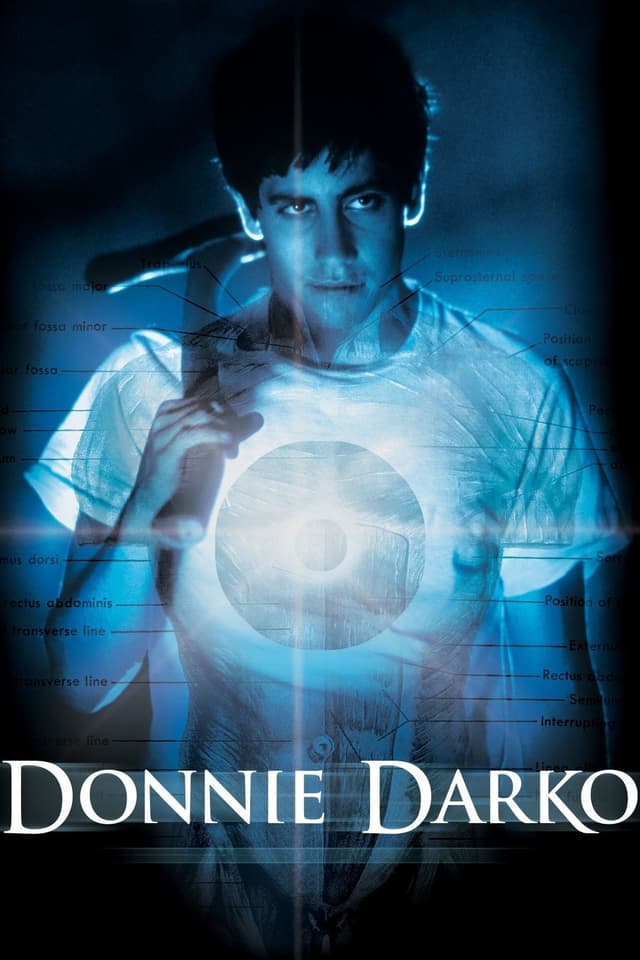
In October 1988 in the suburban town of Middlesex, Virginia, troubled teenager Donnie Darko narrowly escapes death when an airliner engine crashes through his bedroom ceiling while he is sleepwalking, summoned outside by visions of a six-foot rabbit named Frank who tells him the world will end in twenty-eight days. Guided by Frank's instructions and pulled into the writings of an elderly former teacher on the philosophy of time travel, Donnie attempts to reconcile his fracturing reality, his first love with new student Gretchen Ross, and the possibility that the universe he is living in is a tangent that must collapse to save the primary timeline.
What Is the Budget of Donnie Darko (2001)?
Donnie Darko (2001), the feature debut of writer-director Richard Kelly, was produced on a budget of $4,500,000 by Pandora Cinema, Flower Films, and Adam Fields Productions, and released theatrically by Newmarket Films. For a project that ultimately became one of the defining cult films of its decade, the budget was strikingly modest, reflecting both the inexperience of its 25-year-old filmmaker and the leap of faith required of co-producer Drew Barrymore, whose Flower Films company backed the script when established studios passed on its surreal, time-loop-inflected suburban fable.
The financing came together over a roughly 28-day production schedule in the summer of 2000, shot largely in and around Los Angeles County. The budget covered an ensemble led by then-unknown Jake Gyllenhaal in his breakout adult role, alongside his sister Maggie Gyllenhaal, Jena Malone, Mary McDonnell, Patrick Swayze, Noah Wyle, and Drew Barrymore herself in a supporting part she took to help the film get made. The relatively low cost gave Kelly creative latitude that a larger studio production would have stripped away.
Key Budget Allocation Categories
The $4.5 million budget was distributed across the production areas typical of a late-1990s American indie shot under SAG modified low-budget terms:
- Cast and Above-the-Line Talent: SAG low-budget rates governed the ensemble, with Patrick Swayze taking a substantial pay cut to play motivational speaker Jim Cunningham and Drew Barrymore working for scale-plus on top of her producing fee. Jake Gyllenhaal, then 19 and best known for October Sky, anchored the cast at a first-lead salary. The combined above-the-line spend remained well under $1 million, freeing budget for design and post.
- Frank the Rabbit Costume and Practical Effects: The Frank bunny suit, designed by Gary J. Tunnicliffe, was the single most iconic prop in the film and required careful sculpting, articulation, and fit work for performer James Duval. Additional practical effects, the engine that crashes through the Darko house, the jet engine prop, the bleeding eye gag, and the silver liquid timeline tendrils, were achieved through a hybrid of physical builds and modest visual effects insertion.
- Los Angeles Location Filming: Principal photography ran through July and August 2000 across Los Angeles County standing in for the Middlesex, Virginia setting. Loyola High School in mid-city Los Angeles played Middlesex High, with additional shoots in Long Beach and around the San Fernando Valley. California production incentives at the time were modest, and the small unit kept transportation, permits, and per-diem costs contained.
- Visual Effects and the Tangent Universe: Visual effects supervised by a small team handled the liquid time-tendrils protruding from the chests of the characters, the surreal sky and cloud sequences, and the Halloween-night plane engine plummet. These shots represent the film's most ambitious technical work and were executed within tight budget constraints, with practical photography supplemented by digital compositing.
- Music Licensing: One of the production's most pivotal spends was the licensing budget for 1980s needle drops. Tears for Fears' "Head Over Heels" anchors the school corridor introduction, Echo & the Bunnymen's "The Killing Moon" was originally licensed for the opening (with INXS' "Never Tear Us Apart" substituted in the original theatrical cut and the Echo track later restored in the Director's Cut), Joy Division's "Love Will Tear Us Apart" plays the Halloween party, and Gary Jules' soft-piano cover of Tears for Fears' "Mad World" closes the film. The catalog clearances were costly relative to the overall budget.
- Original Score: Composer Michael Andrews, working from his Eagle Rock home studio, delivered a haunting electronic and orchestral score performed largely on his own instruments and laptop, including the celesta-led "Mad World" arrangement that became the film's sonic signature. The cost-effective home-studio production model allowed Andrews to deliver a feature-length score within the indie budget envelope.
- Post-Production and Editing: Editor Sam Bauer cut the film with Kelly over the second half of 2000, with the timeline-loop structure requiring careful reconstruction in post. Color timing, sound mix, and final delivery for the Sundance 2001 premiere had to be completed on a compressed schedule, with the festival deadline determining the final budget cadence.
- Festival and Acquisition Costs: Sundance submission, delegate fees, screening prints, and the press strategy around the January 2001 premiere were folded into the financing plan. Newmarket Films acquired domestic rights at the festival and absorbed subsequent prints and advertising costs separately from the production budget.
How Does Donnie Darko's Budget Compare to Similar Films?
Placing Donnie Darko alongside other cult debuts, Richard Kelly's later work, and other early Jake Gyllenhaal vehicles puts its scale into context:
- Pi (1998): Budget $60,000 | Worldwide $3,221,152. Darren Aronofsky's black-and-white debut cost less than 2% of Donnie Darko and pursued a comparably cerebral, math-and-paranoia premise. Both films launched first-time auteur careers out of Sundance, with Kelly's budget reflecting the modest inflation of late-1990s indie ambition.
- El Mariachi (1992): Budget $7,000 | Worldwide $2,041,928. Robert Rodriguez's notorious $7,000 debut is the canonical reference for cult-debut economics, and Donnie Darko's $4.5 million looks generous against it. The comparison shows how much closer Kelly's film sat to mid-1990s indie norms than to the genuine micro-budget tradition.
- October Sky (1999): Budget $25,000,000 | Worldwide $32,600,000. Jake Gyllenhaal's previous lead role for Universal cost more than five times Donnie Darko's budget and produced a conventional, studio-system box office trajectory. The contrast highlights how indie cinema gave Gyllenhaal the role that defined his actor identity.
- Southland Tales (2006): Budget $17,000,000 | Worldwide $374,743. Richard Kelly's follow-up cost nearly four times Donnie Darko and grossed a fraction in theatrical release, demonstrating the financing leap a cult debut can earn and the commercial risk that scaling up a singular voice carries.
- The Box (2009): Budget $30,000,000 | Worldwide $33,300,000. Kelly's third feature, an adaptation of Richard Matheson's "Button, Button," cost almost seven times Donnie Darko and broke even theatrically. The film's commercial underperformance effectively closed the studio door on Kelly that Donnie Darko had opened.
- Brokeback Mountain (2005): Budget $14,000,000 | Worldwide $178,062,759. Gyllenhaal's Oscar-nominated supporting turn for Ang Lee operated at roughly three times the Donnie Darko budget and grossed more than twenty times its initial theatrical revenue, mapping the post-Darko ascent of the actor whose career the cult debut launched.
Donnie Darko Box Office Performance
Newmarket Films opened Donnie Darko in limited North American theatrical release on October 26, 2001, the weekend before Halloween. The release was shadowed by the September 11 attacks roughly six weeks earlier, with the film's plot involving an airliner engine falling onto a suburban house considered commercially toxic in the post-9/11 climate. The studio kept the rollout small, and the picture never expanded into wide release domestically.
The available financial breakdown:
Box Office Breakdown
Donnie Darko

Against a $4.5 million budget the film returned approximately $1.67 for every $1 of production cost on theatrical revenue alone, a roughly 67% ROI that was insufficient to recoup the combined production and marketing investment in theaters. The domestic theatrical gross of $517,375 was particularly disappointing and confirmed that Newmarket's cautious rollout strategy reflected the post-9/11 commercial realities rather than a lack of belief in the film.
The story changed completely on home video. Donnie Darko became one of the defining DVD-era cult successes in the United States, with steady catalog sales building a passionate fanbase that turned the film into a midnight-movie staple at the Pioneer Theater in Manhattan and similar venues across the country. The 2004 Director's Cut theatrical re-release and DVD edition further extended the commercial tail, and Newmarket's investment was recouped many times over through ancillary windows that dwarfed the initial theatrical performance.
Donnie Darko Production History
Richard Kelly wrote the Donnie Darko screenplay in 1997 while a student at the University of Southern California's School of Cinematic Arts, drawing on memories of his Virginia upbringing and a personal fascination with theoretical physics, time-loop fiction, and 1980s suburban malaise. The script circulated Hollywood for several years and accumulated rejections, with most studios baffled by its blend of teen drama, science-fiction cosmology, and surreal horror imagery centered on a six-foot demonic rabbit named Frank.
The project found its champion in Drew Barrymore, whose Flower Films production company optioned the screenplay and committed both producing resources and an on-screen cameo as English teacher Karen Pomeroy. Barrymore's involvement was decisive in attracting the rest of the financing through Pandora Cinema and Adam Fields Productions, and her commitment also helped Kelly assemble a more accomplished cast than a first-time director would typically secure. Casting director Joseph Middleton signed Jake Gyllenhaal, Maggie Gyllenhaal, Jena Malone, Mary McDonnell, Patrick Swayze, Noah Wyle, and Beth Grant within a compressed pre-production schedule.
Principal photography took place across roughly 28 days in July and August 2000 in Los Angeles County, standing in for the fictional Middlesex, Virginia. Loyola High School in mid-city Los Angeles played Middlesex High School, with additional locations across Long Beach and the San Fernando Valley. Cinematographer Steven Poster ASC shot on 35mm with anamorphic lenses to give the picture a widescreen 1980s feel, leaning on practical lighting and existing architecture rather than constructing elaborate sets.
The Frank the Rabbit costume was designed by Gary J. Tunnicliffe and worn by performer James Duval, whose stillness inside the suit became central to the film's creeping menace. Practical effects supervised by Mike Tristano and Daniel Saraf handled the jet engine crash through the Darko house, the bleeding eye gag, and the bicycle and roadway physical work, with visual effects supplementing on the time-tendrils, sky elements, and final-act airliner imagery. Composer Michael Andrews built the score in his Eagle Rock home studio over the autumn of 2000, and the celesta-led "Mad World" cover featuring Gary Jules was added late in post-production to score the climactic montage.
Donnie Darko premiered at the Sundance Film Festival on January 19, 2001, in the Premieres section, where it received a mixed but increasingly fascinated response from critics and acquisitions executives. Newmarket Films acquired domestic rights at the festival and held the picture for an October 26, 2001 release. The post-9/11 climate, with the central image of an airliner engine destroying a suburban home, complicated the marketing campaign and led Newmarket to keep the theatrical rollout deliberately small. A Director's Cut, twenty minutes longer with restored Echo & the Bunnymen needle drop and additional Roberta Sparrow text inserts, was prepared by Kelly in 2004 and released theatrically that summer.
Awards and Recognition
Donnie Darko premiered in competition at the Sundance Film Festival in January 2001, where Kelly's screenplay drew the most attention, and went on to compete at the Catalonian International Film Festival (Sitges) in October 2001, where it won the Best Film prize, a significant early endorsement from the international genre community. At Sitges the film also won Best Original Soundtrack for Michael Andrews' score.
The film won the Silver Scream Award at the Amsterdam Fantastic Film Festival in 2002, the Special Mention at the Deauville Film Festival, and the Best New Filmmaker prize for Richard Kelly at the San Diego Film Critics Society Awards. The Independent Spirit Awards nominated the picture for Best First Screenplay (Richard Kelly), Best Cinematography (Steven Poster), and Best Supporting Female (Jena Malone) at the 2002 ceremony, although it ultimately won none of the three. Gary Jules' cover of "Mad World" went on to reach number one on the UK Singles Chart in December 2003, an unusual commercial second life for a song attached to a cult film.
Donnie Darko has since been canonized in critical retrospectives as one of the defining films of the 2000s, included on BBC and Empire magazine best-of-decade lists, with the BBC Culture critics poll naming it among the 100 greatest films of the twenty-first century. The recognition came largely through home video and revival programming rather than through awards-season prizes at the time of release.
Critical Reception
Donnie Darko holds an 86% approval rating on Rotten Tomatoes from 175 reviews and a 71 out of 100 score on Metacritic, scores that have steadily climbed since the initial theatrical release as the film's reputation has solidified. The Rotten Tomatoes critical consensus calls it "an audacious feature debut" whose ambitious narrative outweighs its occasional opacity, and the audience score sits at 80%, reflecting the picture's durable enthusiast base.
Roger Ebert gave the film three out of four stars and described it as "a flawed but fascinating work that grabs you and won't let you go," singling out Jake Gyllenhaal's "convincingly disturbed" lead performance. Stephen Holden in The New York Times found the picture "a precocious cinematic head-scratcher" and praised Kelly's ability to balance teen-movie conventions against metaphysical ambition. Empire magazine retroactively named it one of the 500 greatest films of all time. Salon's Andrew O'Hehir called it "the most original, ambitious and audacious American independent film in years."
Detractors found the film willfully obscure, with Owen Gleiberman at Entertainment Weekly criticizing its "smug self-importance" and several reviewers arguing that Kelly's tangent-universe cosmology buckled under its own complexity. The 2004 Director's Cut sharpened the divide, with some critics applauding the additional clarity it brought to the time-loop mechanics and others, including the New York Times' A.O. Scott, arguing the original theatrical cut's ambiguity was preferable. The shared throughline across reviews then and now is recognition of Gyllenhaal's performance, Michael Andrews' score, and Steven Poster's cinematography as the picture's three indelible craft achievements.
Frequently Asked Questions
How much did it cost to make Donnie Darko (2001)?
Donnie Darko had a production budget of $4.5 million, financed by Pandora Cinema, Flower Films, and Adam Fields Productions. The budget covered a 28-day Los Angeles shoot, the Frank the Rabbit costume and practical effects, an ensemble cast led by Jake Gyllenhaal under SAG modified low-budget terms, and significant 1980s music licensing for tracks by Tears for Fears, Echo & the Bunnymen, and Joy Division.
How much did Donnie Darko earn at the box office?
Donnie Darko grossed approximately $517,375 domestically and $7,508,237 worldwide in its initial theatrical release. The Newmarket Films rollout opened in limited release on October 26, 2001, weeks after the September 11 attacks, and never expanded into wide release. The film recouped its budget many times over through home video and the 2004 Director's Cut re-release.
Was Donnie Darko a box office success?
Not in theaters. Against the $4.5 million production budget and an estimated $3 million in prints and advertising, the $7.5 million worldwide gross produced an approximately break-even result on the theatrical run. The film became a major financial success on DVD, where catalog sales over the following decade dwarfed the initial theatrical revenue and made the project highly profitable.
Who directed Donnie Darko?
Donnie Darko was written and directed by Richard Kelly, his feature debut at age 25. Kelly wrote the screenplay as a film student at the University of Southern California, drawing on his Virginia suburban upbringing and an interest in theoretical physics and time-loop fiction. He went on to direct Southland Tales (2006) and The Box (2009).
Why was Drew Barrymore involved in Donnie Darko?
Drew Barrymore's production company Flower Films optioned Kelly's script when established studios passed, and her commitment was decisive in attracting the rest of the financing. She also took the supporting role of English teacher Karen Pomeroy at reduced rates, and her producing involvement helped Kelly attract a more accomplished cast than a first-time director would typically secure.
Where was Donnie Darko filmed?
Donnie Darko was filmed across roughly 28 days in July and August 2000 in Los Angeles County, standing in for the fictional Middlesex, Virginia. Loyola High School in mid-city Los Angeles played Middlesex High, with additional locations in Long Beach and the San Fernando Valley. Cinematographer Steven Poster shot on 35mm anamorphic to give the picture a widescreen 1980s feel.
Why is Donnie Darko a cult classic?
The film became one of the defining DVD-era cult successes through midnight-movie programming at venues like Manhattan's Pioneer Theater, steady home video catalog sales, and online fan analysis of the time-loop and tangent-universe cosmology. The 2004 Director's Cut extended the cult footprint, and Gary Jules' "Mad World" cover reaching number one on the UK Singles Chart in December 2003 amplified the picture's pop-cultural reach.
What is the difference between the original cut and the Director's Cut?
Richard Kelly prepared a Director's Cut in 2004 that runs roughly 134 minutes versus the original theatrical version's 113 minutes. The longer cut restores Echo & the Bunnymen's "The Killing Moon" over the opening (replacing INXS's "Never Tear Us Apart" used theatrically), adds explanatory text inserts from "The Philosophy of Time Travel," and expands several supporting scenes. Critical opinion remains divided on which version is preferable.
Who composed the music for Donnie Darko?
Michael Andrews composed the original score, recording it largely on his own instruments in his Eagle Rock home studio. Andrews also produced the celesta-led cover of Tears for Fears' "Mad World" sung by Gary Jules that closes the film. That cover reached number one on the UK Singles Chart in December 2003, a remarkable commercial second life for a soundtrack track from a cult indie.
What awards did Donnie Darko receive?
Donnie Darko won Best Film at the Catalonian International Film Festival (Sitges) in 2001, Best Original Soundtrack at the same festival for Michael Andrews, and the Silver Scream Award at the Amsterdam Fantastic Film Festival in 2002. The Independent Spirit Awards nominated the picture for Best First Screenplay, Best Cinematography, and Best Supporting Female (Jena Malone) in 2002.
Filmmakers
Donnie Darko

Official Trailer
Build budgets like this one in Saturation
Start from an industry-standard feature film template, import the schedule and rates you already have, and let the cost report keep itself current as you spend. Real-time collaboration, no spreadsheets.