
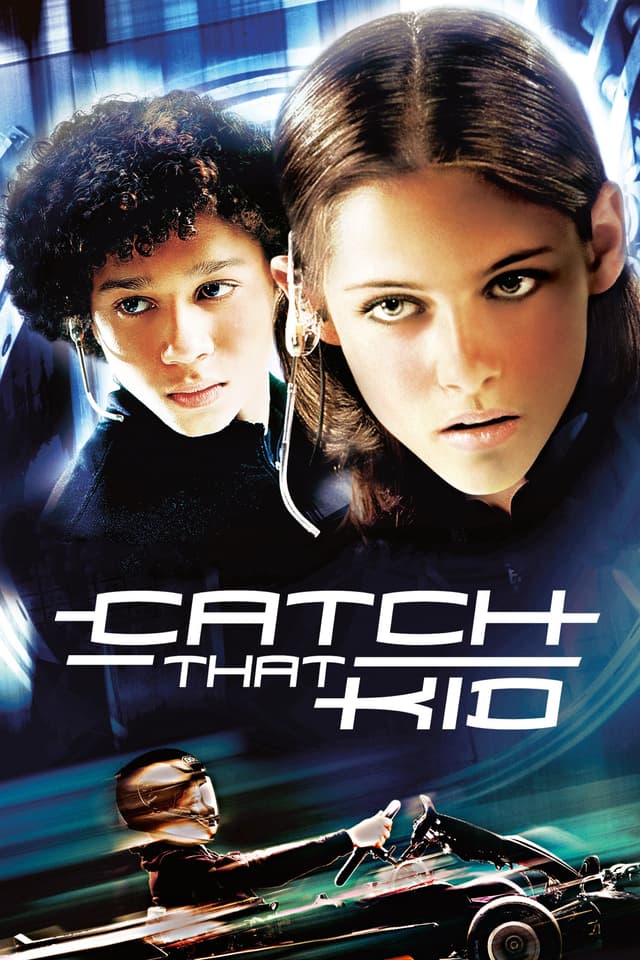
Catch That Kid Budget
 FamilyActionAdventure1h 32m
Updated
Synopsis
When her father, a former mountaineer, is diagnosed with a rare medical condition and the family's insurance refuses to cover the experimental surgery he needs, twelve-year-old Maddy Phillips recruits her two best friends, Austin and Gus, to break into the high-tech bank where her mother works as head of security. Together the trio plans an after-hours heist of the vault that is suspended one hundred feet above the lobby floor, risking everything to save her father's life.
What Is the Budget of Catch That Kid (2004)?
Catch That Kid (2004), directed by Bart Freundlich and distributed by 20th Century Fox, was produced on a reported budget of $12,000,000. The PG-rated family heist film was an American remake of the Danish hit Klatretøsen (Catch That Girl, 2002), with Fox 2000 Pictures, Mad Chance, Mediastream III, and Denmark's Nimbus Film co-producing. The producers Andrew Lazar and Uwe Schott built the project around three preteen leads at a moment when the family-action-comedy field was being recalibrated by Spy Kids and Agent Cody Banks.
The investment reflects the late-stage 20th Century Fox strategy of green-lighting modestly budgeted, four-quadrant family films designed to convert a single theatrical window into a long tail on DVD and cable. The math assumed Catch That Kid would clear roughly $30,000,000 to $40,000,000 worldwide to break even after marketing, a target the film narrowly missed in theaters but eventually exceeded through home video and television sales over the following decade.
Key Budget Allocation Categories
Catch That Kid's $12,000,000 budget was distributed across several core production areas:
- Above-the-Line Talent: Director Bart Freundlich, coming off the indie drama World Traveler and his earlier work with Julianne Moore, commanded a feature-director rate appropriate to a studio family film. The three young leads, thirteen-year-old Kristen Stewart, fourteen-year-old Corbin Bleu, and fourteen-year-old Max Thieriot, were paid scale-plus rates typical for child performers in 2003, with supporting players Jennifer Beals, Sam Robards, John Carroll Lynch, and James Le Gros adding adult marquee value at mid-range salaries.
- Production Design and Bank Vault Set: The film's third act takes place inside a futuristic high-rise bank where the vault is suspended one hundred feet above the lobby floor. Production designer Andrew Laws and his team built a multi-level practical set on a soundstage with a working pulley rig, fiber-optic security lasers, and a climbable atrium structure that doubled for both wide shots and tight insert coverage. Stunts and rigging costs scaled accordingly.
- Stunt Coordination and Child Safety: Because the climax required the three child leads to perform climbing, rappelling, and rope-swing sequences at elevated height, the production carried larger-than-usual stunt and safety overhead, including dedicated harness rigs, doubles matched to each lead, and on-set medical and child welfare supervision required by the Screen Actors Guild for minor performers.
- Animal Performers: The Rottweiler guard dogs and the family golden retriever required licensed animal trainers, on-set veterinary coverage, and multiple animal doubles for continuity, all of which added a meaningful line item beyond what a comparable bankless-heist family film would carry.
- Visual Effects: While modest by tentpole standards, Catch That Kid still required digital effects for the bank atrium height extensions, security laser grids, surveillance camera composites, and several green-screen plate shots used in the climbing sequence. Multiple boutique vendors contributed shots without a single lead VFX house.
- Score and Music Licensing: Composer George S. Clinton scored the film with a brassy heist-comedy palette, and the soundtrack budget covered original composition, orchestra recording, and licensing of contemporary pop and hip hop needle drops aimed squarely at the preteen audience the film was targeting.
- Marketing-Adjacent Costs: Although the marketing spend itself is separate from production budget, the production carried meaningful costs for the EPK shoot, on-set publicity stills, behind-the-scenes documentary footage, and the cast availability days that 20th Century Fox's marketing team used to drive Nickelodeon and Disney Channel cross-promotion in the run-up to the February 2004 release.
How Does Catch That Kid's Budget Compare to Similar Films?
At $12,000,000, Catch That Kid sits at the low end of the early-2000s family heist and kid-adventure category. The comparison set illustrates how a tight budget shaped the film's creative ceiling:
- Spy Kids (2001): Budget $35,000,000 | Worldwide $147,932,720. Robert Rodriguez's Dimension Films breakout cost nearly three times Catch That Kid and earned more than eight times its worldwide total, demonstrating the commercial ceiling a kid-led action film could reach when paired with a distinctive visual style and a built-in spy fantasy hook.
- Agent Cody Banks (2003): Budget $26,000,000 | Worldwide $58,438,420. MGM's teen spy comedy spent more than twice as much and out-grossed Catch That Kid roughly three to one, illustrating how a single recognizable lead, in this case Frankie Muniz, could outperform a three-handed ensemble at the preteen box office.
- Holes (2003): Budget $20,000,000 | Worldwide $71,406,573. Disney's adaptation of the Louis Sachar novel spent 65% more than Catch That Kid and earned more than four times its worldwide total, showing the value of strong source material when targeting the same nine-to-fourteen demographic.
- The Goonies (1985): Budget $19,000,000 | Worldwide $124,000,000. The Richard Donner kid-adventure benchmark, adjusted to 2004 dollars, would have cost roughly $35,000,000 and remains the bar Catch That Kid was implicitly chasing in its three-friends-pull-a-caper structure.
- Honey, I Shrunk the Kids (1989): Budget $32,000,000 | Worldwide $222,724,172. Disney's family adventure spent nearly three times Catch That Kid and earned more than thirteen times its worldwide total, a reminder that family hits with high concept and strong four-quadrant appeal can compound into franchise economics that low-budget remakes rarely achieve.
Catch That Kid Box Office Performance
Catch That Kid opened on February 6, 2004, in 2,330 North American theaters and finished sixth on its opening weekend with $5,829,402, behind You Got Served, The Perfect Score, Barbershop 2, Miracle, and The Butterfly Effect. The opening underperformed industry tracking, which had projected a top-five debut closer to $8,000,000, and 20th Century Fox's decision to release the film in early February rather than during a school holiday window limited its weekday legs.
Against a reported production budget of $12,000,000, the film needed approximately $30,000,000 to $40,000,000 in worldwide gross to reach profitability when accounting for marketing and distribution costs. Here is the financial breakdown:
Box Office Breakdown
Catch That Kid

Catch That Kid returned approximately $0.56 in theatrical revenue for every $1 invested when measured against total estimated production and marketing spend, placing it among the soft theatrical performers of the 2004 first quarter. The split was overwhelmingly domestic, with $16,718,590 earned in North America against just $226,963 internationally, an unusual 99/1 ratio that reflected the film's minimal overseas rollout and 20th Century Fox's decision to push the title direct-to-home-video in most international territories.
Home video and television revenue eventually moved the title into the black for Fox 2000. The DVD release in June 2004 sold strongly into the family rental market, and the film has remained a steady library performer on cable and streaming services, with Netflix licensing it for multiple windows over the late 2000s and 2010s. By the time the film passed its tenth anniversary, ancillary revenue is widely understood to have eclipsed the theatrical loss several times over, a pattern characteristic of mid-2000s family titles that underperformed in their opening window.
Catch That Kid Production History
Development began at 20th Century Fox in 2002 after producer Andrew Lazar acquired the remake rights to Hans Fabian Wullenweber's Klatretøsen (Catch That Girl), the Danish kid-heist film that had won the 2003 Robert Award for Best Children's Film and made a star of its young lead Julie Zangenberg. Lazar partnered with Uwe Schott of Nimbus Film, the original Danish producer, to retain creative continuity, and screenwriters Michael Brandt and Derek Haas, who would go on to write 3:10 to Yuma and Wanted, were brought in to Americanize the structure and dialogue.
Bart Freundlich was attached to direct in mid 2002 on the strength of his indie drama The Myth of Fingerprints and World Traveler, an unconventional choice for a studio family heist film but one that producers hoped would lend the project a slightly more grounded tone than the Spy Kids template. Casting Kristen Stewart as Maddy Phillips in early 2003 was the project's most consequential decision in retrospect. Stewart, then twelve, had appeared in The Safety of Objects and was about to break through to wider recognition in David Fincher's Panic Room (2002) and the Speak (2004) adaptation that would screen at Sundance the same January Catch That Kid opened. Corbin Bleu, two years before High School Musical, was cast as Austin, and Max Thieriot was cast as Gus.
Principal photography ran from spring through early summer 2003, primarily in Toronto, Ontario, with the production drawing on the province's Ontario Film and Television Tax Credit and the Ontario Production Services Tax Credit to anchor the soundstage build of the bank atrium set. Additional location and second-unit work was completed in Los Angeles for the exterior sequences set around the family's suburban Southern California neighborhood, with the production traveling for a short shoot rather than rebuilding the locations in Ontario.
Post-production was completed in Los Angeles in late 2003, with editor Stuart Levy assembling a tight 92-minute cut and George S. Clinton recording the score with a chamber orchestra in November. 20th Century Fox positioned the film for a Super Bowl weekend release on February 6, 2004, betting that families would seek out a PG-rated alternative to The Butterfly Effect and Barbershop 2 that same weekend. The marketing campaign leaned heavily on Nickelodeon cross-promotion and a Coca-Cola tie-in, with Jennifer Beals and Sam Robards making the daytime talk-show circuit in the week of release.
Awards and Recognition
Catch That Kid received no significant industry awards recognition. The film was not nominated at the Academy Awards, the Golden Globes, the BAFTAs, the Critics' Choice Awards, or the Saturn Awards, and it did not register at the Young Artist Awards despite featuring three preteen leads who would all go on to higher-profile careers.
The film also avoided Razzie nominations, with the 2005 ceremony focusing on more publicly maligned titles such as Catwoman, White Chicks, and Christmas with the Kranks. The Danish original Klatretøsen, by contrast, won the 2003 Robert Award for Best Children's Film and the Starboy Award for Best Children's Film at the 2002 Oulu International Children's and Youth Film Festival, recognition the American remake never matched. In the years since release, Catch That Kid has been retrospectively acknowledged primarily for its place in Kristen Stewart's pre-Twilight filmography rather than for any independent merit.
Critical Reception
Catch That Kid received overwhelmingly negative reviews. The film holds a 13% approval rating on Rotten Tomatoes based on 84 critic reviews, with a critical consensus that called it "an unimaginative heist movie aimed strictly at the preteen set." On Metacritic, the film scored 33 out of 100, indicating generally unfavorable reviews. Audience reaction, captured by the Rotten Tomatoes Popcornmeter at 47% based on more than 10,000 user ratings, ran warmer than critic reception but still below the threshold for a recommended family title.
Critics broadly objected to the film's reliance on plot conveniences, the cartoonish villainy of the corporate security antagonist, and a third act that asked young viewers to accept that the child protagonists faced no real consequences for an armed robbery. Nell Minow at Common Sense Media called it "painfully bad, a real head-scratcher," and Marc Savlov at the Austin Chronicle wrote that the film lacked enough humor or genuine tension to engage either children or the parents accompanying them. Roger Ebert filed one of the few positive reviews, awarding the film a thumbs up and noting that it was "more fun than Agent Cody Banks" while acknowledging that the bar set by its source material was modest.
Family-press reaction was kinder, with Rachel Wagner of Rachel's Reviews praising the way the heist plot gave kids their own adventure story to identify with, and the Christian Science Monitor noting that the film's gender-balanced trio offered a refreshing alternative to the male-led adventure films dominating the same release window. The mixed reception, combined with the soft theatrical opening, has cemented Catch That Kid's reputation as a footnote in early-2000s family programming, primarily of interest today for its role as the launchpad for three actors, Kristen Stewart, Corbin Bleu, and Max Thieriot, who would each find more durable careers in the decade that followed.
Frequently Asked Questions
How much did it cost to make Catch That Kid (2004)?
The reported production budget was $12,000,000. The film was co-financed by 20th Century Fox through its Fox 2000 Pictures label, Andrew Lazar's Mad Chance, Mediastream III, and Denmark's Nimbus Film, which had produced the original Klatretøsen.
How much did Catch That Kid earn at the box office?
The film grossed $16,718,590 domestically and $226,963 internationally, for a worldwide total of $16,945,553. It opened to $5,829,402 in the United States, finishing sixth on its February 6, 2004 opening weekend behind You Got Served, The Perfect Score, Barbershop 2, Miracle, and The Butterfly Effect.
Was Catch That Kid a box office bomb?
Yes, in theatrical terms. Against a $12,000,000 production budget and an estimated $15,000,000 to $20,000,000 in marketing spend, the film returned approximately $0.56 in worldwide gross for every $1 invested theatrically. Home video and cable revenue eventually moved the title into the black for 20th Century Fox over the following decade.
Who directed Catch That Kid?
Bart Freundlich directed the film, working from a screenplay by Michael Brandt and Derek Haas based on the Danish film Klatretøsen by Hans Fabian Wullenweber and Nikolaj Arcel. Freundlich had previously directed the indie dramas The Myth of Fingerprints and World Traveler.
Where was Catch That Kid filmed?
Principal photography took place primarily in Toronto, Ontario, Canada from spring through early summer 2003, drawing on the Ontario Film and Television Tax Credit and the Ontario Production Services Tax Credit. The bank atrium set was built on a Toronto soundstage. A short additional shoot in Los Angeles covered exterior sequences set in the family's Southern California neighborhood.
Is Catch That Kid a remake?
Yes. Catch That Kid is an American remake of the 2002 Danish film Klatretøsen, also known internationally as Catch That Girl, directed by Hans Fabian Wullenweber and produced by Nimbus Film. The original won the 2003 Robert Award for Best Children's Film and the Starboy Award at the 2002 Oulu International Children's and Youth Film Festival.
How old was Kristen Stewart in Catch That Kid?
Kristen Stewart was thirteen years old during principal photography in 2003 and had just turned thirteen by the time the film was released on February 6, 2004. The film was shot in the same calendar year as her Sundance breakthrough Speak (2004) and two years after her supporting role in David Fincher's Panic Room (2002).
Who else stars in Catch That Kid besides Kristen Stewart?
Corbin Bleu plays Austin and Max Thieriot plays Gus, with adult supporting roles taken by Jennifer Beals and Sam Robards as Maddy's parents, John Carroll Lynch as the bank's head of security, and James Le Gros as a bank employee. Bleu would go on to High School Musical (2006) and Thieriot to The Pacifier (2005) and Bates Motel.
What did critics think of Catch That Kid?
The film received overwhelmingly negative reviews, with a 13% approval rating on Rotten Tomatoes based on 84 critics and a 33 out of 100 score on Metacritic. The Rotten Tomatoes critical consensus called it an unimaginative heist movie aimed strictly at the preteen set. Roger Ebert was one of the few positive voices, awarding the film a thumbs up.
Did Catch That Kid win any awards?
No. Catch That Kid received no major industry awards recognition. It was not nominated at the Academy Awards, the Golden Globes, the BAFTAs, the Saturn Awards, or the Young Artist Awards, and it also avoided Razzie nominations. The Danish original Klatretøsen, by contrast, won the 2003 Robert Award for Best Children's Film.
Filmmakers
Catch That Kid

Official Trailer
Build budgets like this one in Saturation
Start from an industry-standard feature film template, import the schedule and rates you already have, and let the cost report keep itself current as you spend. Real-time collaboration, no spreadsheets.