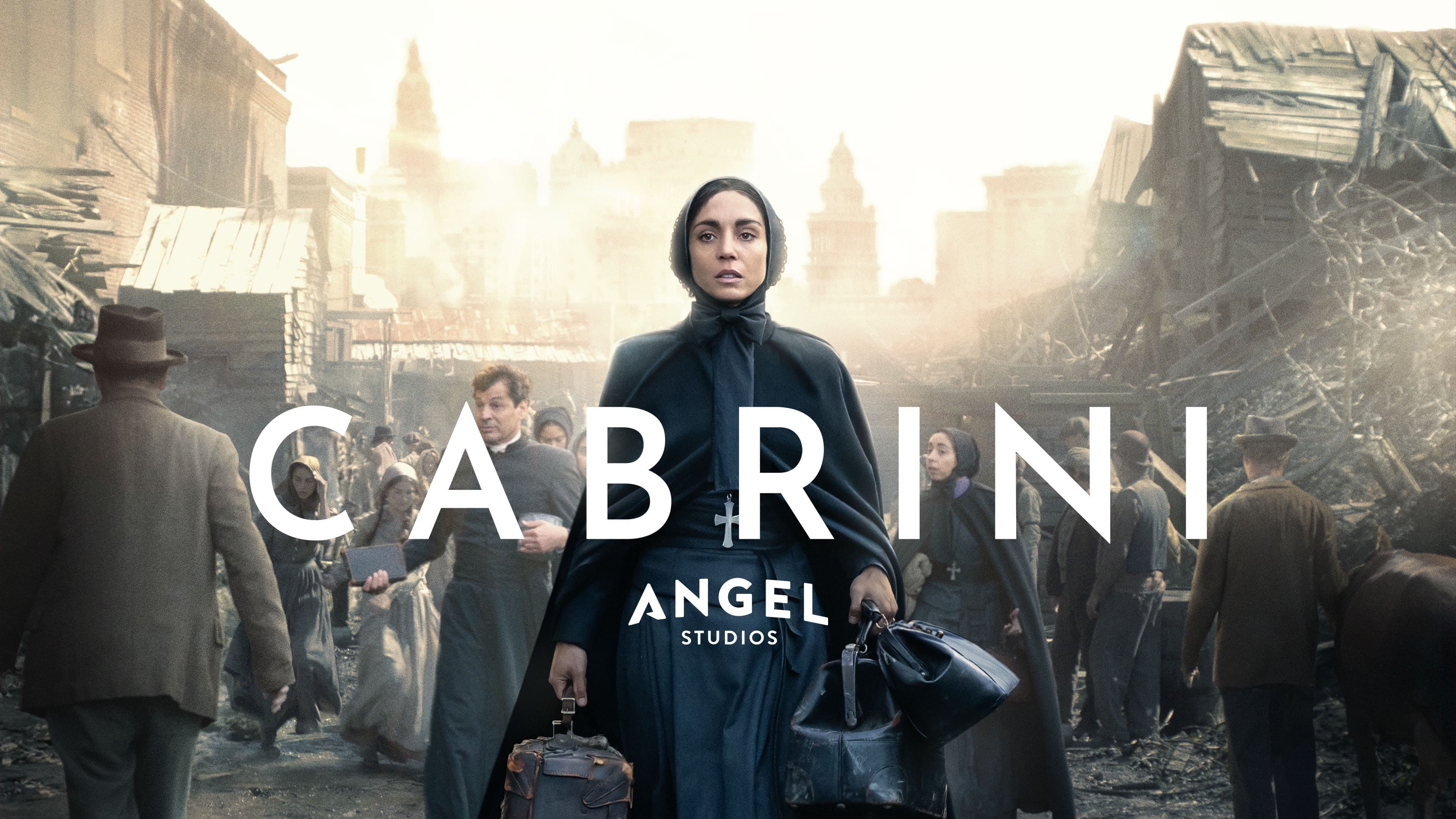
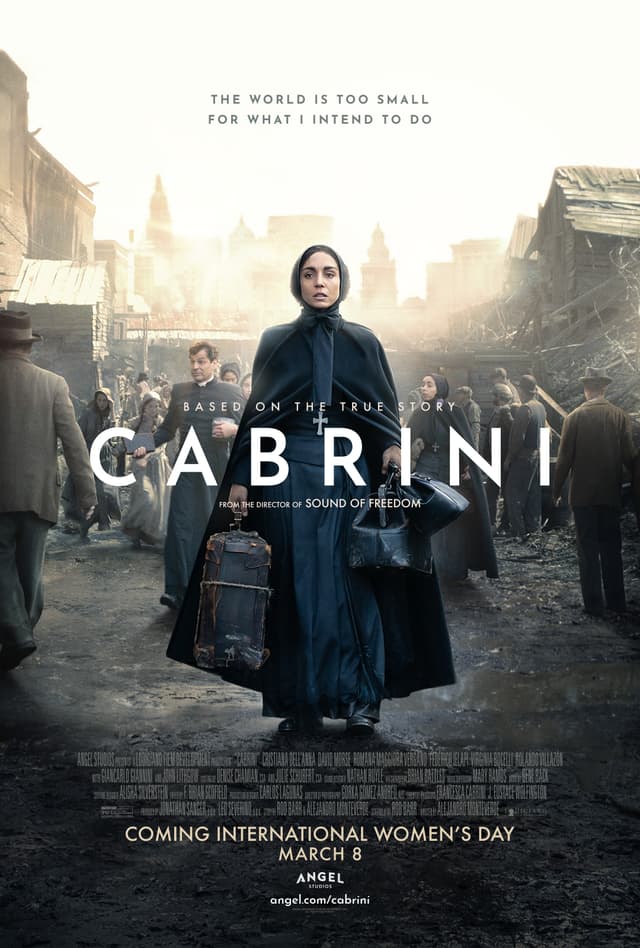
Cabrini Budget
 Biography2h 22m
Updated
Synopsis
Italian immigrant Francesca Cabrini arrives in 1889 New York City and is greeted by disease, crime, and impoverished children. Cabrini sets off on a daring mission to convince the hostile mayor to secure housing and healthcare for society's most vulnerable. With broken English and poor health, Cabrini uses her entrepreneurial mind to build an empire of hope unlike anything the world had ever seen.
What Is the Budget of Cabrini?
Cabrini (2024), directed by Alejandro Monteverde and distributed by Angel Studios, was produced on a significantly larger scale than previous Angel Studios films, with a reported production budget of approximately $50,000,000. This marks a major escalation from earlier films like The Shift ($6,400,000) and His Only Son ($250,000), positioning Cabrini closer to traditional studio-backed historical dramas in terms of financial scope.
The budget was largely financed through private investment, most notably led by Catholic philanthropist J. Eustace Wolfington, rather than relying primarily on the grassroots crowdfunding typical of earlier Angel projects. This shift signals a hybrid financing evolution for Angel Studios, combining high-net-worth private capital with their established audience-driven distribution model to fund productions at a scale their community campaigns alone could not support.
Key Budget Allocation Categories
Cabrini's $50 million budget reflects the demands of a period production with an international footprint and studio-level production values. The primary cost centers break down as follows:
- Period Production Design and Set Construction — Recreating late 19th-century New York City required extensive set design, costuming, and period-accurate historical detail across multiple environments, from tenement slums to ecclesiastical interiors. This category alone likely consumed a disproportionate share of the budget relative to a contemporary-set production.
- International Locations — Principal photography took place across multiple locations in western New York, including Buffalo and Niagara Falls, as well as Rome, Italy. This international production footprint significantly increased costs related to travel, crew logistics, permits, and infrastructure for a cast and crew operating across two continents.
- Above-the-Line Talent — The film stars Cristiana Dell'Anna as Cabrini alongside John Lithgow and David Morse, elevating the film's profile and bringing recognizable names that contributed to above-the-line expenses. For a production at this scale, talent costs typically represent 20 to 30 percent of the total budget.
- Crew, Schedule, and Production Coordination — The film's scale required a larger crew, a longer shooting schedule, and more complex production coordination than any prior Angel Studios release. The cinematography, score, and overall production value reflect a clear intention to compete visually with mainstream studio historical dramas.
How Does Cabrini's Budget Compare to Similar Films?
At $50 million, Cabrini represents a dramatic leap in scale for Angel Studios and places it firmly within the range of mid-budget studio films. Within the Angel slate, the jump is stark: more than 3x the budget of Sound of Freedom, nearly 8x The Shift, and 200x His Only Son. But how does it compare to similar productions outside Angel's ecosystem?
- Sound of Freedom (2023) — Budget $14,500,000 | Worldwide $249,400,000. The most direct Angel Studios comparison. Sound of Freedom operated at less than a third of Cabrini's budget and delivered more than 12x the worldwide gross, a performance that set expectations Cabrini could not match. The contrast highlights how subject matter and mainstream crossover appeal can matter more than production scale.
- Hacksaw Ridge (2016) — Budget $40,000,000 | Worldwide $180,600,000. Mel Gibson's faith-adjacent war drama is arguably the closest genre and tonal comparator. Also independently financed and operating outside the major studio system, Hacksaw Ridge achieved strong mainstream crossover at a similar budget level. Cabrini's $20.6 million worldwide against a comparable investment illustrates how difficult that crossover can be to replicate.
- Harriet (2019) — Budget $17,000,000 | Worldwide $43,800,000. Focus Features' Harriet Tubman biopic is a useful benchmark for faith-adjacent biographical historical dramas with a strong female subject. It operated at roughly a third of Cabrini's budget and earned twice the worldwide gross, suggesting that tighter budgets may be better suited to the market ceiling for this sub-genre.
- Unbroken (2014) — Budget $65,000,000 | Worldwide $163,600,000. Angelina Jolie's WWII survival drama, distributed by Universal, represents the studio infrastructure ceiling for faith-adjacent historical epics. Cabrini attempted to reach comparable production values without the studio marketing machine behind it, a gap that made break-even at the box office significantly harder to achieve.
- The Chosen (Season Budgets) — Per-season budgets ranging from $10,000,000 to $40,000,000. The Chosen is perhaps the most instructive comparison for Angel Studios specifically, showing how the faith-based audience can sustain ambitious, higher-budget content when the release model accounts for how that audience prefers to engage, which is often episodically, repeatedly, and through community-driven platforms rather than a single theatrical window.
Within the broader industry, $50 million is typical for historical dramas that require large-scale period recreation. Unlike studio films at this budget level, Cabrini operated without traditional marketing infrastructure and distribution guarantees, making its financial performance far more dependent on audience-driven engagement and leaving less margin for error.
Cabrini Box Office Performance
Cabrini was released theatrically on March 8, 2024, aligning with International Women's Day to reinforce its thematic positioning around female leadership and resilience. The film opened to approximately $7,200,000 in its first weekend across 2,840 theaters, showing strong initial interest from its core audience.
The film grossed $19,512,134 domestically and $20,590,202 worldwide across its full theatrical run. This represents less than half its reported $50,000,000 production budget, placing it below traditional theatrical profitability thresholds. Industry convention holds that a film generally needs to reach 2 to 2.5 times its production budget in worldwide theatrical revenue to break even after marketing and distribution costs, a threshold Cabrini did not reach through box office alone.
The film experienced a typical drop-off in subsequent weeks after a strong opening, suggesting that while the film successfully activated its core audience in the opening frame, it had limited ability to expand beyond that base. This pattern is common for faith-based releases that depend heavily on pre-sold enthusiasm rather than sustained word-of-mouth from casual audiences.
Cabrini Production History
Development on Cabrini followed the success of Sound of Freedom, with director Alejandro Monteverde continuing his focus on faith-driven, real-world stories with global relevance. The project was backed early by private capital, allowing it to scale significantly beyond typical independent productions. Principal photography began in mid-2021 in western New York and later moved to Rome, reflecting the film's international scope and historical setting.
Cabrini represents a major structural shift in Angel Studios' production strategy. Unlike His Only Son and The Shift, which relied heavily on community crowdfunding, Cabrini was primarily financed through private investment from a single high-net-worth backer. This suggests a transition toward a two-tier model: smaller films funded through community crowdfunding, and larger films financed through private capital and then distributed via the Angel ecosystem.
While Angel Studios continued to utilize its "Pay It Forward" ticketing model and audience engagement platform, there is less evidence of a large-scale public P&A crowdfunding campaign specific to Cabrini, indicating a more traditional financing structure at this budget scale. From a production standpoint, the film is notable for its large-scale period recreation, international production footprint across the US and Italy, expanded crew and infrastructure, and studio-level production values within an independent distribution framework.
This positions Cabrini as Angel Studios' most ambitious production to date at the time of its release in terms of budget and scope, and as a test case for whether the audience-driven model could sustain films competing directly with major studio historical dramas.
Awards and Recognition
Cabrini received strong audience reception metrics, including high audience scores and favorable CinemaScore ratings, reflecting deep engagement among its target demographic. The film's performances, particularly Cristiana Dell'Anna's portrayal of Cabrini, received consistent praise, and the production design was widely noted as the most ambitious in Angel Studios' history.
While Cabrini did not emerge as a major contender in mainstream awards circuits, it gained recognition within faith-based and independent film communities for its storytelling ambition, historical scope, and the strength of its central performance. Its release on International Women's Day positioned it as a cultural moment as much as a theatrical event.
Critical Reception
Critical reception for Cabrini was generally positive, with reviewers directing praise toward its performances, production design, and inspirational narrative. The film achieved strong scores on Rotten Tomatoes across both critic and audience categories, indicating broad approval relative to the expectations placed on faith-based historical dramas.
Critics frequently highlighted Cristiana Dell'Anna's performance as the film's central asset, noting her ability to convey Cabrini's determination and moral clarity without slipping into hagiography. The production design, which recreated late 19th-century New York and Rome, was consistently praised as a standout achievement given the film's independent financing model.
Despite positive reception, the film's box office performance did not match its production scale, making Cabrini an example of a film that resonated deeply with its audience but was unable to translate that resonance into the broader theatrical footprint needed to justify a $50 million budget within the theatrical window alone.
Frequently Asked Questions
How much did it cost to make Cabrini (2024)?
The production budget was $50,000,000, covering principal photography, cast and crew salaries, locations, sets, post-production, and music. Marketing and distribution (P&A) costs are estimated at an additional $25,000,000 - $40,000,000, bringing the total studio investment to approximately $75,000,000 - $90,000,000.
How much did Cabrini (2024) earn at the box office?
Cabrini grossed $19,512,134 domestic, $1,080,662 international, totaling $20,592,796 worldwide.
Was Cabrini (2024) profitable?
The film did not break even theatrically, earning $20,592,796 against an estimated $125,000,000 needed. Ancillary revenue may have improved the picture.
What were the biggest costs in producing Cabrini?
The primary cost drivers were above-the-line talent (Cristiana Dell'Anna, David Morse, Giancarlo Giannini); talent compensation, authentic period production design, and meticulous post-production; international production across Italy, United States of America.
How does Cabrini's budget compare to similar history films?
At $50,000,000, Cabrini is classified as a mid-budget production. The median budget for wide-release history films in the 2020s ranges from $30 - 80M for mid-budget to $150M+ for tentpoles. Comparable budgets: Angela's Ashes (1999, $50,000,000); Dredd (2012, $50,000,000); Lord of War (2005, $50,000,000).
Did Cabrini (2024) go over budget?
There are no widely reported accounts of significant budget overruns for this production. However, studios rarely disclose precise budget overrun figures publicly. The reported production budget reflects the final estimated cost.
What was the return on investment (ROI) for Cabrini?
The theatrical ROI was -58.8%, calculated as ($20,592,796 − $50,000,000) ÷ $50,000,000 × 100. This measures gross revenue against production budget only - it does not account for P&A or exhibitor shares.
What awards did Cabrini (2024) win?
4 wins & 11 nominations total.
Who directed Cabrini and who were the key crew members?
Directed by Alejandro Monteverde, written by Rod Barr, Alejandro Monteverde, shot by Gorka Gómez Andreu, with music by Gene Back, edited by Brian Scofield.
Where was Cabrini filmed?
Cabrini was filmed in Italy, United States of America.
Filmmakers
Cabrini

Build budgets like this one in Saturation
Start from an industry-standard feature film template, import the schedule and rates you already have, and let the cost report keep itself current as you spend. Real-time collaboration, no spreadsheets.