Breaking the Waves Budget
 Drama2h 39m
Updated
Synopsis
In a remote 1970s Calvinist community on the West Highland coast of Scotland, the naive Bess McNeill marries Jan, an oil-rig worker, against the wishes of her Free Church elders. When Jan is paralyzed in an offshore accident, he asks Bess to take other lovers and tell him about them, and her belief that her sexual sacrifice is the only path to his recovery drives the film toward one of the most devastating endings in 1990s cinema. Lars von Trier's Cannes Grand Prix winner made Emily Watson a star and set the template for his Golden Heart trilogy.
What Is the Budget of Breaking the Waves (1996)?
Breaking the Waves, Lars von Trier's 1996 Danish-Swedish-French-Dutch-Norwegian co-production, was made on a reported production budget of approximately $7,500,000. The film was produced by Vibeke Windeløv for Zentropa Entertainments alongside an unusually broad European financing consortium that included Trust Film Svenska, Liberator Productions, Argus Film Produktie, Northern Lights, La Sept Cinéma, VPRO Television, YLE TV1, Canal+, the Danish Film Institute, the Swedish Film Institute, Eurimages, and the Nordic Film and TV Fund. The patchwork of public and private European money was characteristic of the post-Lumière-anniversary art-house financing model that Zentropa had pioneered in Copenhagen.
The $7.5 million figure placed Breaking the Waves at the upper end of Scandinavian independent budgets for the period and well above the typical Dogme 95 production cost, even though von Trier had co-authored the Dogme manifesto only six months before the shoot began. The film officially predates and stands outside the Dogme rulebook (the first Dogme certificate went to The Celebration in 1998), and its handheld Robby Müller cinematography, anamorphic chapter-card sequences, and extensive Scottish location work required a budget level the strict Dogme films would deliberately reject. A meaningful share of the cost went to the cross-border above-the-line cast and to the practical demands of an extended remote-Highlands shoot in winter.
Key Budget Allocation Categories
While Zentropa has not published a full line-item breakdown, the film's production profile points to a handful of dominant cost centers:
- International Cast: Emily Watson was an unknown stage actress when cast (Helena Bonham Carter had originally been attached and withdrew), keeping the lead salary modest, but Stellan Skarsgård, Katrin Cartlidge, Jean-Marc Barr, Adrian Rawlins, Udo Kier, and Jonathan Hackett represented a multinational ensemble drawing British, Swedish, Dutch, German, and French rates. Above-the-line talent absorbed a meaningful slice of the $7.5 million.
- Scottish Highlands Location Shoot: Principal photography took place across the Isle of Skye, Lochaber, and the West Highlands of Scotland over eight weeks in summer and autumn 1995, with additional sequences shot in Copenhagen and at the North Sea oil-platform location. Remote-location travel, lodging for a cross-border crew, transport of equipment to the Highlands, and weather-contingency days were the single largest below-the-line cost.
- Robby Müller Cinematography and Camera Package: Müller, a legend who had shot for Wim Wenders and Jim Jarmusch, photographed Breaking the Waves on Super 35mm with handheld operating throughout. The camera package, combined with the chapter-card sequences shot anamorphically with digitally treated landscape stills, added a layer of optical and post-production cost that a strict Dogme shoot would have eliminated.
- Costume, Period Design, and 1970s Highland Setting: Although ostensibly contemporary in feel, the film was set in the early 1970s in a remote Calvinist Free Church of Scotland community. Costume designer Manon Rasmussen and production designer Karl Júlíusson built a period world from local materials and existing Highland architecture, holding production-design spend below what a fully reconstructed period would have required.
- North Sea Oil Platform and Helicopter Photography: The Jan-on-the-rig sequences required cooperation from a working North Sea oil company, helicopter transport of cast and crew to and from the platform, and aerial photography of the rig and surrounding ocean. These industrial-access and aviation costs were among the most expensive single line items in the schedule.
- Music Rights and 1970s Rock Catalog: The film's chapter cards are scored entirely to licensed 1970s rock recordings including Procol Harum's "A Whiter Shade of Pale," Mott the Hoople, Deep Purple, Elton John, Roxy Music, T. Rex, David Bowie, Leonard Cohen, and Jethro Tull. Music clearance fees for this scale of catalog use were unusually large for an art-house feature and were negotiated through the European co-production partners.
- Post-Production and Optical Effects: Editor Anders Refn cut the film in Copenhagen, with the painterly digitally-treated chapter-card landscape stills produced as a discrete optical-effects element that distinguished the film visually from any pure Dogme work. The film's final image (church bells ringing in the sky) was a high-cost CGI shot for a 1996 European indie.
- Festival Delivery and International Sales: Striking 35mm festival prints, Cannes 1996 submission and delivery, and the international sales-agent campaign run by Trust Film Sales were the final block of spending before the film began earning back through distribution advances and theatrical revenue across thirty-plus territories.
How Does Breaking the Waves's Budget Compare to Similar Films?
At approximately $7.5 million, Breaking the Waves sat at the upper tier of 1990s European art-house budgets and considerably above the strict Dogme productions that followed in its wake. The film's natural peers are von Trier's own subsequent work, other Zentropa productions, and the Cannes Grand Prix winners of the surrounding years.
- Dancer in the Dark (2000): Budget $12,500,000 | Worldwide $40,031,879. Von Trier's next Bess-style faith-and-sacrifice melodrama, this time a musical starring Björk, sat at the very top of Zentropa's budget range and won the Cannes Palme d'Or where Breaking the Waves had won the Grand Prix four years earlier. The $5 million budget jump reflected the song production, Catherine Deneuve's above-the-line fee, and the larger ensemble.
- Dogville (2003): Budget $10,000,000 | Worldwide $16,872,801. Von Trier's subsequent epic, shot on a soundstage with chalk-line sets and an A-list American cast led by Nicole Kidman, cost more than Breaking the Waves despite eliminating physical sets and location travel, with Kidman's salary and the three-hour runtime driving the increase.
- The Celebration (1998): Budget $1,300,000 | Worldwide $12,876,720. Thomas Vinterberg's Dogme #1 was made under the manifesto Lars von Trier had co-authored and shot on consumer DV, demonstrating what the same Zentropa house could deliver at one-sixth the Breaking the Waves cost when the rulebook was followed literally.
- Trainspotting (1996): Budget $3,500,000 | Worldwide $72,000,000. Danny Boyle's 1996 Scottish countercultural hit cost less than half of Breaking the Waves and grossed roughly eighteen times more worldwide, illustrating how dramatically commercial returns diverged for 1996 British and Scottish indies depending on tone and accessibility.
- Secrets and Lies (1996): Budget $4,500,000 | Worldwide $13,387,634. Mike Leigh's social-realist drama, which beat Breaking the Waves to the Cannes Palme d'Or in 1996 (Breaking the Waves took the Grand Prix), occupies the same European art-house tier at roughly sixty percent of the Breaking the Waves budget and earned more than three times its US theatrical gross.
- Reservoir Dogs (1992): Budget $1,200,000 | Worldwide $2,832,029. A 1990s independent debut benchmark, Tarantino's first feature shows the bottom of the indie-festival ladder and underscores how Zentropa's scale of European public co-financing pushed Breaking the Waves to a budget level most American indies of the era could not approach.
Breaking the Waves Box Office Performance
Breaking the Waves premiered in the main competition at the 49th Cannes Film Festival on May 18, 1996, where it won the Grand Prix. Theatrical release followed in Denmark on August 23, 1996, the United Kingdom on October 4, 1996, France on September 4, 1996, and the United States on November 13, 1996 through October Films on a slow art-house platform rollout led by a New York and Los Angeles opening before expanding to roughly 90 screens at its widest. The film grossed $4,036,772 in the United States and Canada and an estimated additional $3.5 million to $4 million across European and international theatrical markets, for a reported global theatrical gross of approximately $4,000,000 to $8,000,000 depending on the source. Box Office Mojo lists worldwide gross at $4,036,772, reflecting only the domestic North American number.
Box Office Breakdown
Breaking the Waves

On the $7.5 million production cost, theatrical receipts returned approximately $0.50 to $1.00 to investors for every $1 invested before P&A, and a fraction of that after print-and-advertising costs were applied. Theatrical economics for art-house features of this era were rarely profitable on the box-office line alone, and Zentropa's recoupment relied on the pre-sale and television-licensing structure that the European co-financing model had been engineered to deliver.
The film's commercial life has been substantial across a thirty-year tail. Home video releases on VHS, DVD (Artisan in the US and Tartan in the UK), and a 2014 Criterion Collection Blu-ray and 4K restoration, plus continuous streaming availability on the Criterion Channel and MUBI, have driven recoupment well beyond the original theatrical window. The Grand Prix and Emily Watson Oscar nomination converted Breaking the Waves into a permanent catalog title rather than a one-cycle release.
Breaking the Waves Production History
Lars von Trier wrote the first draft of Breaking the Waves in 1989 under the working title "Amor Omnia," conceived as the opening film in a planned "Golden Heart" trilogy that would also include The Idiots and Dancer in the Dark, each centered on a naive female protagonist whose moral goodness destroys her. The script went through extensive revisions over five years as von Trier and producer Peter Aalbæk Jensen assembled the European co-production package required to finance a feature shot largely in Scotland. The Dogme 95 manifesto was published in March 1995, only a few months before principal photography on Breaking the Waves began, but the film itself was never intended to follow Dogme rules and is not a Dogme-certified work.
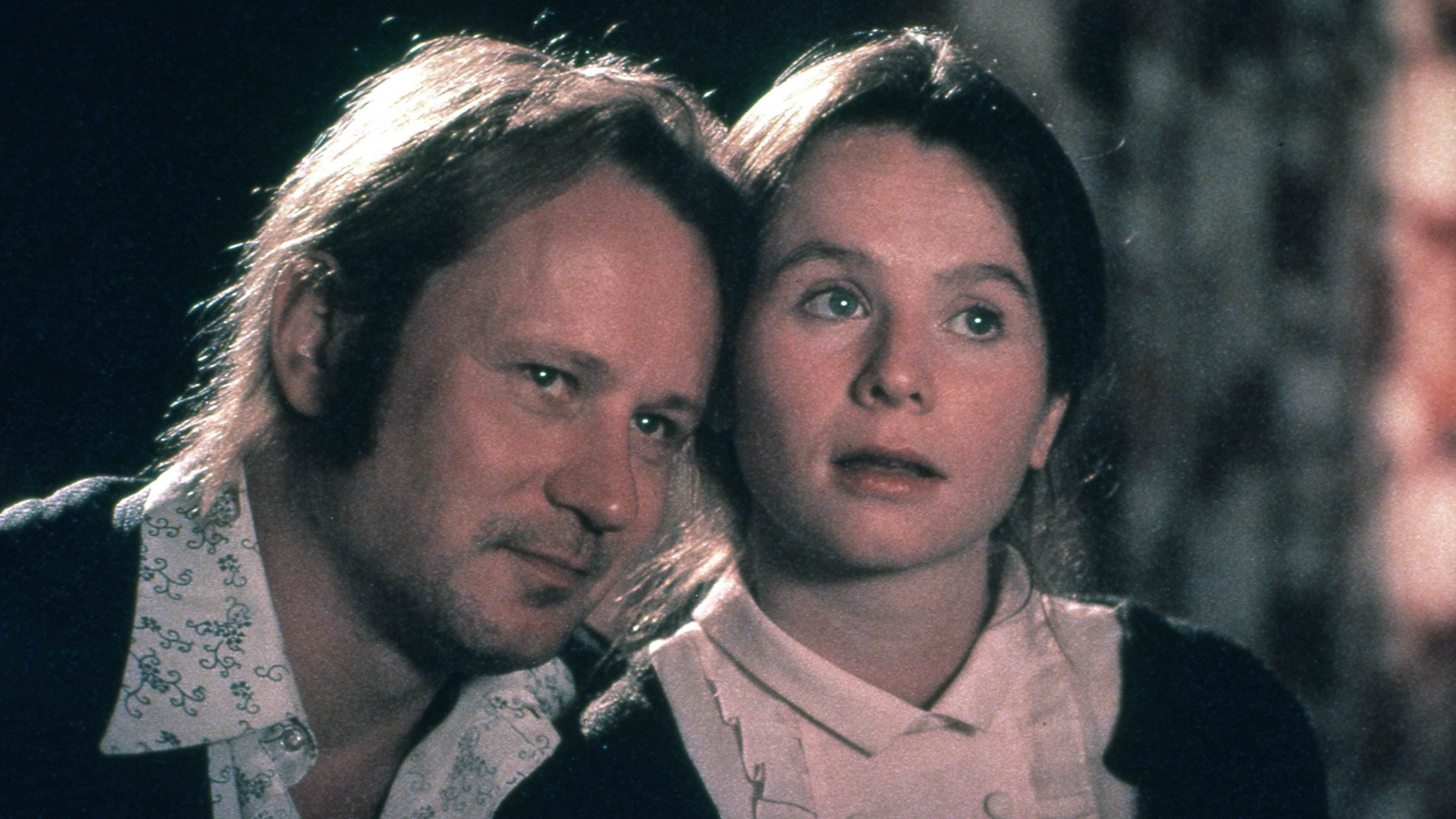
Casting the role of Bess McNeill was the project's defining decision. Helena Bonham Carter had originally accepted the part but withdrew before the shoot, and von Trier auditioned dozens of British and Irish actresses before casting 28-year-old Emily Watson, then a Royal Shakespeare Company stage performer with no previous film roles. Watson's casting tape, in which she performed Bess's prayers directly to camera, convinced von Trier within minutes. Stellan Skarsgård, who had collaborated with von Trier on smaller earlier projects, was cast as Jan; Katrin Cartlidge, fresh off Mike Leigh's Naked, was cast as Bess's sister-in-law Dodo; and the ensemble was rounded out with Jean-Marc Barr (as Terry), Adrian Rawlins, Udo Kier, Jonathan Hackett, and Sandra Voe (as Bess's mother).
Principal photography ran for approximately eight weeks in summer and autumn 1995 across the Isle of Skye, Lochaber, Mallaig, and the wider West Highlands of the United Kingdom, with additional sequences in Copenhagen and at a working North Sea oil platform reached by helicopter. Cinematographer Robby Müller shot Super 35mm with handheld operating throughout, an approach von Trier described as "Dogme-adjacent" and that anticipated the Dogme rulebook's rejection of camera support without committing to its strict prohibitions. Müller's naturally-lit, observational style and his willingness to follow performance in real time gave the film its distinctive raw immediacy.
The shoot was difficult. Watson, in her first feature, performed many of the emotional set-pieces in long unbroken takes, with the camera roaming close around her face. Highland weather, ferry schedules to Skye, and the practical demands of moving a multinational crew to remote locations produced multiple schedule overruns. The North Sea oil-rig sequences in particular required cooperation from a working platform and helicopter transport of cast and equipment, costs that absorbed an outsized share of the budget. Tensions between von Trier and members of the British cast, documented in subsequent interviews, were part of a pattern that would recur on Dancer in the Dark.
Post-production was completed in Copenhagen, with editor Anders Refn cutting the film into eight chapters separated by anamorphic chapter-card sequences scored to licensed 1970s rock tracks. Joachim Holbek's sparse original score sat against the catalog music, and the closing image (church bells ringing in the sky above the North Sea) was rendered as a CGI effect that was unusually expensive for a 1996 European indie. The film was completed in time for Cannes 1996, where it premiered in competition on May 18, 1996 and won the Grand Prix from the jury chaired by Francis Ford Coppola.
Awards and Recognition
Breaking the Waves won the Grand Prix at the 1996 Cannes Film Festival, the festival's second-highest competition prize, with the Palme d'Or that year going to Mike Leigh's Secrets and Lies. The Grand Prix was the most significant institutional recognition of Lars von Trier's career to that point and established Zentropa as a major European production company. The film also received the Bodil Award and Robert Award sweeps in Denmark in 1997, where it took Best Danish Film and Best Director at both the Danish Film Critics' Association and the Danish Film Academy ceremonies, alongside acting prizes for Emily Watson and Stellan Skarsgård.
Emily Watson received an Academy Award nomination for Best Actress at the 69th Academy Awards in 1997, an extraordinary outcome for an unknown actress in her debut feature in a Danish-language-frame foreign-financed art-house drama. The Best Actress prize that year went to Frances McDormand for Fargo. Watson also received Golden Globe, BAFTA, Screen Actors Guild, and Independent Spirit Award nominations for the same performance, sweeping the awards-circuit attention reserved for a breakout debut. Breaking the Waves itself received BAFTA nominations for Best Film Not in the English Language and Best Original Screenplay and won Best Foreign Film at the European Film Awards.
Beyond Cannes and the Oscar nomination, the film took the Best Picture and Best Director prizes from the National Society of Film Critics, Best Picture from the Los Angeles Film Critics Association, Best Director and Best Actress from the New York Film Critics Circle, Best Foreign Language Film at the Independent Spirit Awards, and the Best Director award at the Guldbagge Awards in Sweden. The film was ranked 75th in the 2012 Sight & Sound Greatest Films of All Time critics' poll, the highest position for any Lars von Trier film, and appears regularly on best-of-the-1990s and best-of-the-decade lists.
Critical Reception
Breaking the Waves holds an 86 percent positive score on Rotten Tomatoes based on 75 critic reviews and a 79 out of 100 on Metacritic based on 25 critic reviews, both placing it in the upper tier of 1996 art-house releases. CinemaScore did not survey audiences for the platform US release, so no consumer letter grade exists. The film carries an 7.8 average on IMDb based on roughly 90,000 user ratings, an exceptionally strong score for a long-runtime Scandinavian-British arthouse drama with explicit sexual content. The Criterion Collection canonized the film with a 2014 4K-restoration Blu-ray edition that brought a second generation of critical writing.
Janet Maslin, writing for The New York Times in November 1996, called the film "harrowing, profound and altogether amazing" and singled out Emily Watson's performance as "stunning" and "destined to win great praise." Roger Ebert awarded Breaking the Waves four stars in the Chicago Sun-Times, writing that "the film is a triumph of pure imagination" and named it the best film of 1996. Peter Travers in Rolling Stone called it "shattering" and described Watson's work as "miraculous." Negative reviews were rare; J. Hoberman in The Village Voice and a small number of feminist critics raised objections to the film's gendered narrative of female sacrifice, a critical strand that has remained part of the long-running discussion of von Trier's work.
In the years since release, Breaking the Waves has been ranked 75th in the 2012 Sight & Sound critics' poll, was selected by The Guardian as one of the 100 best films of the twenty-first century-adjacent canon, and appears on the BFI, Time Out, and Cahiers du Cinéma best-of-the-1990s lists. Critics including Stephanie Zacharek, Manohla Dargis, and Anthony Lane have repeatedly cited the film as the high-water mark of von Trier's career and the defining moment of Emily Watson's, and the film has remained a cornerstone of European-cinema curriculum at film schools worldwide.
Frequently Asked Questions
How much did it cost to make Breaking the Waves (1996)?
The production budget for Breaking the Waves was approximately $7,500,000. The film was produced by Vibeke Windeløv for Zentropa Entertainments through a multi-territory European co-production package including Denmark, Sweden, France, the Netherlands, and Norway, with backing from the Danish Film Institute, Swedish Film Institute, Eurimages, Canal+, and the Nordic Film and TV Fund. The budget sat at the upper end of Scandinavian indie financing for the period.
How much did Breaking the Waves (1996) earn at the box office?
Breaking the Waves grossed $4,036,772 in the United States and Canada through October Films, plus an estimated additional $3.5 million to $4 million across European and international theatrical markets, for a global theatrical total in the range of $7 million to $8 million. Box Office Mojo lists only the North American figure of $4,036,772 as the publicly tracked worldwide gross.
Was Breaking the Waves (1996) profitable?
Breaking the Waves did not recoup its approximately $7.5 million production budget on theatrical receipts alone, and after prints-and-advertising the theatrical line was negative. Recoupment was achieved through European television pre-sales, home video (Artisan in the US, Tartan in the UK, Criterion in 2014), the catalog value of the Cannes Grand Prix and Emily Watson's Oscar nomination, and three decades of cinematheque and streaming licensing.
Who directed Breaking the Waves (1996)?
Breaking the Waves was written and directed by Lars von Trier, the Danish filmmaker who had co-authored the Dogme 95 manifesto in March 1995, only months before principal photography on Breaking the Waves began. The film officially predates the Dogme rulebook and is not a Dogme-certified work. It is the first feature in von Trier's Golden Heart trilogy, followed by The Idiots (1998) and Dancer in the Dark (2000).
Is Breaking the Waves (1996) a Dogme 95 film?
No. Although Lars von Trier co-authored the Dogme 95 manifesto with Thomas Vinterberg in March 1995, Breaking the Waves is not a Dogme-certified film. Its handheld Super 35mm cinematography by Robby Müller, anamorphic chapter-card sequences, original score by Joachim Holbek, and CGI closing shot all violate Dogme rules. The first Dogme-certified film was Vinterberg's The Celebration in 1998.
Where was Breaking the Waves (1996) filmed?
Principal photography took place over approximately eight weeks in summer and autumn 1995 across the Isle of Skye, Lochaber, Mallaig, and the wider West Highlands of Scotland, with additional sequences shot in Copenhagen and at a working North Sea oil platform reached by helicopter. Robby Müller photographed the film on Super 35mm with handheld operating throughout. Post-production was completed in Copenhagen by editor Anders Refn.
Where did Breaking the Waves (1996) premiere?
Breaking the Waves premiered in the main competition at the 49th Cannes Film Festival on May 18, 1996, where it won the Grand Prix from the jury chaired by Francis Ford Coppola. Theatrical release followed in Denmark on August 23, 1996, France on September 4, 1996, the United Kingdom on October 4, 1996, and the United States on November 13, 1996 through October Films on a platform rollout.
What awards did Breaking the Waves (1996) win?
Breaking the Waves won the Grand Prix at Cannes 1996, the European Film Award for Best Film, Best Picture and Best Director from the National Society of Film Critics, Best Picture from the Los Angeles Film Critics Association, Best Director and Best Actress from the New York Film Critics Circle, the Bodil and Robert Awards in Denmark, and the Independent Spirit Award for Best Foreign Film. Emily Watson received Academy Award, Golden Globe, BAFTA, SAG, and Independent Spirit nominations for Best Actress.
Did Emily Watson win an Oscar for Breaking the Waves (1996)?
Emily Watson was nominated for the Academy Award for Best Actress at the 69th Academy Awards in 1997 for Breaking the Waves, her feature film debut, but did not win. The Best Actress Oscar that year went to Frances McDormand for Fargo. Watson also received Golden Globe, BAFTA, Screen Actors Guild, and Independent Spirit Award nominations for the role, which launched her career.
Where can you watch Breaking the Waves (1996) today?
Breaking the Waves is available on the Criterion Channel and MUBI, with a 4K restoration released by the Criterion Collection on Blu-ray in 2014. The film is also available to rent or purchase on Amazon Prime Video, Apple TV, and Google Play in the United States, and on Curzon Home Cinema and BFI Player in the United Kingdom. Rights are administered through Zentropa and TrustNordisk.
Filmmakers
Breaking the Waves

Official Trailer
Build budgets like this one in Saturation
Start from an industry-standard feature film template, import the schedule and rates you already have, and let the cost report keep itself current as you spend. Real-time collaboration, no spreadsheets.