
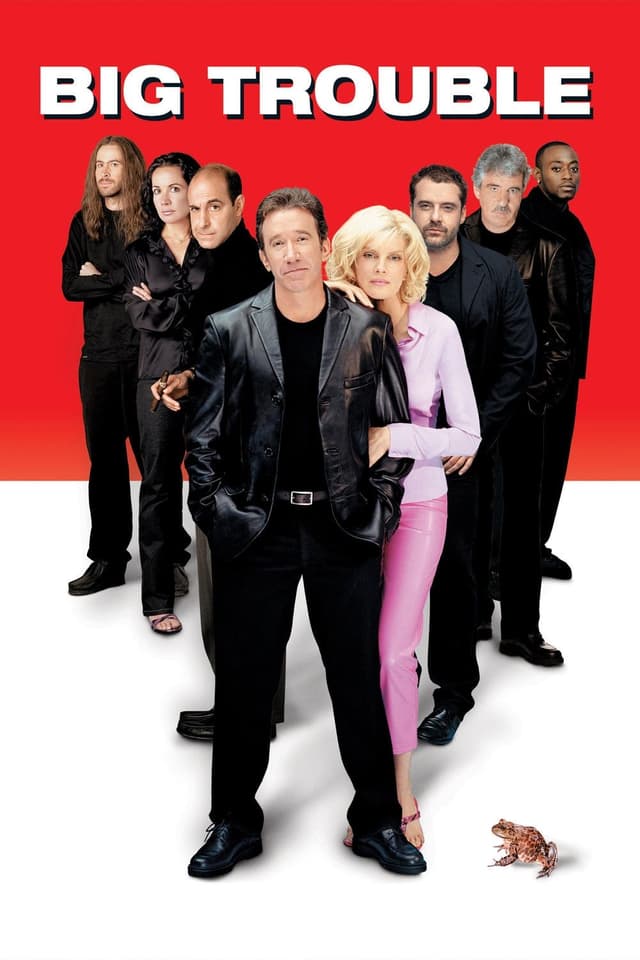
Big Trouble Budget
 ActionComedyThrillerMysteryCrime1h 25m
Updated
Synopsis
"Big Trouble" is a comedic caper that intertwines the lives of several quirky characters in a chaotic Miami setting. The story kicks off when a mysterious suitcase filled with a nuclear bomb is mistakenly delivered to a group of unsuspecting individuals. As they navigate through a series of misadventures, including a hitman, a bumbling father, and a group of eccentric criminals, the film showcases the absurdity of their situations. With a blend of humor and action, the characters must work together to prevent disaster while dealing with their own personal dilemmas. Ultimately, "Big Trouble" is a wild ride that highlights the unpredictability of life and the importance of teamwork in the face of chaos.
What is the budget of Big Trouble?
"Big Trouble," an action released in 2002, was directed by Barry Sonnenfeld and stars Tim Allen, Rene Russo. The production budget was $40,000,000, placing it in the mid-budget range for action productions of its era.
Key Budget Allocation Categories
While specific budget breakdowns are not publicly available, typical cost drivers for an action production like this include:
- Stunts, Action Sequences & Visual Effects: Action films allocate a substantial portion of their budget to choreographing and executing practical stunts, pyrotechnics, and CGI-heavy sequences.
- Above-the-Line Talent (Cast & Director): A-list talent commands significant upfront fees plus backend participation.
- Production Design, Sets & Locations: Action films frequently require multiple international shooting locations, large-scale set construction, vehicle acquisitions and modifications, and specialized equipment , all of which drive production costs well above those of dialogue-driven genres.
- Production: Filming took place entirely in Miami, Florida from July 31 to October 2000.
What were the major cost factors in Big Trouble?
Several factors contributed to the overall production costs of "Big Trouble."
- Stunts: Stunts, Action Sequences & Visual Effects is one of the primary cost drivers in action productions of this scale.
- Above-the-Line Talent (Cast: Above-the-Line Talent (Cast & Director) is one of the primary cost drivers in action productions of this scale.
- Production Design: Production Design, Sets & Locations is one of the primary cost drivers in action productions of this scale.
How Does Big Trouble's Budget Compare to Similar Films?
At $40,000,000, Big Trouble sits in the mid-budget range. Here is how it compares to productions with a similar budget:
- 42 (2013): Budget $40,000,000, Worldwide Gross $95,020,213
- A Few Good Men (1992): Budget $40,000,000, Worldwide Gross $243,240,178
- 8 Mile (2002): Budget $41,000,000, Worldwide Gross $242,875,078
- Along Came Polly (2004): Budget $42,000,000, Worldwide Gross $178,300,000
- 28 Days (2000): Budget $43,000,000, Worldwide Gross $62,198,945
The median budget for wide-release action films in the 2000s ranges from $30 to 80M for mid-budget to $150M+ for tentpoles.
Big Trouble Box Office Performance
"Big Trouble" earned $7,267,307 domestically and $8,493,890 worldwide at the box office. Against a production budget of $40,000,000, the film faced challenges in theatrical release. Home video, streaming, and ancillary revenue may have contributed to its overall performance.
A film typically needs to earn approximately twice its production budget to cover marketing and distribution costs. For "Big Trouble," that break-even threshold was roughly $80,000,000. With worldwide earnings of $8,493,890, the film did not reach break-even in theatrical release.
Box Office Breakdown
Big Trouble

At -78.8%, "Big Trouble" did not recoup its production budget through theatrical release alone.
Awards and Recognition
N/A
Critical Reception
Big Trouble came quietly to American theaters and left quickly afterwards, receiving mixed reviews and being generally ignored by audiences, becoming a box office bomb. On Metacritic, it has a score of 47% based on reviews from 32 critics, indicating "mixed or average" reviews. Audiences polled by CinemaScore gave the film an average grade of "C+" on an A+ to F scale.
Official Trailer
Build budgets like this one in Saturation
Start from an industry-standard feature film template, import the schedule and rates you already have, and let the cost report keep itself current as you spend. Real-time collaboration, no spreadsheets.