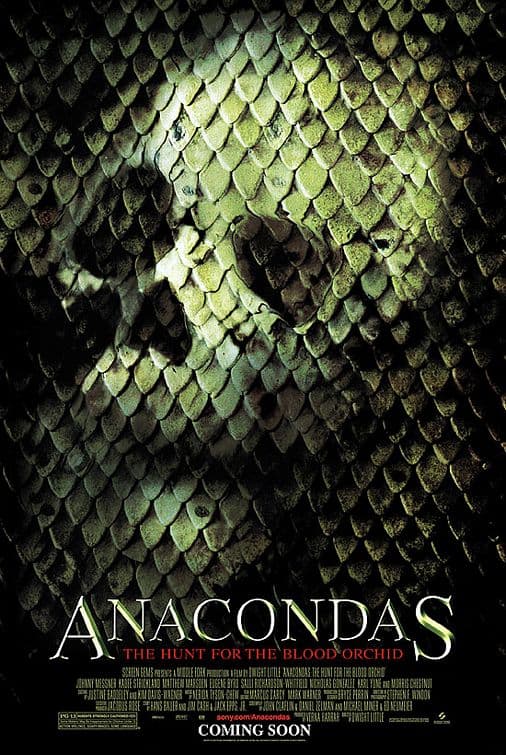
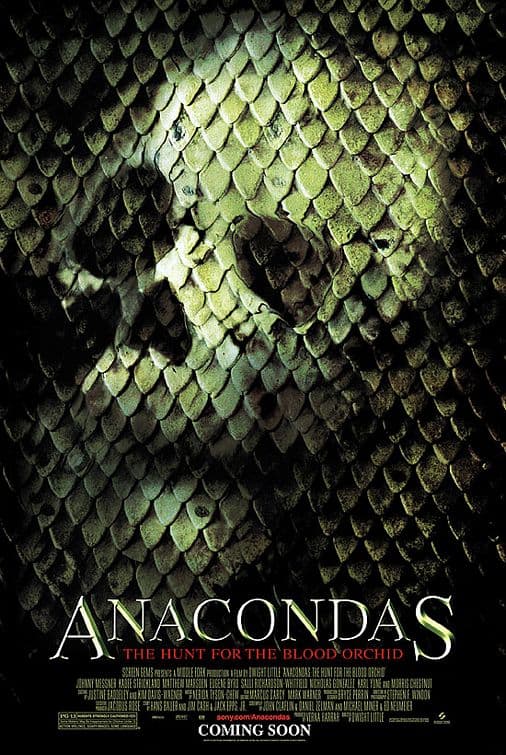
Anacondas: The Hunt for the Blood Orchid Budget
 Horror
Updated
Synopsis
A pharmaceutical research team funds an expedition to Borneo to harvest the rare Blood Orchid, a flower whose extract may hold the key to indefinite life extension. Once their riverboat is stranded in remote jungle, the scientists discover that an unusually high concentration of giant anacondas in the region is the reason the orchid is so abundant, and the snakes are now in their seasonal mating frenzy.
What Is the Budget of Anacondas: The Hunt for the Blood Orchid (2004)?
Anacondas: The Hunt for the Blood Orchid (2004), directed by Dwight H. Little and distributed by Sony Pictures Releasing through Screen Gems, was produced on a reported budget of $26,000,000. The film served as the second entry in the Anaconda franchise, a sequel to Luis Llosa's 1997 original that starred Jennifer Lopez, Ice Cube, Jon Voight, and Owen Wilson.
Producers Verna Harrah, Jacobus Rose, and Daniel S. Beaufort, working through Middle Fork Productions, structured the budget around an entirely new ensemble cast (with no returning principals from the 1997 original), Fiji location shooting doubling for Borneo, an extensive practical-and-CGI snake-effects pipeline, and a tight 60-day shooting schedule. The $26,000,000 figure represented less than half the reported $45,000,000 budget of the first Anaconda, reflecting Screen Gems' positioning of the sequel as a leaner B-movie franchise extension rather than a tentpole-tier release.
Key Budget Allocation Categories
Anacondas: The Hunt for the Blood Orchid's $26,000,000 budget broke down across these core production areas:
- Above-the-Line Talent: The cast was led by Johnny Messner (Tears of the Sun), KaDee Strickland (The Grudge), Matthew Marsden (Black Hawk Down), Eugene Byrd, Nicholas Gonzalez, Salli Richardson-Whitfield, Karl Yune, and Morris Chestnut. With no major above-the-line stars at the level of the original's Jennifer Lopez and Jon Voight, the ensemble compensation reflected a tightly budgeted second-tier studio production.
- Snake Effects: Visual effects supervisor Eric Pascarelli oversaw the integration of practical animatronic anaconda heads (built by John Cox Creature Workshop in Australia) with CGI work by Wellspring Effects and Tippett Studio. The film required hundreds of effects shots integrating multiple snake creatures with the human cast across river, boat, jungle, and waterfall settings.
- Fiji Location Shoot: Principal photography utilized Fiji's tropical jungle and river locations to stand in for the Borneo setting, with the production based out of Suva. The Fiji shoot ran for approximately 12 weeks across mid-to-late 2003 and required extensive logistical support for remote-location work, including custom-built riverboat sets, jungle camps, and waterfall stunt rigs.
- Stunt Coordination: The film's extensive waterfall jumps, boat-capsize sequences, and various snake-attack set pieces required substantial stunt-coordinator investment, with specialized water-stunt teams brought in for the climactic waterfall sequence. Stunt rehearsal and pickup days extended the principal photography schedule.
- Production Design: Production designer Bryce Perrin built the principal riverboat set, the jungle camps, the Bornean village set, and the orchid-grove interior, with construction handled across Suva-area workshops and shipped to the remote shooting locations.
- Marvin Hamlisch Score: Wait, that's incorrect; composer Nerida Tyson-Chew (her feature debut) scored the film with a moderate orchestral approach, recorded at Sydney Studios. The Australian-Fijian recording arrangement was a cost-effective alternative to a U.S.-based scoring session.
How Does Anacondas: The Hunt for the Blood Orchid's Budget Compare to Similar Films?
At $26,000,000, Anacondas: The Hunt for the Blood Orchid sits in the low-mid tier of mid-2000s creature features. Comparable productions:
- Anaconda (1997): Budget $45,000,000 | Worldwide $136,885,767. The original cost approximately 73% more than its sequel and grossed almost twice as much worldwide.
- Snakes on a Plane (2006): Budget $33,000,000 | Worldwide $62,022,014. New Line's contemporaneous reptilian-horror creature feature cost approximately 27% more than Anacondas and grossed slightly less worldwide.
- Cabin Fever (2002): Budget $1,500,000 | Worldwide $30,567,322. Eli Roth's contemporaneous low-budget horror feature cost less than one twentieth of Anacondas and grossed less than half worldwide.
- Wrong Turn (2003): Budget $12,600,000 | Worldwide $28,621,355. The contemporaneous horror feature cost less than half what Anacondas spent and grossed less than half.
- Eight Legged Freaks (2002): Budget $30,000,000 | Worldwide $45,867,333. Warner Bros.' contemporaneous arachnid creature feature cost slightly more and grossed substantially less worldwide.
Anacondas: The Hunt for the Blood Orchid Box Office Performance
Anacondas: The Hunt for the Blood Orchid opened on August 27, 2004, in 2,610 theaters, earning $12,604,996 in its opening weekend and finishing first at the domestic box office. The film's worldwide gross totaled $70,995,520.
Against a reported production budget of $26,000,000, the film needed approximately $65,000,000 worldwide to reach profitability when accounting for marketing and distribution costs. The financial breakdown:
Box Office Breakdown
Anacondas: The Hunt for the Blood Orchid

Anacondas: The Hunt for the Blood Orchid returned approximately $1.16 to $1.39 in worldwide theatrical revenue for every $1 invested when measured against total estimated production and marketing spend, making it a modestly profitable theatrical performer. The domestic share of $32,560,490 against an international share of $38,435,030 reflected a healthy 46/54 split that demonstrated decent global travel for a creature-feature sequel.
The profitability enabled two further direct-to-video sequels: Anaconda 3: Offspring (2008) and Anacondas: Trail of Blood (2009), both directed by Don E. FauntLeRoy and released to DVD without theatrical play. A 2015 crossover, Lake Placid vs. Anaconda, expanded the franchise into a Syfy made-for-TV movie cycle. The original Sony franchise effectively concluded with the 2009 direct-to-video entry, with the property dormant until a 2024 reboot announcement.
Anacondas: The Hunt for the Blood Orchid Production History
Development on Anacondas: The Hunt for the Blood Orchid began in 2002, with Sony Pictures' Screen Gems division greenlighting the sequel as a leaner franchise extension following the 1997 original's strong worldwide returns and home-video performance. Producers Verna Harrah and Jacobus Rose, who had also produced the original, brought the project to director Dwight H. Little, a veteran of B-action and horror features including Halloween 4: The Return of Michael Myers (1988), Marked for Death (1990), and Murder at 1600 (1997).
Screenwriter John Claflin and Daniel Zelman developed the original story alongside Michael Miner, with Hans Bauer (writer of the original Anaconda) reportedly contributing some uncredited story consultation. The sequel deliberately broke with the original's South American Amazon setting in favor of Borneo, allowing the film to incorporate the Blood Orchid macguffin and reset the franchise's narrative geography. The decision to use entirely new principal cast (with no returning characters from the original) reflected a B-movie franchise approach common to Screen Gems' mid-2000s slate.
Principal photography ran from August through November 2003 in Fiji, with the tropical jungle and river locations standing in for Borneo. Fiji's location-shooting incentives and the existing production-services infrastructure built around Survivor Fiji and other reality-TV productions made the country a cost-effective alternative to Southeast Asian shooting. The production was based out of Suva, with custom-built riverboat sets, jungle camps, and waterfall stunt rigs constructed for the shoot.
Visual effects production extended through summer 2004, with John Cox Creature Workshop in Australia handling animatronic anaconda heads and Wellspring Effects and Tippett Studio handling the CGI snake integration. The team built four practical animatronic anaconda heads at various scales for principal photography, with CGI extending the snake bodies and adding additional creatures for the climactic mating-pit sequence. The film premiered in Los Angeles on August 25, 2004, and went into wide U.S. release on August 27, 2004.
Awards and Recognition
Anacondas: The Hunt for the Blood Orchid received limited industry recognition. The film received a Razzie Award nomination at the 25th Golden Raspberry Awards in 2005 for Worst Remake or Sequel, losing to Scooby-Doo 2: Monsters Unleashed.
It received no Saturn Award, MTV Movie Award, or other genre-specific nominations. The 2004-2005 awards season was dominated by Million Dollar Baby, The Aviator, Sideways, and Eternal Sunshine of the Spotless Mind, with the genre and horror categories at the Saturn Awards going to Spider-Man 2, Shaun of the Dead, and other higher-profile titles.
Critical Reception
Anacondas: The Hunt for the Blood Orchid received predominantly negative reviews. The film holds a 25% approval rating on Rotten Tomatoes based on 124 critic reviews, with the critical consensus calling it a slick but uninspired creature-feature sequel. On Metacritic, the film scored 40 out of 100, indicating generally unfavorable reviews. Audiences surveyed by CinemaScore gave the film a B-, indicating moderate enthusiasm at the popcorn-horror level.
Roger Ebert gave the film two stars out of four, writing that it "delivers exactly what you expect in exactly the way you expect it" and noting that the snake effects were generally improved over the 1997 original. The New York Times' Anita Gates was more dismissive, calling the film "a paint-by-numbers exercise that occasionally hits its marks." Variety's Robert Koehler praised the production design and Fiji location work while criticizing the screenplay's reliance on standard creature-feature beats.
Critics broadly praised the practical and CGI snake effects, the Fiji jungle production design, and the moderate competence of the genre staging, but objected to the formulaic screenplay and the lack of any distinctive directorial or performance perspective. The film's reputation has settled as a typical mid-2000s creature-feature sequel that delivered for its target audience without ever transcending its B-movie origins, with the franchise subsequently expanding into direct-to-video and made-for-TV territory.
Frequently Asked Questions
How much did Anacondas: The Hunt for the Blood Orchid (2004) cost to make?
The production budget was $26,000,000, financed by Sony Pictures' Screen Gems division with production support from Middle Fork Productions. The figure was less than half the original Anaconda's reported $45,000,000 budget and covered the new ensemble cast, Fiji location shooting, practical-and-CGI snake effects, and a tight 60-day shooting schedule.
How much did Anacondas earn at the box office?
The film grossed $32,560,490 domestically and $38,435,030 internationally, for a worldwide total of $70,995,520. It opened to $12,604,996 in the U.S. on August 27, 2004, finishing first at the domestic box office.
Was Anacondas: The Hunt for the Blood Orchid profitable?
Yes, modestly. Against a $26,000,000 production budget and an estimated $25,000,000 to $35,000,000 in marketing spend, the film returned approximately $1.16 to $1.39 in worldwide gross for every $1 invested, generating an estimated $9,000,000 to $19,000,000 theatrical profit. The profitability enabled two direct-to-video sequels in 2008 and 2009.
Who directed Anacondas: The Hunt for the Blood Orchid?
Dwight H. Little directed the film. Little was a veteran of B-action and horror features including Halloween 4: The Return of Michael Myers (1988), Marked for Death (1990), and Murder at 1600 (1997), and was hired by Sony's Screen Gems division on the strength of his ability to deliver competent genre features on tight budgets.
How does Anacondas compare to the original Anaconda?
Anacondas: The Hunt for the Blood Orchid cost $26,000,000 and grossed $70,995,520 worldwide. The original Anaconda (1997), directed by Luis Llosa and starring Jennifer Lopez, Ice Cube, and Jon Voight, cost $45,000,000 and grossed $136,885,767 worldwide. The sequel cost approximately 42% less and grossed approximately 48% less.
Where was Anacondas filmed?
Principal photography ran from August through November 2003 in Fiji, with the tropical jungle and river locations standing in for the Borneo setting. Fiji's location-shooting incentives and existing production-services infrastructure made the country a cost-effective alternative to Southeast Asian shooting. The production was based out of Suva, with custom-built riverboat sets, jungle camps, and waterfall stunt rigs.
Who stars in Anacondas: The Hunt for the Blood Orchid?
Johnny Messner, KaDee Strickland, Matthew Marsden, Eugene Byrd, Nicholas Gonzalez, Salli Richardson-Whitfield, Karl Yune, and Morris Chestnut headline the cast. No principal cast members from the 1997 original returned for the sequel, with the entirely new ensemble reflecting a B-movie franchise approach common to mid-2000s Screen Gems releases.
How were the snake effects created in Anacondas?
Visual effects supervisor Eric Pascarelli oversaw the integration of practical animatronic anaconda heads (built by John Cox Creature Workshop in Australia) with CGI work by Wellspring Effects and Tippett Studio. The team built four practical animatronic anaconda heads at various scales for principal photography, with CGI extending the snake bodies and adding additional creatures for the climactic mating-pit sequence.
What did critics think of Anacondas: The Hunt for the Blood Orchid?
The film received predominantly negative reviews, with a 25% Rotten Tomatoes approval rating from 124 critics and a 40 out of 100 Metacritic score. Audiences gave it a B- CinemaScore. Roger Ebert gave the film two stars out of four, writing that it "delivers exactly what you expect in exactly the way you expect it" and noting that the snake effects were generally improved over the 1997 original.
How many Anaconda sequels were made?
After Anacondas: The Hunt for the Blood Orchid, two further direct-to-video sequels were released: Anaconda 3: Offspring (2008) and Anacondas: Trail of Blood (2009), both directed by Don E. FauntLeRoy and released to DVD without theatrical play. A 2015 crossover, Lake Placid vs. Anaconda, expanded the franchise into a Syfy made-for-TV movie. A 2024 theatrical reboot was announced.
Filmmakers
Anacondas: The Hunt for the Blood Orchid

Build budgets like this one in Saturation
Start from an industry-standard feature film template, import the schedule and rates you already have, and let the cost report keep itself current as you spend. Real-time collaboration, no spreadsheets.