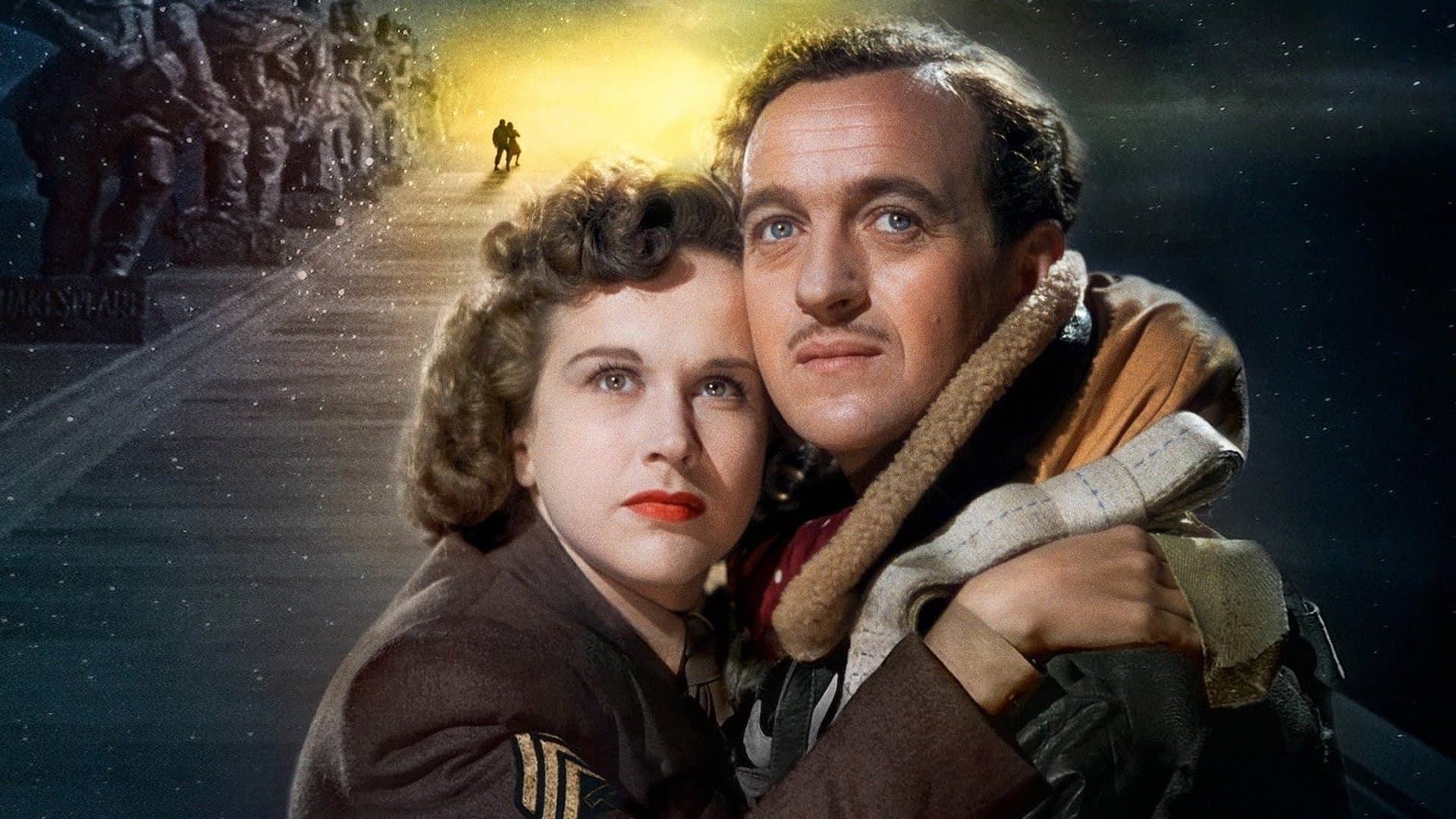
A Matter of Life and Death Budget
 RomanceFantasyDramaComedy1h 44m
Updated
Synopsis
Returning to England from a bombing run in May 1945, pilot Peter Carter's plane is damaged and his parachute ripped to shreds. He has his crew bail out safely, but figures it is curtains for himself. He gets on the radio, and talks to June, a young American woman working for the U.S. Army Air Forces, and they are quite moved by each other's voices. Then he jumps, preferring this to burning up with his plane. He wakes up in the surf. It was his time to die, but there was a mix-up in heaven. They couldn't find him in all that fog. By the time his "Conductor" catches up with him twenty hours later, Peter and June have met and fallen in love. This changes everything, and since it happened through no fault of his own, Peter figures that heaven owes him a second chance. Heaven agrees to a trial to decide his fate.
What is the budget of A Matter of Life and Death?
"A Matter of Life and Death," a romance released in 1946, was directed by Michael Powell, Emeric Pressburger and stars David Niven, Kim Hunter. The production budget was $450,000, placing it in the micro-budget range for romance productions of the 1940s.
Key Budget Allocation Categories
While specific budget breakdowns are not publicly available, typical cost drivers for a romance production like this include:
- Lead Cast Compensation: Romantic films depend entirely on the chemistry and appeal of their leads, making star casting decisions the most consequential budget item.
- Location Filming: Picturesque, often international locations are central to the romantic genre's visual appeal.
- Music Supervision & Soundtrack: Iconic songs can cost $250,000 to 500,000 to license per use, and a well-curated soundtrack is often as important to marketing as the trailer itself.
- Production: A Matter of Life and Death was filmed at D&P Studios and Denham Studios in Denham, Buckinghamshire, England, and on location in Devon and Surrey.
What were the major cost factors in A Matter of Life and Death?
Several factors contributed to the overall production costs of "A Matter of Life and Death."
- Lead Cast Compensation: Lead Cast Compensation is one of the primary cost drivers in romance productions of this scale.
- Location Filming: Location Filming is one of the primary cost drivers in romance productions of this scale.
- Music Supervision: Music Supervision & Soundtrack is one of the primary cost drivers in romance productions of this scale.
How Does A Matter of Life and Death's Budget Compare to Similar Films?
At $450,000, A Matter of Life and Death sits in the micro-budget range. Here is how it compares to productions with a similar budget:
- Duel (1971): Budget $450,000, Worldwide Gross $2,544
- The Beguiled (1971): Budget $475,000, Worldwide Gross $1,100,000
- Threads (1985): Budget $420,000
- The Red Shoes (1948): Budget $500,000, Worldwide Gross $10,000,000
- Cries and Whispers (1972): Budget $400,000
The median budget for wide-release romance films in the era ranges from $30 to 80M for mid-budget to $150M+ for tentpoles.
A Matter of Life and Death Box Office Performance
"A Matter of Life and Death" earned $1,750,000 worldwide at the box office. Against a production budget of $450,000, the film performed strongly at the box office.
A film typically needs to earn approximately twice its production budget to cover marketing and distribution costs. For "A Matter of Life and Death," that break-even threshold was roughly $900,000. With worldwide earnings of $1,750,000, the film cleared that threshold comfortably.
Box Office Breakdown
A Matter of Life and Death

At 288.9%, "A Matter of Life and Death" earned roughly $3.89 for every $1 invested in production.
Awards and Recognition
5 wins & 2 nominations total
Frequently Asked Questions
How much did it cost to make A Matter of Life and Death (1946)?
The production budget was $450,000, covering principal photography, cast and crew salaries, locations, sets, post-production, and music. Marketing and distribution (P&A) costs are estimated at an additional $225,000 - $360,000, bringing the total studio investment to approximately $675,000 - $810,000.
How much did A Matter of Life and Death (1946) earn at the box office?
A Matter of Life and Death grossed $1,750,000 worldwide.
Was A Matter of Life and Death (1946) profitable?
Yes. Against a production budget of $450,000 and estimated total costs of ~$1,125,000, the film earned $1,750,000 theatrically - a 289% ROI on production costs alone.
What were the biggest costs in producing A Matter of Life and Death?
The primary cost drivers were above-the-line talent (David Niven, Kim Hunter, Roger Livesey); lead talent, aspirational location filming, and a carefully curated soundtrack.
How does A Matter of Life and Death's budget compare to similar romance films?
At $450,000, A Matter of Life and Death is classified as a ultra-low-budget production. The median budget for wide-release romance films in the era ranges from $30 - 80M for mid-budget to $150M+ for tentpoles. Comparable budgets: Duel (1971, $450,000); The Beguiled (1971, $475,000); Threads (1985, $420,000).
Did A Matter of Life and Death (1946) go over budget?
There are no widely reported accounts of significant budget overruns for this production. However, studios rarely disclose precise budget overrun figures publicly. The reported production budget reflects the final estimated cost.
What was the return on investment (ROI) for A Matter of Life and Death?
The theatrical ROI was 288.9%, calculated as ($1,750,000 − $450,000) ÷ $450,000 × 100. This measures gross revenue against production budget only - it does not account for P&A or exhibitor shares.
What awards did A Matter of Life and Death (1946) win?
5 wins & 2 nominations total.
Who directed A Matter of Life and Death and who were the key crew members?
Directed by Michael Powell, Emeric Pressburger, written by Michael Powell, Emeric Pressburger, shot by Jack Cardiff, with music by Allan Gray, edited by Reginald Mills.
Where was A Matter of Life and Death filmed?
A Matter of Life and Death was filmed in United Kingdom.
Filmmakers
A Matter of Life and Death

Official Trailer
Build budgets like this one in Saturation
Start from an industry-standard feature film template, import the schedule and rates you already have, and let the cost report keep itself current as you spend. Real-time collaboration, no spreadsheets.