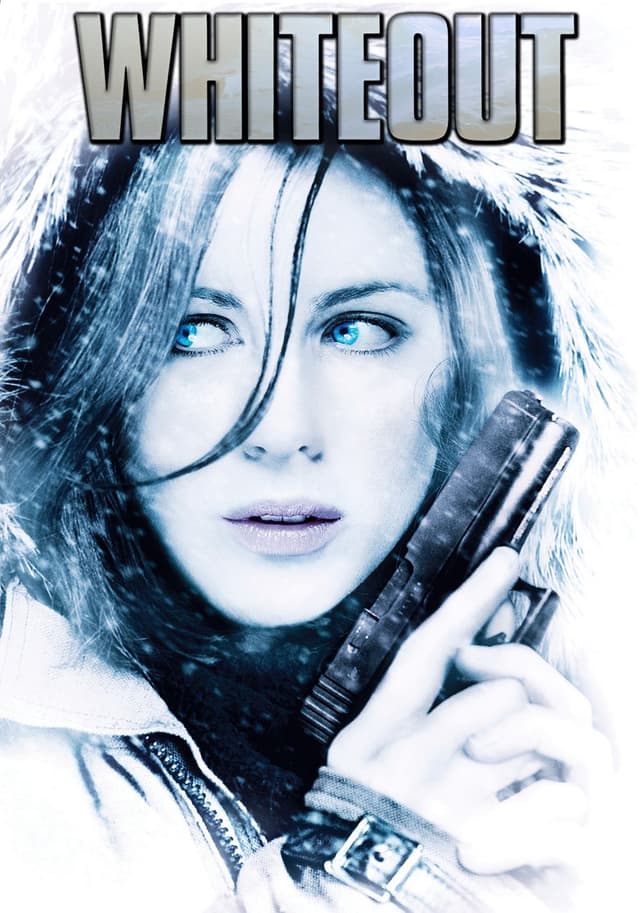
Whiteout Budget
 ActionCrimeMysteryThriller1h 41m
Atualizado
Synopsis
U.S. Marshal Carrie Stetko is three days from the end of her tour at an international research station in Antarctica after which she'll resign. An incident from her past haunts her. The continent's first winter storm is coming when a body, wearing no gear, is discovered in the tundra. She investigates, soon finds more bodies, and must find a motive and a murderer before the storm and her departure. A U.N. agent, Robert Pryce, appears, seemingly out of nowhere, to help. An aging physician about to retire, a nervous mission chief, a downed Soviet plane, and the weather's deadly elements add to the story. Can Carrie trust Pryce and does she still have what it takes?
What is the budget of Whiteout?
"Whiteout," an action released in 2009, was directed by Dominic Sena and stars Kate Beckinsale, Gabriel Macht. The production budget was $40,000,000, placing it in the mid-budget range for action productions of its era.
Key Budget Allocation Categories
While specific budget breakdowns are not publicly available, typical cost drivers for an action production like this include:
- Stunts, Action Sequences & Visual Effects: Action films allocate a substantial portion of their budget to choreographing and executing practical stunts, pyrotechnics, and CGI-heavy sequences.
- Above-the-Line Talent (Cast & Director): A-list talent commands significant upfront fees plus backend participation.
- Production Design, Sets & Locations: Action films frequently require multiple international shooting locations, large-scale set construction, vehicle acquisitions and modifications, and specialized equipment , all of which drive production costs well above those of dialogue-driven genres.
- Production: In November 1999, Columbia Pictures acquired feature film rights to the comic book Whiteout by Greg Rucka and Steve Lieber.
What were the major cost factors in Whiteout?
Several factors contributed to the overall production costs of "Whiteout."
- Stunts: Stunts, Action Sequences & Visual Effects is one of the primary cost drivers in action productions of this scale.
- Above-the-Line Talent (Cast: Above-the-Line Talent (Cast & Director) is one of the primary cost drivers in action productions of this scale.
- Production Design: Production Design, Sets & Locations is one of the primary cost drivers in action productions of this scale.
How Does Whiteout's Budget Compare to Similar Films?
At $40,000,000, Whiteout sits in the mid-budget range. Here is how it compares to productions with a similar budget:
- 42 (2013): Budget $40,000,000, Worldwide Gross $95,020,213
- A Few Good Men (1992): Budget $40,000,000, Worldwide Gross $243,240,178
- Big Trouble (2002): Budget $40,000,000, Worldwide Gross $8,493,890
- Boomerang (1992): Budget $40,000,000, Worldwide Gross $131,052,444
- Fifty Shades of Grey (2015): Budget $40,000,000, Worldwide Gross $569,651,467
The median budget for wide-release action films in the 2000s ranges from $30 to 80M for mid-budget to $150M+ for tentpoles.
Whiteout Box Office Performance
"Whiteout" earned $10,275,638 domestically and $17,976,667 worldwide at the box office. Against a production budget of $40,000,000, the film faced challenges in theatrical release. Home video, streaming, and ancillary revenue may have contributed to its overall performance.
A film typically needs to earn approximately twice its production budget to cover marketing and distribution costs. For "Whiteout," that break-even threshold was roughly $80,000,000. With worldwide earnings of $17,976,667, the film did not reach break-even in theatrical release.
Box Office Breakdown
Whiteout

At -74%, "Whiteout" returned roughly $0.26 for every $1 invested.
Whiteout Production History
Whiteout began as a 1998 comic book miniseries by writer Greg Rucka and artist Steve Lieber, published by Oni Press. Columbia Pictures acquired the film rights in November 1999 and hired Jon and Erich Hoeber to adapt it, and the script was reworked to place a male character opposite the female lead because the studio was hesitant about how large an audience the original setup of two female leads would draw. By 2002 the rights had moved to Universal Studios, which cast Reese Witherspoon as Deputy U.S. Marshal Carrie Stetko. The rights changed hands again and Witherspoon detached from the project, leaving the adaptation without a studio for a second time.
The film finally landed at Dark Castle Entertainment in October 2006, with production slated to begin that winter for a first quarter 2008 release. Dominic Sena, a fan of the graphic novel, petitioned producer Joel Silver for the job and was hired in February 2007 once Warner Bros. Pictures signed on to distribute. Kate Beckinsale was cast as Stetko the same month.
Principal photography began on March 5, 2007 in Manitoba. Production designer Grace Walker built the entire film from scratch, since there were no practical locations available: every set in the picture was constructed, the interiors dressed with floor tiles on the walls, exposed piping and stainless steel to suggest a space colony, with upper levels added as CGI extensions. Exteriors were shot on a frozen lake roughly two hours from Winnipeg, on a private spit of land that offered shooting angles with no tree line or cityscape in frame, over four feet of solid ice. The weather worked against the schedule rather than for it: Manitoba was having its warmest winter on record, so cameras had to be specially oiled and heating units fitted to each magazine to keep the film running, and when sun hit the steel beams the resulting thaw destabilised the set foundations. The production then moved indoors to soundstages in Montreal, taking the foundations of four interconnecting buildings, the station and the airplane hangar, with it, where crews blasted the sets with fake snow from giant fans and laid 120 tons of sand under 12 tons of salt to build artificial drifts. Filming wrapped a few weeks before Comic-Con in July 2007.
The finished film then sat. Against the first quarter 2008 date announced when Dark Castle took the project on, Warner Bros. did not release Whiteout until September 11, 2009, more than two years after photography wrapped. It opened in 2,745 theatres, took $4,915,104 in its first weekend, and closed on December 17, 2009 with $10,275,638 domestically.
Awards and Recognition
N/A
Critical Reception
Whiteout was panned by critics. Audiences polled by CinemaScore gave the film an average grade of "C-" on an A+ to F scale.
Perguntas frequentes
How much did it cost to make Whiteout (2009)?
The production budget was $40,000,000, covering principal photography, visual effects, cast and crew salaries, locations, sets, post-production, and music. Marketing and distribution (P&A) costs are estimated at an additional $20,000,000 - $32,000,000, bringing the total studio investment to approximately $60,000,000 - $72,000,000.
How much did Whiteout (2009) earn at the box office?
Whiteout grossed $10,275,638 domestic, $7,701,029 international, totaling $17,976,667 worldwide.
Was Whiteout (2009) profitable?
The film did not break even theatrically, earning $17,976,667 against an estimated $100,000,000 needed. Ancillary revenue may have improved the picture.
What were the biggest costs in producing Whiteout?
The primary cost drivers were above-the-line talent (Kate Beckinsale, Gabriel Macht, Tom Skerritt); visual effects, practical stunts, and A-list talent compensation.
How does Whiteout's budget compare to similar action films?
At $40,000,000, Whiteout is classified as a mid-budget production. The median budget for wide-release action films in the 2000s ranges from $30 - 80M for mid-budget to $150M+ for tentpoles. Comparable budgets: 42 (2013, $40,000,000); A Few Good Men (1992, $40,000,000); Big Trouble (2002, $40,000,000).
Did Whiteout (2009) go over budget?
There are no widely reported accounts of significant budget overruns for this production. However, studios rarely disclose precise budget overrun figures publicly. The reported production budget reflects the final estimated cost.
What was the return on investment (ROI) for Whiteout?
The theatrical ROI was -55.1%, calculated as ($17,976,667 − $40,000,000) ÷ $40,000,000 × 100. This measures gross revenue against production budget only - it does not account for P&A or exhibitor shares.
What awards did Whiteout (2009) win?
N/A.
Who directed Whiteout and who were the key crew members?
Directed by Dominic Sena, written by Jon Hoeber, Erich Hoeber, Chad Hayes, Carey Hayes, shot by Christopher Soos, with music by John Frizzell, edited by Martin Hunter.
Where was Whiteout filmed?
Whiteout was filmed in United States of America.
Filmmakers
Whiteout

Official Trailer
Crie orçamentos como este no Saturation
Comece com um modelo de longa-metragem padrão do setor, importe o cronograma e as tarifas que você já tem e deixe o relatório de custos se manter atualizado conforme você gasta. Colaboração em tempo real, sem planilhas.