There Will Be Blood Budget
 Drama2h 38m
업데이트
Synopsis
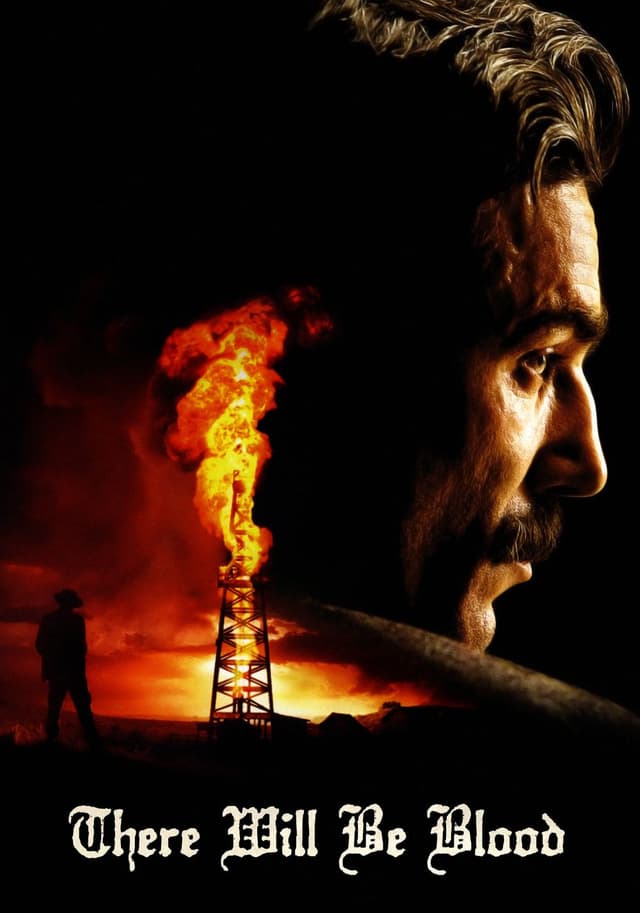
"There Will Be Blood" is a gripping drama directed by Paul Thomas Anderson, set in the late 19th and early 20th centuries. The film follows the ambitious and ruthless oilman Daniel Plainview, portrayed by Daniel Day-Lewis, who is determined to build his empire in the burgeoning oil industry of California. As he navigates the challenges of drilling for oil, Plainview's relentless pursuit of wealth leads him to confront moral dilemmas and personal conflicts, particularly with a local preacher named Eli Sunday, played by Paul Dano. The story explores themes of ambition, greed, and the dark side of capitalism, ultimately showcasing the destructive nature of Plainview's obsession with power and success. With its stunning cinematography and powerful performances, "There Will Be Blood" stands as a modern classic that delves deep into the human condition.
What Is the Budget of There Will Be Blood?
There Will Be Blood was produced on a budget of $25 million, a moderate figure for a 2007 period drama that required extensive location shooting and elaborate production design. The film was financed through a partnership between Paramount Vantage and Miramax Films, with Paramount handling domestic distribution and Miramax covering international territories.
Director Paul Thomas Anderson kept the budget disciplined despite the film's sweeping scope, which spans several decades of early 20th-century California oil country. The production relied on practical locations rather than expensive studio builds, and Anderson's efficient shooting style helped contain costs. Daniel Day-Lewis's commitment to extended preparation and his method approach to the role of Daniel Plainview were factored into the production timeline from the outset.
Key Budget Allocation Categories
- Above-the-Line Talent included Daniel Day-Lewis's fee as lead actor and producer, along with writer-director Paul Thomas Anderson's compensation. Day-Lewis's reputation as a selective, awards-caliber performer commanded a significant portion of the talent budget.
- Production Design and Art Direction required recreating turn-of-the-century oil towns, period-accurate drilling rigs, and the sprawling Plainview compound. Jack Fisk's production design team built functional oil derricks and period structures on location in West Texas.
- Location and Cinematography consumed a major share, with Robert Elswit shooting across multiple Texas and New Mexico locations. The remote Marfa, Texas setting required substantial logistics for crew housing, equipment transport, and the construction of a fully operational oil well set.
- Music and Score featured an unconventional collaboration with Jonny Greenwood of Radiohead, whose original orchestral compositions blended period-appropriate textures with dissonant modern strings. The score required recording sessions with the BBC Concert Orchestra.
- Period Wardrobe and Makeup covered decades of costume changes reflecting Plainview's rise from dirt-poor prospector to oil baron, plus the aging makeup required to portray the character across roughly 30 years of story time.
- Post-Production and Visual Effects remained relatively lean, as Anderson favored in-camera practical effects. The oil derrick fire sequence was achieved practically on set, reducing the need for costly digital compositing.
How Does There Will Be Blood's Budget Compare to Similar Films?
- No Country for Old Men (2007) had a budget of $25 million and earned $171 million worldwide. The Coen Brothers' parallel Best Picture competitor matched There Will Be Blood's budget exactly but achieved significantly higher commercial returns, driven by wider genre appeal as a thriller.
- The Assassination of Jesse James by the Coward Robert Ford (2007) cost $30 million and grossed just $15 million worldwide. Andrew Dominik's period western, released the same year, demonstrated how similar scope and ambition could result in far steeper commercial losses.
- Gangs of New York (2002) carried a budget of $97 million and earned $193 million worldwide. Martin Scorsese's period epic, also starring Daniel Day-Lewis, cost nearly four times as much, largely due to elaborate New York City set construction at Cinecitta Studios in Rome.
- The Master (2012) was budgeted at $32 million and grossed $28 million worldwide. Anderson's follow-up featured a similar prestige cast and period setting but struggled commercially, highlighting how There Will Be Blood's $76 million gross was a strong result for Anderson's filmography.
- Lincoln (2012) cost $65 million and earned $275 million worldwide. Steven Spielberg's Day-Lewis collaboration carried more than double the budget but also commanded far wider audience reach through its historical subject matter and Spielberg's commercial pull.
There Will Be Blood Box Office Performance
There Will Be Blood opened in limited release on December 26, 2007, expanding gradually through early 2008 as awards buzz intensified. The film earned $40.2 million domestically and $36 million internationally, bringing the worldwide total to $76.2 million. Against its $25 million production budget, the film needed roughly $50 million worldwide to break even after accounting for marketing and distribution costs (the standard 2x multiplier for P&A).
The film's return on investment was healthy: ($76.2M - $25M) / $25M x 100 = 204.7% ROI on production costs alone. Paramount Vantage's measured rollout strategy, starting with just two screens before expanding to over 1,500, maximized per-screen averages early and built sustained word-of-mouth. The film's commercial performance was further bolstered by its eight Oscar nominations and two wins, which drove additional theatrical runs through February and March 2008.
Home video and ancillary revenues added substantially to the theatrical total. The DVD release became one of the top-selling catalog titles in Paramount's specialty division, and the film has continued generating revenue through streaming licenses and premium cable deals in the years since its release.
Box Office Breakdown
There Will Be Blood

There Will Be Blood Production History
Paul Thomas Anderson first encountered Upton Sinclair's 1927 novel "Oil!" in the early 2000s and spent several years developing a screenplay loosely inspired by its opening sections. Anderson focused on the character of a ruthless oil prospector rather than attempting a faithful adaptation of the full novel, which spans labor politics and the Teapot Dome scandal. The resulting script compressed decades of California oil history into the story of Daniel Plainview, a silver miner turned petroleum magnate whose ambition corrodes every human relationship in his life.
Daniel Day-Lewis was Anderson's first and only choice for Plainview. The actor immersed himself in research for months before production began, studying early oil industry history, listening to recordings from the period, and developing Plainview's distinctive voice, which he based partly on the cadence of filmmaker John Huston. Day-Lewis remained in character throughout the shoot, insisting the cast and crew address him as "Daniel" on set.
Principal photography took place from June to December 2006, primarily in and around Marfa, Texas, with additional shooting in rural locations across West Texas and New Mexico. Production designer Jack Fisk, a Marfa resident himself, helped identify locations that could convincingly double for early 1900s California oil country. The crew built a full-scale oil derrick and surrounding town from scratch, and the climactic derrick fire was achieved as a controlled practical stunt rather than a visual effect.
Paul Dano was originally cast in the smaller role of Paul Sunday, Eli's twin brother. When the actor initially cast as Eli departed the production shortly after filming began, Anderson offered both roles to Dano with minimal preparation time. Dano's raw, unsettled performance opposite Day-Lewis became one of the film's defining dynamics, particularly in the baptism and "milkshake" confrontation scenes.
Jonny Greenwood composed the score after Anderson, a longtime admirer of Radiohead, reached out directly. Greenwood's orchestral work drew on contemporary classical influences, blending Arvo Part-like minimalism with aggressive, percussive string writing. The Academy controversially ruled portions of the score ineligible for the Best Original Score Oscar because Greenwood had adapted some passages from his earlier concert work "Popcorn Superhet Receiver."
Awards and Recognition
There Will Be Blood received eight Academy Award nominations at the 80th ceremony, competing head-to-head with the Coen Brothers' No Country for Old Men across multiple categories. Daniel Day-Lewis won Best Actor for his portrayal of Daniel Plainview, his second Oscar in the category (after My Left Foot in 1990). Robert Elswit won Best Cinematography for his widescreen compositions of the Texas landscape, capturing both the vastness of the oil fields and the claustrophobic intensity of Plainview's interior world.
The film's additional nominations included Best Picture, Best Director for Paul Thomas Anderson, Best Adapted Screenplay, Best Art Direction, Best Film Editing, and Best Sound Editing. Anderson lost the directing prize to Joel and Ethan Coen, continuing a pattern of Oscar recognition without a directing win that has persisted throughout his career.
Beyond the Oscars, Day-Lewis won the Screen Actors Guild Award, the BAFTA, and the Golden Globe for Best Actor in a Drama. The film earned Best Picture honors from the New York Film Critics Circle, the National Society of Film Critics, and numerous other regional critics' organizations. Anderson received the Silver Bear for Best Director at the 2008 Berlin International Film Festival.
Critical Reception
There Will Be Blood holds a 91% approval rating on Rotten Tomatoes with an average score of 8.5/10, based on over 230 reviews. The critical consensus praised the film as a monumental achievement in American filmmaking, with near-universal acclaim for Day-Lewis's performance and Anderson's directorial ambition. Metacritic assigned the film a weighted score of 93 out of 100, indicating "universal acclaim."
Critics singled out Day-Lewis's work as one of the defining screen performances of the decade. Roger Ebert awarded the film four stars, calling it "one of the great American films" and praising its operatic scope. A.O. Scott of The New York Times described it as "a great American story" told with "ferocious imaginative energy." The film's final sequence, culminating in the now-iconic "I drink your milkshake!" line, became one of the most referenced and parodied moments in modern cinema.
The film has only grown in stature since its release. In the years following, numerous publications and polls have ranked it among the greatest films of the 21st century. The British Film Institute's Sight & Sound poll, the BBC's critics' poll, and the Associated Press's survey of critics and filmmakers have all placed There Will Be Blood in the top tier of contemporary American cinema. Its influence extends to a generation of filmmakers who cite Anderson's work as a benchmark for ambitious, character-driven storytelling on an epic scale.
자주 묻는 질문
How much did it cost to make There Will Be Blood (2007)?
The production budget was $25,000,000, covering principal photography, cast and crew salaries, locations, sets, post-production, and music. Marketing and distribution (P&A) costs are estimated at an additional $12,500,000 - $20,000,000, bringing the total studio investment to approximately $37,500,000 - $45,000,000.
How much did There Will Be Blood (2007) earn at the box office?
There Will Be Blood grossed $40,222,514 domestic, $36,986,197 international, totaling $77,208,711 worldwide.
Was There Will Be Blood (2007) profitable?
Yes. Against a production budget of $25,000,000 and estimated total costs of ~$62,500,000, the film earned $77,208,711 theatrically - a 209% ROI on production costs alone.
What were the biggest costs in producing There Will Be Blood?
The primary cost drivers were above-the-line talent (Daniel Day-Lewis, Paul Dano, Kevin J. O'Connor); talent compensation, authentic period production design, and meticulous post-production.
How does There Will Be Blood's budget compare to similar drama films?
At $25,000,000, There Will Be Blood is classified as a low-budget production. The median budget for wide-release drama films in the 2000s ranges from $30 - 80M for mid-budget to $150M+ for tentpoles. Comparable budgets: 1408 (2007, $25,000,000); A Journal for Jordan (2021, $25,000,000); Abandon (2002, $25,000,000).
Did There Will Be Blood (2007) go over budget?
There are no widely reported accounts of significant budget overruns for this production. However, studios rarely disclose precise budget overrun figures publicly. The reported production budget reflects the final estimated cost.
What was the return on investment (ROI) for There Will Be Blood?
The theatrical ROI was 208.8%, calculated as ($77,208,711 − $25,000,000) ÷ $25,000,000 × 100. This measures gross revenue against production budget only - it does not account for P&A or exhibitor shares.
What awards did There Will Be Blood (2007) win?
Won 2 Oscars. 114 wins & 138 nominations total.
Who directed There Will Be Blood and who were the key crew members?
Directed by Paul Thomas Anderson, written by Paul Thomas Anderson, shot by Robert Elswit, with music by Jonny Greenwood, edited by Dylan Tichenor.
Where was There Will Be Blood filmed?
There Will Be Blood was filmed in United States of America. Principal photography began in June 2006 on a ranch in Marfa, Texas, Anderson tried to shoot the script in sequence with most of the sets on the ranch. and Day-Lewis stated, "I absolutely don't believe that it was because he was intimidated by me.
Filmmakers
There Will Be Blood

Official Trailer
Saturation에서 이런 예산을 만들어 보세요
업계 표준 장편 영화 템플릿으로 시작해 이미 가진 일정과 요율을 가져오고, 지출과 함께 비용 보고서가 자동으로 최신 상태를 유지하게 하세요. 실시간 협업, 스프레드시트 없이.