The Bridges of Madison County Budget
 Drama
Dramaअपडेट किया गया
Synopsis
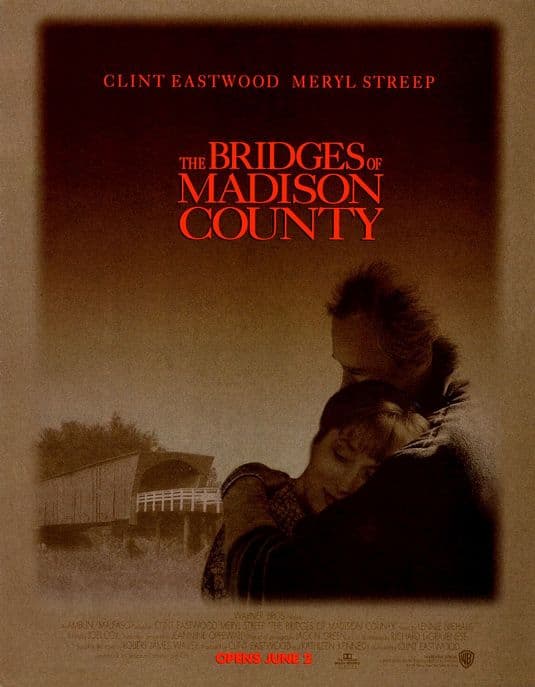
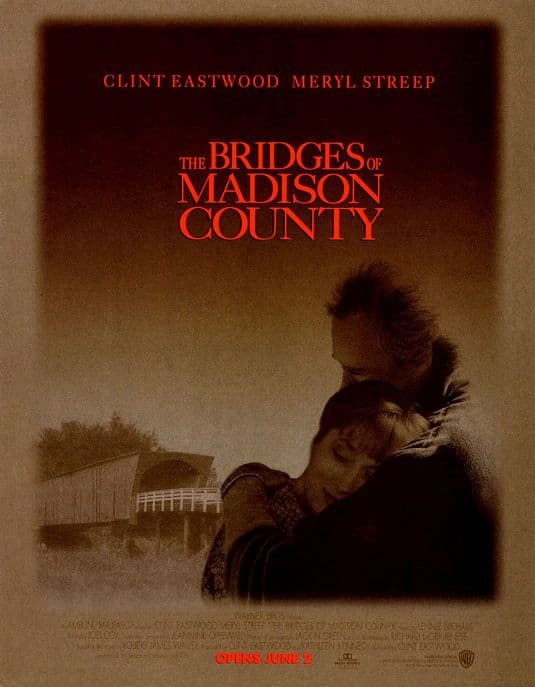
"The Bridges of Madison County" (1995) is a poignant romantic drama that explores the fleeting nature of love and the choices that define our lives. Set in the picturesque countryside of Iowa, the story revolves around Francesca Johnson, a lonely Italian-American housewife played by Meryl Streep, who feels trapped in her mundane life. When a traveling photographer named Robert Kincaid, portrayed by Clint Eastwood, arrives to document the iconic covered bridges of Madison County, their paths cross in an unexpected and life-altering way.
Over the course of four days, Francesca and Robert share deep conversations and an undeniable chemistry that leads to a passionate affair. As they navigate their feelings, Francesca grapples with her responsibilities to her family and the yearning for a life filled with adventure and love. The film beautifully captures the essence of a brief yet transformative connection, ultimately raising questions about sacrifice, regret, and the enduring impact of love. Through stunning cinematography and heartfelt performances, "The Bridges of Madison County" remains a timeless exploration of the heart's desires and the choices we make.
What Is the Budget of The Bridges of Madison County?
The Bridges of Madison County was produced on a budget of $22 million, a figure modest by 1995 Hollywood standards yet substantial enough for a prestige drama anchored by two of cinema's most respected actors. Director Clint Eastwood and producer Kathleen Kennedy kept costs disciplined by shooting on authentic Iowa locations rather than studio backlots, a decision that honored the source material and ultimately reduced the need for expensive set construction.
The production was financed through Eastwood's Malpaso Productions in partnership with Amblin Entertainment and distributed by Warner Bros. Given that Robert James Waller's 1992 novel had sold more than 50 million copies worldwide by the time filming began, the studio had strong confidence in the commercial prospects despite the quiet, introspective nature of the story.
Key Budget Allocation Categories
Eastwood's signature approach to filmmaking, efficient shooting schedules and minimal coverage, kept the $22 million budget working hard across every department.
- Above-the-Line Talent: Clint Eastwood as director, lead actor, and producer anchored the project's above-the-line spend. Meryl Streep, cast opposite him as Francesca Johnson, commanded a fee commensurate with her status as a two-time Oscar winner. Together their combined above-the-line package likely consumed $8 to $10 million of the total budget, with Richard LaGravenese's screenplay adaptation rights adding additional cost.
- Location Shooting in Iowa: Eastwood insisted on filming the actual covered bridges of Madison County, Iowa, and the surrounding Winterset farmland rather than recreating them on a Los Angeles soundstage. The location shoot required transporting the full cast and crew to Iowa for an extended production period, adding logistical costs but eliminating expensive set construction and lending the film an unmistakable authenticity.
- Cinematography: Cinematographer Jack N. Green, Eastwood's longtime collaborator, shot the film with a naturalistic, golden-hour palette that emphasized the Iowa landscape's warmth and the intimacy of the farmhouse interiors. Green's approach required careful scheduling around natural light, particularly for the iconic rainstorm sequence, which was shot practically in actual rainfall conditions.
- Score and Music: Composer Lennie Niehaus, who had scored eight previous Eastwood films including Unforgiven and A Perfect World, wrote an intimate orchestral score built around piano and strings. The music was designed to underscore emotional restraint rather than melodrama, complementing the performances without overriding them. Niehaus's score and a licensed soundtrack of period jazz and blues added depth to the film's 1965 Iowa setting.
- Post-Production and Visual Effects: The film required minimal visual effects, keeping post-production costs low relative to studio productions of the same year. Eastwood's preference for getting scenes right in-camera, reinforced by a famously compressed shooting schedule, meant the editing room was working with clean, usable footage from nearly every take.
How Does The Bridges of Madison County's Budget Compare to Similar Films?
Among mid-1990s prestige romance dramas, The Bridges of Madison County occupies an interesting position: a modest budget by studio standards that was rewarded with a worldwide return nearly eight times its production cost.
- The English Patient (1996): Budget $27M | Worldwide $232M. Anthony Minghella's Oscar-winning romance came in at $5 million more and slightly outperformed worldwide, but required far more extensive location work across Italy, Tunisia, and the UK. Madison County's tighter Iowa-centric shoot was notably more efficient.
- The Remains of the Day (1993): Budget $15M | Worldwide $69M. The Anthony Hopkins and Emma Thompson period drama cost $7 million less than Madison County but also earned significantly less, demonstrating how Eastwood and Streep's star power translated directly into expanded audience reach and box office pull.
- Message in a Bottle (1999): Budget $80M | Worldwide $118M. This Nicholas Sparks adaptation came four years later with nearly four times Madison County's budget but returned only marginally more in worldwide grosses, illustrating that throwing money at a romance drama rarely improves returns when the source material and performances are the primary draw.
- Unforgiven (1992): Budget $14.4M | Worldwide $159M. Eastwood's own Oscar-winning Western three years earlier had been made for $7.6 million less and was similarly efficient. Madison County shows Eastwood applying the same disciplined production philosophy to a different genre with comparable return-on-investment results.
The Bridges of Madison County Box Office Performance
The Bridges of Madison County was released by Warner Bros. on June 2, 1995 and performed strongly throughout the summer, earning $71.5 million domestically and $182 million worldwide. For a quiet, dialogue-driven romance drama with a two-hour-fifteen-minute runtime, those numbers represented a remarkable commercial outcome, proving that adult audiences would turn out in force for a well-made film that spoke directly to them.
Against a $22 million production budget plus an estimated $15 million in prints and advertising, the film's total investment was approximately $37 million. With theaters retaining roughly half of gross receipts, Warner Bros.'s studio share from the worldwide gross was approximately $91 million. The film cleared break-even comfortably and became one of the higher-ROI romance dramas of the decade.
Box Office Breakdown
The Bridges of Madison County (1995)

The Bridges of Madison County earned roughly $8.27 for every $1 invested in production. Accounting for the estimated $15 million in P&A spend and the roughly 50% theatrical split, the actual profitability was more modest, but the film still generated meaningful returns for Warner Bros. and solidified Eastwood's reputation as a filmmaker who could make commercially efficient prestige dramas.
The Bridges of Madison County Production History
Robert James Waller's slim novel, published in October 1992, was an immediate and improbable phenomenon. A story about a four-day affair between a National Geographic photographer and an Italian-born Iowa farm wife sold over 50 million copies worldwide within three years and spent three years on the New York Times bestseller list. Warner Bros. moved quickly to acquire the rights, sensing that the book's vast readership represented a ready-made audience. Multiple directors were considered before Clint Eastwood came aboard, bringing with him Kathleen Kennedy as co-producer and his Malpaso Productions banner.
Casting the two leads was the film's central creative challenge. Eastwood was attached early as both director and Robert Kincaid, the wandering photographer. Finding the right Francesca was harder. Meryl Streep, who had never worked with Eastwood, was cast after extensive consideration. To prepare, Streep studied the rhythms of Italian-immigrant speech patterns in the American Midwest, developed a specific Iowa-Italian accent for Francesca, and learned to cook Italian food, which she prepared in several scenes. Streep and Eastwood met for the first time shortly before production began; their chemistry was immediate and, by all accounts on set, entirely natural.
Principal photography took place across Madison County and Winterset, Iowa in the summer of 1994. Eastwood's commitment to authenticity meant the production was centered on the actual covered bridges that gave the novel its title: the Roseman Bridge, the Hogback Bridge, and the Cedar Covered Bridge. Filming in actual agricultural Iowa in summer brought practical challenges, including scheduling around golden-hour windows for exterior shots and coordinating around the working rhythms of local farms. The rainstorm sequence, in which Streep's Francesca hesitates with her hand on the truck door handle before ultimately staying, was shot in genuine Iowa rainfall and required precise coordination between the actors and the camera crew.
Post-production was handled with Eastwood's characteristic efficiency. The film received a rapturous response at its Cannes Film Festival premiere in May 1995 and opened theatrically on June 2, 1995. Meryl Streep's performance was immediately recognized as exceptional, generating Oscar and Golden Globe buzz from the film's first public screenings. Warner Bros. gave the film a wide domestic release that summer, trusting the book's enormous existing fan base to fill seats and drive strong word-of-mouth.
Awards and Recognition
The Bridges of Madison County earned its most significant recognition for Meryl Streep's performance as Francesca Johnson. At the 68th Academy Awards, Streep received a nomination for Best Actress, her tenth Oscar nomination overall, in a competitive year that also included Susan Sarandon's win for Dead Man Walking. The nomination affirmed what critics had been saying since the film's Cannes premiere: that Streep's Francesca was among the finest performances of her career.
Streep also received a Golden Globe nomination for Best Actress in a Drama at the 53rd Golden Globe Awards. The Film Independent Spirit Awards recognized the film with a nomination in the Best Female Lead category. The broader critical community embraced the film with a 93 percent score on Rotten Tomatoes, a rare achievement for a mainstream studio romance of the era, reflecting near-universal praise for both Streep's and Eastwood's work.
Critical Reception
Critics in 1995 responded to The Bridges of Madison County with genuine enthusiasm, particularly for the restraint Eastwood brought to material that could easily have become syrupy or overwrought. Roger Ebert gave the film four stars and wrote that Eastwood and Streep "bring a complexity to their roles that transforms the film from a weeper into a meditation on choice, responsibility, and the lives we construct for ourselves." The New York Times praised the film for honoring its source while elevating it, calling it one of the year's best films.
The truck door scene, in which Streep's Francesca sits in her husband's truck at a red light and watches Eastwood's Kincaid standing in the rain at his own truck ahead, her hand hovering over the door handle, became immediately iconic. Critics and filmmakers cited it repeatedly in subsequent years as one of the most economical pieces of storytelling in 1990s cinema: two characters, no dialogue, and a single hand gesture that carries the full weight of the film's emotional argument.
Decades after release, the film's reputation has only grown. It is widely cited as evidence that Eastwood the director was always more interesting than Eastwood the action star, and that Streep's chameleonic ability to inhabit ordinary women facing extraordinary internal decisions is among the defining qualities of her career. The Bridges of Madison County holds its 93 percent score on Rotten Tomatoes and is regularly included in critical surveys of the best American romantic dramas of the 1990s.
अक्सर पूछे जाने वाले सवाल
How much did The Bridges of Madison County cost to make?
The production budget was $22,000,000. Warner Bros. produced and distributed the romantic drama through Amblin Entertainment, with Steven Spielberg as a producer and Clint Eastwood's Malpaso Productions co-producing.
How much did The Bridges of Madison County earn at the box office?
The film grossed $71,516,617 domestically and $110,500,000 internationally, for a worldwide total of approximately $182,000,000. It opened to $10,519,257 on June 2, 1995, finishing second behind Casper.
Who directed The Bridges of Madison County?
Clint Eastwood directed and starred in the film. Eastwood had previously directed Unforgiven (1992, $14,400,000 budget, $159,200,000 worldwide), which won four Academy Awards including Best Picture and Best Director. Madison County was his next directorial feature after the Western that defined his late-career transition.
Who stars in The Bridges of Madison County?
Clint Eastwood plays National Geographic photographer Robert Kincaid, with Meryl Streep as Iowa housewife Francesca Johnson. Annie Corley and Victor Slezak play Francesca's adult children in the present-day framing scenes that bookend the 1965 central romance.
Is The Bridges of Madison County based on a book?
Yes. The film adapts Robert James Waller's 1992 novel, which spent over three years on The New York Times Best Seller list and sold over 60 million copies worldwide. Screenwriter Richard LaGravenese expanded the lean source novella into a feature-length structure with the children's framing material.
Did The Bridges of Madison County receive any Oscar nominations?
Yes. Meryl Streep received an Academy Award nomination for Best Actress at the 68th Academy Awards. Streep lost to Susan Sarandon for Dead Man Walking. The film was widely expected to receive a Best Picture nomination but was omitted from the field.
Where was The Bridges of Madison County filmed?
Principal photography took place in Madison County, Iowa, including filming at four of the six remaining historic covered bridges that gave the source novel its title. Production crews worked on a tight 42-day schedule across a single Iowa summer, taking advantage of the state's rural landscapes.
What did critics think of The Bridges of Madison County?
The film received strong reviews, with a 90% approval rating on Rotten Tomatoes and a 69 out of 100 score on Metacritic. Critics praised the restraint and emotional depth of both lead performances, with several reviewers calling it a course correction from the source novel's flowery prose.
Was The Bridges of Madison County profitable?
Yes. Against the $22,000,000 production budget and an estimated $25,000,000 to $30,000,000 in marketing spend, the worldwide gross of $182,000,000 produced a substantial theatrical profit. Strong international receipts, home video, and adult-audience theatrical demand drove the result.
Did The Bridges of Madison County become a Broadway musical?
Yes. A stage musical adaptation by composer Jason Robert Brown and book writer Marsha Norman opened on Broadway in February 2014, with Kelli O'Hara as Francesca and Steven Pasquale as Robert. The musical won two Tony Awards including Best Original Score and ran for 137 performances.
Filmmakers
The Bridges of Madison County (1995)

Saturation में ऐसे ही budgets बनाएं
Industry-standard feature film template से शुरू करें, अपना मौजूदा schedule और rates import करें, और खर्च के साथ cost report को अपने आप अपडेट होते देखें। Real-time collaboration, बिना spreadsheets।