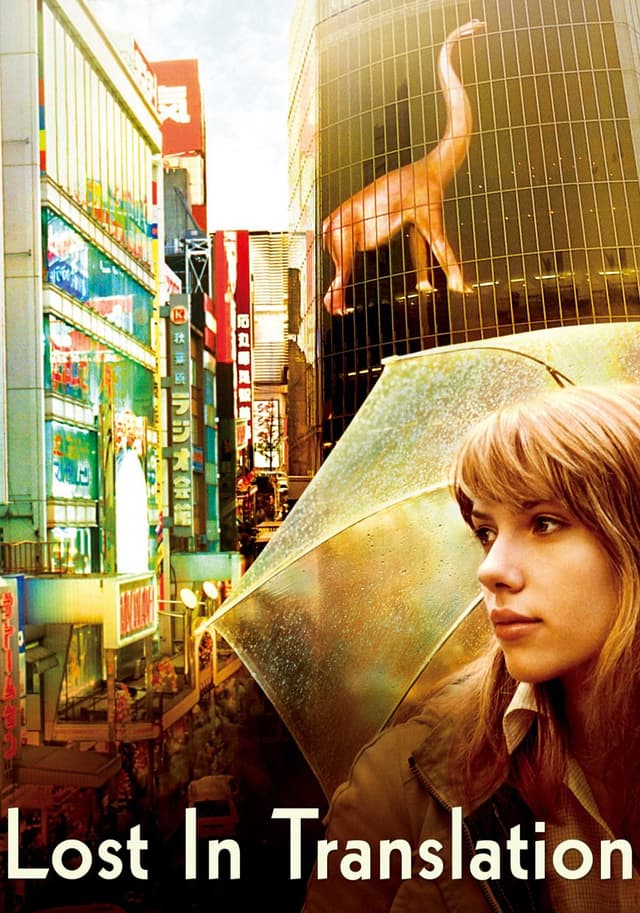
Lost in Translation Budget
 DramaComedyRomance1h 42m
Mis à jour
Synopsis
Middle-aged American movie star Bob Harris is in Tokyo to film a personal endorsement Suntory whiskey ad solely for the Japanese market. He is past his movie star prime, but his name and image still have enough cachet for him to have gotten this lucrative $2 million job. He has an unsatisfying home life where his wife Lydia follows him wherever he goes - in the form of messages and faxes - for him to deal with the minutiae of their everyday lives, while she stays at home to look after their kids. Staying at the same upscale hotel is fellow American, twenty-something recent Yale Philosophy graduate Charlotte, her husband John, an entertainment still photographer, who is on assignment in Japan. As such, she is largely left to her own devices in the city, especially when his job takes him out of Tokyo. Both Bob and Charlotte are feeling lost by their current situations, which are not helped by the cultural barriers they feel in Tokyo, those cultural barriers extending far beyond just not knowing the language. After a few chance encounters in the hotel, they end up spending much of their time hanging out together, each helping the other deal with their feelings of loss in their current lives. The friendship that develops between the two, which is not always a bumpy-free one, may be just for this specific place and time, but it may also have long lasting implications.
What is the budget of Lost in Translation?
"Lost in Translation," a drama released in 2003, was directed by Sofia Coppola and stars Bill Murray, Scarlett Johansson. The production budget was $4,000,000, placing it in the micro-budget range for drama productions of its era.
Key Budget Allocation Categories
While specific budget breakdowns are not publicly available, typical cost drivers for a drama production like this include:
- Above-the-Line Talent: Drama films live or die on the strength of their performances.
- Location Filming & Period Production Design: Authentic locations , whether contemporary or historical , require scouting, permits, travel, lodging, and often significant dressing to match the story's time period.
- Post-Production, Color Grading & Score: The editorial process for dramas is typically longer than genre films, with careful attention to pacing and tone.
- Development: Coppola maintained that she would not have made Lost in Translation without Murray. Coppola relentlessly pursued him and sent telephone messages and letters for months.
What were the major cost factors in Lost in Translation?
Several factors contributed to the overall production costs of "Lost in Translation."
- Above-the-Line Talent: Above-the-Line Talent is one of the primary cost drivers in drama productions of this scale.
- Location Filming: Location Filming & Period Production Design is one of the primary cost drivers in drama productions of this scale.
- Post-Production: Post-Production, Color Grading & Score is one of the primary cost drivers in drama productions of this scale.
How Does Lost in Translation's Budget Compare to Similar Films?
At $4,000,000, Lost in Translation sits in the micro-budget range. Here is how it compares to productions with a similar budget:
- Peter Pan (1953): Budget $4,000,000, Worldwide Gross $87,400,000
- Farewell My Concubine (1993): Budget $4,000,000, Worldwide Gross $6,400,000
- Dersu Uzala (1975): Budget $4,000,000
- Interstella 5555: The 5tory of the 5ecret 5tar 5ystem (2003): Budget $4,000,000 , Gross $6,664,789
- Trainspotting (1996): Budget $4,000,000, Worldwide Gross $71,981,823
The median budget for wide-release drama films in the 2000s ranges from $30 to 80M for mid-budget to $150M+ for tentpoles.
Lost in Translation Box Office Performance
"Lost in Translation" earned $44,585,453 domestically and $119,723,856 worldwide at the box office. Against a production budget of $4,000,000, the film performed strongly at the box office.
A film typically needs to earn approximately twice its production budget to cover marketing and distribution costs. For "Lost in Translation," that break-even threshold was roughly $8,000,000. With worldwide earnings of $119,723,856, the film cleared that threshold comfortably.
Box Office Breakdown
Lost in Translation

At 2893.1%, "Lost in Translation" earned roughly $29.93 for every $1 invested in production.
Lost in Translation Production History
Coppola maintained that she would not have made Lost in Translation without Murray. Coppola relentlessly pursued him and sent telephone messages and letters for months. Despite Murray's agreement, Coppola had to take him at his word, as he did not sign a formal contract.
left|After dropping out of college in her early twenties, Coppola often traveled to Tokyo, trying out a variety of jobs in fashion and photography. Unsure of what to do for a career, she described this period as a "kind of crisis" She came to feel fond of Tokyo, noting an otherworldly quality brought on as a foreigner grappling with feelings of jet lag in an unfamiliar setting. After many years, she settled on a career in filmmaking and returned to the city, staying at the Park Hyatt Tokyo to promote her first feature film, the 1999 drama The Virgin Suicides.
Principal photography began on September 29, 2002, and lasted 27 days. Since the screenplay was sparse, missing details were often addressed during shooting, and Coppola allowed a significant amount of improvisation in dialogue, especially from Murray. Many of the shooting locations were local places of business and public areas at the time of filming, including rooms, bar and swimming pool in the Park Hyatt Tokyo and Shibuya Crossing in Tokyo.
Awards and Recognition
Won 1 Oscar. 98 wins & 133 nominations total
- Satellite Award for Best Original Screenplay: Sofia Coppola
- BAFTA Award for Best Editing: Sarah Flack
- Online Film Critics Society Award for Best Actor: Bill Murray
- Los Angeles Film Critics Association Award for Best Actor: Bill Murray
- New York Film Critics Circle Award for Best Actor: Bill Murray
- Chicago Film Critics Association Award for Best Screenplay: Sofia Coppola
- Bodil Award for Best American Film: Sofia Coppola
- Online Film Critics Society Award for Best Original Screenplay: Sofia Coppola
Critical Reception
Lost in Translation received widespread critical acclaim, particularly for Murray's performance and for Coppola's direction and screenplay. On Rotten Tomatoes, the film has an approval rating of 95% based on 234 reviews, with an average rating of 8.5/10.
Questions fréquentes
How much did it cost to make Lost in Translation (2003)?
The production budget was $4,000,000, covering principal photography, cast and crew salaries, locations, sets, post-production, and music. Marketing and distribution (P&A) costs are estimated at an additional $2,000,000 - $3,200,000, bringing the total studio investment to approximately $6,000,000 - $7,200,000.
How much did Lost in Translation (2003) earn at the box office?
Lost in Translation grossed $44,585,453 domestic, $75,138,403 international, totaling $119,723,856 worldwide.
Was Lost in Translation (2003) profitable?
Yes. Against a production budget of $4,000,000 and estimated total costs of ~$10,000,000, the film earned $119,723,856 theatrically - a 2893% ROI on production costs alone.
What were the biggest costs in producing Lost in Translation?
The primary cost drivers were above-the-line talent (Bill Murray, Scarlett Johansson, Giovanni Ribisi); talent compensation, authentic period production design, and meticulous post-production; international production across United Kingdom, United States of America.
How does Lost in Translation's budget compare to similar drama films?
At $4,000,000, Lost in Translation is classified as a micro-budget production. The median budget for wide-release drama films in the 2000s ranges from $30 - 80M for mid-budget to $150M+ for tentpoles. Comparable budgets: Peter Pan (1953, $4,000,000); Farewell My Concubine (1993, $4,000,000); Dersu Uzala (1975, $4,000,000).
Did Lost in Translation (2003) go over budget?
There are no widely reported accounts of significant budget overruns for this production. However, studios rarely disclose precise budget overrun figures publicly. The reported production budget reflects the final estimated cost.
What was the return on investment (ROI) for Lost in Translation?
The theatrical ROI was 2893.1%, calculated as ($119,723,856 − $4,000,000) ÷ $4,000,000 × 100. This measures gross revenue against production budget only - it does not account for P&A or exhibitor shares.
What awards did Lost in Translation (2003) win?
Won 1 Oscar. 98 wins & 133 nominations total.
Who directed Lost in Translation and who were the key crew members?
Directed by Sofia Coppola, written by Sofia Coppola, shot by Lance Acord, with music by Kevin Shields, Roy Hawkins, edited by Sarah Flack.
Where was Lost in Translation filmed?
Lost in Translation was filmed in United Kingdom, United States of America. Principal photography began on September 29, 2002, and lasted 27 days. Since the screenplay was sparse, missing details were often addressed during shooting, and Coppola allowed a significant amount of improvisation in dialogue, especially from Murray. Many of the shooting locations were local places of business and public areas at the time of filming, including rooms, bar and swimming pool in the Park Hyatt Tokyo and Shibuya Crossing in Tokyo.
Filmmakers
Lost in Translation

Official Trailer
Créez des budgets comme celui-ci dans Saturation
Partez d'un modèle de long métrage aux normes du secteur, importez le planning et les tarifs que vous avez déjà, et laissez le rapport de coûts se tenir à jour au fil des dépenses. Collaboration en temps réel, sans tableurs.