Indiana Jones and the Kingdom of the Crystal Skull Budget
 AdventureAction2h 2m
Aktualisiert
Synopsis
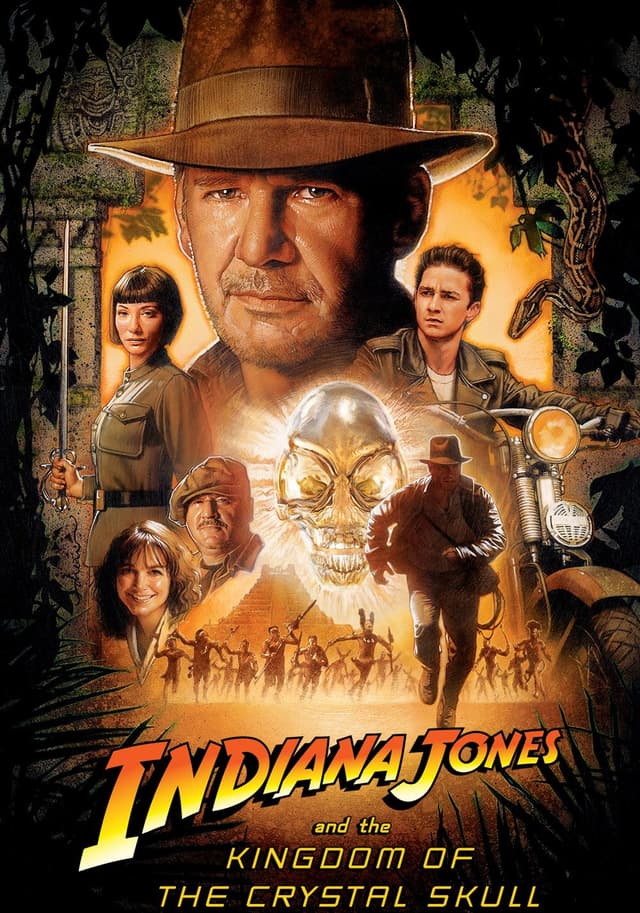
It’s the height of the Cold War, and famous archaeologist Indiana Jones, returning from his latest adventure, finds out his job at Marshall College is in jeopardy. He meets Mutt, a young man who wants Indy to help him find the legendary Crystal Skull of Akator, and the pair set out for Peru. However, deadly agent Irina Spalko is searching for the powerful artifact, too, because the Soviets believe it can help them conquer the world.
What is the budget of Indiana Jones and the Kingdom of the Crystal Skull?
Indiana Jones and the Kingdom of the Crystal Skull carried a production budget of approximately $185,000,000, placing it among the most expensive films of 2008 alongside tentpoles like The Dark Knight and Quantum of Solace. The figure ran higher than Paramount initially anticipated, and to keep the studio's exposure in check, Steven Spielberg, George Lucas, and Harrison Ford each declined large upfront salaries in exchange for substantial gross-participation stakes, with their profit participation reportedly structured to begin only after the picture cleared roughly $400,000,000 in revenue. That arrangement meant the trio absorbed much of the financial risk personally while standing to capture a majority share of the upside, a deal made possible by the franchise's pedigree and Ford's marquee value. Layered on top of the production spend were nearly two decades of development costs, since the project gestated for around 19 years through a long succession of paid screenwriters before cameras finally rolled. By the time it opened in May 2008 the film had become a global event release, ultimately grossing $786,636,033 worldwide against that $185,000,000 base, a return that vindicated the back-end-heavy compensation structure even as critical reception proved divisive.
Key Budget Allocation Categories
Indiana Jones and the Kingdom of the Crystal Skull's $185,000,000 budget was distributed across several core production areas:
- Above-the-Line Talent: Harrison Ford returned at age 65 to headline the fourth Indiana Jones picture, and rather than taking a conventional fixed salary he, Steven Spielberg, and George Lucas all reduced their upfront fees in exchange for gross-participation deals that kicked in after the film passed a reported $400,000,000 in revenue. The ensemble around Ford was unusually deep: Cate Blanchett, fresh off Oscar attention, played Soviet agent Irina Spalko; Karen Allen reprised Marion Ravenwood from Raiders of the Lost Ark; and rising star Shia LaBeouf was cast as Mutt Williams in a role positioned to potentially carry the franchise forward. Ray Winstone and John Hurt rounded out the principal cast as Mac and Professor Oxley. These deferred, back-end-weighted deals shifted a large portion of the budget off the books at the front end while concentrating the upside in the hands of the three principals.
- Industrial Light & Magic Visual Effects: Lucasfilm's own Industrial Light & Magic delivered roughly 450 visual effects shots, with reporting indicating that around 30 percent of the film's shots contained CG matte paintings or digital set extensions. ILM's work spanned the glowing crystal and alien skeletons, the interdimensional collapse of the lost city of Akator in the climax, and the vast interior of the Hangar 51 warehouse where the opening sequence unfolds. Digital set extensions widened the Amazonian jungle environments, and crew built the extraterrestrial and supernatural payoffs that the story's science-fiction turn demanded. Some of the digital work drew pointed criticism, particularly the CGI prairie-dog gophers in the opening desert scene and the digitally augmented monkeys that swing alongside Mutt during the jungle chase, which many reviewers singled out as breaking the grounded texture of the earlier films.
- Practical Stunts and Action: The film leaned heavily on large-scale practical action staged across multiple set pieces. The Hangar 51 warehouse opening builds to a rocket-sled gag that flings Indy across the New Mexico desert, followed by the now-infamous sequence in which he survives a nuclear test-site blast by sheltering inside a lead-lined refrigerator. At Marshall College, the New Haven motorcycle chase sends Indy and Mutt weaving through campus traffic and into a library on a vintage bike. The jungle centerpiece is an extended amphibious pursuit built around DUKW-style duck boats, threading through a sword fight atop moving vehicles, a quicksand peril, a swarm of siafu army ants, and a plunge over three successive waterfalls. These physically demanding sequences required extensive stunt coordination, vehicle rigs, and location work that drove a substantial portion of the production cost.
- Locations and Production Design: Production designer Guy Hendrix Dyas oversaw a design program that mixed real locations with large constructed sets and soundstage work. Deming, New Mexico stood in for the Nevada nuclear proving ground and the Doom Town test site, as well as the desert surrounding Hangar 51, while Yale University in New Haven, Connecticut provided the campus backdrop for the Marshall College motorcycle chase. Hilo, Hawaii supplied the lush tropical environments that doubled for the South American jungle, and interiors and controlled-environment sequences were shot on soundstages in the Los Angeles area. Dyas's team built everything from the cavernous warehouse and the Akator temple interiors to period 1957 dressing, anchoring the film's Cold War setting in tactile, photographable spaces rather than relying solely on digital backdrops.
- Cinematography: Steven Spielberg's longtime collaborator Janusz Kaminski shot the film, but deliberately set aside his own signature style to emulate the look that Douglas Slocombe, the cinematographer of the original trilogy, had established on Raiders of the Lost Ark, Temple of Doom, and Last Crusade. To preserve continuity with the 1980s entries, the production shot photochemically on film rather than digitally, and Kaminski studied Slocombe's lighting and lensing choices to match the warm, classical adventure-serial aesthetic. This conscious throwback approach was a creative cost driver in its own right, prioritizing analog craftsmanship and careful reference work over the more modern, contrast-heavy style Kaminski typically brought to Spielberg's dramas.
- Music: John Williams composed the score, his fourth for the Indiana Jones series, once again building the soundtrack around the unmistakable Raiders March and the established Indy themes while introducing new motifs for Marion, Mutt, and Irina Spalko. Recorded with a large symphony orchestra, the score reprised and reorchestrated decades-old material to maintain the franchise's sonic identity across a 19-year gap since The Last Crusade. Williams's continuity as composer was one of the few unbroken creative threads from the original trilogy, and the full orchestral recording sessions represented a meaningful line item befitting a tentpole of this scale.
- Extended Development and Pre-Production: The script passed through nearly two decades of paid screenwriters before reaching the screen, and those accumulated writing fees formed a significant sunk cost. Jeb Stuart took an early pass in the mid-1990s, Jeffrey Boam wrote several versions, and Frank Darabont spent considerable time on a draft titled Indiana Jones and the City of the Gods that was ultimately rejected. M. Night Shyamalan, Stephen Gaghan, and Tom Stoppard also circled the project at various points, before Jeff Nathanson and finally David Koepp delivered the shooting script from a story developed by George Lucas and Spielberg. This long, expensive gestation, spanning roughly 19 years of false starts and discarded drafts, meant the production carried the weight of years of pre-production spending before a single frame was photographed.
How Does Indiana Jones and the Kingdom of the Crystal Skull's Budget Compare to Similar Films?
To understand where Kingdom of the Crystal Skull's $185,000,000 budget and $786,636,033 worldwide gross sit, it helps to line it up against other major releases from its own 2008 season and against the franchise's own later chapter. The comparisons below show both how dominant blockbuster spending had become by the late 2000s and how unusual Crystal Skull's overseas-driven success really was.
- The Dark Knight (2008): Budget $185,000,000 | Worldwide $1,004,558,444. Released the same summer on an identical budget, Christopher Nolan's Batman film was the only 2008 title to outgross Crystal Skull worldwide, crossing the billion-dollar mark and showing the ceiling a four-quadrant tentpole could reach that year.
- Iron Man (2008): Budget $140,000,000 | Worldwide $585,366,247. Launched just weeks earlier in May 2008, the film that kicked off the Marvel Cinematic Universe did so on a leaner budget and still cleared $585 million, a reminder that a fresh franchise could rival a four-decade-old one in the same crowded summer.
- Indiana Jones and the Dial of Destiny (2023): Budget $294,700,000 | Worldwide $383,963,371. The franchise's next and final entry cost far more yet grossed less than half of Crystal Skull, a steep decline that makes clear how much commercial power the series carried in 2008 and how much it had faded fifteen years later.
Indiana Jones and the Kingdom of the Crystal Skull Box Office Performance
Indiana Jones and the Kingdom of the Crystal Skull opened on May 22, 2008, four days after its out-of-competition world premiere at the Cannes Film Festival on May 18, and timed to ride the lucrative Memorial Day corridor. It earned $100,137,835 in its three-day Friday-to-Sunday domestic frame and roughly $126 million across the four-day holiday weekend, the biggest opening of the franchise and one of the largest Memorial Day debuts on record at the time. From there the picture's strength shifted overseas: a domestic run of $317,101,119 was comfortably outpaced by $469,534,914 from international territories, where the Indiana Jones name carried decades of goodwill and the film played as a true global event.
Box Office Breakdown
Indiana Jones and the Kingdom of the Crystal Skull

Measured against an estimated $335,000,000 total investment, the film returned approximately $2.35 for every $1 invested, a clear commercial success that landed it among the year's biggest earners even as critical and fan reception split sharply over the story's tone, CGI gophers, and the now-infamous refrigerator escape. The box office verdict was unambiguous regardless of the discourse: audiences turned out in enormous numbers worldwide.
Crystal Skull finished as the second-highest-grossing film of 2008 globally, trailing only The Dark Knight, and the roughly $317 million domestic versus $469 million international split underlined how much of its muscle came from overseas markets. Its $786,636,033 worldwide haul outgrossed every entry in the original 1980s trilogy in raw dollars, and the financial appetite it demonstrated was a key reason the franchise was eventually revived for Indiana Jones and the Dial of Destiny in 2023, whose far softer $384 million worldwide result stood in stark contrast to the 2008 film's reach.
Indiana Jones and the Kingdom of the Crystal Skull Production History
When Indiana Jones and the Kingdom of the Crystal Skull opened in 2008, it arrived 19 years after Indiana Jones and the Last Crusade (1989), one of the longest gaps between installments in any major action franchise. A fifth film had been discussed almost continuously since the early 1990s, but the project stalled for over a decade because the three principals, director Steven Spielberg, executive producer and story originator George Lucas, and star Harrison Ford, could not agree on a premise. Lucas became fixated on a 1950s setting built around an extraterrestrial MacGuffin, the crystal skull, an idea he tied to the era's flying-saucer paranoia and Cold War anxieties. Spielberg and Ford repeatedly resisted, worried that aliens were too far from the supernatural-but-earthbound tone of Raiders of the Lost Ark and would alienate fans.
The script went through a long succession of drafts and writers. The most notable rejected version was Frank Darabont's Indiana Jones and the City of Gods, which Spielberg reportedly liked but Lucas turned down; that draft kept ex-Nazis as villains, an idea the filmmakers eventually abandoned because the Nazis had been used in the earlier films and the new Cold War setting called for Soviet antagonists instead. Jeff Nathanson also contributed before David Koepp was brought in to write the final screenplay, working from a story credited to Lucas and Nathanson. Koepp's task was to reconcile Lucas's alien concept with the franchise's established texture, landing on interdimensional beings rather than literal outer-space aliens as a compromise.
Casting reunited the original creative core while adding a younger generation. Harrison Ford returned to the title role at 65, performing many of his own stunts, and Karen Allen came back as Marion Ravenwood, her first appearance in the series since Raiders of the Lost Ark. Shia LaBeouf was cast as Mutt Williams, Indiana and Marion's son, while Cate Blanchett played the Soviet agent Irina Spalko, a sword-wielding psychic-research specialist with a severe bob and a thick Russian accent. Ray Winstone, John Hurt, and Jim Broadbent rounded out the supporting cast. Principal photography ran from June 18 to October 12, 2007, with locations including New Mexico standing in for the Nevada desert and the warehouse finale, New Haven, Connecticut, where Yale University doubled for the Marshall College campus chase, plus Hawaii for jungle sequences and California soundstages; Argentina and other South American settings were recreated rather than shot on location.
Spielberg made a deliberate stylistic choice to keep the film rooted in the practical, analog craft of the original trilogy. He shot on photochemical film rather than digital, favored physical sets, real stunts, and on-set effects, and aimed to minimize computer-generated imagery so the picture would feel continuous with the 1980s entries; in practice roughly 450 CGI shots still made it into the finished film. John Williams returned to score, the only composer the series has ever had, weaving his iconic Raiders March through the soundtrack while writing several new themes for Marion, Mutt, Spalko, and the crystal skulls; the recording sessions wrapped on March 6, 2008, ahead of the May release.
Awards and Recognition
Awards recognition for Kingdom of the Crystal Skull was modest and clustered in technical and genre categories rather than the major prizes its franchise pedigree might have suggested. The film earned a BAFTA Award nomination for Best Special Visual Effects, a nod to Industrial Light & Magic's roughly 450 effects shots. At the 35th Saturn Awards in 2009, hosted by the Academy of Science Fiction, Fantasy and Horror Films, it collected multiple nominations across categories including Best Director for Steven Spielberg, Best Actor for Harrison Ford, Best Supporting Actor for Shia LaBeouf, and Best Special Effects, and it converted that genre-community goodwill into a win for Best Costume, recognizing Mary Zophres's period 1957 wardrobe.
The flip side of the film's reception showed up at the 29th Golden Raspberry Awards, where the picture drew Razzie attention reflecting the backlash from longtime fans, including recognition in the Worst Prequel, Remake, Rip-Off or Sequel category. Taken together, the awards record tells a consistent story: voters credited the craft on display, particularly the visual effects, costuming, and orchestral pedigree, while the film attracted little of the prestige-season recognition that greets a true awards contender, and a measurable share of the commentary tilted toward disappointment. For a release this commercially successful, the accolades skewed firmly toward technical categories and tongue-in-cheek Razzie notice rather than the top honors.
Critical Reception
Indiana Jones and the Kingdom of the Crystal Skull premiered out of competition at the Cannes Film Festival on May 18, 2008, Spielberg's first film at the festival since E.T. the Extra-Terrestrial in 1982, before its worldwide theatrical rollout. Reviews were generally positive but markedly more divided than the praise that had greeted the original trilogy. On Rotten Tomatoes the film holds a 77% approval rating from 307 reviews with an average score of 7 out of 10, and the site's critics consensus reads: "Though the plot elements are certainly familiar, Indiana Jones and the Kingdom of the Crystal Skull still delivers the thrills and Harrison Ford's return in the title role is more than welcome." Metacritic assigned a metascore of 65 out of 100 based on 40 critics, indicating generally favorable reviews, while audiences polled by CinemaScore gave the film a B, a notch below the A grades earned by its predecessors.
Critics largely praised what worked in the franchise's DNA: Harrison Ford's easy return to the role at 65, John Williams's rousing score, and Spielberg's command of large set pieces such as the warehouse opening, the jungle chase, and the campus motorcycle sequence. The complaints, however, were specific and recurring. Many reviewers and longtime fans objected to the heavy reliance on CGI in a series that had been built on practical effects, to the science-fiction turn toward interdimensional aliens and a flying saucer, and to broad comic touches like the swarming jungle gophers and the computer-generated monkeys that swing alongside Mutt during the chase.
The film's most enduring cultural footnote came from a single scene early on, in which Indiana survives a nuclear test blast by climbing inside a lead-lined refrigerator and being hurled clear of the explosion. Fan derision over the moment's implausibility crystallized into the phrase "nuke the fridge," which entered internet vocabulary as shorthand for the exact instant a beloved franchise jumps the shark, a direct analog to "jumping the shark" itself. Spielberg took ownership of the gag, saying, "That was my silly idea ... I'm proud of that," while Lucas defended it by claiming he had researched the survival odds at roughly fifty-fifty. The episode came to symbolize the broader, polarized reaction: a commercial success that grossed over $786 million worldwide, yet one that crystallized a lasting argument among fans about whether the fourth Indiana Jones honored the spirit of the originals.
Häufig gestellte Fragen
What is the budget of Indiana Jones and the Kingdom of the Crystal Skull (2008)?
Indiana Jones and the Kingdom of the Crystal Skull had a production budget of $185,000,000. Directed by Steven Spielberg and produced by Frank Marshall for Lucasfilm and Paramount Pictures, it was one of the most expensive films of 2008. The figure reflected extensive location shooting, large-scale practical sets, and digital effects work.
How much did Indiana Jones and the Kingdom of the Crystal Skull make at the box office?
The film grossed $317,101,119 in the United States and Canada and $786,636,033 worldwide. That worldwide total made it one of the highest grossing films of 2008. It comfortably out-earned its $185,000,000 production budget on theatrical revenue alone.
Who directed Indiana Jones and the Kingdom of the Crystal Skull?
Steven Spielberg directed the film, returning to the franchise alongside producer George Lucas. It marked their first Indiana Jones collaboration since 1989's Indiana Jones and the Last Crusade. John Williams again composed the score, and Janusz Kaminski served as cinematographer.
Who starred in Indiana Jones and the Kingdom of the Crystal Skull?
Harrison Ford returned as Indiana Jones, joined by Cate Blanchett as Soviet agent Irina Spalko and Shia LaBeouf as Mutt Williams. Karen Allen reprised her role as Marion Ravenwood from Raiders of the Lost Ark. The supporting cast included Ray Winstone, John Hurt, and Jim Broadbent.
Was Indiana Jones and the Kingdom of the Crystal Skull a box office success?
Yes. On a $185,000,000 budget the film earned roughly $786,636,033 worldwide, ranking among 2008's highest grossing releases. It was a clear commercial success despite a divisive critical and fan reception. The strong returns helped justify Lucasfilm and Paramount's long-running interest in continuing the franchise.
Why was there a 19-year gap before this Indiana Jones film?
Kingdom of the Crystal Skull arrived 19 years after Indiana Jones and the Last Crusade in 1989. The long delay stemmed largely from disagreements among Spielberg, Lucas, and Ford over the story and script, which went through many drafts before David Koepp's screenplay was approved. Only once all three principals signed off did production move forward.
What is the crystal skull plot about?
Set in 1957, the story follows Indiana Jones as he races Soviet agents to recover a mysterious crystal skull tied to a legendary lost city. The artifact's interdimensional and extraterrestrial origins gave the film a science fiction slant inspired by 1950s B-movies. This shift away from the earlier films' supernatural relics proved one of the most debated creative choices among fans.
Did Indiana Jones and the Kingdom of the Crystal Skull win any awards?
The film received largely mixed reviews and earned several Razzie nominations, with the infamous "nuked the fridge" scene becoming a lightning rod for criticism. It did not feature in the major Academy Award categories. Even so, its commercial performance and John Williams' score kept it a notable franchise entry.
Filmmakers
Indiana Jones and the Kingdom of the Crystal Skull

Official Trailer
Erstellen Sie Budgets wie dieses in Saturation
Starten Sie mit einer branchenüblichen Spielfilmvorlage, importieren Sie Drehplan und Gagen, die Sie schon haben, und lassen Sie den Kostenbericht sich beim Ausgeben von selbst aktualisieren. Zusammenarbeit in Echtzeit, ohne Tabellen.